Antique rag dolls aren't just old toys. They’re little pieces of history you can hold in your hands, often stitched together with love from whatever scraps of fabric a family had to spare. These charming figures have traveled a long way, from humble comfort objects to cherished collectibles, and every single one has a story woven right into its seams.
The Timeless Allure of Antique rag dolls
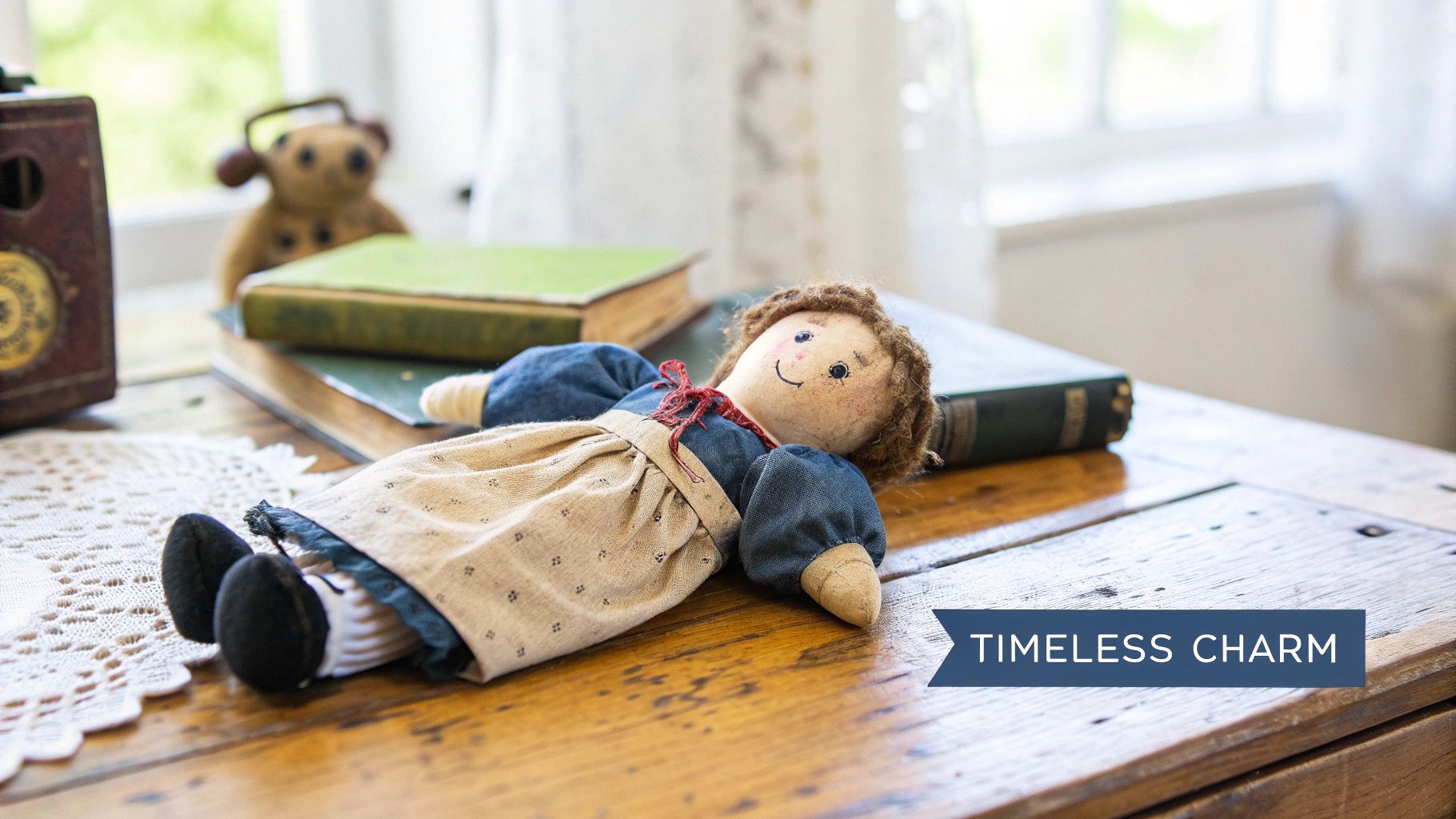
There’s just something special about an antique rag doll. It’s a nostalgic pull that's hard to explain. Unlike their more delicate porcelain or modern plastic cousins, these dolls were usually the very first toy a child ever loved, made from bits of worn-out dresses or leftover cloth.
This simple origin gives them a warmth and personality that still draws in collectors today. Each one is a small artifact, telling you everything about the era it came from through its stuffing, stitching, and style. Their journey from simple, faceless dolls in the 18th century to commercially printed icons in the early 20th century mirrors huge shifts in society—from making do during lean times to the very beginning of mass production.
A Journey Through Time and Thread
Getting to know antique rag dolls means looking past their playful faces. You have to put on your detective hat and learn to spot the clues hidden in their construction.
- Handmade vs. Manufactured: The earliest dolls were almost always made at home. You can spot them by their charmingly irregular stitches and one-of-a-kind look. Later, in the late 19th century, companies like the Arnold Print Works started making printed "cut-and-sew" dolls, which made them affordable and available to almost everyone.
- A Reflection of Culture: The doll's clothing, yarn hair, and painted expressions are like a time capsule. They give you a direct glimpse into the fashions and feelings of the past.
For so many collectors, it’s all about connecting with that history. These aren't just inanimate objects; they are storytellers, each one whispering about the child who once loved it and the person who brought it to life.
Why This Guide Is for You
I've put this guide together to give you the confidence to explore the fascinating world of antique rag dolls. Maybe you're a long-time collector looking to sharpen your skills, a reseller hoping to spot a hidden gem, or you’ve just found an old doll in your grandmother’s attic. Whatever your reason, you're in the right place.
We're going to cover it all—from the history and identification tricks to valuing your finds and keeping them safe. By the time you're done, you'll be able to see the story and the value hidden in every fabric treasure you come across.
Tracing the History of Rag Dolls
To really get a feel for antique rag dolls, you have to picture a world without toy stores. Long before plastic toys were even a dream, these soft figures were stitched into existence out of pure necessity and a little bit of love. They were the original "make-do" playthings, crafted from old fabric scraps, bits of worn-out clothing, and whatever else a family had lying around.
These early dolls, some reaching back to the 18th and early 19th centuries, were so much more than toys. They were little symbols of a family’s resourcefulness, pieced together by mothers and grandmothers to give a child a friend. Their forms were often incredibly simple, sometimes without any face at all, leaving everything up to a child's imagination.
This handmade tradition tells a story not just of scarcity, but of a deep, personal connection. Every doll was one-of-a-kind, carrying the history of its fabric—a scrap from a baby’s blanket here, a piece of a mother’s apron there.
The Dawn of Commercial Rag Dolls
The Industrial Revolution changed just about everything, and that included how children played. As textile production exploded in the mid-19th century, fabrics became cheaper and more available. Even more importantly, advances in printing technology opened the door for the very first commercially produced antique rag dolls.
A true pioneer in this shift was the Arnold Print Works of Massachusetts. In the 1890s, they started printing doll patterns right onto fabric, giving birth to what we now call "cut-and-sew" dolls. For the first time, you could buy a sheet of printed muslin, take it home, cut out the pieces, and stitch a doll together yourself.
This was a game-changer for a few big reasons:
- Affordability: These printed dolls cost a fraction of what a porcelain or bisque doll would, putting them within reach for many middle-class families.
- Consistency: Suddenly, a child could have a doll that looked just like their friend's, introducing the very idea of a branded toy.
- Durability: Unlike their fragile, fancy cousins, rag dolls could be hugged, squeezed, and dragged on adventures without any fear of them breaking.
The rise of printed rag dolls marks a huge moment in toy history. It’s that fascinating point where handmade folk art started to blend with mass-market characters, bridging the gap between homespun tradition and modern consumer culture.
This period was setting the stage for some truly iconic characters who would soon capture the hearts of millions.
Iconic Characters and Cultural Impact
The turn of the 20th century was really the golden age for antique rag dolls. This is when we see the birth of characters that have stuck with us for over a century.
The most famous of them all is, without a doubt, Raggedy Ann. Created by writer Johnny Gruelle in 1915, she was more than just a doll with her classic red yarn hair, triangle nose, and button eyes. She was the hero of her own series of storybooks. Pairing a physical toy with a beloved narrative character was a stroke of marketing genius that cemented her place in childhood history.
But the boom wasn’t just about one doll. Companies like the Art Fabric Mills and Selchow & Righter were also producing their own popular printed dolls, each one a small reflection of the art and values of the time. Antique rag dolls exploded in popularity during the 19th century's industrial boom, becoming treasured playthings in both Europe and the United States. By the 1890s, factory production soared, with printed muslin fabric slashing costs by up to 70% compared to hand-stitched dolls.
This made them affordable for countless families who had previously made their own. Historical records show that between 1900 and 1920, over 5 million rag dolls were made each year in U.S. hubs like New York and Pennsylvania. This was partly fueled by a 40% rise in textile waste from the cotton mills—perfect material for these toys, making them eco-friendly long before it was a buzzword. You can read the full research about the dolls and collectibles market to learn more.
Understanding this journey—from a mother’s sewing basket to a factory’s printing press—is the key to identifying the antique rag dolls you come across today. Every stitch, fabric choice, and painted smile is a clue to its unique story and place in time.
How to Identify and Date Your Rag Doll
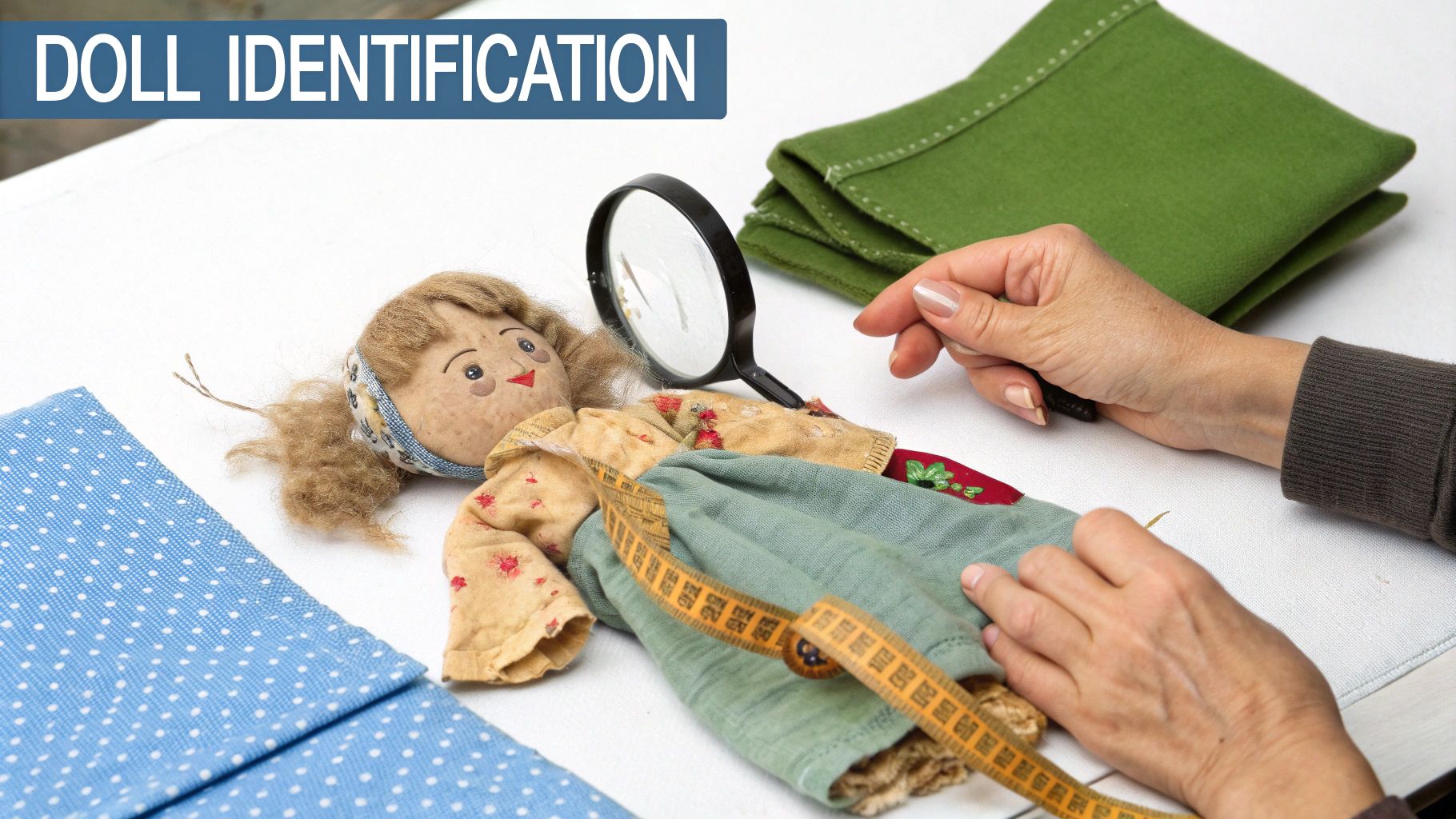
Holding an old rag doll feels a bit like holding a mystery. When was it made? Who stitched it together? The good news is, the answers are often hidden in plain sight, woven right into the fabric of the doll itself. To solve the puzzle, you just have to learn how to be a doll detective.
Think of it as piecing together a story. By looking closely at the materials, the way it was put together, and its little face, you can start to understand where—and when—your doll came from. This process does more than just give you a date; it connects you to its history.
Unraveling the Fabric Clues
Your first and most reliable clue is always the fabric. The textiles used in old rag dolls are a perfect reflection of what was common and affordable in a given era. The earliest dolls, from before the 1850s, were true "make-do" creations, often pieced together from scraps of homespun linen or tough, hand-dyed cottons.
As the 19th century rolled on, the Industrial Revolution made printed fabrics much easier to get. This is when you start seeing dolls made from calico, gingham, and sturdy muslin. If your doll is made from a very simple, practical fabric, it’s a good hint that it might be an earlier, homemade piece.
Later, around the turn of the 20th century, materials like felt and velveteen became popular, especially for dolls made in factories. The trick is to look for fabrics that feel right for the period. The logic is very similar to how you would date vintage clothing by examining its fabric and construction.
Looking Inside at the Stuffing
What’s inside your rag doll is just as telling as what’s on the outside. The stuffing material is a fantastic indicator of age, since different fillers were used in different periods.
Early 19th Century: Dolls from this time were often filled with whatever was handy. That could mean raw cotton (seeds and all!), dried leaves, old rags, or even horsehair, which gave the doll a very firm, slightly lumpy feel.
Mid-to-Late 19th Century: As manufacturing improved, so did the materials. Sawdust became a very common filler, creating a surprisingly heavy and dense doll. Smoother and cleaner cotton batting also became a popular choice.
Early 20th Century: Excelsior (basically fine wood shavings) and kapok (a silky fiber from the kapok tree) were frequently used in factory-made dolls. These materials gave dolls a much lighter and more even feel than their predecessors.
A doll's stuffing is its internal time capsule. A simple squeeze can often tell you more about its age than its outward appearance. A heavy, lumpy feel might suggest sawdust, while a softer, more uniform texture could point to a later, commercially produced doll.
Decoding the Doll's Face
A doll's face gives it a soul, and the way that face was created offers some of the best clues for dating. The techniques evolved dramatically over time, moving from simple needlework to sophisticated printing.
Dating Your Rag Doll: Key Features by Era
The table below breaks down the key features you'll find in rag dolls from different periods. Use it as a quick reference guide when you're examining a new find.
| Era | Common Fabrics | Stuffing Material | Facial Features | Construction Clues |
|---|---|---|---|---|
| Pre-1850s | Homespun linen, wool, cotton | Rags, raw cotton, horsehair | Simple embroidered stitches, sometimes painted | Hand-stitched, often with irregular seams |
| 1850s–1890s | Calico, muslin, gingham | Sawdust, cotton batting | Hand-painted, more detailed embroidery | Early machine stitching (chain stitch), some hand-sewing |
| 1890s–1920s | Printed cotton, felt | Kapok, excelsior, cotton | Lithographed (printed) faces, molded cloth | Uniform machine stitching (lockstitch) |
| 1920s–1940s | Velveteen, percale, felt | Cotton, shredded foam rubber | Printed faces, stylized painted or stitched features | Factory-made, uniform patterns and construction |
By comparing your doll's characteristics to this timeline, you can start to narrow down its age with a good deal of confidence.
Embroidered Features Faces stitched with thread are a classic sign of an early, handmade doll. The charming simplicity of embroidered eyes, noses, and mouths speaks to their folk-art roots. You’ll often notice a lovely, slightly asymmetrical quality that you just don't find in mass-produced dolls.
Painted Features Hand-painted faces, often done with oil or watercolor paints, became more common in the mid-to-late 19th century. These can range from simple rosy-cheeked smiles to more detailed, artistic expressions. Look for authentic signs of age, like fine cracking (crazing) or fading in the paint.
Lithographed Faces The arrival of color lithography in the late 19th century changed everything. Companies could now print detailed, colorful faces right onto fabric. These "printed" faces, often found on cut-and-sew dolls from makers like Arnold Print Works, are a dead giveaway for a mass-produced doll from the 1890s to the 1920s.
Stitching It All Together
Finally, take a close look at the seams. How a doll was stitched together tells you whether it was a labor of love made at home or a product rolling off a factory line.
Hand Stitching: Look for small, sometimes uneven stitches. This is the clearest sign of a homemade doll, most likely from before sewing machines became common in the 1860s.
Early Machine Stitching: The first sewing machines created a simple "chain stitch." If a thread breaks, the whole seam can unravel easily. Spotting this type of stitch can help you date a doll to the second half of the 19th century.
Lockstitch Machine Stitching: The much more secure "lockstitch" became standard by the late 19th century. If you see perfectly uniform, tight stitching, it’s a strong sign of a commercially made doll, especially one from the 20th century.
By carefully piecing together all these clues—the fabric, the stuffing, the face, and the stitches—you can start to see the full story of your precious antique rag doll.
Understanding the Value of Your Antique Rag Doll
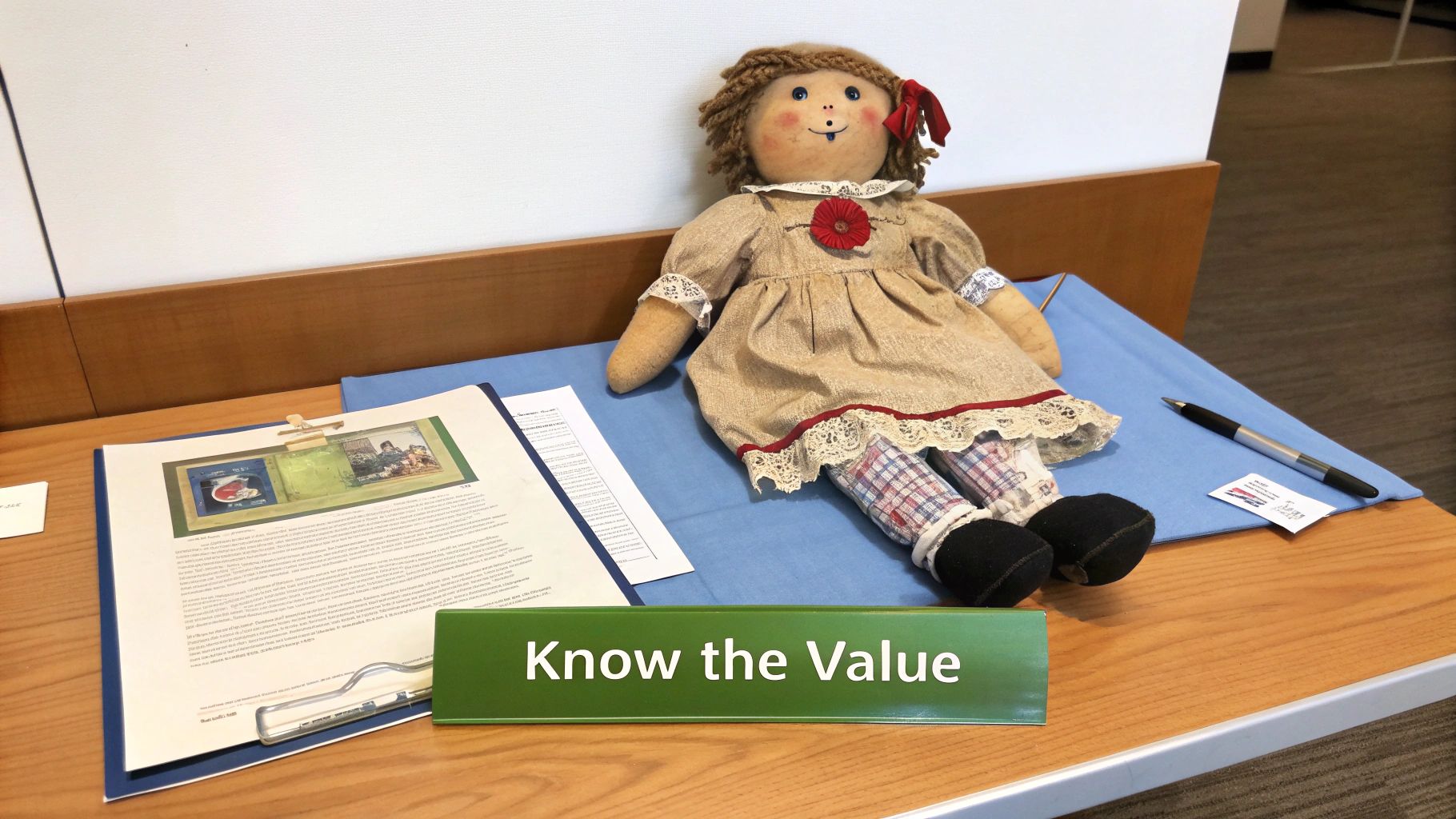
So, you've played detective and started to piece together your doll's history. Now for the big question: what is it actually worth? Figuring out the value of an antique rag doll isn't about landing on a single, fixed price. It’s more of a thoughtful appraisal, where a few key factors come together to tell a story of worth.
Think of it like assessing a vintage car. A rare model is a great starting point, but its value skyrockets or plummets based on its condition, who made it, and whether it has a documented history. The very same principles apply to these fabric treasures.
The doll collectibles market is huge and growing, projected to expand from $7.26 billion in 2023 to $12.88 billion by 2032. Antiques, especially cherished rag dolls, make up a solid 15-20% of that market because of their history and authenticity. For Curio users, those numbers are a big deal. Whether you've inherited an old toy or you're a reseller spotting finds at an estate sale, a simple photo could reveal some serious value. The real kicker is that fewer than 10% of pre-1900 dolls survived intact, which is why a doll that originally sold for 50 cents can fetch over $1,000 today. You can learn more about the expanding world of doll collectibles on 360iResearch.com.
The Four Pillars of Rag Doll Valuation
Valuing an antique is never an exact science, but appraisers almost always look at four primary elements. If you learn to see your doll through this same lens, you'll get a much clearer picture of its market value. These pillars work together, and a high score in one area can often make up for a lower score in another.
Rarity: How many of these are out there? A one-of-a-kind, handmade folk art doll is inherently rare. Likewise, a commercial doll from a company that was only in business for a few years will be much scarcer than a mass-produced icon.
Condition: How well has it held up over the years? This is often the most critical factor, and we’ll get into the nuances of it. "Good condition" can mean different things for different dolls.
Maker: Who made it? A doll signed by a known artist or made by a famous manufacturer like the Arnold Print Works will almost always be worth more than an unidentified one.
Provenance: What's its story? A doll with a paper trail—maybe an old photo of its original owner or a letter talking about its creation—has a verifiable history that adds tremendous value.
Condition Is King, But Character Counts
When it comes to value, condition is paramount. A doll in near-mint shape, with its original clothes, clean fabric, and intact features, is the gold standard. Stains, tears, missing limbs, or heavy fading will almost always bring the value down. Originality is a huge part of this; a doll still in its factory-made dress is far more desirable than one that’s been redressed.
But here’s where rag dolls are different. Unlike porcelain dolls, where a single crack can be a deal-breaker, some signs of wear on a rag doll can actually add to its charm. A little fading or a carefully mended tear can be seen as proof of a well-loved life, adding to its "folk art" character.
The key is distinguishing between gentle, loving wear and outright damage or neglect. A doll that has been played with tells a story; a doll that has been stored improperly in a damp attic shows damage.
Real-World Value: An Example
Let’s take the iconic Raggedy Ann doll. An early, first-edition doll made by Johnny Gruelle and produced by Volland between 1915 and 1918 can be incredibly valuable. If it’s in excellent condition with its original clothing and the famous cardboard heart inside its chest, these dolls have sold for thousands at auction.
On the other hand, a mass-produced Raggedy Ann from the 1970s, even in good shape, might only be worth a fraction of that. This is a perfect example of how rarity, maker, and age all come together to create value. As you get a feel for these factors, you’ll be able to size up your own dolls much more accurately. If you're looking to dive deeper into this process, check out our practical guide to finding your antique's money value.
Preserving and Caring for Your Collection
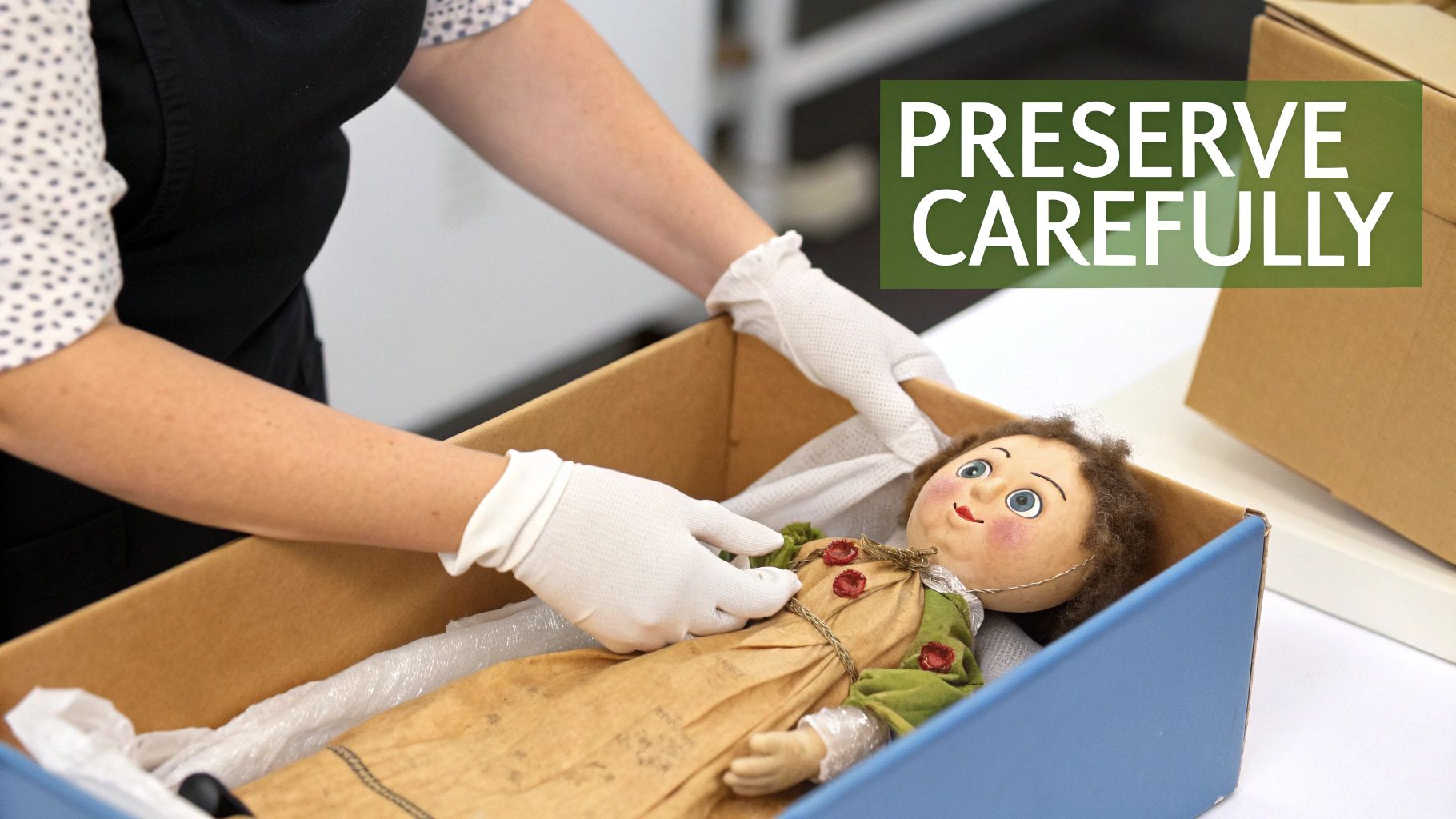
Once you've uncovered your doll's story, the next chapter is all about protecting it. This isn't just basic maintenance; it's about safeguarding the doll's history, character, and value for generations to come.
Think of the delicate fabrics and fragile stuffing just like you would an old photograph. They're incredibly sensitive to their surroundings. Direct sunlight, humidity, and wild temperature swings can cause irreversible damage—fading, brittleness, and even mildew. The principles are so similar, in fact, that it’s helpful to understand how to preserve old photographs. You can learn more about that at https://www.curio.app/blog/how-to-preserve-old-photographs.
Gentle Cleaning Techniques
When it comes to cleaning an antique rag doll, a very light touch is non-negotiable. Aggressive cleaning can strip away its history right along with the dirt. Never, under any circumstances, put an antique doll in a washing machine or douse it with chemical cleaners. You'll risk destroying the very fabric and painted features that make it special.
Instead, stick with these gentle, minimalist approaches:
- Surface Dusting: A soft, clean artist's paintbrush or a gentle puff of canned air (held at a distance!) works wonders for removing loose dust from the doll's surface and clothing.
- Light Spot Cleaning: If you find a small stain, you can try lightly dabbing the area with a cotton swab barely dampened with distilled water. Just be sure to test it on a hidden spot first.
- Airing Out: For those musty odors from decades of storage, simply let the doll air out in a well-ventilated room, far away from direct sunlight.
A huge part of preservation is knowing when to leave it alone. Sometimes, a bit of dust or a stable stain is an integral part of the doll's authentic patina. Over-cleaning can easily diminish its character and its value.
Smart Storage and Display Solutions
Proper storage is your number one defense against the slow march of time. The ideal environment is cool, dark, and dry. That means attics and basements, with their fluctuating temperatures and humidity, are completely out.
For long-term storage, wrap each doll individually in acid-free archival tissue paper and place it in an archival-quality box. This simple step prevents fabrics from yellowing and keeps pests at bay.
The numbers don't lie. Preservation data shows that improper storage can lead to a staggering 70% loss in value. On the flip side, a well-preserved but unrestored Depression-era doll often commands a 65% premium for its authentic patina. It's a delicate balance that serious collectors understand well, especially since U.S. insurance policies cover an estimated $1.2 billion in doll collections annually.
For professionals using Curio, this data highlights why rarity is so crucial. A common Armand Marseille rag doll might start around $300, but a rare version can easily soar past $2,500. You can discover more insights about doll market trends on ResearchandMarkets.com.
Got Questions About Antique Rag Dolls? We’ve Got Answers.
As you start exploring the world of antique rag dolls, a few key questions almost always pop up. It’s natural, especially when you're just getting your bearings. Maybe you've just been handed a doll that’s been in your family for generations, or you've stumbled upon a charming face at a dusty flea market.
Getting a handle on these common queries is the best way to build your confidence as a collector. Let's clear up some of the most frequent points of confusion.
Antique vs. Vintage: What’s the Difference?
This is easily the first question everyone asks. It seems simple, but in the collecting world, words like "antique" and "vintage" have very specific meanings.
Think of it like this: antique is the big milestone. For an item to earn that title, it has to be 100 years old or older. So, a rag doll stitched together in 1920 is a genuine antique. On the other hand, vintage is for something more recent but still old enough to be collectible—generally at least 20 to 50 years old, but under that 100-year mark. A doll from the 1970s is a perfect example of vintage.
Knowing this distinction isn't just about sounding like you know your stuff; it's essential for getting the value right when you buy or sell.
Are All Old Homemade Rag Dolls Valuable?
It's a wonderful thought—that any lovingly handmade doll from a bygone era must be worth a small fortune. But while age is a huge piece of the puzzle, it doesn’t automatically translate to a high price tag.
A doll's value really comes down to a mix of things: its rarity, its condition, who made it (if you can figure that out), and its unique charm or artistic quality. You might find that a very common, beat-up antique doll is worth less than a rare vintage one that looks like it was just made yesterday. Many homemade rag dolls are incredibly precious for their sentimental value, but they only really command high prices if they have that special "folk art" magic or a documented history, which collectors call provenance.
Don't mistake age for automatic value. A doll's unique character, condition, and story are what truly drive its worth in the collector's market. Many beautiful homemade dolls are priceless to a family but modest in market price.
How Can I Spot a Reproduction?
Just like with any other popular collectible, fakes and reproductions are out there, and they can be tricky. Thankfully, once you know what to look for, the imposters often give themselves away.
Start by trusting your sense of touch and sight. Look for modern materials that just don't fit the doll's supposed age—things like polyester stuffing, synthetic fabrics, or machine stitching that looks too perfect and even. Real antique dolls usually have wonderfully imperfect hand-stitching or the tell-tale signs of early, less precise machine work.
Also, keep an eye out for artificial aging. Stains that look deliberately placed or fading that doesn't follow natural wear and tear patterns are big red flags. Real age has a look that’s hard to fake.
Feeling inspired to uncover the stories hiding in your own home? Whether it’s an old doll, a piece of furniture, or a curious trinket, Curio can help. Snap a photo, and our app will provide you with its history, origin, and an estimated value in seconds. Download Curio today and turn your mysteries into known treasures.