There's a special kind of thrill when you stumble upon a piece of deep cobalt blue glass. Its color is so intense and captivating, it feels like you're holding a fragment of the past. That's the magic of Bristol blue glass, and learning to read Bristol blue glass marks is your key to unlocking its secrets.
These marks—from the rough pontil scars on the base to a maker's faint signature—are the fingerprints left behind by artisans centuries ago. They tell a story, revealing a piece's age, where it came from, and whether it's the real deal.
The Allure of Bristol Blue Glass

Whether you're a seasoned collector, a weekend thrifter, or you've just inherited a box of family heirlooms, spotting genuine Bristol blue glass is an exciting hunt. This guide is here to help you do just that. We'll walk through everything, from the fascinating history that makes this glass so special to the specific clues that separate a priceless antique from a modern lookalike.
The story starts in 18th-century England, a time of incredible craftsmanship. A merchant named Richard Champion and a chemist, William Cookworthy, had the brilliant idea to exclusively import high-quality cobalt oxide from Saxony. This gave Bristol glassmakers the secret ingredient for their signature deep blue flint glass, which quickly became a symbol of luxury across Europe.
It's hard to overstate their success. By the mid-18th century, Bristol's sixty-plus glass houses were churning out over 50% of all glass in Britain, thanks to the city's bustling port and easy access to coal.
What You Will Learn
Think of this guide as your personal cheat sheet for the next time you're at an estate sale or browsing an antique shop. We're going to build your expertise by covering a few key areas:
- The Story Behind the Glass: We'll dig into why Bristol became such a glassmaking giant and how that history shows up in the marks you'll find today.
- Decoding the Clues: You'll learn how to read the essential signs, like pontil scars, mold seams, and those faint acid-etched signatures.
- Spotting the Fakes: I'll share practical tips for telling the difference between an 18th-century original and a much later reproduction.
- Knowing the Makers: We'll get to know the famous glasshouses and artisans who created the most collectible pieces.
Getting a handle on these details does more than just help you identify a piece; it connects you to a rich history of artistry. And if you're curious about antique glassware in general, you might enjoy our guide on the most valuable antique glassware.
By the time you're done here, you'll be able to pick up a piece of Bristol blue and read the subtle stories it has to tell.
Why Bristol Became a Glassmaking Powerhouse
To get a real feel for Bristol blue glass marks, you first have to understand why Bristol became the heart of English glassmaking in the 17th and 18th centuries. It wasn't a happy accident. A unique mix of geography, resources, and politics created the perfect conditions for the industry to flourish.
It all started with a royal decree in 1615 that banned using wood to fire furnaces. The goal was to stop deforestation, but it threw the glass industry into chaos. Glassmakers needed a new fuel, and they found it in Bristol. The city was sitting on a goldmine of coal.
This single fact made Bristol a magnet for glass artisans. With cheap, plentiful fuel right on their doorstep, they could build bigger, hotter furnaces than their competitors, giving them a massive edge.
The Power of the Port
Coal fueled the furnaces, but Bristol’s port fueled the business. As one of England's busiest ports, ships were constantly sailing in and out. This gave glassmakers easy access to essential raw materials like pure silica sand from the coast and the alkali fluxes needed to melt it down.
The port was a two-way street. Once the glass was made, it had to go somewhere. Bristol's glasshouses churned out a staggering number of bottles for the city's booming wine, beer, and cider trades. Those bottles, filled with local drinks, were then shipped all over the world, making the glass industry an economic powerhouse.
The economic and political landscape of 17th-18th century Bristol propelled its blue glass industry to global prominence, transforming the city into England's glassmaking capital outside London. A 1699 survey listed nine glass houses 'in and about Bristol', the largest concentration beyond the capital.
After a brief slowdown caused by heavy taxes, the industry came roaring back. In the 1720s, the writer Daniel Defoe called Bristol the richest port in Britain after London. Its success was built on this potent combination of local coal, imported materials, and merchant money. You can dive deeper into the history of antique Bristol blue glass on lavishshoestring.com.
A Hub of Innovation and Capital
This thriving environment didn't just draw in skilled workers; it attracted deep-pocketed investors and forward-thinking innovators. The city was flush with cash from global trade, especially from West Indies sugar imports, and that money was poured into new ventures.
This capital funded bigger glasshouses and experimentation with new techniques. So, when high-quality cobalt oxide—the secret to that brilliant blue—became available, Bristol was perfectly poised to take advantage. The city already had a reputation for making stunning lead crystal.
Adding that vibrant new colorant to their existing expertise gave birth to the iconic Bristol blue glass we know and love. Every mark, pontil scar, and label tells a piece of this story.
How to Read the Clues on Your Glass
Every piece of antique Bristol blue glass tells a story, and the marks are your way of reading it. Think of yourself as a detective. With a bit of practice, you’ll start spotting the subtle clues that reveal how a piece was made, when it was created, and whether it’s the real deal.
We're about to get hands-on. By carefully examining the base, sides, and any hidden signatures, you can begin to piece together the history locked inside the glass. Don't worry about becoming an expert overnight—the key is simply knowing what to look for first.
The Tell-Tale Pontil Scar
For any hand-blown glass, the most important clue is often found on the bottom: the pontil scar. This is that small, sometimes rough spot right in the center of the base of a vase, bottle, or decanter. It’s what’s left behind when the glassblower snapped the finished piece off the long metal pontil rod used to hold it while shaping it.
Finding a pontil scar is a fantastic sign. It's direct evidence that the piece was crafted by hand, not by a machine. Even better, its appearance can give you solid clues about its age.
- Rough Pontil: A jagged, sharp scar points to an older piece, most likely from the 18th or early 19th century. Finishing techniques were simply less refined back then.
- Ground Pontil: If the mark has been ground down to be smoother, you're likely looking at a piece from the mid-to-late 19th century.
- Polished Pontil: A completely smooth, polished base usually indicates a 20th-century or modern piece where a perfectly clean finish was the goal.
A rough pontil mark is your strongest indicator of authentic, early craftsmanship. While a smooth base doesn't automatically mean a piece is a reproduction, the presence of that distinct, unpolished scar is a feature that collectors actively seek out.
Mold Seams and Other Physical Clues
While much of the earliest Bristol glass was free-blown, some pieces were blown into molds to create consistent shapes. When you have a piece in your hands, run your fingers along the sides. Do you feel a faint vertical line? That’s a mold seam, and it tells you a mold was part of the process.
Prominent, sharp seams often suggest more modern, mass-production methods. In contrast, older molded glass might have seams that are softer and less defined, sometimes partially smoothed over by the artisan.
Beyond seams, keep an eye out for tiny imperfections. Small trapped air bubbles, which collectors call "seeds," are incredibly common in early glass. These aren't flaws; they're hallmarks of the hand-blowing process and another great sign that you're holding an older piece. If you're new to collecting, general guides on how to identify common antiques can offer a broader perspective on these kinds of details.
To help you get started, here's a quick cheat sheet for the marks we've discussed.
Quick Guide to Bristol Blue Glass Marks
| Mark Type | Typical Appearance | What It Indicates |
|---|---|---|
| Rough Pontil | Jagged, unpolished spot on the base. | Early hand-blown production (18th to early 19th C). |
| Ground Pontil | Smoothed-down, often circular, spot on the base. | Later hand-blown production (mid-to-late 19th C). |
| Polished Pontil | Perfectly smooth, polished base. | Modern or 20th C. production with a refined finish. |
| Mold Seam | Faint vertical line on the body of the glass. | The piece was blown into a mold for shaping. |
| "Seeds" (Bubbles) | Tiny, trapped air bubbles within the glass. | Common in older, handmade glass. |
Remember, each mark tells part of a bigger story. Understanding these physical markers is crucial, and for those who want to dig deeper, our comprehensive guide to antique glass makers' marks provides more detailed insights that apply to all types of collectible glassware, including Bristol blue.
Spotting Fakes and Modern Reproductions
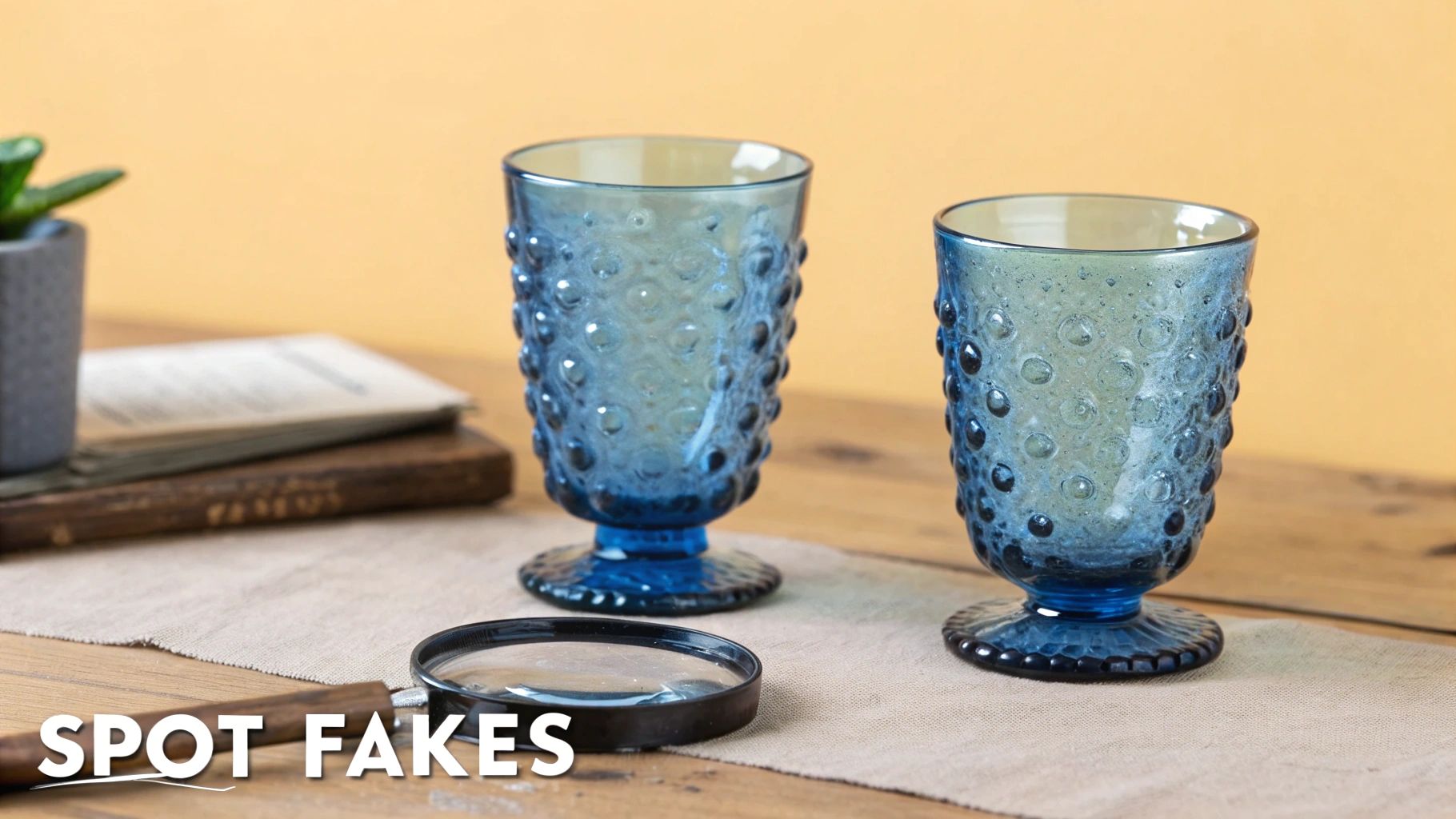
There’s a special kind of disappointment that comes from realizing a piece you treasured is just a modern copy. We've all been there. This is where we arm you with the knowledge to avoid that feeling, training your eye to see the subtle story a piece of glass tells.
It's about developing a feel for the real thing. Once you know what to look for, you'll be able to spot the tell-tale signs that separate an 18th-century treasure from a 20th-century imitation. We'll go beyond the basic Bristol blue glass marks and dig into the nuances that machines just can't fake.
Color and Consistency Clues
The first thing I always check is the color—not just that it's blue, but how it's blue. Authentic antique Bristol glass has a deep, almost luminous cobalt hue. Hold it up to the light; it should be rich and vibrant, but you should still be able to see through it.
Reproductions often get this wrong. The blue might be too dark and muddy, looking almost black unless under a bright lamp. Sometimes you'll see a purplish or even greenish cast to it. Modern glass is also usually perfectly uniform in color, a dead giveaway of machine mixing. Early, hand-mixed glass often has faint streaks or subtle variations, a beautiful testament to its handmade origins.
A key giveaway of a modern piece is its perfection. Early glassmaking was an art, not a science, and pieces often bear the marks of their creation—subtle asymmetries, tiny bubbles, and variations in thickness that are absent in machine-made replicas.
Look closely for tiny trapped air bubbles, what collectors call "seeds." They're another classic sign of age. While some modern makers try to mimic this, the bubbles in reproductions often look too perfect or evenly spaced. In genuine antique glass, they’re wonderfully random. For more general advice, our guide on how to spot fake antiques has some great tips that apply here, too.
Weight and Physical Feel
Don't just look at a piece—pick it up. True Bristol blue glass has a high lead content, which gives it a surprising weight. It should feel solid and substantial in your hand, heavier than you'd expect for its size.
Modern copies, particularly those made after the mid-1900s, usually have less lead or use different formulas entirely. The result is glass that feels lighter, almost flimsy in comparison. You can also get clues from the texture. Run your fingers over the surface. An antique often feels incredibly smooth, almost silky, from centuries of handling. New glass tends to feel sharper, with crisper edges.
Here are a few quick physical checks I always run through:
- Check the Base: Is there a rough pontil scar? A perfectly smooth, polished base is a huge red flag for a modern piece.
- Examine the Shape: Is it perfectly symmetrical? Early free-blown glass rarely is. Look for slight irregularities or a subtle lean that a machine can't replicate.
- Feel for Seams: Sharp, obvious mold seams are a hallmark of mass production. Older molded pieces have seams that are much softer and less defined.
When you start combining these hands-on observations with what you know about the maker's marks, you’re building a powerful toolkit. You’ll be able to confidently identify the fakes and make sure your collection is filled with genuine pieces of history.
Famous Makers and Their Signature Styles
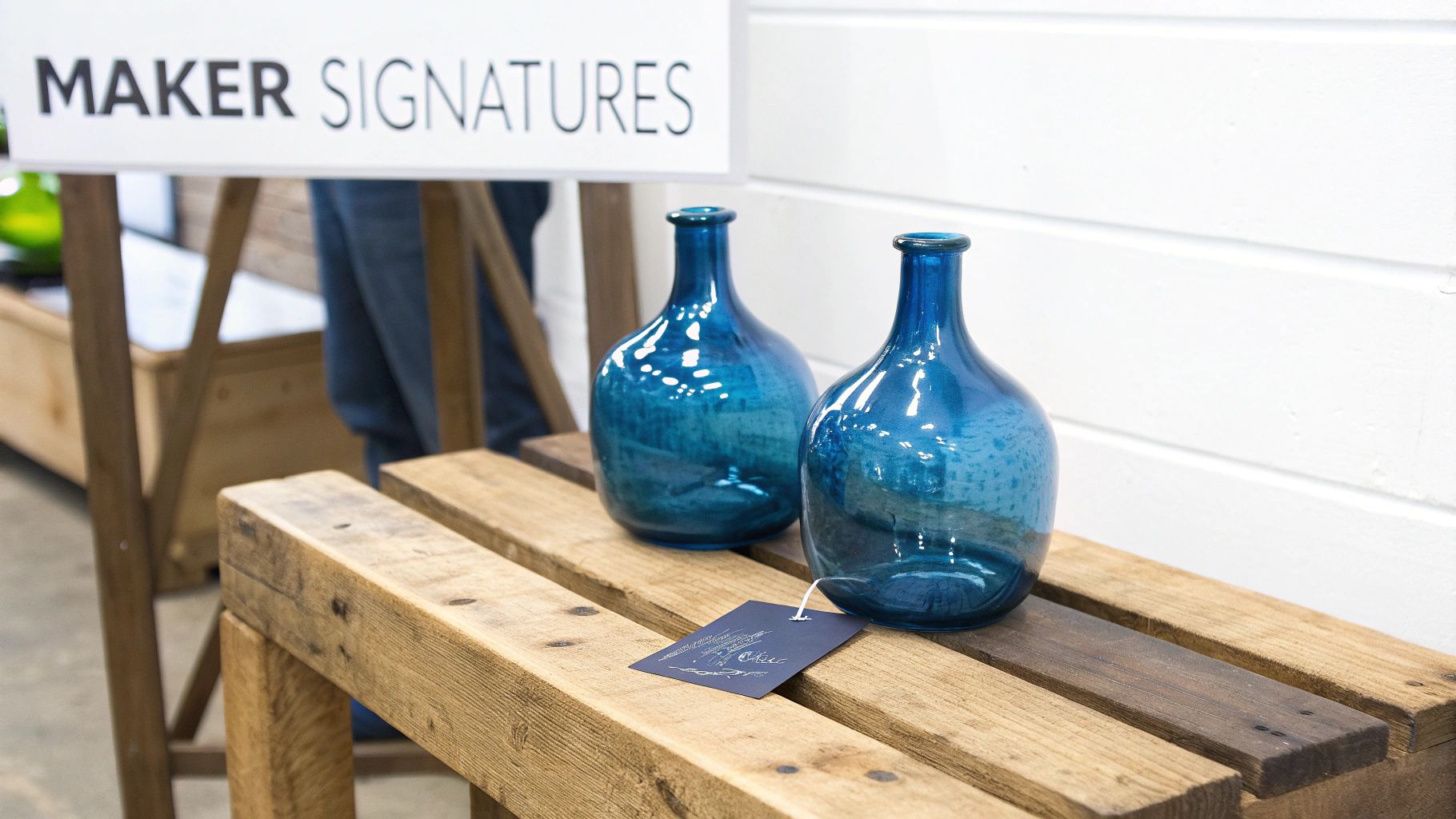
Behind every beautiful piece of Bristol blue glass, there's a story of artistry and skill, often tied to a specific person or glasshouse. Frustratingly, most early glassmakers left their work unsigned. But a few names became legends, leaving a legacy through their distinctive styles that are almost as good as a physical mark.
Learning about these makers is a bit like learning to spot a Monet or a Picasso by its brushstrokes. It helps you attribute unmarked pieces based on their shape, quality, and the types of items a specific workshop was famous for. This connection adds a rich layer of history, turning a simple object into a direct link to a master artisan's hands.
When it comes to Bristol blue glass, the most important name you need to know is Isaac Jacobs. His work truly defines the golden age of its production.
The Legacy of Isaac Jacobs
Isaac Jacobs was more than just a glassmaker; he was a brilliant artist and a savvy marketer. After taking over his father Lazarus’s business, he transformed Bristol blue glass from a local specialty into a national sensation. His workshop, the Non-Such Flint Glass Manufactory, became synonymous with luxury glass of the highest quality.
Jacobs' pieces are famous for their incredibly elegant forms and, most of all, their exquisite gilding. He often decorated his decanters, glasses, and finger bowls with delicate, burnished gold lettering and intricate patterns. A classic Jacobs piece, for instance, might feature the name of a spirit like "SHRUB" or "BRANDY" in beautiful, ornate script.
Isaac Jacobs became so well-regarded that he was appointed "Glass Manufacturer to his Majesty," King George III. This royal seal of approval cemented Bristol blue glass as a symbol of aristocratic taste and luxury.
Because signed pieces are practically unheard of, identifying an original Jacobs often means learning to recognize these stylistic hallmarks. If you stumble upon a piece of deep cobalt glass with faint, worn gilding and a perfectly balanced shape, you might just be looking at the work of a master. In this case, the Bristol blue glass marks aren't stamped on the bottom—they're the artistic clues left behind in the style itself.
The Nailsea Glassworks Influence
Though not located right in Bristol, the Nailsea glassworks—just a few miles away—was another major force in English glass. Operating from 1788 to 1873, Nailsea was best known for its more whimsical and everyday glass, but it also produced plenty of items in that iconic cobalt blue.
Nailsea glass is most famous for a very particular decorative flair: looped or "latticinio" patterns. This technique involved trailing threads of white or colored enamel over the surface of the hot glass to create mesmerizing swirls, loops, and combed designs.
You can often spot a Nailsea-style piece of blue glass by these signatures:
- Looped Decorations: Those trails of white enamel looping over a dark blue background are the classic giveaway.
- Flecked Glass: The workshop also made "flecked" glass, which had splashes of different colors mixed into the blue.
- Novelty Items: Think of charming, everyday objects like glass rolling pins, decorative flasks, and witch balls, all made special by their vibrant color and playful designs.
Just like with Jacobs' work, Nailsea pieces were rarely signed. But their decorative style is so unique that it acts as its own kind of maker's mark. Recognizing these patterns helps you place a piece within a specific tradition, adding another fascinating chapter to its story.
Common Questions About Bristol Blue Glass
After diving into the world of Bristol blue glass marks, you're bound to have a few questions popping up. This last section is all about giving you quick, straightforward answers to the things collectors wonder about most. Think of it as a final chat to clear up any lingering doubts.
We'll tackle those common "what if" moments and "how can I be sure?" scenarios you'll run into. The goal here is simple clarity, so you have the confidence you need when you're out hunting for your next piece.
Does All Authentic Bristol Blue Glass Have a Mark?
This is the big one, and the answer is a definite no. In fact, a huge amount of early Bristol blue glass, especially from that 18th-century golden age, is completely unmarked. The absence of a maker's stamp doesn't mean you should dismiss a piece.
When there's no mark, you have to play detective with the physical clues. Look for the tell-tale signs: a rough pontil scar on the base, that specific deep cobalt blue hue, the hefty weight of the lead glass, and charming little imperfections like tiny bubbles or "seeds." These traits are often a much better guide to authenticity than a stamp.
What Is the Difference Between a Pontil Mark and a Mold Seam?
It's really easy to get these two mixed up, but they tell completely different stories about how a piece was made.
A pontil mark, or scar, is that circular, often rough or ground-down spot on the bottom of hand-blown glass. It's the physical evidence left behind when the pontil rod was snapped off after the glassblower finished their work. It screams "hand-finished."
A mold seam, on the other hand, is a faint vertical line you might see running up the side of the glass. This tells you the piece was at least partially shaped by being blown into a mold. While some older glass was made this way, the pontil scar is the classic sign of older, hands-on craftsmanship.
How Can I Tell If the Blue Color Is Authentic?
True Bristol blue has a signature look. It's a rich, deep cobalt blue that still lets light pass through it, so it's translucent, not opaque. It should never look like the color was just painted on or have a flat, dull appearance.
Reproductions and glass from other places often just don't get this color right. Theirs might be a bit too light, lean more towards purple or turquoise, or even look muddy and almost black. The real deal is famous for its vibrancy, which comes from the high-quality cobalt oxide they used. The best way to train your eye is to compare any potential find to photos of well-documented, authentic pieces.
The "Made in England" stamp is a critical clue for dating. This mark was required by U.S. law on imported goods starting in the late 19th century and was very common by the early 20th century. If you see this stamp, you know for sure it's not from the 18th-century peak of Bristol blue glass production.
Beyond just identifying your finds, you'll want to take good care of them. For some great tips on safely packing delicate glassware, whether for a move or just for storage, it’s worth checking out how the pros do it.
Uncovering the story behind your antiques is an exciting journey. With the Curio app, you can get instant identification, historical context, and appraisal estimates right from your phone. Snap a photo of your find and let Curio do the detective work. Download it today at https://www.curio.app and turn your curiosity into expertise.