The backstamp on a piece of Buffalo Pottery is more than just a logo; it's a key that unlocks the item's history. These marks, most often featuring the iconic American bison, are the primary tool collectors use to identify and date their pieces. You'll usually see phrases like "Vitrified China" and sometimes a specific date code, which tell you about its age and intended use—often for the rough-and-tumble world of restaurants and hotels.
Learning to spot these visual clues is the first step in figuring out where your piece fits in the Buffalo China story.
Your Quick Guide to Identifying Buffalo China Marks
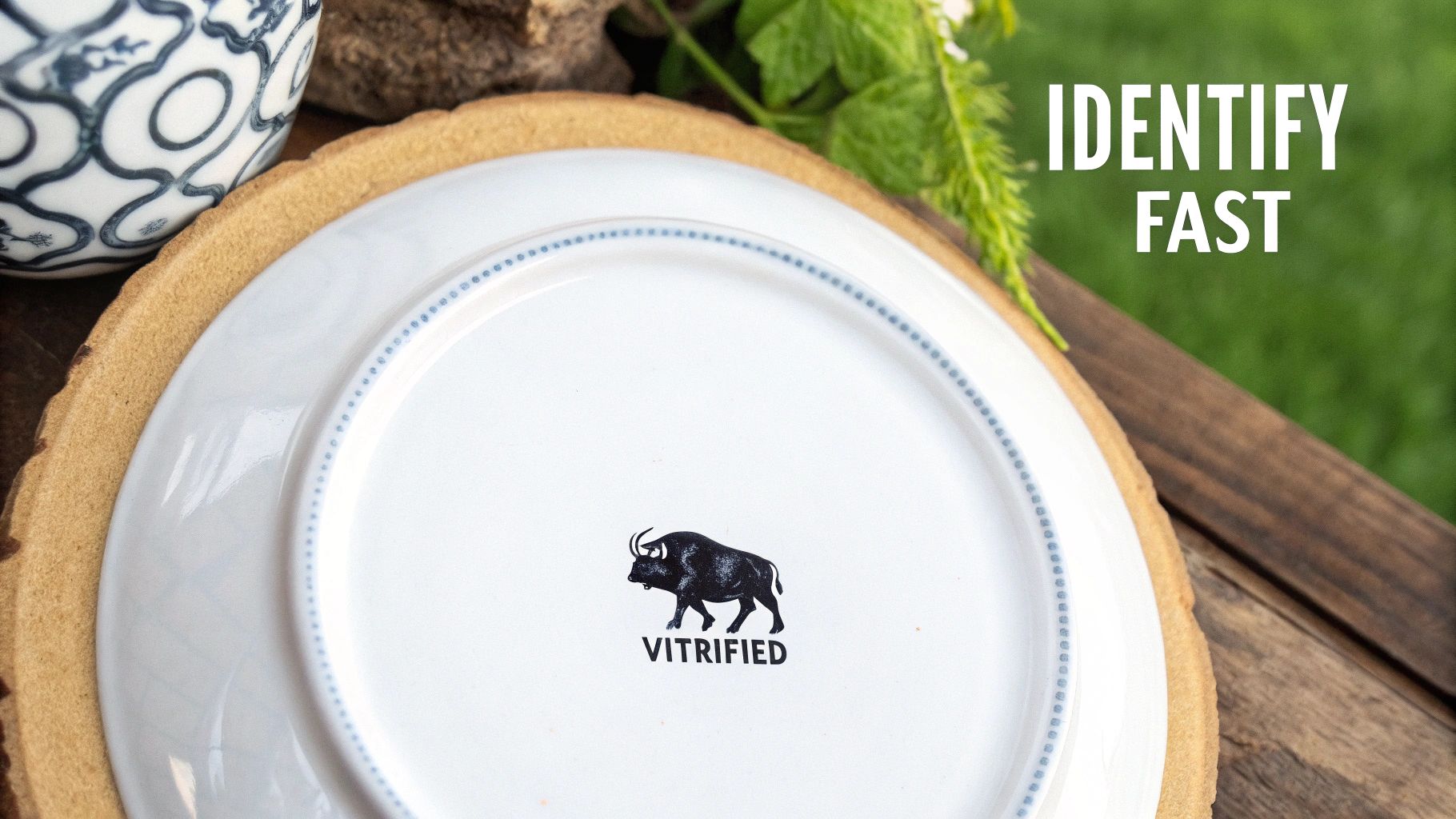
When you flip over a piece of that satisfyingly heavy, well-made dinnerware, the backstamp is like a treasure map. For Buffalo China, these marks tell the story of a company that grew from making soap premiums to dominating the commercial dinnerware industry. For any collector or seller, knowing how to read these symbols is an essential skill.
Think of this as your field guide for quick, on-the-spot identification. Whether you're digging through a box at an estate sale or browsing an antique shop, knowing what to look for can give you a pretty good idea of a piece's age and history long before you dive into a detailed timeline.
Core Visual Elements to Look For
It’s no surprise that the American bison is the star of almost every buffalo china mark. But how that bison looks—and the words around it—changed a lot over the company's 100+ year run. You'll want to pay close attention to these specific details:
- The Bison Logo: Is the buffalo standing still, or is it charging forward? The early "Buffalo Pottery" marks often show a more detailed, static bison. Later, as the company became "Buffalo China," the logo became more streamlined and was often depicted on the move.
- Company Name: Does it say "Buffalo Pottery" or "Buffalo China"? This is a major clue. "Pottery" usually points to an earlier piece, made roughly between 1901 and the 1940s. "China" signifies the later, vitrified commercial ware the company became famous for.
- Key Phrases: Words like "Vitrified" or "Semi-Vitreous" are dead giveaways. "Vitrified" tells you it's the tough, non-porous stuff made for heavy use in diners, railroads, and hotels, which was the company’s main focus from the 1910s onward.
- Date Codes: Many pieces, especially those made after the 1940s, have a date code. These numerical or alphanumeric codes can help you pinpoint the exact year and even the quarter it was made.
Getting a handle on these basics gives you a solid foundation for identification. If you want to see how these marks compare to others in the ceramics world, our general pottery marks identification guide is a great resource for broader context.
Quick Identification Checklist for Buffalo China Marks
Use this table to quickly interpret the visual cues on your Buffalo China and estimate its production era. It’s a handy reference for when you're out in the field.
| Visual Element | What It Signifies | Common Time Period |
|---|---|---|
| "Buffalo Pottery" Name | An early, often semi-vitreous piece. | 1901 - c. 1940s |
| "Buffalo China" Name | A later, fully vitrified commercial-grade piece. | c. 1920s - 1980s |
| Standing Bison | Typically found on the earliest marks. | 1901 - c. 1920s |
| Charging Bison | The more common logo on later vitrified ware. | c. 1920s - 1980s |
| "Vitrified" Text | Confirms it's the durable, non-porous hotel ware. | c. 1915 onward |
| Numerical Date Code | Allows for precise dating. | 1941 - 1980s |
| "Made in USA" | Often added to marks after import/export laws. | Post-1921 |
Remember, these are general rules, and there are always exceptions and overlapping marks. But this checklist should help you narrow things down fast.
The History and Legacy of Buffalo China
To really get a feel for the different buffalo china marks, you have to go back to the beginning. It’s a pretty unique story. Buffalo China wasn't born out of a desire to make dinnerware; it was actually a clever marketing ploy for a completely different business.
Back in 1901, a man named John D. Larkin, of the Larkin Soap Company, established Buffalo Pottery in Buffalo, New York. His goal was simple: create beautiful pottery to give away as premiums to customers who bought his soap. The idea was a massive hit, and it wasn't long before this side-project turned into a seriously profitable arm of his company. The earliest items, stamped "Buffalo Pottery," were usually semi-vitreous pieces like decorative plates and dinnerware sets for the home.
From Soap Premiums to Tough-as-Nails Restaurant Ware
As the pottery business took off, the folks in charge spotted a huge opportunity beyond the soap-buying public—the commercial world. The turn of the 20th century saw a boom in public dining. Hotels, railroad dining cars, and diners were popping up everywhere, and they all needed one thing: dinnerware that could take a beating.
Sensing this demand, Buffalo Pottery started playing around with a high-firing technique to create something new: vitrified china. This wasn't your grandmother's delicate porcelain. Vitrified china is fired at such a high temperature that it becomes non-porous, incredibly strong, and resistant to chips and thermal shock. It was the perfect solution for the chaos of a commercial kitchen. This smart move from household freebies to heavy-duty restaurant ware would shape the company's entire future.
Of course, this change was reflected in the buffalo china marks. The name "Buffalo China" started appearing on the backstamps, letting buyers know this was the new, tougher stuff. Their reputation for quality and durability quickly made them a go-to name in the business.
By 1911, a mere decade after opening, the company had 250 workers and was shipping its wares to 27 different countries. The company's pivot to vitrified china in 1915 supercharged its growth, leading to a major expansion of its factory. Fast forward to 1965, and Buffalo China was producing an incredible 250,000 pieces of commercial dinnerware every single week. You can dig deeper into this history on its Wikipedia page.
Becoming an Industry Icon
In 1956, the company made it official, changing its name to Buffalo China, Inc. This wasn't really a new direction, but rather a formal acknowledgment of the identity they had built over the past several decades as a leader in commercial china.
The legacy of Buffalo China is a classic American story of innovation and industrial strength. What started as a freebie to sell soap grew into an industry giant that furnished the tables of America's restaurants, hotels, and diners. Each little mark on the bottom of a plate tells part of that story, capturing a moment in time from its early days as an art pottery to its reign as the king of vitrified ware. Knowing this history is the key to figuring out what you're holding and where it fits in the timeline.
A Visual Timeline of Buffalo China Marks
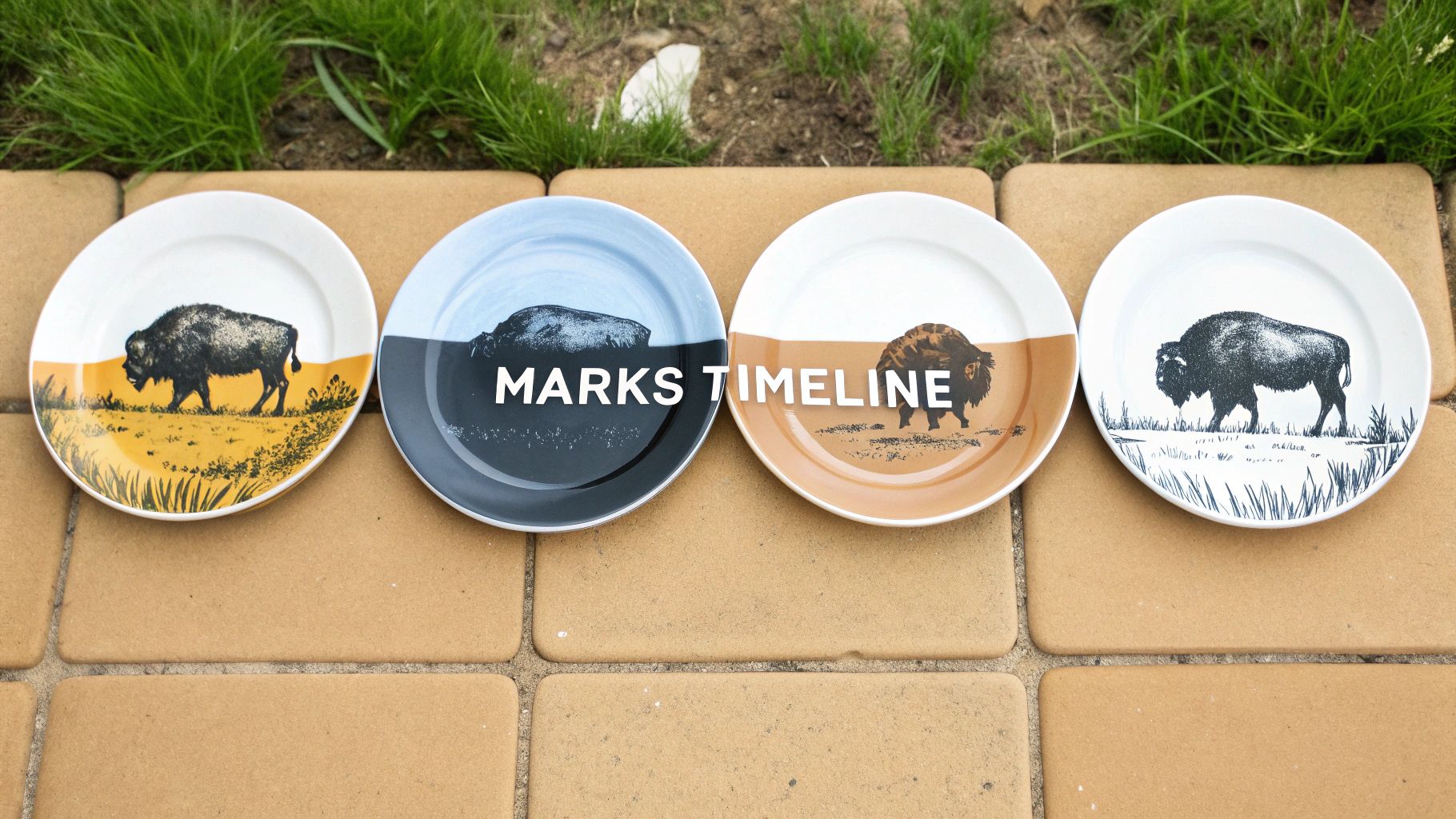
Dating a piece of Buffalo China is a bit like detective work. Your single most important clue is almost always the mark on the back. These backstamps changed quite a bit over the company's long history, tracking shifts in production, branding, and even ownership. Think of this visual timeline as your chronological field guide to figuring out exactly when your piece was made.
Every little change—from the name used to the way the bison is standing, or the addition of a new phrase—tells part of the company's story. By comparing the mark on your item to the examples here, you can get a much clearer picture of its age.
The Early "Buffalo Pottery" Era (1903-1920s)
The very first marks used by the company are a world away from the later ones and are a big deal for collectors. These early backstamps clearly state the maker is "Buffalo Pottery," a direct reference to its original name and its initial focus on semi-vitreous wares.
The dead giveaway for this period is the detailed, standing American bison. You'll often see it looking straight ahead or just slightly to the side, usually standing on a small patch of grass. The whole design has the feel of an intricate illustration, not the kind of streamlined logo we're used to today.
Key features to look for:
- Name: It will always say "Buffalo Pottery."
- Bison: A static, standing American bison, often with fine, artistic detail.
- Text: Look for extra phrases like "Semi-Vitreous" and, if you're lucky, the year of production printed right on the mark.
Finding a piece with a date like "1907" or "1911" printed within the circle of the backstamp is a fantastic find. It’s a surefire way to pinpoint its early origins and adds real credibility to a collection's timeline.
Transition and the Rise of "Buffalo China" (1920s-1940s)
The 1920s was a period of major change. The company had perfected its vitrification process and was shifting its focus to the tough, durable china needed by restaurants and hotels. This evolution was mirrored in the backstamps, where the name "Buffalo China" started to appear. For a while, both "Buffalo Pottery" and "Buffalo China" marks were in use, which can sometimes cause a bit of confusion.
The most obvious change, though, was the bison itself. The calm, standing animal was replaced by a dynamic, charging bison. This new logo was meant to symbolize the strength and forward momentum of the company and its incredibly durable new product line. Marks from this time often feel like a bridge connecting the old identity to the new.
One thing to keep in mind is that these changes weren't always a clean break. It was common for the factory to use up old stock of decals, so you might find a "Buffalo Pottery" mark on a piece made a bit later. However, the presence of a "Buffalo China" mark confirms it was made in the vitrified china era.
The Standardized Green Ink Era (1940s-1960s)
By the 1940s, Buffalo China had really hit its stride, and its marks became much more consistent. The most common backstamp you'll find from this mid-century period is the charging bison logo, almost always printed in a very distinct green ink. This is arguably the most recognizable of all buffalo china marks.
Around this time, the company also rolled out a system of date codes, which we'll break down in the next section. The words "Made in U.S.A." also became a standard part of the mark, usually appearing right below the bison. The overall design is clean and confident, reflecting a company at the absolute peak of its production. For collectors interested in how other ceramic companies handle dating, our guide to understanding Belleek backstamp dates provides a fascinating point of comparison.
Later Marks and Oneida Ownership (1970s-Closure)
In the final decades of the company's run, the marks were simplified even further. That familiar green ink stuck around, but the designs became more streamlined. The bison logo was often less detailed, and the text was arranged in a straightforward, modern font.
After Oneida Ltd. bought Buffalo China in 1983, you'll sometimes see the Oneida name or logo incorporated into the backstamp. These later marks represent the final chapter in the company's long story. While they aren't typically as valuable as the early "Buffalo Pottery" pieces, they are an essential part of the timeline for any serious collector.
How to Decode Buffalo China Date Codes

While the style of a buffalo china mark can give you a pretty good idea of the general era, the real secret to getting a precise date is in the codes. Around 1941, Buffalo China started adding a simple numerical system right into their backstamps. This is the detail that lets collectors pinpoint not just the year, but the very quarter a piece was made.
You'll usually find these numbers tucked just below or next to the main bison logo. Learning to read them is probably the most important skill you can have for moving beyond a decade-long guess to a specific three-month window. It really is a game-changer.
The Two-Digit Year System
The most common system Buffalo China used is refreshingly simple. Look for a two-digit number, then a single digit, often with a hyphen or a space between them, like 52-4.
- The first two digits are the year. So, "52" means 1952, "67" is 1967, and "48" is 1948. Easy enough.
- The single digit after that is the quarter of the year. This tells you which three-month stretch it came out of the kiln.
Here’s the breakdown of the quarter codes:
- -1 is for the First Quarter (January, February, March)
- -2 is for the Second Quarter (April, May, June)
- -3 is for the Third Quarter (July, August, September)
- -4 is for the Fourth Quarter (October, November, December)
Putting it all together, a piece stamped with "52-4" was made sometime between October and December of 1952. That kind of precision is fantastic for authenticating a piece or understanding its place in your collection.
Special Cases and Variations
Now, while the two-digit system is what you'll see most of the time, don't be surprised if you run into some slight differences. Some of the very early coded pieces might just show the year, or the formatting could be a little different. The core idea of year-and-quarter, however, stays pretty consistent through the company's busiest years.
A quick tip: The presence of these date codes is a dead giveaway that you're looking at commercial ware. This was their tough, vitrified china made for the daily grind of restaurants, hotels, and railroads.
Sometimes the codes are faint or have worn down over the years, so don't hesitate to grab a magnifying glass and get some good light on the mark. A little patience in decoding these numbers can tell you the exact story of your Buffalo China, adding a whole new layer of history to the piece in your hands.
How Ownership Changes Influenced the Marks
A piece's backstamp tells you more than just when it was made; it's a window into the company's journey through a shifting American industrial landscape. Major business changes, especially the Oneida Ltd. acquisition in 1983, had a direct and visible impact on the marks you'll find on Buffalo China.
Knowing this history gives you a huge advantage as a collector. When you spot a mark that includes the Oneida name or looks like a simplified, modern logo, you're looking at a piece from the company's later, more turbulent years. These marks are a sign of a brand adapting to new ownership and a completely different market.
Responding to a Changing World
The late 20th century was a tough time for American manufacturers. Fierce competition from overseas flooded the market, forcing companies like Buffalo China to make some hard choices to survive. These strategic shifts are subtly recorded in the company's backstamps.
These weren't just simple branding updates; they were moves made out of necessity. To stay afloat against low-cost imports, Oneida modernized factories and eventually moved some production. This era marked a real turning point, and you can see it in the variations of the classic buffalo china marks as the company fought to hold its ground. The marks from this period tell a story of resilience.
Buffalo China's story is deeply tied to international trade. The company was bought by Oneida Ltd. in 1983 as it struggled with pressure from overseas competitors. To cut costs, a factory was opened in Juarez, Mexico, in 1986. For a while, this strategy worked, thanks to a hefty 35% import duty on commercial restaurant china. But when Congress slashed that tariff to 0%, the company's ability to compete was crippled. The factory was sold to Niagara Ceramics in 2004 and finally closed for good in 2013, with cheap imports cited as the main reason. You can read a fantastic deep dive into these business challenges at Acorn Abbey.
The Final Marks Under New Ownership
In the last decades of production, the marks often combined the Oneida brand with the classic Buffalo China name. These backstamps represent the final chapter in the company's incredible 112-year history. For a collector, finding one of these marks means you're holding a piece from the transitional and ultimately final phase of an iconic American brand.
How to Value Your Buffalo China Collection
So, you've successfully decoded the buffalo china marks and have a good idea of when your piece was made. That naturally leads to the big question: "What's it actually worth?" The answer isn't just about the backstamp. A whole mix of factors comes into play, and a rare mark on a damaged, common plate might be worth less than a pristine piece with a standard mark but a sought-after pattern.
To get a real sense of value, you need to look at rarity, how desirable the pattern is, and—above all—the physical condition of the item. Getting a handle on these key areas will help you manage your expectations, whether you're selling, insuring, or just satisfying your own curiosity.
Condition Is King
When it comes to value, condition is everything. Buffalo China was built tough for restaurant use, but that doesn't mean it's all in perfect shape today. Even what seems like a minor flaw can seriously slash what a collector will pay.
Here’s what to look for when you inspect a piece:
- Chips and Cracks: Carefully check the rims, spouts, and handles. Pay close attention to hairline cracks; they can be tough to spot but are a major hit to value.
- Crazing: This is a fine web of cracks in the glaze itself. It’s pretty common in older pottery, but heavy crazing is a definite turn-off for most buyers.
- Utensil Marks: Scratches from knives and forks are part of the territory for restaurant ware. Still, excessive, deep marks can spoil the look and lower the price.
- Staining: Check for any discoloration from food or drink, especially inside cups, mugs, and bowls.
A piece in mint or near-mint condition is the gold standard. It will always fetch the highest price, often 50-75% more than the same item with obvious wear and tear.
Rarity and Desirability of Patterns
Let's be clear: not all Buffalo China is created equal. The pattern and the rarity of the mark itself are huge factors. An early "Buffalo Pottery" mark from the 1910s on a beautiful Deldare Ware plate is in a completely different world than a run-of-the-mill green-striped diner plate from the 1960s.
As a rule of thumb, the pieces that collectors get most excited about are from the early "Buffalo Pottery" years (1903-1920s). Art lines like Deldare Ware or special commemorative plates from this era are the most valuable and can command hundreds of dollars. In contrast, common restaurant ware patterns might only sell for a few dollars.
If you're appraising a larger collection, you might find it helpful to look into different antique inventory valuation techniques. For a broader look at what makes antiques valuable in general, our guide on the monetary value of antiques has some great information.
Frequently Asked Questions About Buffalo China
Even with a good timeline and a list of date codes, a few tricky questions always seem to pop up. This section is designed to tackle those common sticking points head-on, giving you clear answers to help you identify your pieces with more confidence.
Think of it as a quick guide for the nuances of collecting Buffalo China. We'll clear up confusion around the company's history and help you sidestep some common misconceptions about value and authenticity.
Does All Buffalo China Have a Buffalo in the Mark?
You’d think so, but surprisingly, no. While the American bison is the brand’s iconic symbol, you won't find it on every single piece. The vast majority of items do feature it, but the logo itself changed quite a bit over the years—from a detailed, standing animal to the more familiar charging one.
Some very early experimental pieces or unique, specialized items might lack the buffalo altogether, though finding one is rare. The most reliable identifier is the name itself: "Buffalo Pottery" or "Buffalo China." An absent buffalo is unusual, but not a deal-breaker, especially if you suspect you have a piece from the company's earliest years.
What Is the Difference Between Buffalo Pottery and Buffalo China?
This is one of the most important distinctions for dating your pieces. "Buffalo Pottery" was the company's original name, and you'll find that wording on its earlier semi-vitreous ware made from 1901 into the early 1940s. This ware was typically made for home use, advertising, or as decorative items.
Later on, the company shifted its focus to producing incredibly durable, vitrified china for the restaurant and hotel industry. This is when the "Buffalo China" mark was introduced. As a general rule, a "Buffalo Pottery" mark points to an older, and often more collectible, piece than something stamped "Buffalo China."
Are Pieces Marked "Made in USA" More Valuable?
Not necessarily. The "Made in USA" stamp is a great dating clue—it tells you the piece was made after 1921 when country-of-origin labeling became common. However, it doesn't automatically make a piece more valuable.
A piece’s worth really comes down to the age of the mark, how rare the pattern is, and its condition. For example, a rare 1910s Deldare Ware plate without the "Made in USA" stamp will almost always be worth more than a common 1970s diner plate that has it.
How Can I Spot a Fake Buffalo China Piece?
Good news on this front: outright forgeries are not a big problem in the world of Buffalo China collecting. Since most of the company's output was mass-produced commercial ware, there’s very little financial incentive for forgers to make fakes.
The real challenge is learning to distinguish genuine Buffalo China from other restaurant ware made by competing companies during the same era. Always look for the specific buffalo logo and wording you see in authentic buffalo china marks. A blurry or poorly defined mark that doesn't match known examples probably isn't a fake, but it might mean you're looking at a piece from a different manufacturer.
Sorting through a collection and need a fast, accurate ID? Think of Curio as your expert in your pocket. Just snap a photo to uncover the history, origin, and value of your antiques. Download Curio today and let your treasures tell their story.