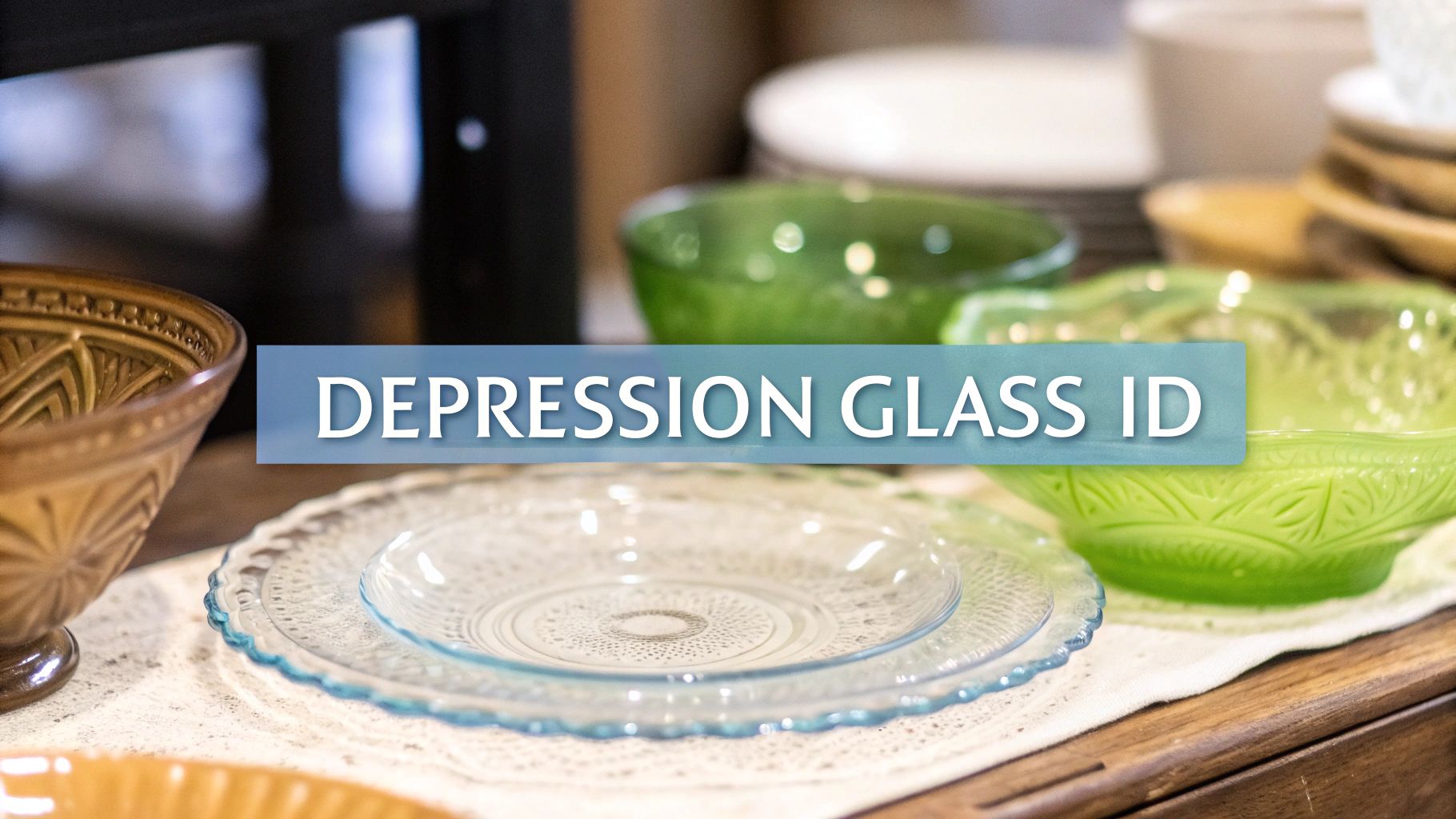
Spotting real Depression glass is like a treasure hunt, and it all starts with training your eye to recognize the little clues left behind by history. The secret isn't just in the patterns, but in the color, the thinness of the glass, and the charming imperfections like mold seams and tiny bubbles. These details are the fingerprints of mass production from a bygone era, and they're your first clue in telling an authentic piece from a modern look-alike.
Your Starting Point for Identifying Depression Glass
So, you've found a piece of colorful, patterned glassware and you're wondering if it's the real deal. You're in the right place. This guide will walk you through exactly what to look for—the specific colors, the feel of the glass in your hand, the iconic patterns, and even the flaws that make these pieces so special.
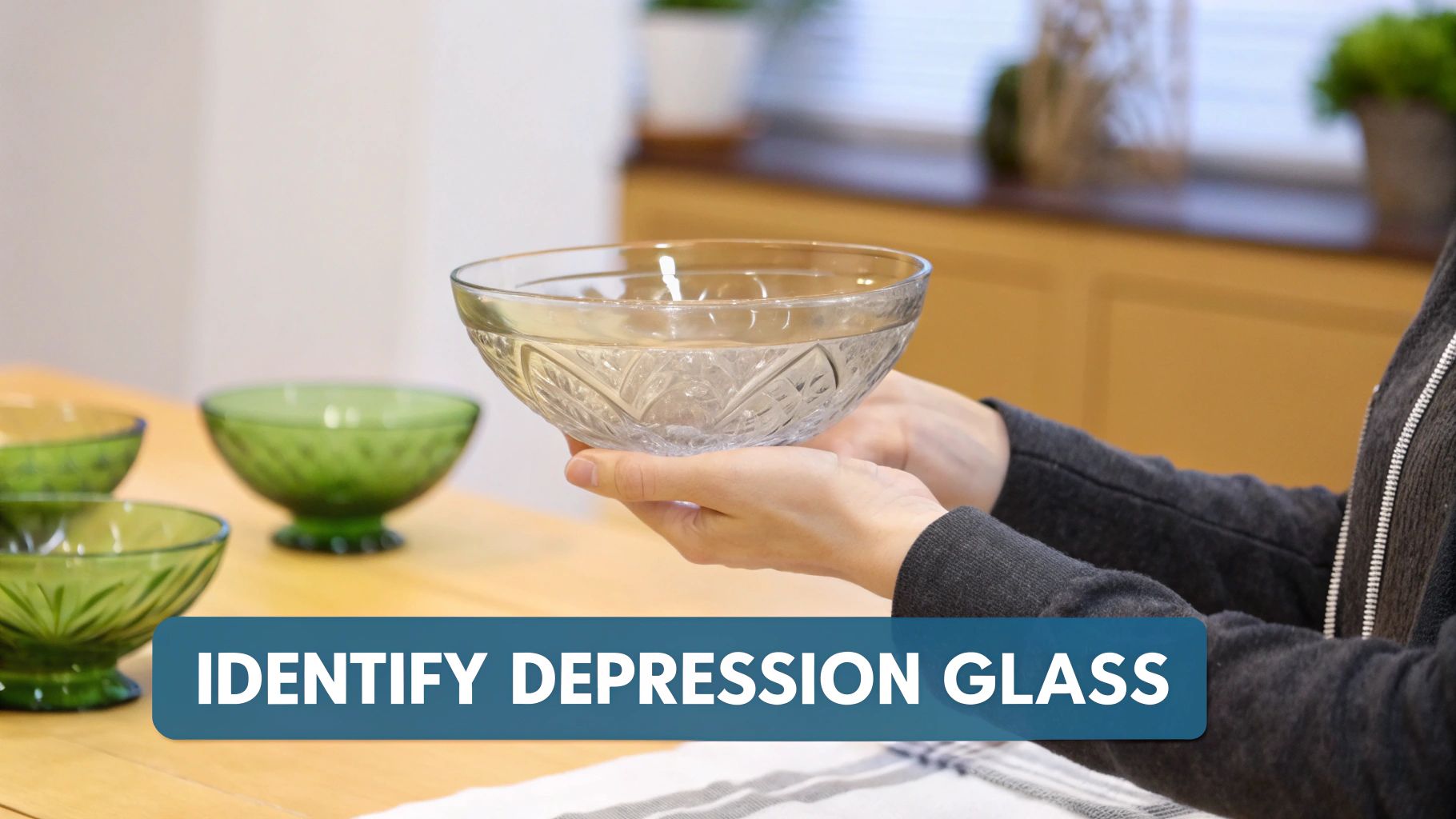
To really get a handle on identification, it helps to know where this glass came from. It was made in the United States, mostly between 1931 and 1936, as a cheerful and affordable household item for families navigating the Great Depression. Glassmakers pressed it into molds to crank it out quickly and cheaply, a process that often left behind little bubbles, flaws, and other quirks. Back then, they were just signs of cheap production; today, they're clues that help us confirm a piece's age. For a deeper dive into this history, The Vintage Seeker's guide to Depression glass is a great resource.
What Defines Authentic Depression Glass
Before you even start worrying about specific patterns, you need to get a feel for the glass itself. Think of this as building a mental checklist you can run through whenever you’re browsing a flea market or antique store. Over time, this becomes second nature.
Here are the core traits that scream "Depression glass":
- Signature Colors: The classics are pale pink, soft green (which sometimes glows under a blacklight and is called uranium green), amber, and a sunny yellow. You'll also find richer colors like cobalt blue and ruby red, but these are much rarer and typically more valuable.
- Lightweight Feel: This one surprises people. Depression glass is noticeably thin and light. To keep costs rock-bottom, manufacturers used as little glass as they could get away with. It just doesn't have the weight of modern glassware.
- Visible Mold Seams: The glass was pressed in two-part molds, and where those two halves met, they almost always left a faint vertical line. Run your finger along the side of a cup or bowl—if you can feel a subtle ridge, that’s a great sign.
A key tip for anyone starting out: perfection is a red flag. The very things that might seem like defects—tiny trapped air bubbles, faint "straw marks" from cooling, or a slightly uneven shape—are actually the hallmarks of authenticity. They're not flaws; they're stamps of a bygone era.
Building Your Foundational Skills
Learning depression glass patterns identification is less about memorizing a thousand designs and more about trusting your senses.
Next time you pick up a piece, hold it up to a window. Can you see those tiny bubbles suspended inside? Now run your finger along the rim. Is it perfectly smooth, or does it have a slight waviness to it that speaks to older manufacturing?
This initial hands-on assessment is your most powerful tool. It lets you quickly scan a shelf of glassware and zero in on the pieces that have the right "feel." Once you get these basics down, you’ll have the confidence to move on to the fun part: figuring out the specific pattern and maker.
Look for Clues in Color and Texture
The real secret to identifying Depression glass patterns isn't always in a book. Before you even think about matching designs, the best clues are right in your hands. A careful look at the color and a good feel of the piece can tell you an incredible amount.
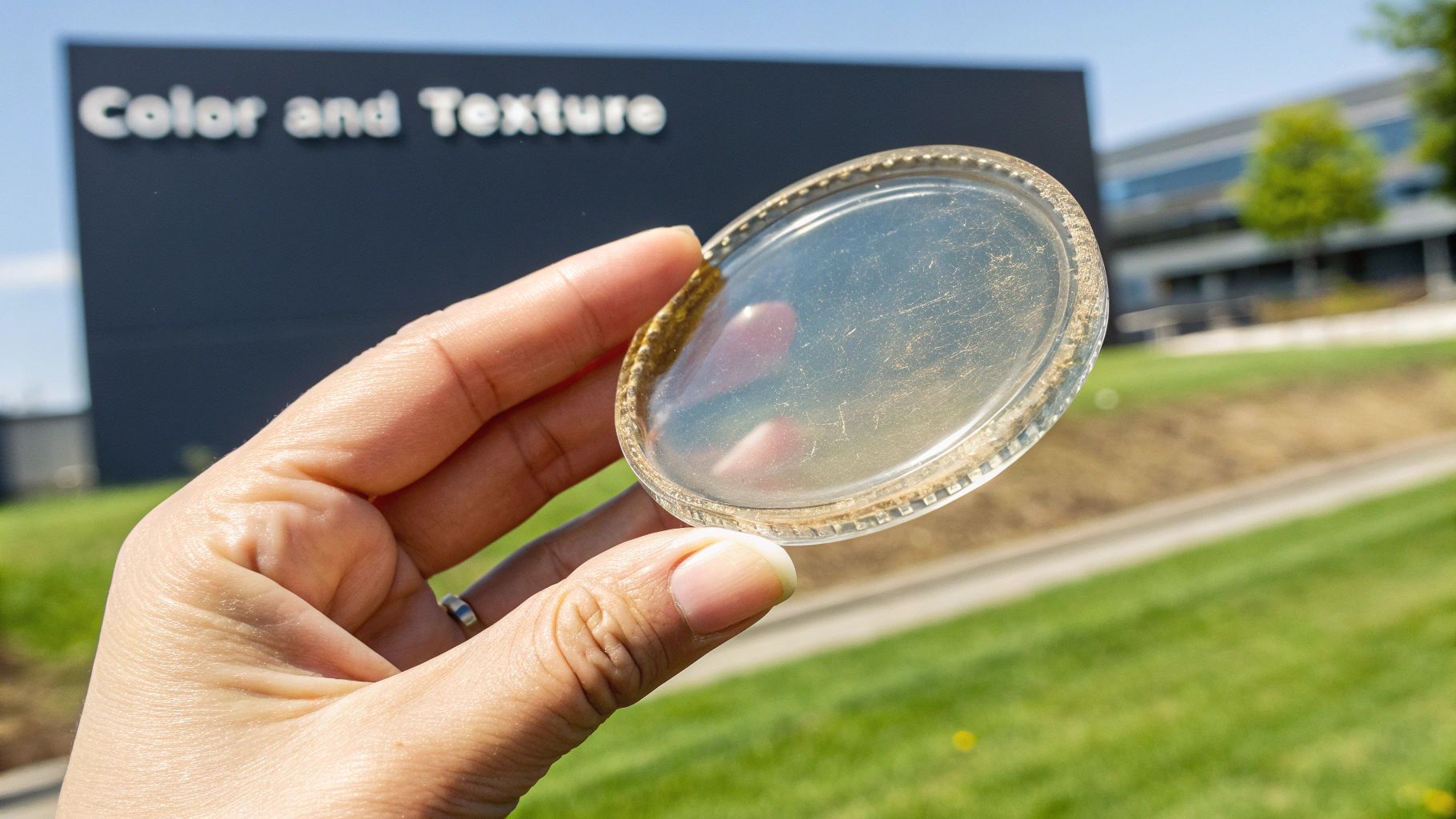
This whole process really starts with its most defining feature: the color. Glassmakers of the era used a very specific palette meant to bring a little cheer into homes during some tough years. Getting to know these signature shades is your first big step.
Recognizing Signature Depression Glass Colors
The colors of authentic Depression glass are often soft, translucent, and full of optimism. While you’ll find tons of slight variations, a few key hues make up most of what you'll discover out in the wild.
- Delicate Rose Pink: This is, without a doubt, the most famous and widely collected color. It’s a gentle, soft pink—not a flashy magenta.
- Uranium Green: This classic green has a distinctive, almost watery look. The real magic happens under a blacklight, where it glows brilliantly due to a small amount of uranium oxide in the glass. You can learn all about this trait in our guide to antique Vaseline glassware.
- Amber & Yellow: These shades were hugely popular for kitchen and dinner sets, ranging from a warm honey amber to a bright, sunny yellow.
- Cobalt Blue: This one is a much deeper and rarer color. Finding a genuine piece in this rich cobalt is a major score for any collector.
- Ruby Red & Amethyst: Just like cobalt, these were made in far smaller numbers. That rarity often makes them more valuable.
Whenever you can, hold a potential piece up to natural light. The color should be consistent all the way through the glass. If you spot any flaking or notice the color seems to be just a surface coating, you're likely looking at a modern piece with a "flashed-on" finish, not true colored glass.
Interpreting the Feel of the Glass
Next, actually pick the piece up. How it feels is just as telling as how it looks. Real Depression glass has a distinct quality that sets it apart from heavier modern glassware or its more refined contemporary, "Elegant" glass.
The most obvious tell is its surprising thinness and light weight. Back in the 1930s, the goal was to produce things as cheaply as possible, and that meant using less glass. A genuine piece of Depression glass often feels almost fragile compared to a modern dinner plate.
I always tell new collectors to trust their hands. If a piece feels thick, heavy, and flawless, it should raise a red flag. The charm of Depression glass is in its imperfections, a direct result of the rapid, cost-cutting production methods of the era.
Finding Clues in Manufacturing Quirks
The fast-and-cheap production lines of the 1930s left behind a trail of evidence. These so-called "flaws" are actually your best friends when authenticating a piece, since modern techniques have mostly erased them.
Run your fingers along the sides of a cup, bowl, or pitcher. You're searching for these tell-tale signs:
- Mold Seams: Nearly all Depression glass was pressed in a two-part mold. Where those two halves met, they left a faint, raised line or seam. It can be subtle, but you can almost always feel it. Perfectly smooth sides are a big warning sign of a reproduction.
- Trapped Air Bubbles: Look closely right into the glass itself. Tiny suspended air bubbles are a classic hallmark of old glassmaking. Modern methods create glass that is almost perfectly clear and free of these charming little imperfections.
- Straw Marks or Shear Marks: These might look like faint scratches or lines on the surface. They happened when the hot, molten glass was handled or slid onto surfaces to cool down.
Picture this: you're at a flea market holding two green plates that look identical. One is heavy, its edges are perfectly smooth, and the glass is crystal clear. The other is lightweight, has a faint vertical line you can feel on the side, and you can see a tiny bubble trapped near the rim. That second plate, with all its "flaws," is far more likely to be the real deal from the 1930s.
How to Recognize the Most Common Patterns
Once you've trained your eye to spot the right colors and feel for those tell-tale imperfections, the next step is recognizing the designs themselves. This is where the real fun begins. It's the moment a simple piece of colored glass transforms into a story with a name, a maker, and a history.
You'll go from finding a "pretty pink plate" to confidently identifying a "Jeannette Glass Cherry Blossom platter."
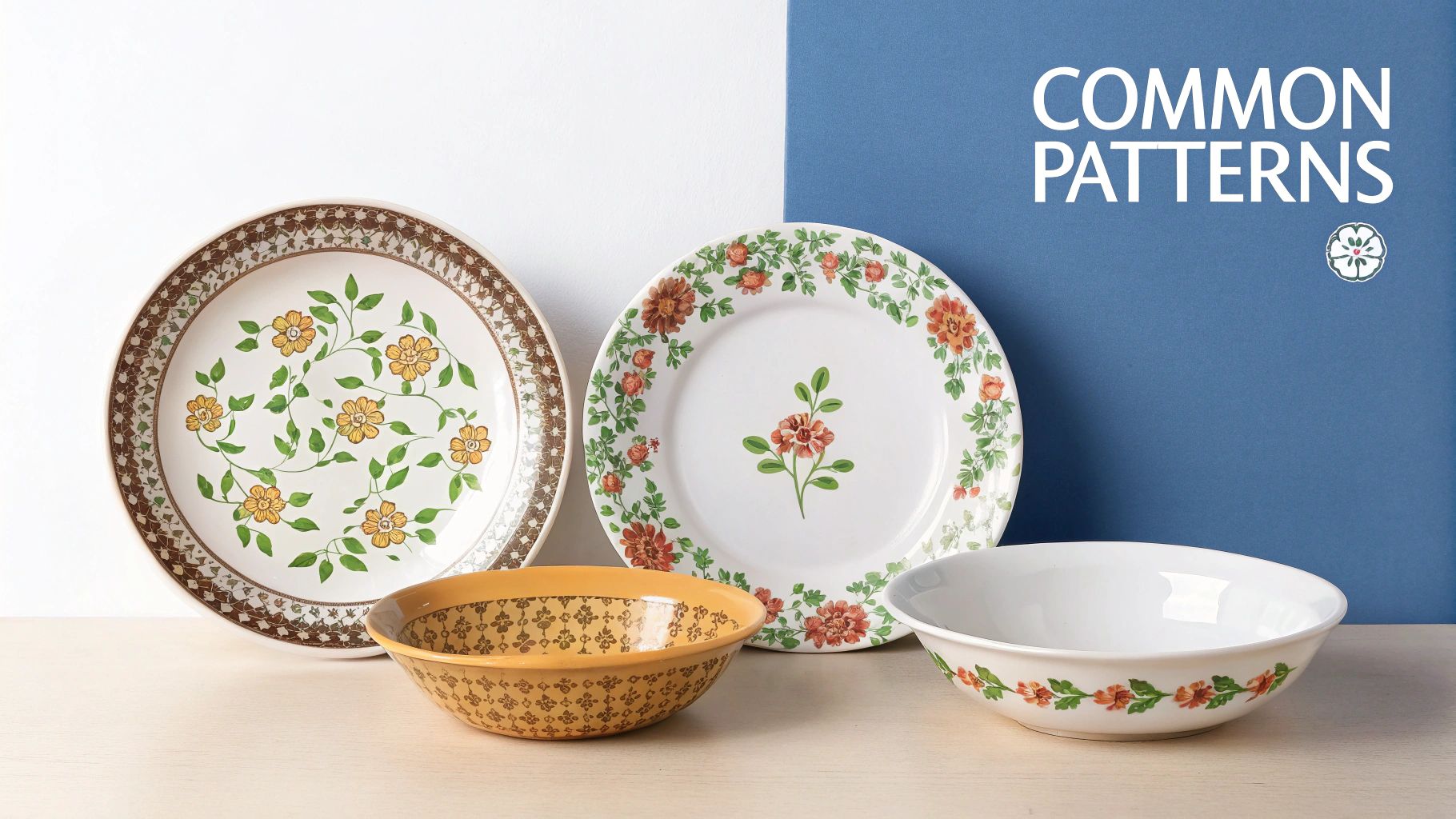
With dozens of patterns out there, knowing where to start can feel overwhelming. The trick is to focus on the classics—the handful of patterns you're most likely to find out in the wild. Experts have cataloged around 92 known Depression glass patterns made by about 19 American companies in the 1930s.
A few major firms, however, made most of what we find today. Patterns like Cherry Blossom (1930-1939) were wildly popular and produced in huge quantities, which is why they’re still common finds. To get a broader sense of the variety, you can discover more insights about these patterns on LoveToKnow.com.
Before we dive into the big ones, here's a quick cheat sheet to help you recognize the most popular patterns at a glance.
Popular Depression Glass Patterns at a Glance
| Pattern Name | Manufacturer | Years Produced | Identifying Motifs | Common Colors |
|---|---|---|---|---|
| Cherry Blossom | Jeannette Glass | 1930-1939 | Branches with blossoms and cherries | Pink, Green |
| Cameo | Hocking Glass | 1930-1934 | A dancing woman in a cameo frame with swags | Green, Yellow |
| American Sweetheart | Macbeth-Evans | 1930-1936 | Intricate, fine swirls creating a lacy, doily look | Pink, Monax (white) |
| Royal Lace | Hazel-Atlas | 1934-1941 | Geometric, interlocking doily or snowflake design | Cobalt Blue, Pink |
This table is just a starting point, of course. The real skill comes from learning the little details of each design.
Cherry Blossom: The Iconic Floral
If there's one pattern that just screams "Depression glass," it's Cherry Blossom. Made by Jeannette Glass from 1930 to 1939, this design is a collector favorite for its delicate, all-over pattern of branches heavy with blossoms and cherries. It was a massive commercial success, which is fantastic news for us because it's still relatively easy to find.
Here's how to spot it:
- Distinctive Motif: Look for sprawling branches with small, five-petaled flowers and little clusters of cherries. It's a busy, intricate design that covers most of the piece.
- Common Colors: Pink and green are everywhere. You might also find Delphite (a pale opaque blue) or jadeite (opaque green), but those are much rarer and more valuable.
- Key Pieces to Find: Keep an eye out for footed tumblers, handled cake plates, and the classic round butter dish with its domed lid.
Because it was so popular, Cherry Blossom was heavily reproduced, especially in pink. A genuine piece will have that characteristic thinness and the imperfections we talked about earlier. Fakes often feel clunky, heavier, and just a little "too perfect."
Cameo: The Dancing Ballerina
Also known as "Ballerina" or "Dancing Girl," the Cameo pattern is an elegant and unforgettable design from Hocking Glass Company (1930-1934). It’s a bit more subtle than Cherry Blossom, but its graceful, Art Deco look has earned it a dedicated following.
The central feature is a delicate cameo of a dancing woman in profile, draped in flowing fabric. This medallion is framed by swags of curtains or garlands, giving the whole piece a romantic, theatrical feel.
Cameo is one of those patterns you can often spot from across the room. The repeating motif of the dancer in her draped frame creates a visual rhythm that just pops on a crowded antique store shelf. It’s a perfect example of how one elegant figure can define an entire dinnerware line.
Green is by far the most common color for Cameo, with yellow being a distant second. Pink and clear pieces with a platinum rim were also made, but they are much harder to come by and will fetch higher prices.
American Sweetheart: The Lacy Masterpiece
If you find a piece that looks like it's been draped in fine, intricate lace, you’ve probably found American Sweetheart. Produced by the Macbeth-Evans Glass Company from 1930 to 1936, this pattern is beloved for its breathtakingly detailed and delicate design.
Unlike the bold flowers of other patterns, American Sweetheart features finely molded swirls, scrolls, and webs that radiate from the center, creating a stunning doily-like effect. The glass itself is remarkably thin, even for Depression glass, which only adds to its fragile, ethereal look.
- Most Common Color: Pink is the quintessential color for this pattern, and it’s what you’ll see most often.
- Rarer Finds: The pattern was also made in a beautiful translucent white called Monax. Ruby red pieces also exist, but they are exceptionally rare.
- Worth Noting: Because this pattern is so delicate, it's prone to utensil scratches. Finding a piece in pristine condition is a real victory.
Royal Lace: The Geometric Beauty
For collectors who love clean lines and geometric precision, Royal Lace is a pattern you absolutely need to know. Hazel-Atlas Glass Company made it from 1934 to 1941, and it perfectly captures the Art Deco vibe with its intricate, repeating design.
The pattern looks like a series of interlocking doilies or even stylized snowflakes. Fine lines create a lacy, almost web-like texture that is both crisp and uniform—a testament to the quality they achieved at the time.
You'll most often find Royal Lace in a stunning cobalt blue, which makes it a dramatic standout on any shelf. It also came in green, pink, and crystal (clear). The cobalt blue pieces remain the most sought-after and often become the centerpiece of a serious collection.
When you're hunting, pay special attention to the tumblers and pitchers in this pattern, as they are particularly striking. Building this mental library of iconic patterns is the best way to get really good at spotting the treasures.
Finding Maker's Marks and Company Traits
While the beautiful patterns and vibrant colors are what catch your eye, sometimes the real breakthrough in identifying a piece is a tiny, hidden signature. Finding a maker’s mark feels like uncovering a secret message from the past, giving you a direct link to the company that made your glass nearly a century ago.
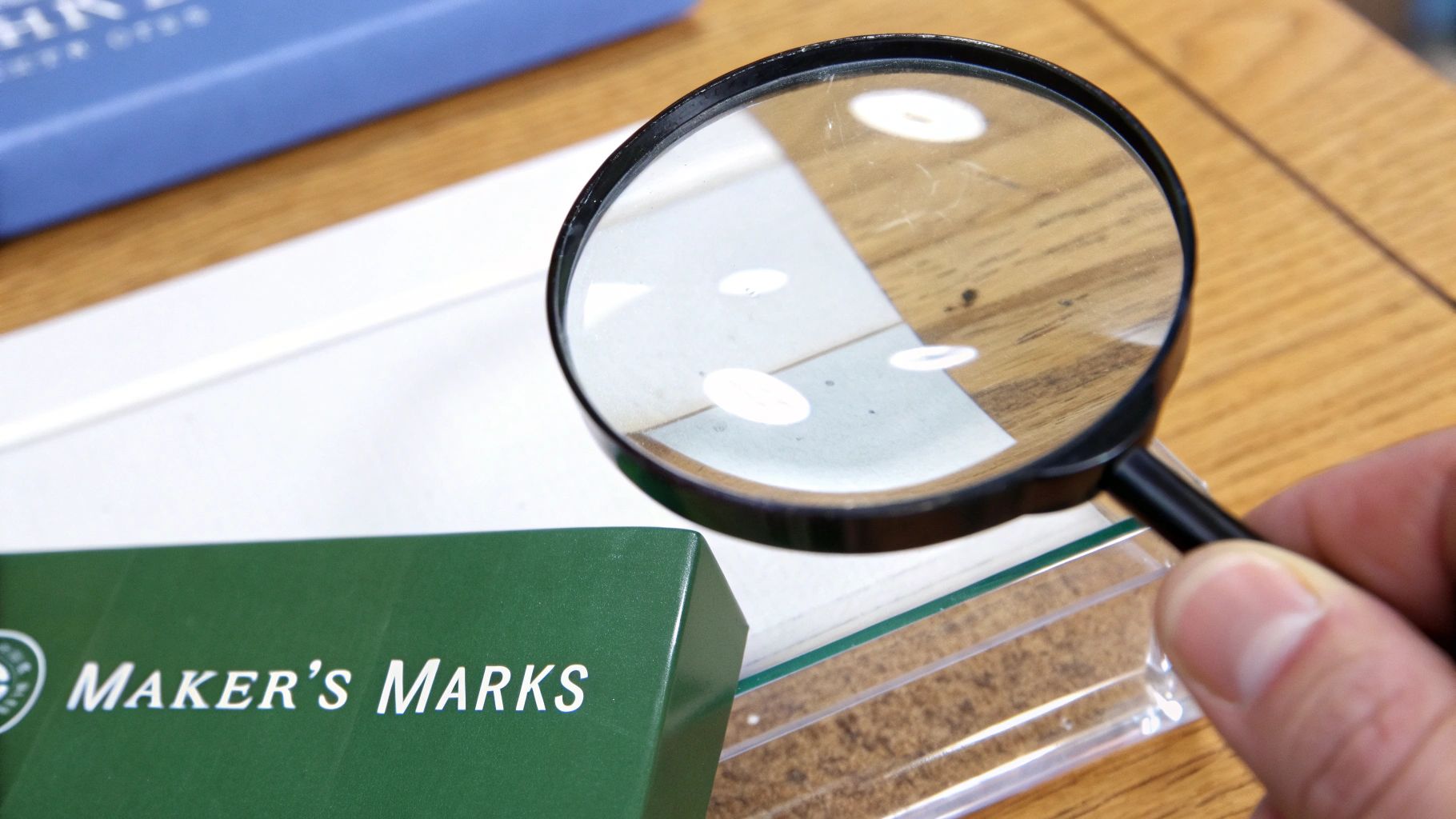
Here's the thing, though: the vast majority of Depression glass is completely unmarked. Manufacturers often used simple paper or foil labels that vanished after the first wash, leaving no trace. A lack of a mark isn't a red flag; it’s actually the norm.
When marks do show up, they're typically embossed (raised) right into the mold. You'll almost always find them on the bottom of the piece, often right in the center.
Hunting for the Hidden Logos
Ready to play detective? Grab a good light source and a magnifying glass. Tilt the piece under the light and slowly turn it, looking for any subtle impressions to pop. Sometimes a mark is so faint you can feel it better with your fingertip than you can see it.
Keep an eye out for some of the most common logos from the era:
- Hazel-Atlas Glass Company: Look for an intertwined "H" over an "A". This is one of the most common marks you'll find on Depression-era glass.
- Federal Glass Company: Their classic mark is an "F" inside a shield. Spotting this is always a great feeling for a collector.
- Anchor Hocking Glass Company: This one can be a little trickier. You might find an anchor symbol, sometimes with an "H" laid over it.
- Jeannette Glass Company: They rarely marked their Depression-era pieces, but when they did, it was often a simple "J" inside a square.
Don't get discouraged if your piece is unmarked. Honestly, it just gives you a chance to flex your other identification skills. Pinpointing a piece by its pattern, color, and physical traits can be even more rewarding than just finding a logo.
When There's No Mark, Look for Company Traits
So, what do you do with the other 90% of pieces that have no mark? This is where you learn to recognize a manufacturer's "handwriting." Different companies had their own production habits and design quirks that can be just as telling as a logo.
For instance, some glasshouses were known for certain shapes or finishing touches. Macbeth-Evans, the maker of the famously delicate "American Sweetheart" pattern, was known for producing incredibly thin glassware. If you pick up a piece that feels almost impossibly light and fragile, there's a good chance it's one of theirs.
This is where hands-on experience really pays off. The more glass you handle, the more you'll start to notice these subtle, company-specific traits. It's a skill that just grows over time with every piece you inspect. For a great visual reference of different logos and symbols, check out our comprehensive guide to antique glass maker's marks.
Recognizing Design Signatures
Beyond the physical feel, companies often had their own signature design elements they'd use across different patterns—think of it as their artistic style.
- Rim Styles: Some companies loved scalloped edges, while others stuck to beaded or pie-crust rims. A specific rim style can be a huge clue pointing you toward a particular maker.
- Base Shapes: Flip a bowl or tumbler over. Was the company known for star-bottomed bases, rayed designs, or simple, plain feet? These details are rarely an accident.
- Glass Quality: You'll also start to notice differences in the clarity and quality of the glass itself. Some manufacturers consistently produced clearer glass with fewer bubbles, while others had a reputation for being a bit less refined.
Let's say you find an unmarked pink plate. You recognize the "Cherry Blossom" pattern and know it was made by Jeannette Glass. Later, you find a green creamer in a totally different pattern, but it has that same distinctive thinness and a similarly finished base. Even without a mark or a pattern you know, you can now make an educated guess that it might also be a Jeannette piece. This is how you start connecting the dots and building a real, intuitive understanding of your collection.
How to Spot Fakes and Reproductions
Diving into the world of Depression glass is a blast, but it has one major hurdle: reproductions. Once collectors started clamoring for certain patterns, modern companies jumped on the bandwagon and started making copies. Learning to tell a genuine antique from a recent look-alike is probably the single most important skill you'll develop.
Even seasoned pros can get tripped up by a really convincing fake. The key is to slow down and really look at what you’re holding. Trust your senses. Reproductions often get the pattern right, but they completely miss the small details that give away a piece's true origins from the 1930s.
The "Too Perfect" Problem
One of the biggest giveaways is a piece that looks absolutely flawless. You have to remember, original Depression glass was made quickly and cheaply. Those little quirks—tiny trapped air bubbles, faint mold seams, and subtle swirls in the color—aren't just common; they're proof of authenticity.
Modern manufacturing is just too good, too precise. If you're holding a piece that feels perfectly balanced, has no visible seams, and is free of any bubbles or marks, be suspicious. A lot of the charm of real Depression glass comes from its history, and that includes the imperfections from how it was made.
A healthy dose of skepticism is your best friend here. If you see a rare piece, like a pink Cherry Blossom pitcher, for a price that seems too good to be true... it is. Trust your gut and what your hands are telling you.
Physical Clues That Give Fakes Away
Beyond just looking too perfect, fakes often have very specific tells. Next time you're at a flea market or antique shop, run through this mental checklist before you even think about buying.
- Weight and Thickness: This is a big one. Reproductions are almost always heavier and thicker than originals. Authentic Depression glass is notoriously thin and lightweight because glass companies were trying to save every penny by using less material. Pick it up. If it feels clunky or substantial, it's probably a modern copy.
- Color Vibrancy: Fakes often have colors that are just a little... off. The pink might be a garish, hot pink instead of a delicate rose, or the green might look muddy and wrong. Original pieces have softer, more translucent colors that have mellowed over time.
- Pattern Sharpness: This is a fantastic clue. When a company uses an old, worn-out mold to make a reproduction, the details get blurry and lose their definition. An authentic piece, even with its other little flaws, will almost always have a crisp, sharp pattern that really pops.
Getting a feel for these differences just takes practice. For more general advice that applies to all sorts of collectibles, check out our guide on how to spot fake antiques.
Common Misidentifications to Avoid
Sometimes, a piece isn't an outright fake but is just misidentified. A few types of vintage glassware look a lot like Depression glass and can easily fool someone just starting out. Knowing what they are can save you from a costly mistake.
"Goofus" glass is a common look-alike. This was early 20th-century glassware where the pattern was cold-painted on the reverse, usually in red and gold. While it's a collectible in its own right, it’s not Depression glass. The dead giveaway is the paint—it's on the surface and often flakes off. The color in real Depression glass is in the glass itself.
Another point of confusion is "Elegant" glass. This was made during the same era but was a much higher-quality, more expensive product. It was often hand-finished to remove mold seams and feels noticeably heavier and clearer than its Depression-era cousins.
Ultimately, your hands and eyes are your best tools. The more authentic pieces you can handle, the sharper your instincts will get. You’ll start to develop a feel for the right weight, an eye for the right colors, and a genuine appreciation for the charming flaws that tell the true story of a piece from the 1930s.
Got Questions? We've Got Answers
When you're starting out with Depression glass, a few questions pop up time and time again. You might be standing in the middle of a packed antique mall, holding a piece and wondering, "Is this really it?" Let's clear up some of the most common points of confusion.
Think of this as your quick-start guide to sidestepping the usual mistakes. Getting these fundamentals down will not only boost your confidence but also make you a much smarter collector.
"Is All Colored Glassware from the 1930s Depression Glass?"
This is probably the biggest misconception out there, and the answer is a simple, resounding no. The 1930s and 40s were a golden age for American glassmakers, and all sorts of glassware were rolling off the production lines.
The term "Depression glass" has a very specific meaning. It refers to the cheap, machine-pressed glassware that was churned out in massive quantities. This was the stuff given away as a freebie at movie theaters or packed inside a bag of flour to entice buyers.
At the same time, companies were also making what collectors now call "Elegant" glass. This was its more expensive cousin—often hand-finished to smooth out mold seams, noticeably heavier, and sold in fine department stores.
Bottom line: "Depression glass" is all about its humble, mass-produced origins, not just its age or color. Look for the tell-tale signs: it feels thin, you can spot mold seams, and it has those little imperfections that give it character.
"Does a Missing Maker's Mark Mean It's Not Authentic?"
Not at all! In fact, most genuine Depression glass has no mark. Back then, manufacturers often just stuck a simple paper or foil label on the item, which usually washed right off the first time it hit the sink. They weren't thinking about branding these everyday items for future collectors.
This is exactly why learning the other characteristics is so important. A solid depression glass patterns identification method depends on recognizing the pattern, the specific shade of color, and the physical feel of the piece—like its weight and those signature mold lines—far more than a logo. A missing mark is the rule, not the exception.
"Are Small Chips and Scratches a Bad Sign?"
For many collectors, a few signs of a life well-lived can actually be a good thing. Think about it: this glassware was meant to be used every single day. Faint scratches from forks and knives or a couple of tiny "flea bite" chips along a rim are just proof of its history and authenticity.
Of course, a piece in mint condition is always worth more, but don't automatically pass on something with a little light wear. Those imperfections tell the story of the family that used it. Sometimes, a piece that looks absolutely perfect should make you pause—it might just be a modern reproduction that has never seen a dinner table. Normal wear is often what separates an 80-year-old treasure from a new knockoff.
Ready to take the guesswork out of your next find? Curio puts an antique expert in your pocket. Snap a photo of any piece of glassware, and our app can help you identify its pattern, origin, and estimated value in seconds. Stop wondering and start knowing. Download Curio today at https://www.curio.app and turn your curiosity into expertise.