
When you flip over a piece of porcelain and see that distinctive backstamp, you're looking at its birth certificate. For Royal Bayreuth, those little emblems—most often seen in green or blue—are a collector's roadmap. They're the single most important clue for figuring out when a piece was made, which in turn heavily influences its value.
A Visual Guide to Identifying Royal Bayreuth Marks
Let's be honest, identifying Royal Bayreuth porcelain begins and ends with the mark. These small stamps tell a story that stretches back over 200 years, all the way from the factory's founding in Tettau to its boom years as an exporter. For any serious collector, learning to read these marks is the skill that separates a common find from a truly rare treasure.
Think of this section as your cheat sheet for when you're out in the field. Maybe you're at a dusty estate sale, digging through a box at a flea market, or just trying to make sense of your grandmother's china cabinet. A quick look at the chart below can give you the answers you need, right on the spot. It's all about taking the guesswork out of the equation.
How To Use This Visual Chart
The table below lays out the most common Royal Bayreuth marks in chronological order. Just match the mark on your piece to the examples and descriptions to pin down its production date. As you do, keep an eye out for these key details:
- Color: This is your first and biggest clue. Early marks are almost always green, while the famous blue mark dominated the company's classic era.
- Design Elements: Get a good look at the details. Is there a lion? What does the shield look like? How is "Royal Bayreuth" or "Tettau" written? The little things matter.
- Accompanying Text: Extra words like "Bavaria," "Germany," or the tell-tale "Priv. 1794" are critical for narrowing down the timeline.
Paying attention to these details does more than just date your piece; it connects it to a specific moment in the company’s long history. If you're interested in a wider look at ceramic identification, our comprehensive pottery marks identification guide is a great resource.
Expert Tip: The mark you'll see more than any other is the blue one used from 1902 through the late 1920s. This was the golden age for Royal Bayreuth's popularity in America, especially for all those quirky figural and novelty pieces collectors love.
Quick Reference Chart of Key Royal Bayreuth Marks
The following table is designed to be your go-to visual reference for identifying and dating Royal Bayreuth porcelain. Compare your mark to the images and pay close attention to the distinguishing features noted for each period.
| Mark Image (Example) | Date Range | Mark Color and Type | Distinguishing Features and Notes |
|---|---|---|---|
|
c. 1794-1858 | Blue or Green (incised/impressed) | Look for a simple impressed 'T' for Tettau. The earliest and rarest mark, often hard to spot. |
|
1870-1902 | Green (stamped) | Known as the "Lion and Shield" mark. Always green. Note the "Deponirt" and "Ges. Gesch." text, indicating a registered trademark. |
|
c. 1900 | Blue (stamped) | Transitional mark used for export to the US market. The circle contains "PMR" instead of the lion/shield. |
|
1902 - c. 1920s | Blue (stamped) | The most iconic and common mark. "Royal Bayreuth" arched over the shield with "PRIV. 1794" below. Found on most figural pieces. |
|
1945-1949 | Green (stamped) | Post-WWII mark. The addition of "Germany US Zone" makes this very easy to date to the immediate post-war period. |
|
1960s - Present | Green or Black (stamped) | Modern marks are simplified. Look for "Royal Tettau" or "Royal Bayreuth" with "West Germany" or just "Germany" after reunification. |
With this chart, you have a solid foundation for identifying nearly any piece of Royal Bayreuth you might encounter. It simplifies the complex world of Royal Bayreuth marks into an easy-to-scan format, helping you become more confident in your collecting.
The Green Tettau Marks: 1794 to 1902

To really understand Royal Bayreuth, you have to go back to its roots in the small Bavarian town of Tettau. This is where the story began in 1794 with the founding of the Königlich privilegierte Porzellanfabrik Tettau. This early history is crucial for any serious collector, as the marks from this era are some of the rarest and most valuable.
While the factory first built its name producing fine porcelain for the European market, the real game-changer was its push into America during the 19th century. This focus on exports drove the creation of some of the brand's most elaborate and sought-after designs—many of which carry the distinct green underglaze mark.
Identifying The Early Green Marks
The green marks, used mainly between 1885 and 1902, are your guide to this early period. They stand apart from the more common blue marks that came later, signaling a shorter, more dynamic chapter in the factory's history. Wares from this time often feature the intricate floral patterns, scenic transfers, and portraits that were all the rage in the late Victorian era.
For a collector, finding a piece with a sharp, well-defined green Tettau mark is a real find. These marks trace the factory's journey from a royal-chartered German workshop—founded with the blessing of Prussian King Friedrich Wilhelm II in 1794—to a world-famous brand. The switch from green underglaze to the familiar blue mark after 1902 creates a clear timeline, helping collectors date pieces with confidence. It's no surprise that green-marked examples can command prices 20-50% higher at auction. You can dig deeper into this history with resources from the Royal Bayreuth Collectors Society.
The Fire of 1897 and Its Impact
The factory’s history was almost cut short by a catastrophic fire in 1897. The blaze gutted much of the facility, grinding production to a halt and casting serious doubt on its survival. But the company persevered and rebuilt with more modern equipment, an event that would reshape its future.
This fire was a true turning point. The rebuilding process spurred the official adoption of the "Royal Bayreuth" trade name and the shift to the iconic blue mark that would define the brand's golden age of exports.
The years immediately before and after the fire are fascinating for anyone studying Royal Bayreuth marks. Pieces made right after the rebuild can show slight inconsistencies as the factory ramped up production again. This context makes the pre-1902 green-marked porcelain more than just old; it represents the original Tettau legacy, right before it became the global powerhouse collectors know and love today.
The Iconic Blue Marks and The Walküre Factory
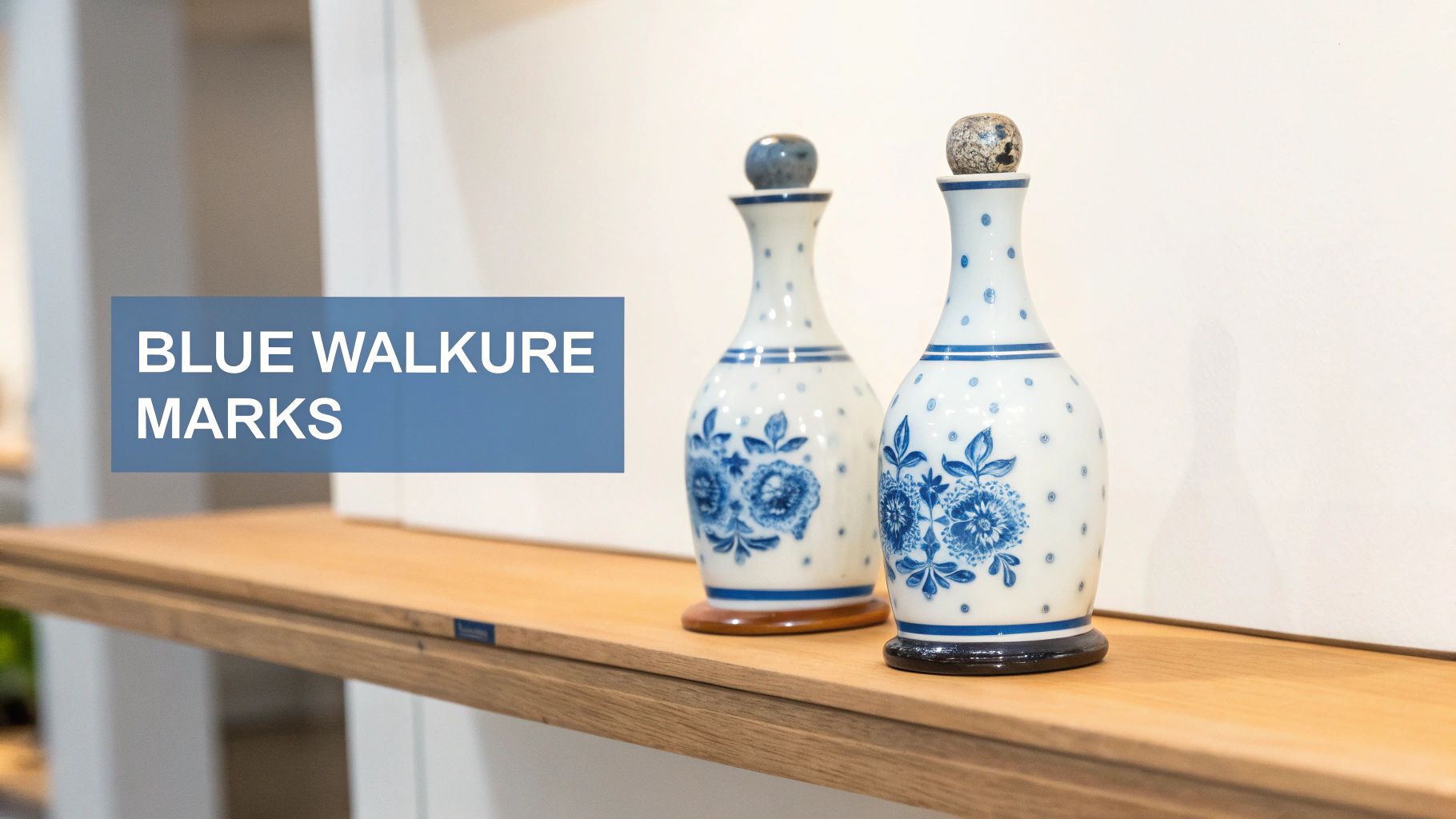
When collectors think of Royal Bayreuth, they almost always picture the famous blue underglaze mark. This is no surprise, as it stamped the pieces made during the company's golden age, which ran from about 1902 through the late 1920s. It was an incredibly prolific period, especially for the American export market, and the blue mark became the company’s signature.
While the original Tettau factory was the company's historic soul, another facility was crucial for keeping up with massive international demand. The Porzellanfabrik Walküre, established in Bayreuth by Siegmund Paul Meyer (often initialed as SPM), was instrumental in producing goods that carried the Royal Bayreuth marks abroad. This factory's work is the very reason so many people connect the brand directly with the city of Bayreuth itself.
The SPM Emblem and Its Importance
It's not uncommon to find marks from this era that include the SPM initials, a direct nod to the Walküre factory's founder. Knowing this little detail helps you understand the full story of Royal Bayreuth's production. The pieces made there were essential in making the brand a beloved name in American homes.
The Walküre factory was responsible for many of the whimsical and figural items that are now so collectible:
- Tomato, lobster, and other food-shaped creamers and sugars
- Imaginative animal pitchers, like eagles, crows, or foxes
- Elaborate scenic tapestries with pastoral or classical imagery
- Detailed portrait vases and decorative plates
This factory was a true powerhouse of German porcelain, running for a staggering 120 years, from 1899 all the way to 2019. Its history is one of incredible resilience. Production ground to a halt on March 3, 1945, due to wartime fuel shortages, but the kilns were fired up again in June 1946 with just 60 employees. You can dig deeper into this factory’s fascinating story and its role in German porcelain exports on Wikipedia.
Collector's Insight: You'll find a lot of blue-marked pieces out there because of how much was produced. Don't let that fool you, though. Their timeless charm keeps them in high demand, and rare forms or examples in perfect condition will always command top dollar.
Legacy of the Blue Mark Era
The partnership between the Tettau and Walküre factories created the legacy that most collectors associate with the brand today. That blue mark is more than just a stamp; it’s a symbol of an era when brilliant German craftsmanship and creative design perfectly met the tastes of a worldwide audience.
For anyone serious about identifying Royal Bayreuth marks, this period is the foundation. It represents the absolute peak of the company's artistic and commercial success, leaving behind a treasure trove of delightful porcelain for us to find and enjoy.
Post-War and Modern Marks: A New Direction
Everything changed for Royal Bayreuth after World War II. The company, once famous for its elaborate and imaginative figural pieces, had to adapt to a completely different world. Economic pressures and new consumer tastes meant that practical, everyday items took center stage.
This shift away from whimsical collectibles and towards mass-produced dinnerware became official in 1957. That's when the historic Tettau factory joined the Seltmann Weiden group, a move made to survive the flood of cheap Asian imports. By the 1960s, these imports dominated 70% of the affordable tableware market, forcing many German factories to consolidate or close. The "Royal Bayreuth" name, once synonymous with art porcelain, now appeared mostly on practical dinner sets. You can read more about how this trend impacted German porcelain factories on TheOldStuff.com.
Telling Vintage Art from Modern Tableware
For any collector, knowing the difference between a pre-war figural and a post-war dinner plate is absolutely essential for valuation. The backstamp is your best clue. Post-war marks are often simpler and might include phrases like "Western Germany" before the country's reunification.
The shape of the piece itself is another dead giveaway. Items from this later period are almost always plates, cups, and saucers—not the figural creamers or novelty vases that defined their golden age.
Here's what to look for on later pieces:
- Simplified Marks: The ornate blue and green marks gave way to much simpler, modern-looking stamps.
- Utilitarian Forms: Think functional dinnerware, not decorative art.
- "Made in Germany" Variations: You'll often see "Western Germany," "W. Germany," or just "Germany" on items made after 1990.
The End of an Era and How It Affects Value
The final chapter for hands-on production came with the closure of the Walküre factory in 2018, followed by the Tettau factory. After more than two centuries, the original Royal Bayreuth legacy of porcelain making came to an end. This has had a real impact on the vintage market.
With no new pieces being made in the traditional way, the value of authentic, older items has been steadily climbing.
We've seen a clear trend in the auction world since the factories closed. Post-2020 sales data shows that verified pre-war Royal Bayreuth marks are commanding premiums of 30-50%. The supply is now finite, and serious collectors know it. This is why learning to spot the difference between a modern dinner plate and an early 20th-century figural is more important than ever for building a valuable collection.
How to Spot Fakes and Reproductions

As with any popular collectible, Royal Bayreuth's charming figural pieces have attracted their fair share of reproductions and fakes. Knowing what to look for is your best defense against a bad buy. The first and most critical place to look is the Royal Bayreuth mark itself—this is where forgeries often give themselves away.
Authentic marks are almost always underglaze, meaning they were stamped before the final firing. Run your finger over it; it should feel perfectly smooth. If the mark feels raised, bumpy, or uneven in the slightest, it was likely applied over the glaze, which is a major red flag. Also, look closely at the details. A genuine stamp is crisp and clear, while a fake often looks blurry, smudged, or poorly defined, as if made from a bad copy.
Key Characteristics of Genuine Pieces
Beyond the mark, the porcelain itself has a story to tell. True Royal Bayreuth has a quality and finish that imitators find very difficult to replicate.
Here's a checklist for what to examine on the piece itself:
- Glaze Quality: Look for a smooth, lustrous, and evenly applied glaze. Be suspicious of any bubbling, drips, inconsistencies, or a finish that seems too shiny or almost plastic-like.
- Weight and Feel: Originals tend to feel delicate yet solid in your hand. Reproductions can feel clumsy and heavy, or sometimes surprisingly light, because they use different clay and firing techniques.
- Artistic Detail: The hand-painted decoration on authentic pieces is typically very fine and precise. Fakes often betray themselves with sloppy brushwork, simplified designs, and colors that lack depth and vibrancy.
A common trick is for a forger to apply a fake blue mark to a new piece of white porcelain that copies an old, desirable shape. Always ask yourself if the mark's style and era match the item's design. A piece that looks modern in style simply shouldn't have a 1902 blue mark.
Known Reproductions of Popular Forms
Some Royal Bayreuth pieces are copied far more often than others simply because they are so popular with collectors. Figural pitchers and creamers—like the famous tomato, the devil and cards, and various animal forms—are at the top of the list.
When you're looking at one of these, pay close attention to the details of the mold. Originals come from well-crafted molds and have sharp, crisp lines. Reproductions often look "soft" or blurry, with less definition in the details. Honing these skills is essential, and you can learn more by reading our general guide on how to spot fake antiques. These core principles will help you develop a confident eye for authenticity, no matter what you collect.
How Marks and Condition Affect Value
Figuring out the correct Royal Bayreuth mark is your starting line, but what collectors and sellers really want to know is how that translates into dollars and cents. A piece's real-world value is a blend of its age, rarity, specific form, and, of course, its condition. The little emblem on the bottom of your porcelain is the first major clue.
As a general rule, pieces with the earlier green underglaze marks from around 1885-1902 are harder to come by and often command higher prices. They typically fetch more than items with the more common blue marks used after 1902. It really just boils down to supply and demand—the green mark era was shorter, and fewer of those pieces have survived the last century, making them a prize for serious collectors.
Beyond the Mark Itself
While the mark sets a baseline, several other factors are just as crucial in deciding the final value. The shape or form of the piece is a huge one. Those quirky and charming figural items—like the famous tomato creamers or animal-shaped pitchers—are usually worth more than a standard dinner plate from the very same period. A rare pattern or an unusual scenic transfer can also make the price jump significantly.
And then there's condition. Condition is everything. A piece that still has its bright, original colors and is completely free of chips, cracks, or any repairs will always be at the top of the value chain. Even a tiny, hard-to-see hairline crack can slash a piece's worth by 50% or more. For a closer look at how these principles apply across different antiques, our comprehensive price guide to antique items is a great resource.
A quick note on other marks: Don't just dismiss those other little stickers or stamps you might find. Secondary marks, like an old retailer's tag or an auction sticker, don't change where the piece came from, but they do add to its provenance—its life story. A well-documented history can make an item far more interesting and valuable to a potential buyer.
A Framework for Valuation
So, how do all these pieces fit together? It helps to think about valuation as a simple checklist. First, identify the mark to get a baseline for age and rarity. Next, look at the form—is it a common teacup or a highly sought-after figural? Finally, inspect the condition with a magnifying glass if you have to.
The table below breaks down how these different factors influence what a piece might be worth.
Factors Influencing Royal Bayreuth Value
| Factor | High Value Indicator | Moderate Value Indicator | Lower Value Indicator |
|---|---|---|---|
| Mark | Early green marks (c. 1885-1902); rare variations. | Common blue marks (post-1902). | Unofficial or later "Germany" marks; modern reproductions. |
| Form | Figural items (tomatoes, animals), unique shapes, portraiture. | Standard tableware (plates, cups) with desirable patterns. | Common tableware with standard patterns; souvenir items. |
| Condition | Mint: no chips, cracks, crazing, or repairs. Vibrant colors. | Minor wear: slight gold loss, minor surface scratches. | Damaged: chips, cracks, heavy crazing, repairs, faded colors. |
| Rarity | Limited production patterns; unusual colorways or scenes. | Popular, widely produced patterns (e.g., Sunbonnet Babies). | Mass-produced, common patterns and forms. |
| Provenance | Documented history, original sales receipts, notable previous owner. | Some anecdotal history, old retailer sticker. | No known history. |
Ultimately, a rare, green-marked figural piece in perfect condition is your holy grail. On the other end of the spectrum, a common blue-marked plate with visible damage will have minimal value. By systematically checking these key elements, you can build a much more accurate picture of what your Royal Bayreuth porcelain is truly worth.
Common Questions About Royal Bayreuth Marks
Even with a detailed guide, some questions about Royal Bayreuth marks pop up again and again. I've pulled together some of the most common ones here to give you quick, straightforward answers for those tricky situations.
Think of this as your go-to spot when you're puzzling over a specific detail that isn't quite covered in the main mark charts. It's built for fast answers, whether you've been collecting for years or just found your first piece.
What Does a Number or Letter Next to a Mark Mean?
So you've spotted a small, hand-painted letter or an incised number right next to the official factory mark. It’s easy to think it’s some kind of secret code, but these secondary marks usually have nothing to do with Royal Bayreuth itself.
Most of the time, these were added by importers or big department stores for their own inventory control. While they can add a little bit of flavor to a piece's history—telling you where it might have been sold—they aren't factory date codes, pattern names, or decorator signatures. They're just a footnote, not a headline.
Are All Pieces Marked Royal Bayreuth Made in Bayreuth?
Nope, and this is a classic source of confusion. The company's story actually starts in Tettau back in 1794. The "Royal Bayreuth" brand name didn't even come into play until after 1902.
While the Porzellanfabrik Walküre factory in the city of Bayreuth made a ton of porcelain for export, production continued at the original Tettau factory. After 1957, the mark was also used on dinnerware made at other factories owned by the Seltmann Weiden group. The key takeaway? The mark represents the brand, not always the specific town it was made in.
Why Are Some Marks Green and Others Blue?
The color of the mark is one of the quickest ways to get a rough idea of a piece's age. It's a simple but effective clue.
- Green Marks: These point to an earlier production window, roughly from 1885 to 1902.
- Blue Marks: The company switched to blue around 1902, and this became the signature color for their most recognizable and productive era.
Because the green-mark period was much shorter and fewer pieces are still around, finding a genuine green Royal Bayreuth mark often means you're holding something a bit rarer and potentially more valuable.
Uncovering the history and value of your antiques can be a challenge. With the Curio app, you can get instant identification, historical context, and an expert appraisal right from your phone. Download Curio today and let your antiques tell their story!