A Teco pottery mark is more than just an identifier; it’s the signature of the American Terra Cotta Tile and Ceramic Company, stamped on the art pottery they created mostly between 1902 and the 1920s. These marks, often a simple impressed "TECO," are the key to proving a piece is genuine and figuring out its age.
But to really get what these marks mean, you first have to understand the company that made them.
The Story Behind Every Teco Mark
When you turn over a Teco vase and see that mark, you're not just looking at a stamp. You're looking at a piece of a much bigger story—one of architectural vision and artistic ambition that shaped America's Arts and Crafts movement. And funny enough, this story didn't start in an artist's studio but in the very practical world of industrial building materials.
It all began with William Day Gates. He was a lawyer with a passion for clay who saw artistic beauty where others just saw function. In 1881, he started the American Terra Cotta Tile and Ceramic Company, which at first made mundane but necessary things like drain tiles and bricks. You can dig deeper into the company's origins and impressive growth in this profile of Teco Pottery.
This industrial background was Gates's secret weapon. It gave him access to excellent clays and top-of-the-line kilns, creating the perfect playground for experimentation.
From Architecture to Art Pottery
By the late 1880s, the company was a major player in architectural terracotta, working alongside giants of the Prairie School like Louis H. Sullivan. These collaborations sparked something in Gates, pushing him to explore new frontiers in glaze technology. He started to tinker with the distinctive matte green glazes that would soon become Teco's calling card.
These experiments weren't just for buildings. Gates dreamed of a line of art pottery that followed the same design principles he admired in architecture: simple forms, organic lines, and a deep connection to nature. He wanted to create accessible "art for everyone," bringing beautiful objects into the average home.
The name "Teco" itself is a smart bit of branding, formed from the first two letters of TErra COtta. It was a clever way to tie the new art pottery line directly to its architectural and industrial origins, signaling a unique blend of artistry and durability.
A Legacy of Prolific Design
The official Teco art pottery line launched around 1902 and was an instant hit. The company did things differently. Instead of keeping a small team of artists on staff, Gates opened the doors to collaboration, working with a diverse group of architects and designers, including names like Frank Lloyd Wright and George Grant Elmslie.
This open, collaborative approach fueled an incredible burst of creativity. By 1911, Teco had produced over 500 unique designs—an astounding number that speaks to its dedication to artistic variety. The shapes varied wildly, from graceful, classic vases to striking, sculptural forms that felt more like modern art than pottery.
This is exactly why that little mark on the bottom is so crucial for collectors today. It’s the key that unlocks the story of each of those hundreds of designs, linking a piece back to a specific moment in the company's dynamic history. Every time you inspect a Teco mark, you’re reading the final signature on a chapter of American design innovation.
How to Identify Every Teco Pottery Mark
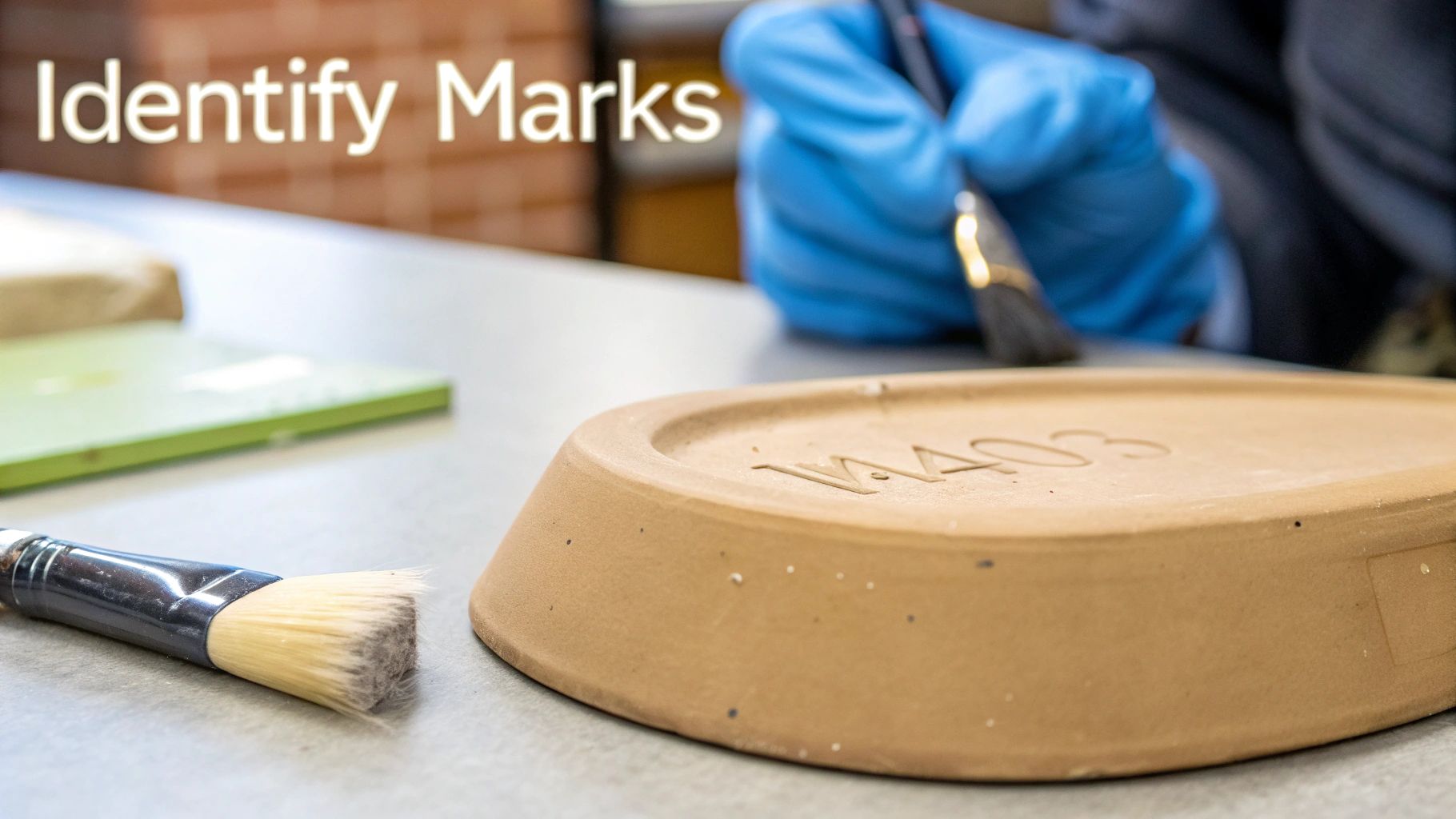
Think of a Teco mark as a time stamp from a century ago. Each variation tells a story, revealing a bit about when a piece was made and the hands that crafted it. For any Teco enthusiast, learning to read these marks is what separates a casual admirer from a knowledgeable collector.
Fortunately, Teco’s marking system is pretty straightforward. The company used just a few key designs during its prime production years, so with a little practice, you can date most pieces with confidence.
Let's walk through the main marks you're likely to find.
The Earliest Marks: Hand-Incised Signatures
The very first Teco pieces, made between roughly 1902 and 1904, often had a mark that was drawn right into the wet clay by hand. These are the most organic and personal of all the Teco marks.
- What It Looks Like: You'll see the word "Teco" scratched into the clay base. The handwriting varies wildly—it can be flowing or blocky, deep or shallow, depending entirely on who was signing off on the pot that day.
- Why It's Special: A hand-incised mark points to the company's early, almost experimental phase. Finding one is a real treat for collectors who prize the earliest examples of Teco's work.
This handmade approach didn't last long. As production grew, the company needed a consistent brand identity, which led them to create standardized, impressed marks. This shift from handmade to stamped marks is a common story in the pottery world, as you can see in our broader pottery marks identification guide.
The Classic Impressed Teco Marks
By about 1905, Teco switched to using die-stamps to press their logo into the clay. These marks are far more uniform and appear on the vast majority of Teco pottery you'll encounter.
There are two main versions you'll see:
- The Simple Impressed "TECO": This is the most common mark, featuring the four letters T-E-C-O pressed right into the base. The font is a clean, block style, with the "T" often having a slightly longer crossbar that gives it an architectural flair.
- The Rectangular "TECO" Mark: This version is the same "TECO" name, but it's enclosed within a neat rectangular border. It's a bit more formal and contained.
Both of these impressed marks were used throughout the company's peak years, from the mid-1900s into the 1920s. While there's no hard-and-fast rule, the simple impressed mark is generally seen on slightly earlier pieces than the one in the rectangle.
Collector's Insight: Pay attention to how clear the mark is. A crisp, deep impression is a sign of quality. A faint, blurry, or glaze-filled mark can be a red flag and sometimes makes it harder to be certain you have an authentic piece.
Understanding Form Numbers and Paper Labels
Beyond the main logo, other clues on the base can tell you even more about a piece.
Form Numbers
Look closely, and you'll often find a number stamped or scratched near the Teco mark. This is the form number, and it's like a model number for the pot's shape.
- What they mean: These numbers, which can be single digits or climb past 500, correspond to a specific design in the official Teco catalog.
- Why they matter: Form numbers are a collector's best friend. You can use them to look up a piece in old catalogs or online databases to confirm its design and, in some cases, who designed it. Rare form numbers can make a piece much more valuable.
Original Paper Labels
It’s believed that every piece of Teco pottery originally left the factory with a paper label. These were incredibly important because they often named the designer, like Fritz Albert or W.B. Mundie.
Unfortunately, these little gummed labels were incredibly fragile. Most were washed away or fell apart decades ago. Finding a Teco piece with its original paper label still intact is exceptionally rare and adds a huge premium to its value, as it provides an undeniable link to its creator.
To help you on your hunt, here is a quick reference table outlining the primary marks.
Teco Pottery Mark Variations and Timelines
| Mark Type | Description | Approximate Era | Associated Features |
|---|---|---|---|
| Hand-Incised "Teco" | The word "Teco" is hand-drawn into the clay. Script and depth vary. | 1902–1904 | Earliest production pieces, often experimental glazes. |
| Impressed "TECO" | The letters T-E-C-O are stamped into the clay with a block-style font. | c. 1905–1920s | Most common mark, often seen with form numbers. |
| Impressed "TECO" in Rectangle | The "TECO" name is stamped within a rectangular border. | c. 1910s–1920s | Typically seen on later production pieces. |
| Paper Label | A small, printed paper label naming the designer. | 1902–1920s | Extremely rare to find intact. Adds significant value. |
This table covers the essentials, but the fun is in finding these marks in the wild. Each one connects you directly to the artisans at the American Terra Cotta and Ceramic Company over a century ago.
The Teco Production Timeline
To really get a feel for a Teco pottery mark, you have to picture the world it came from. The company’s story isn’t a straight line. It’s a compelling tale of explosive creativity, a powerful peak, and a gradual fade shaped by sweeping historical forces. Understanding this journey is the key to knowing why some Teco pieces turn up everywhere while others are incredibly hard to find.
The story doesn't even start with art pottery. It begins with the American Terra Cotta Tile and Ceramic Company, founded way back in 1881. For nearly two decades, its founder, William Day Gates, was all about architectural materials. He was laying the groundwork for his artistic future without even knowing it. The Teco art pottery line we know and love didn't officially kick off until around 1902, and that's when things got exciting.
This early period was an explosion of fresh ideas. The years leading up to 1911 were especially creative, with the company churning out over 500 unique designs. Many of these have since become icons of the Arts and Crafts movement. This is the era that gave us some of the most desirable Teco forms, full of experimental glazes and bold, sculptural shapes.
The Peak and the Pivot
By the mid-1910s, Teco was at the top of its game. The company had perfected its signature matte green glaze and was a major player in the American art pottery scene. During these years, Teco really cemented its legacy, capturing a huge share of the market.
A huge shift happened in 1915. William Gates returned to the company, bringing with him some of his son's innovations that reportedly doubled the factory's efficiency. This pivot towards mass production allowed Teco to crank out more pottery than ever before, satisfying a public hungry for its distinctive look. It also means that pieces from this era are much more common today.
Another big move came in 1918 with the acquisition of a facility in Indianapolis, which expanded their production capacity even further. This was Teco at its zenith—a well-oiled machine sending beautiful, accessible art pottery into homes all across the country.
Timeline Insight: The rise and fall of Teco mirrors the whole American industrial art pottery boom. While the company was founded in 1881, its art pottery heyday spanned roughly thirty years, ending around 1930. In its prime, from about 1905 to 1920, Teco commanded an impressive 10-15% of the U.S. art pottery market. You can dive deeper into Teco pottery's historical context to learn more.
The Slow Decline
Even with all this success, change was in the air. By the early 1920s, tastes were starting to move away from the earthy, handcrafted vibe of the Arts and Crafts style. People were getting into the sleek, modern lines of Art Deco. The last known advertisement for Teco pottery ran in 1923, a clear sign that things were winding down.
The final nail in the coffin was the stock market crash of October 1929. The Great Depression that followed completely wiped out the market for decorative goods, and Teco couldn't escape the fallout. The Indianapolis factory was closed, and by 1930, the production of Teco art pottery was effectively over. This abrupt halt is precisely why finding pieces from the late 1920s is so rare.
Knowing this timeline completely changes how you look at a Teco pottery mark. A mark on an early, sculptural piece tells a story of artistic discovery. One on a streamlined vase from 1918 speaks to peak industrial power. And the scarcity of anything dated to the late 1920s is a direct result of a company fighting for its life against powerful economic forces. This context is what turns every Teco pot into a small but fascinating piece of American history.
How a Teco Mark Impacts Value
In the antiques game, a tiny stamp on the bottom of a pot can be the difference between a nice decoration and a five-figure investment. When it comes to Teco pottery, the mark isn't just important—it's everything. It's the ironclad proof of authenticity that separates a genuine Arts and Crafts treasure from a clever imitation.
Think of the Teco pottery mark as a certificate of authenticity baked right into the clay. For serious collectors and major auction houses, an unmarked piece is a huge gamble. A clear, legitimate mark can easily increase a piece's value by 90% or more compared to an identical but unmarked counterpart. Why? Because it erases all doubt and provides a direct, verifiable link back to William Day Gates's innovative workshop.
The Mark as a Seal of Authenticity
At its core, a Teco mark’s job is simple: authentication. It confirms you're holding a genuine piece of American art pottery history, not a modern reproduction or something made "in the style of" Teco. This guarantee is the foundation upon which all other value is built.
Without that mark, proving a piece's origin becomes a forensic exercise. Experts have to rely on subtle clues in the glaze, the feel of the clay body, and the specifics of the form. While seasoned pros can sometimes attribute unmarked pieces with confidence, the market overwhelmingly favors the certainty that an impressed “TECO” provides.
A crisp, deeply impressed Teco mark is the gold standard. It tells you the piece was carefully finished and inspected before it ever left the factory. On the flip side, a faint, blurry, or glaze-filled mark can sometimes lower the value simply because it introduces that tiny sliver of uncertainty.
How Different Marks Influence Price
While the mere presence of a mark is huge, the specific type of mark can also move the price tag. An early, hand-incised "Teco" from the 1902-1904 period, for instance, is a real prize. It signals one of the earliest, most experimental pieces from the company's formative years, which is a massive draw for specialized collectors.
The distinct marks on Teco pottery are absolutely critical in a market where top-tier Arts and Crafts pieces command serious money. You'll see marked Teco vases from the prime 1902-1920 era regularly fetch $1,500-$10,000 at auction. The truly rare forms can soar past $50,000, and it's the mark that gives bidders the confidence to go that high. You can dive deeper into Teco's production history and its market impact to see how this evolved.
Beyond the Mark: Form Numbers and Designer Clues
Other elements stamped alongside the Teco name can dramatically boost a piece's worth.
- Form Numbers: A clear form number is a massive asset. It allows you or an appraiser to cross-reference the vase with original Teco catalogs, confirming its design, date, and rarity. A common form number might put a vase in the $1,500 range, but a rare, highly sculptural form could easily push its value into the tens of thousands.
- Designer Association: The holy grail for any collector is a piece tied to a famous designer. While original paper labels are almost unheard of today, a documented form number designed by an architect like Frank Lloyd Wright or George Grant Elmslie elevates a piece to the absolute highest tier. These "starchitect" pieces can command $50,000 to $100,000 or more at auction.
The table below breaks down what to look for when you're trying to gauge a piece's potential value.
Factors Affecting Teco Pottery Value
| Factor | Low Value Indicator | High Value Indicator | Market Impact |
|---|---|---|---|
| Mark Authenticity | No mark, blurry, or obscured mark | Clear, crisp, deeply impressed mark | The single most important factor. A clear mark removes doubt and dramatically increases buyer confidence and price. |
| Designer Link | Common, undocumented form | Form number attributed to a famous architect (e.g., Frank Lloyd Wright) | The ultimate value multiplier. "Starchitect" pieces are the most sought-after and command the highest prices. |
| Form Rarity | Common, simple, widely produced shape | Rare, sculptural, complex, or large-scale form | Unique and architectural forms are highly coveted. Rarity drives competition among serious collectors. |
| Glaze Quality | Uneven application, common green glaze | Exceptional matte green, rare curdled "charcoaled" glaze, or unique color | While Teco's matte green is iconic, exceptional or rare glazes add significant value and visual appeal. |
| Condition | Chips, cracks, hairlines, or restoration | Pristine, original condition with no damage or repairs | Damage will always reduce value, no matter how rare the piece. Condition is paramount. |
Ultimately, condition is still king. A rare piece with a great mark will always be devalued by chips, cracks, or clumsy repairs. If you need a starting point, using an antique value estimator can give you a rough idea of what your piece might be worth.
Spotting and understanding a Teco pottery mark is the first step in a much larger valuation puzzle. It’s the key that unlocks a piece's history, confirming it’s the real deal and allowing you to properly assess its form, rarity, and designer pedigree. This is where your knowledge transforms a simple pot into a documented piece of art with a clear, and often significant, market value.
How to Spot Fakes and Alterations
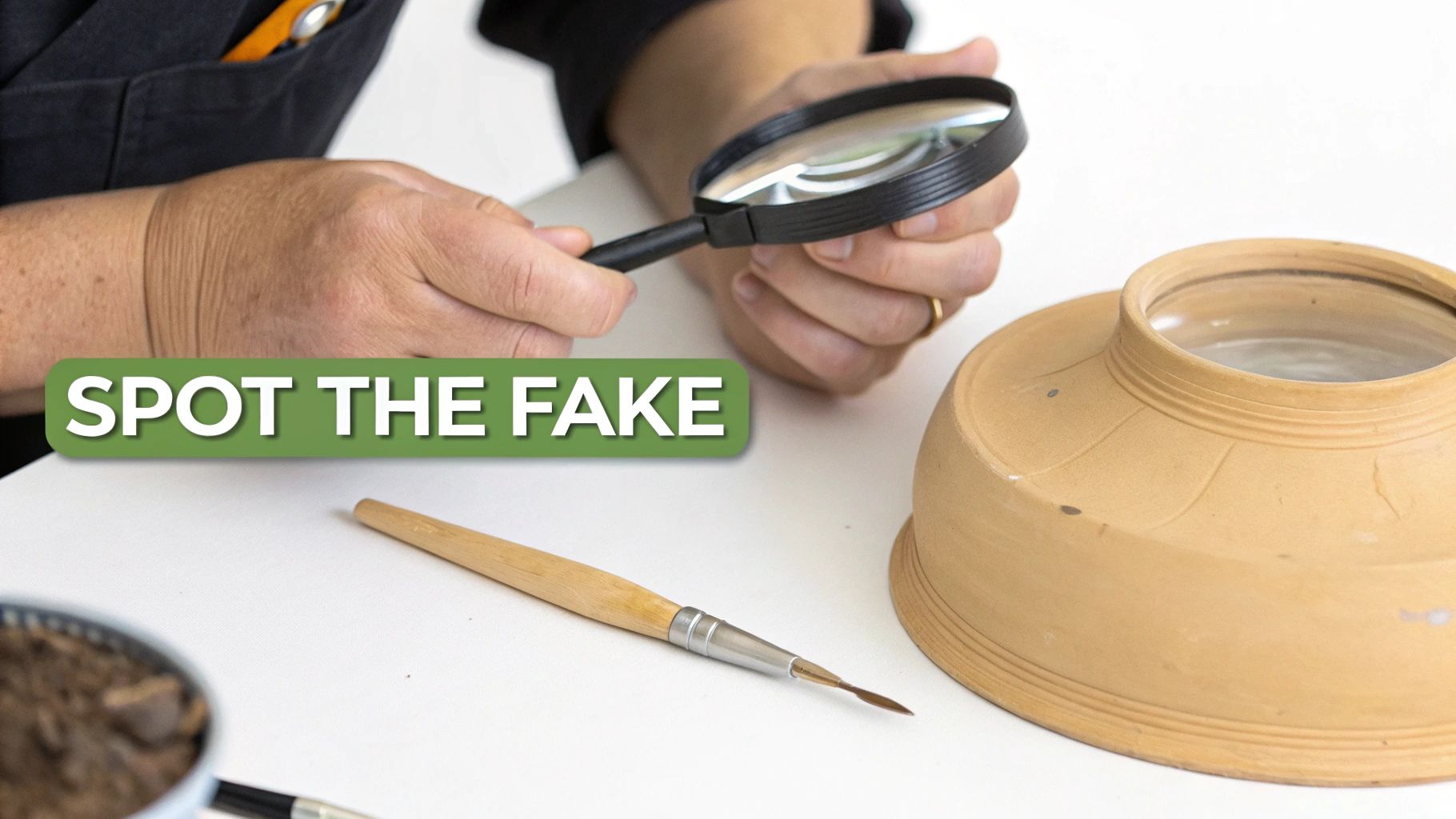
As Teco pottery's value has climbed, so has the incentive for forgeries and clever repairs. A fake mark or a hidden restoration can quickly turn a prized discovery into a very expensive mistake. The best way to protect yourself is to develop a sharp eye for the little things that just don't add up.
The first place to look, of course, is the Teco pottery mark itself. A forger can get close, but they often mess up the small details. Be on the lookout for sloppy impressions, fonts that look slightly off, or marks that seem carved into a fired piece instead of being pressed into wet clay.
An authentic mark should look like it's part of the pot—crisp, clean, and integrated into the base. A fake often looks too sharp, sits too shallowly on the surface, or just doesn't match the age and wear of the rest of the piece.
Beyond the Mark: Examining the Pottery Itself
Even if the mark seems perfect, the pot itself has its own story to tell. Forgers really struggle to nail the unique feel of Teco's materials and glazes. Over time, you need to train your hands and eyes to know the difference between a real Teco and a convincing look-alike.
Start with the clay body. Genuine Teco pottery was made from a specific buff-colored clay found in Illinois. Flip the piece over and look at any unglazed clay on the foot rim. If it's bright white, reddish, or a dark brown, that’s a huge red flag.
Next, get a feel for the iconic matte green glaze. An original Teco glaze feels smooth, almost waxy, never rough or overly glossy. It also has subtle, beautiful variations in color—pooling a bit thicker and darker in the crevices and appearing thinner on raised edges. A flat, uniform color that looks painted on is a dead giveaway of a reproduction.
A common sign of age on authentic art pottery is crazing—a fine web of tiny cracks in the glaze. While not every genuine piece has it, its presence is often a good sign of age that fakers find very difficult to replicate convincingly.
Spotting Hidden Repairs and Restorations
A piece can be 100% authentic but have its value tank because of undisclosed repairs. Good restoration work can be incredibly hard to find, but you have a fighting chance if you know what to look for.
Here are the most common alterations to watch for:
- Filled Chips and Cracks: Restorers use colored epoxy to fill chips and hide hairline cracks. Slowly run your fingertips along the rims and edges. You can often feel a slight change in texture where a repair has been made.
- Reglazing: Sometimes, a heavily damaged piece is completely reglazed to hide the evidence. A reglazed pot often feels too slick, lacks the original's texture, and the new glaze might obscure the Teco mark or make it look blurry.
- UV Light Inspection: A blacklight is a non-negotiable tool for any serious collector. Under UV light, modern glues, paints, and epoxies used in repairs will usually glow a different color—often a bright white or purple—than the original pottery. It's the fastest way to uncover hidden work.
Learning these inspection techniques takes practice, but it's an essential skill. For more general advice, our guide on how to spot fake antiques offers great tips that apply across all kinds of collectibles. By looking beyond the mark and learning to read the piece as a whole, you can buy with much more confidence.
Your Teco Questions, Answered
Once you get past the basics, the world of Teco pottery is full of nuance. It's those tricky "what if" scenarios that often separate a good find from a great one. Let's tackle some of the most common questions that pop up for collectors, both new and seasoned.
Think of this as your field guide for handling the exceptions. We’ve covered the core history and marks, but these answers will help you think like a true expert when you're faced with a piece that doesn't neatly fit the mold.
Does Every Real Teco Piece Have a Mark?
This is the big one, and for good reason. The short answer is no, not every single piece that came out of the factory received a mark. You'll sometimes find very early or experimental pieces that were created before the company really locked down its branding process.
However—and this is a big "however"—the market expects a mark. A clear, authentic Teco pottery mark is the gold standard for authentication. A piece without a mark, even if it looks right, is shrouded in doubt. That uncertainty dramatically lowers its value. Collectors and auction houses pay for certainty, so an unmarked piece will nearly always sell for a small fraction of what its marked counterpart would command.
Expert Tip: Glaze is a mark’s worst enemy. Before you write a piece off as unmarked, get it under a bright light and examine the base from every angle. It's surprisingly common for a thick drip of that classic matte green glaze to completely or partially fill in the impressed mark. A little extra scrutiny can make all the difference.
What’s the Most Valuable Teco Mark?
This is a bit of a trick question. It’s a common myth that one version of the Teco mark is automatically more valuable than another. The truth is, the value is in the pot, not the stamp. The piece's form, its glaze, its condition, and—most critically—its designer are what drive the price tag.
The mark's job is to prove it's the real deal and place it in the correct time period. An early, hand-incised "Teco" on a rare, architectural vase designed by someone like Frank Lloyd Wright would obviously be part of a multi-thousand-dollar package. But the value comes from the vase itself.
What really matters is clarity. A crisp, easy-to-read mark of any authentic type is always better than a faint or sloppy one. And if you find a rare form number stamped next to the mark? That’s a huge bonus, as it directly links the piece to Teco’s historical catalogs and can significantly boost its value.
How Can I Tell if a Teco Green Glaze Is Original?
That iconic Teco matte green is one of the most imitated glazes in American art pottery. To tell a real one from a reproduction, you have to use your eyes and your hands.
- Feel the Texture: An authentic Teco matte glaze feels uniquely smooth and waxy, almost like velvet. If a glaze feels rough, gritty, or overly glossy (unless it’s a rare gloss-glazed example), your fake-dar should be going off.
- Look for Color Depth: The original glaze is almost never a flat, uniform green. A real Teco piece will have subtle variations in color, shifting from a light chartreuse to a deep olive. You’ll see the glaze pool and darken in the crevices while it appears thinner on the high points. Reproductions rarely capture this beautiful, organic quality.
- Look for Signs of Age: Crazing—that fine network of tiny cracks in the glaze's surface—is a fantastic sign of age. It's a natural result of the pottery expanding and contracting over a century, and it’s something forgers find almost impossible to replicate convincingly.
Where Can I Find Good Resources to Verify a Teco Mark?
You can’t be an expert in a vacuum. Building a solid reference library is crucial for making smart buying decisions and avoiding costly mistakes. When you need to cross-reference a Teco pottery mark, here are the best places to turn:
- Reference Books: The definitive guide for any serious collector is Teco: Art Pottery of the Prairie School by Sharon S. Darling. It's considered the bible on the subject.
- Auction House Catalogs: Major auction houses that specialize in American art pottery, like Rago Arts or Treadway Gallery, have incredible online archives. Their past catalogs are a treasure trove of high-resolution photos, including crystal-clear shots of marks on pieces they’ve authenticated.
- Collector Communities: Don't underestimate the power of community. Online forums and groups like the American Art Pottery Association (AAPA) are full of knowledgeable collectors who are often happy to share their expertise.
- Professional Appraisals: If you think you have a particularly valuable piece, nothing beats a professional appraisal. An expert who specializes in the American Arts and Crafts movement can give you the most reliable authentication and valuation.
Uncovering the history and value of your finds shouldn't be a mystery. With Curio, you get an antique expert in your pocket. Just snap a photo to instantly identify your items, learn their stories, and get an estimated value. Download the app today and let your antiques tell their story. Find out more at https://www.curio.app.