Trying to figure out what a Toby jug is worth can feel like a guessing game. You might see one for under $50 at a flea market, while another fetches over $5,000 at a high-end auction. So, what's the secret? It all boils down to four things: its age, who made it, how rare it is, and what kind of shape it’s in. An early, flawless jug from a master potter will always outshine a common, damaged one from a modern factory.
What Really Determines a Toby Jug's Value
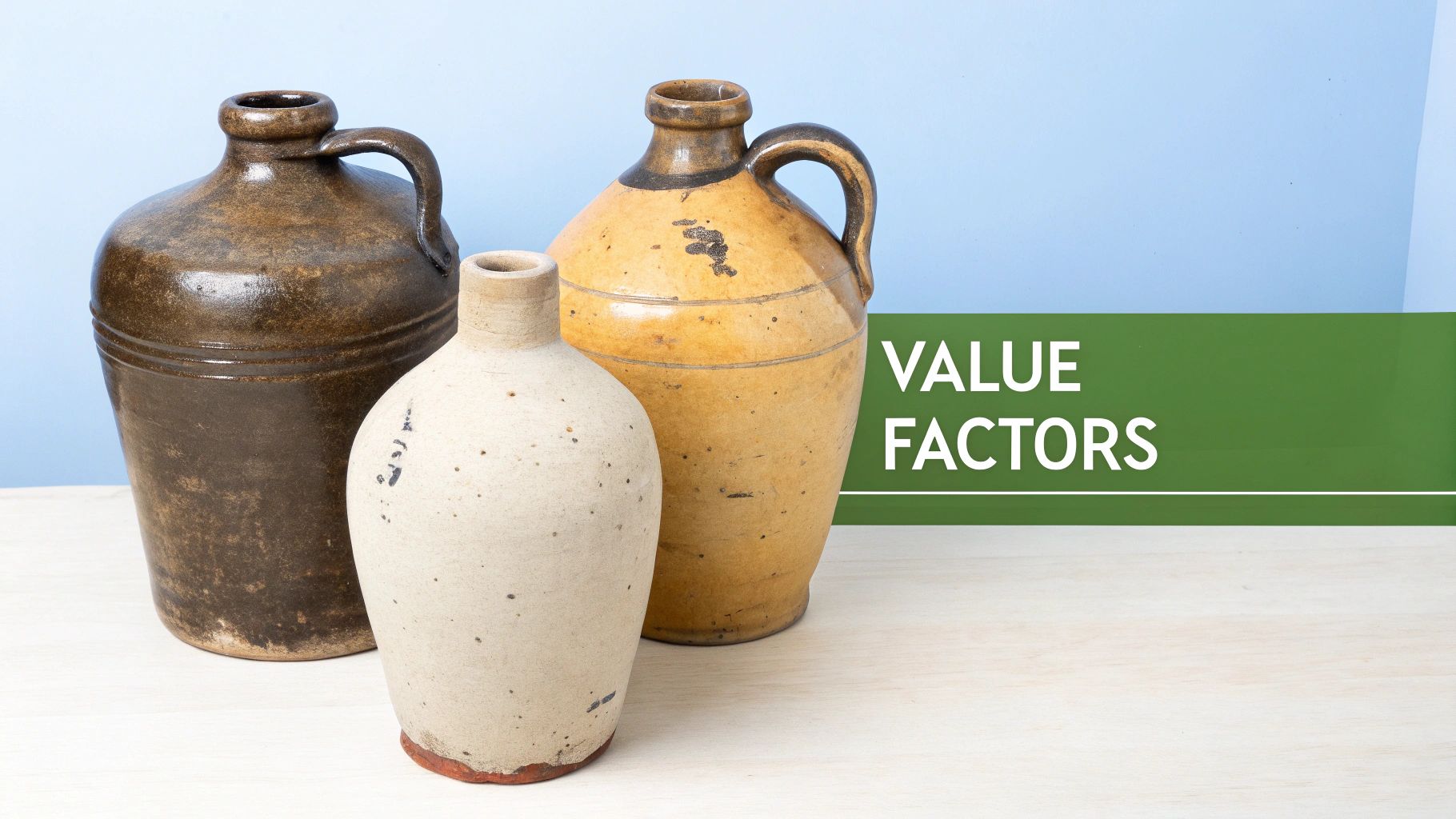
Ever look at two Toby jugs that seem almost identical and wonder why one is worth a fortune and the other isn't? The answer lies in a blend of history, artistry, and physical condition. Collectors and appraisers have a keen eye for these details, and learning what they look for is the first step to understanding what you have in your hands.
Think of it like appraising a classic car. A 1960s Ford Mustang, all original parts and in pristine condition, is a collector's dream. A modern replica, or even a classic that's rusted out with a swapped engine, just doesn't have the same pull—or price tag. Toby jugs are no different. The closer a jug is to its original glory and the fewer of its kind that exist, the more valuable it becomes.
The Four Pillars of Valuation
To get a real sense of a Toby jug's value, you need to look at it from four different angles. Each one tells part of the story, and together they create a full picture of what a piece is worth.
These are the key things that separate a treasured heirloom from a simple ceramic knick-knack:
- Age and Maker: Who made it and when? An 18th-century jug from a legendary Staffordshire potter like Ralph Wood is in a completely different ballpark than a mass-produced piece from the 1980s.
- Rarity and Scarcity: Was this a one-off, part of a small batch, or one of thousands? Nothing drives up a price like the simple fact that there aren't many to go around.
- Condition: How has it held up over the years? Any chips, cracks, or clumsy repairs can tank its value. In fact, significant damage can slash a jug's worth by more than 90%, even if it's a rare model.
- Provenance: Does the jug have a story? A documented history of ownership, especially if it’s tied to a notable collection, can add a surprising amount to its final price.
A common mistake is getting hung up on just one thing, like its age. A truly valuable Toby jug needs to tick multiple boxes. It’s that magic combination of age, rarity, and top-notch condition that makes collectors reach for their wallets.
Quick Guide to Toby Jug Value Factors
This might seem like a lot to remember, but it’s pretty logical once you get the hang of it. To make things easier, here’s a quick-reference table that breaks down what to look for when you're sizing up a Toby jug.
| Value Factor | High-Value Indicators | Low-Value Indicators |
|---|---|---|
| Maker | Early Staffordshire (e.g., Ralph Wood), Royal Doulton prototypes | Unmarked, modern mass-producers, souvenir-grade makers |
| Age | 18th or early 19th century | Late 20th century to present day |
| Condition | Mint, no chips, cracks, or restoration | Obvious chips, hairline cracks, heavy crazing, poor repairs |
| Rarity | Limited editions, unusual colorways, prototypes, early models | Mass-produced, common character designs |
Use this guide as your starting point. It’s a great way to quickly assess whether you’re holding a charming trinket or a potential treasure.
The Makers and History That Drive High Prices
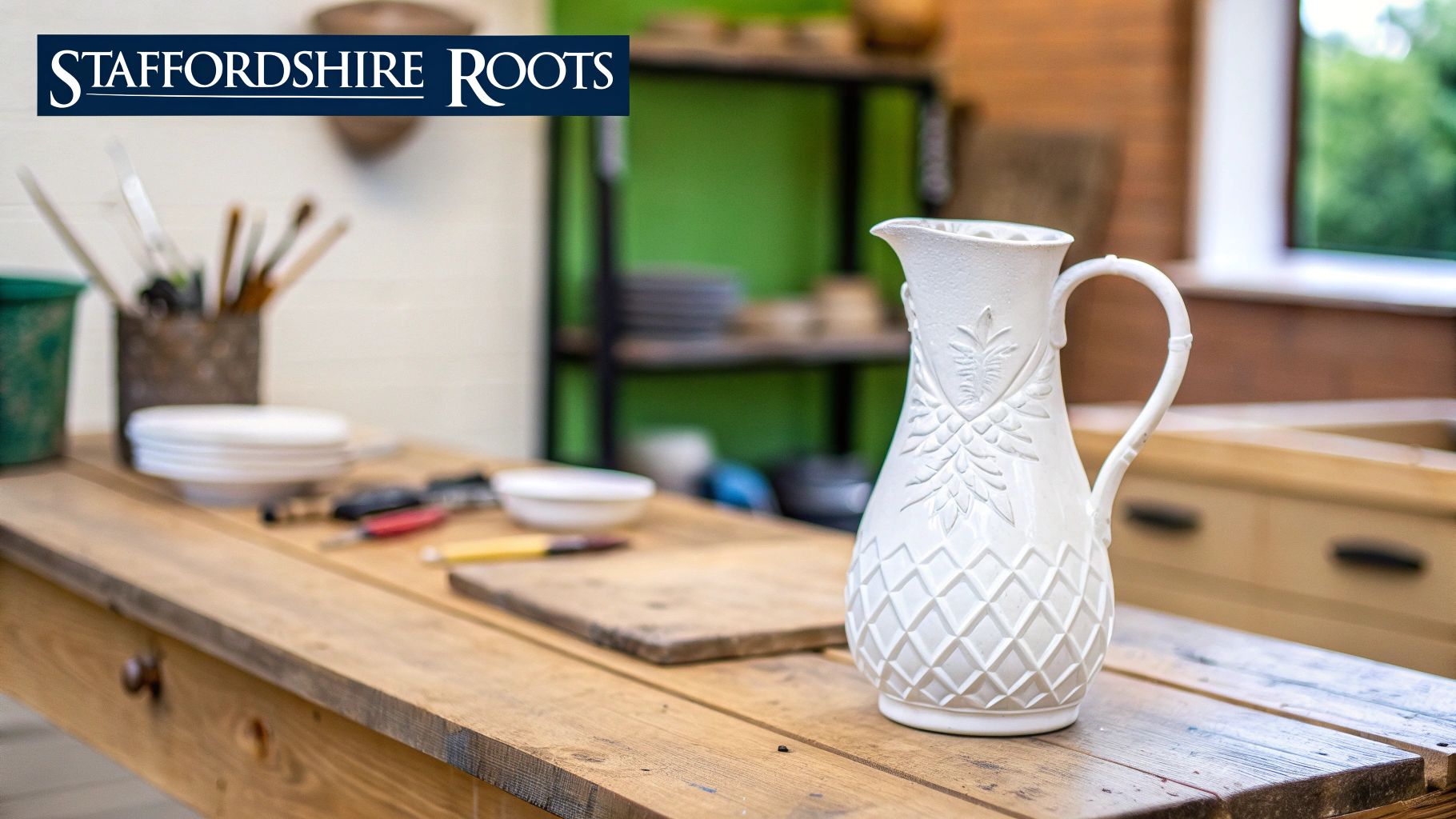
If you really want to understand what makes a Toby jug valuable, you have to travel back in time. The history of these quirky ceramic figures isn't just a fun backstory; it's a treasure map that points directly to their worth. In fact, a jug's origin—who made it, when they made it, and where—is almost always the biggest factor in its price tag.
Think of it like the art world. An original Picasso is going to be worth infinitely more than a beautiful painting by a talented modern artist. It’s the same with Toby jugs. A jug crafted by a pioneering 18th-century potter will always command more respect, and a higher price, than a mass-produced piece from a hundred years later. The maker's name is everything.
It all started around the 1760s in the Staffordshire Potteries, the heart of England's ceramic industry. These were originally just beer mugs, but their charm quickly made them popular as decorations. The first jugs, often showing a jolly man with a pipe and a pint, were based on popular characters of the day. You can get a great deep dive into how early pottery influences modern value on potteriesauctions.com.
The Staffordshire Originals: The Holy Grail
The very first, and most prized, Toby jugs came out of Staffordshire. Potters like Ralph Wood are practically legends in this world. His jugs are the holy grail for serious collectors, celebrated for their rustic charm and unique colored glazes.
These 18th-century originals were all made by hand, which means every single one has its own subtle quirks. The glazes often had a soft, almost translucent quality that you just don't see in later, more uniform productions. Finding an authentic Ralph Wood or a piece from one of his peers is incredibly rare, and their prices absolutely reflect that.
For a collector, an original Staffordshire jug is the art form at its purest. These weren't made for a mass market; they were individual expressions of a potter's skill, making them feel more like folk art sculptures than simple drinking vessels.
Royal Doulton and the Character Jug Revolution
Fast forward to the 20th century, and the world of Toby jug collecting was completely transformed, thanks mainly to one iconic company: Royal Doulton. In the 1930s, Royal Doulton breathed new life into the market by introducing "character jugs." These were different because they focused just on the head and shoulders of famous people, fictional characters, and other archetypes.
While a traditional Toby jug shows a full seated figure, these character jugs captured everyone's imagination with their bright colors and incredible detail. Royal Doulton’s art director, Charles Noke, was the genius behind this new wave, and he kicked off a collecting craze that went on for decades.
This was a game-changer. It created a much more accessible entry point for new collectors. An 18th-century Staffordshire original might be out of reach for most, but a limited-edition Royal Doulton from the 1950s was a piece of the legacy that people could actually own.
Key Makers and Their Impact on Value
The name stamped on the bottom of a jug can tell you almost everything you need to know about its potential value. While countless potteries have made Toby jugs over the years, a few names always rise to the top.
- Ralph Wood (and Family): The originals, the pioneers. Their 18th-century Staffordshire jugs are cherished for their age, scarcity, and one-of-a-kind glazes. It's not uncommon for verified pieces to sell for thousands of dollars.
- Whieldon and Wedgwood: Working around the same time as Wood, these master potters also produced incredible early jugs. Their work is highly collectible, carrying immense historical weight and financial value.
- Royal Doulton: The brand that introduced character jugs to a whole new generation. While many common Doulton jugs are quite affordable, rare prototypes and limited editions can fetch shocking prices, sometimes exceeding $5,000. For instance, a jug that was discontinued shortly after release, like "The Clown" (White Hair) D6322, is now a hot-ticket item for collectors.
Knowing these makers is the first and most important step. It's the difference between finding a neat piece of decorative pottery and uncovering a valuable antique with a rich, documented story.
How to Identify and Date Your Toby Jug
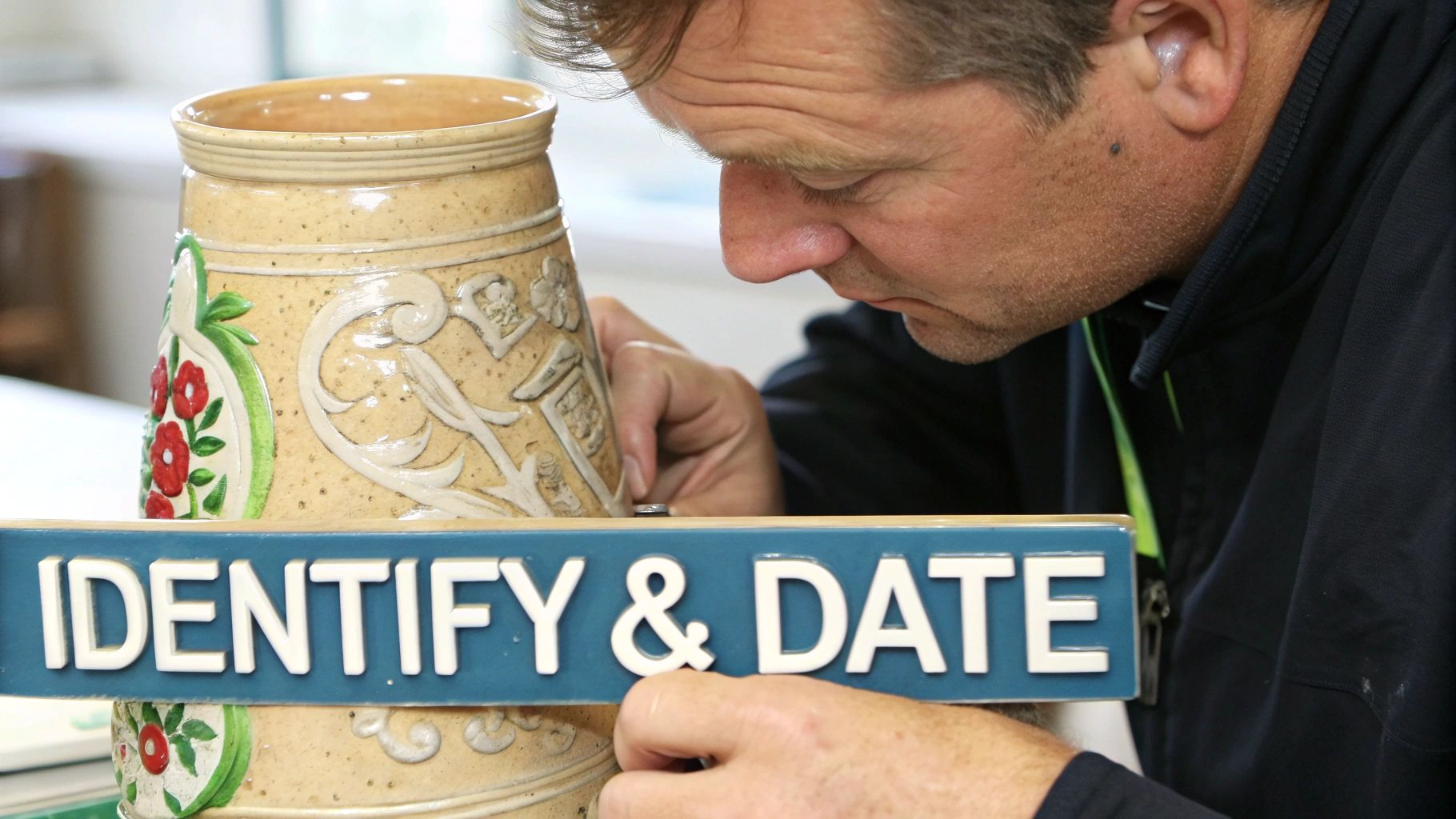
To really get a handle on your Toby jug's value, you have to play detective. Every jug has a story to tell, with clues hidden in plain sight. Learning to read these signs—from the potter’s signature on the bottom to the style of the paint—is the first real step in figuring out if you have a common flea market find or a genuine antique.
Think of it like piecing together a puzzle. The maker's mark tells you who made it, the style gives you a timeframe, and the physical feel of the piece can reveal its authenticity. Once you combine these clues, you start to get a clear picture of your jug's history and, ultimately, its worth.
Start with the Bottom: The Maker's Mark
The single most important clue is almost always on the base. Carefully turn your jug over and look for any marks that are impressed, printed, or even handwritten. This backstamp is the potter's signature, and it can tell you the maker and often the rough production date.
Royal Doulton, for example, used a very specific marking system that evolved over time. A jug from the early 1900s might have a lion and crown emblem, while later ones feature a much simpler mark. The phrase “Made in England” is a great clue, telling you the piece was made after 1891. To get more comfortable spotting these details, our pottery marks identification guide is a fantastic resource.
Think of the maker's mark as a birth certificate for your pottery. A clear, well-documented mark provides a direct link to the manufacturer's history, immediately placing your jug within a specific time and context, which is essential for valuation.
But don't panic if you find no mark at all. Many of the earliest—and most valuable—Staffordshire jugs from the 18th century were completely unmarked. For these pieces, you'll need to rely on the physical clues from the jug itself.
Examine the Style and Construction
Beyond a simple stamp, the jug has its own story to tell. How it was made and decorated can shout its age from the rooftops. Early Toby jugs just feel different from their 20th-century cousins.
Keep an eye out for these key characteristics:
- Glaze and Finish: The earliest Staffordshire jugs often have a soft, lead-based glaze that might feel a little uneven to the touch. Later pieces, especially from the Victorian era onward, tend to have a harder, shinier, and more uniform finish.
- Painting Style: Was the color put on by hand, or is it a transfer print? Hand-painting was the standard for older pieces and will always show slight imperfections and brush strokes. Transferware, a method for applying a printed pattern, gained steam in the 19th century and has a much more precise look.
- Modeling and Detail: Take a look at the sculpting. Jugs from the 1700s often have a charming, slightly rustic quality with softer features. By contrast, Royal Doulton character jugs are famous for their sharp, highly detailed, and crisp modeling.
For instance, an old jug might have a slightly "smudged" appearance where the colored glazes bled into each other during firing—that’s a classic hallmark of early production methods.
Putting It All Together: A Practical Checklist
Identifying a Toby jug is a process of elimination. You’re looking for clues that either confirm or rule out a certain maker or era. Use this checklist to guide you.
- Check the Base: Is there a mark? Is it pressed in, printed on, or handwritten? Make a note of any names, symbols, or numbers you see.
- Assess the Weight and Clay: How does it feel in your hands? Older pottery is often surprisingly heavy and dense for its size. Look at any unglazed parts, like the bottom rim, to see the actual color of the clay.
- Analyze the Decoration: Note the color palette. Early potters used a limited range of earthy colors like browns, greens, and ochres. The bright, vibrant colors seen on many Royal Doulton jugs came much later.
- Evaluate the Form: Are you looking at a full-figure Toby jug or just a head-and-shoulders character jug? This is a critical distinction that points to different time periods and makers.
By working through these steps methodically, you’ll go from just looking at a jug to truly understanding it. That knowledge is the foundation for determining its real value.
Assessing Condition and Rarity

Alright, so you've figured out the maker and maybe even the decade your Toby jug was born in. Now for the two factors that really make or break its value: condition and rarity. These two work hand-in-hand. An incredibly rare jug with a massive crack might fetch less than a more common one that's absolutely pristine.
On the flip side, a perfect but mass-produced jug isn't going to command the prices of a scarce, well-preserved antique. Getting a feel for this balance is really the key to understanding why some jugs are worth a small fortune and others are just charming decorations.
Your Collector's Checklist for Condition
When collectors talk about "mint condition," they mean it looks like it just came out of the kiln yesterday. In the world of ceramics, even small flaws can cause the value to plummet, sometimes by 75% or more. This is why you need to play detective.
Grab a good light and a magnifying glass, and give your jug a thorough once-over. Here’s what to look for:
- Chips and Cracks: The usual suspects are the most vulnerable spots—the rim of the hat, the tip of the nose, and the handle. Run your finger gently along these edges; you can often feel a tiny chip before you see it.
- Hairline Cracks: These are sneaky, spidery cracks in the ceramic itself. A good trick is to hold the jug up to a bright light. You can also give it a gentle tap with your knuckle; a dull thud instead of a clear, bell-like ring often signals a hidden fracture.
- Crazing: This is that network of fine cracks you see in the glaze, not the actual pottery. A little bit of light crazing is often expected on very old pieces and can be forgiven. But heavy, dark, or stained crazing is a serious flaw.
- Restoration: Good repairs can be almost invisible, but bad ones are a disaster. Look for subtle differences in paint color, sheen, or texture. Obvious glue lines or mismatched paint can unfortunately render a jug almost worthless to a serious collector.
There's a common belief that a bit of wear and tear just adds to an antique's charm. While that might be true for an old wooden chest, it's a death sentence for ceramics. Collectors pay top dollar for perfection.
Spotting a skillful repair can be tough. Learning how to spot fake antiques can give you a leg up, as many of the same techniques for identifying fakes apply to uncovering hidden restorations.
What Makes a Toby Jug Truly Rare?
Rarity is the other side of the coin. It's simple supply and demand—if tons of people want something that’s hard to find, the price goes up. But what makes one jug rare and another common isn't always obvious at first glance.
A jug’s scarcity might be because it was a prototype that never went into mass production. Or perhaps it was part of a very small run for a special event. Sometimes a particular color or glaze was only used for a short time before the factory changed it, making those early versions highly sought-after.
Unpacking Scarcity and Demand
Take Royal Doulton, for example. They made millions of character jugs, and you can pick up many common ones for a song. But find a prototype of a character like 'Marilyn Monroe' or 'Neil Armstrong', and you're talking thousands of pounds. Why? Because only a few were ever made for internal review.
Here are the main drivers of rarity that can send a Toby jug's value through the roof:
- Prototypes: These are the holy grail. As one-of-a-kind test pieces, they are the rarest and most valuable versions of any design.
- Limited Editions: Jugs made in a specific, numbered batch are automatically more desirable than their mass-produced cousins.
- Unusual Colorways: A jug briefly produced in a different color scheme is a prize for collectors trying to complete a full set. These "variations" can be worth many times more than the standard version.
- Early and Discontinued Models: Jugs from a potter's early days, or designs that were quickly pulled from the market, are naturally rarer because fewer have survived. The Royal Doulton "The Clown" (White Hair) D6322, for instance, was only made for five years. That makes it far more valuable than a jug that was in production for decades.
In the end, it’s the combination of pristine condition and genuine rarity that separates a $20 flea market find from a piece that becomes the star of a major auction.
Understanding Real Market Prices
Alright, we've covered what makes a Toby jug special—its age, condition, and rarity. Now for the fun part: what are they actually worth? It’s crucial to look past the hopeful asking prices you see online and focus on what people are really paying.
A seller can list a jug for $500, but that means nothing until someone actually buys it for that price. The key is digging into completed sales records. Think of it this way: the sticker price on a car isn't always what it sells for. You want to know the final, negotiated price. It's the same principle here. It's interesting to see how demand and condition impact resale value in different markets, a concept that applies across many collectibles.
Finding the True Market Value
So, where do you find this "sold" data? Luckily, the best tools are often right at your fingertips. They cut through the noise and show you what's really happening in the market.
Here’s where experienced collectors look for reliable price information:
- eBay's "Sold Items" Filter: This is your best friend. Search for a specific Toby jug, then click the "Sold Items" filter. This shows you exactly what buyers have paid recently, not what sellers are hoping to get. It’s raw, real-world data.
- Auction House Results: Major auction houses like Christie's and Sotheby's, as well as pottery specialists, publish their final hammer prices. This is the gold standard for valuing high-end, rare, and antique pieces.
- Subscription-Based Price Guides: Sites like WorthPoint are fantastic resources. They compile sales data from hundreds of auction sites and online marketplaces, giving you a historical view of an item's value.
Using these sources helps you ground your expectations in reality, not speculation. For more valuation tips, you can explore our price guide to antique collecting.
Sample Toby Jug Value Ranges
To give you a clearer picture, let's look at some typical price ranges. Remember, a common modern jug might fetch less than dinner for two, while a rare 18th-century original could be worth a small fortune. The spectrum is huge.
The table below gives you a general idea of what to expect for different categories of Toby jugs.
| Toby Jug Category | Typical Value Range (USD) |
|---|---|
| Common 20th Century (Post-1960) | $20 - $75 |
| Mid-Century Royal Doulton (Common) | $50 - $150 |
| Early 20th Century (Uncommon) | $150 - $400 |
| 19th Century Staffordshire | $400 - $1,500+ |
| 18th Century Staffordshire Originals | $2,000 - $10,000+ |
| Rare Prototypes & Limited Editions | $3,000 - $15,000+ |
This is just a starting point, of course. A pristine example from a lower tier could easily outperform a damaged one from a higher tier. Condition is everything.
Real World Examples of High-Value Sales
To see what's possible at the very top of the market, it helps to look at some record-breaking sales. Prototypes, in particular, show just how high prices can go when extreme rarity is involved.
The value of Toby jugs can range from less than $50 to well over $5,000. For example, a prototype 'Neil Armstrong The Astronaut' Toby jug sold for approximately £3,900 in 2021, followed by rare prototypes of Marilyn Monroe and Winston Churchill fetching £3,100 and £3,400 respectively in 2022. Discover more insights about these remarkable Toby jug values on truelegacyhomes.com.
These sales are a powerful reminder of what collectors are willing to pay for those truly one-of-a-kind pieces. While your average jug won't hit these numbers, it proves that incredible treasures are still out there waiting to be found.
Frequently Asked Questions About Toby Jug Value
Once you start looking into Toby jugs, a bunch of questions always seem to come up. It happens whether you're a new collector staring at a flea market find or a seasoned pro managing a collection. Getting the details straight can be tricky, so this section is here to give you quick, clear answers to the most common questions.
Think of this as your go-to reference. We've already walked through the big principles—age, maker, condition, and rarity—but these are the real-world scenarios you’ll actually run into.
What Is the Difference Between a Toby Jug and a Character Jug?
This is the big one. A lot of people use the terms interchangeably, but they're two completely different things, and that difference is a huge deal for their value. Nailing this distinction is the very first step to figuring out what you have.
A traditional Toby jug shows a full figure, usually a stout man sitting down with a mug of ale and a pipe. It captures a whole scene. On the other hand, a character jug is just the head and shoulders of a person or character. Royal Doulton famously made this style popular back in the 1930s, and it kicked off a collecting craze that's still going strong.
While they're related, they play in different sandboxes. An 18th-century, full-figure Toby jug is valued for its raw history and rustic charm. A Royal Doulton character jug? Its value is all about the specific model number, how many were made, and how popular that character is.
Is It Worth Repairing My Chipped Toby Jug?
Ah, the classic collector's dilemma. The short answer is almost always: it depends on what the jug is worth. Professional restoration doesn't come cheap, so you have to treat it as a financial decision. A botched repair job can absolutely tank a piece's value, making a bad situation even worse.
Here’s a simple way to think about it:
- For High-Value Jugs: If you’re holding a rare 18th-century Staffordshire piece worth thousands, then yes, professional restoration is definitely on the table. A skilled conservator can stabilize the jug and make the damage almost invisible, which can preserve or even boost its market value.
- For Low-Value Jugs: If your jug is a common, mass-produced piece from the late 20th century, the repair bill will almost certainly be higher than the jug's value. In that case, it’s best to just embrace the chip as part of its story.
Before you do anything, talk to an appraiser. They can give you the hard numbers: the jug's value as-is versus its potential value after restoration. That's how you make a smart call.
How Can I Spot a Fake or Modern Reproduction?
Spotting a fake is all about developing an eye for things that just don't feel right. Reproductions often look "too perfect," or they're just plain sloppy. They're missing those subtle signs of age and handcrafted quality that scream "authentic."
Keep an eye out for these red flags:
- The Glaze and Color: Fakes often have a super bright, uniform, and unnaturally glossy finish. Real, early glazes usually have a softer look and might show tiny imperfections or color variations.
- The Maker's Mark: Flip the jug over and check the base. A genuine mark from a maker like Royal Doulton will be crisp and clear. Fakes often have blurry, poorly stamped, or just plain wrong markings.
- Weight and Feel: Old pottery, especially from the 18th and 19th centuries, just feels different—it has a certain density. If a supposedly old jug feels surprisingly light, that’s a major warning sign.
- Modeling Detail: Look closely at the face and clothes. Authentic pieces show real skill and artistry. Reproductions often have soft, mushy details that look clumsy in comparison.
Where Is the Best Place to Sell My Toby Jugs?
Picking the right place to sell is crucial for getting the best price. Your choice should really depend on the quality and value of what you're selling.
For high-end, rare, and antique jugs, your best bet is a specialized auction house. These places have a direct line to serious collectors around the world who are ready to compete and pay top dollar for the good stuff. This is where you'd take that 18th-century Staffordshire original.
For common to mid-range jugs, online marketplaces like eBay and Etsy are fantastic. They give you access to a massive audience of potential buyers. The trick is to do your homework: check eBay's "sold" listings to set a fair price, take great photos, and write a detailed, honest description.
Finally, you can always go to local antique dealers, especially if you need to sell quickly. Just remember, they’re running a business. They have to buy low enough to make a profit, so you should expect a wholesale offer, which will be quite a bit less than its retail value.
Feeling overwhelmed by a box of inherited jugs or curious about a thrift store find? Let Curio do the detective work for you. Just snap a photo, and our app instantly identifies your Toby jug, provides historical context, and gives you a reliable appraisal. Download Curio today and uncover the stories and value hidden in your collection.