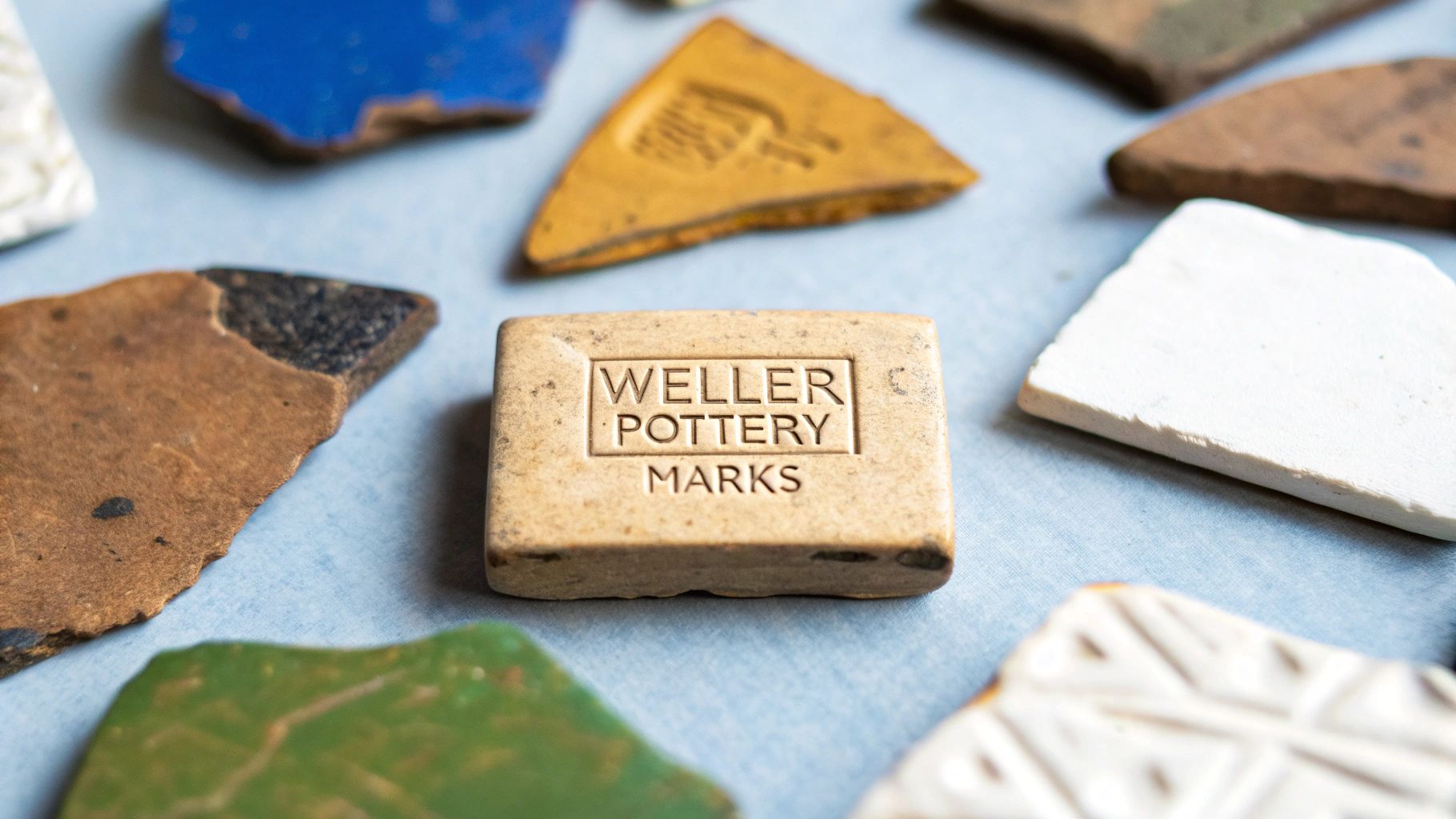
Figuring out Weller pottery marks is the first step every collector takes. These little symbols are like a secret code, telling you everything about a piece's age, history, and ultimately, its value. Think of this guide as your decoder ring—a visual catalog that walks you through every mark, from the early hand-carved signatures to the factory stamps used later on. Knowing these marks is the key to getting your authentication and valuation right.
Your Essential Guide to Identifying Weller Pottery Marks
This guide is built to be a go-to reference for anyone interested in Weller pottery, whether you're a serious collector, a reseller hunting for treasure, or just curious about a piece you own. We'll trace the evolution of Weller's marks, starting with the unique, hand-incised signatures from the late 1800s and moving all the way through the standardized stamps and in-mold marks of its later years. For instance, an early Louwelsa vase might have a flowing, hand-etched signature, while a Woodcraft log planter from the 1920s will likely have a crisp, die-impressed seal.
Getting a handle on these subtle shifts is the single fastest way to date and authenticate your pottery with confidence. I’ve organized this guide chronologically, so you can easily compare your piece to detailed photos from each era. Whether you're trying to make out a faded ink stamp or a bold in-mold signature, you'll find the context you need right here.
From Humble Beginnings to an Industry Giant
The story of Weller's marks is really the story of the company itself. Samuel Augustus Weller started his pottery in 1872 in Fultonham, Ohio, making simple stoneware like jars and flowerpots. It was a pretty small-time operation until he moved to Zanesville in 1882. That’s when things really took off.
By then, he had 68 potters working at the original Putnam factory. Just 12 years later, in 1894, that number had jumped to 175, a testament to Weller's meteoric rise in the crowded Ohio art pottery scene. You can discover more insights about Weller's early growth and its impact on American art pottery. This explosive growth meant they had to standardize how they marked their wares, which led to the incredible variety of marks we see today.
How to Use This Guide
Before you dive deep, the table below gives a quick overview of the major marking periods. It's a great starting point to help you narrow down the era of your piece. Find the mark type that looks closest to yours, then jump to the detailed section for a closer look.
Quick Reference Guide to Major Weller Mark Eras
| Mark Type | Era | Common Lines Associated |
|---|---|---|
| Hand-Incised Script | Pre-1900 | Louwelsa, Lonhuda, Dickens Ware |
| Die-Impressed Seals | 1900s–1920s | Hudson, Eocean, Sicard, Aurelian |
| Ink Stamps | 1920s–1930s | Forest, LaSa, Knifewood |
| In-Mold Marks | 1930s–1948 | Woodcraft, Sabrinian, Mammy |
This table should give you a solid footing. Now, let's get into the specifics of each mark and what they tell us.
Early Hand-Incised Marks: The Pre-1900s Era
The very first Weller pottery marks are a beautiful reflection of the Arts and Crafts philosophy that championed handmade quality. Before 1900, you won't find many clean, stamped logos. Instead, most marks were incised—scratched by hand right into the wet clay before the piece ever saw a kiln. This gives every mark a personal touch that collectors really look for today.
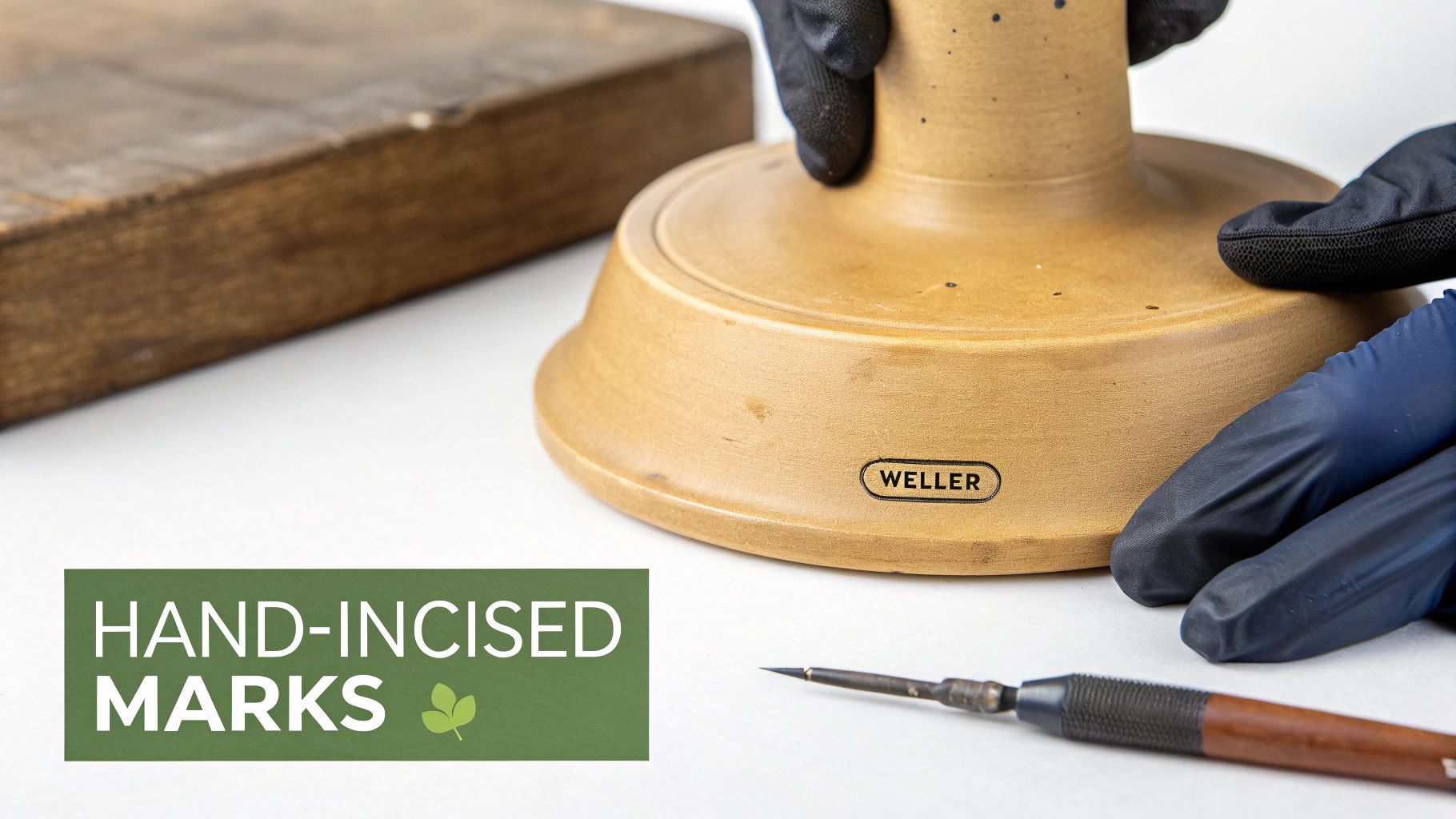
These early signatures often include the "Weller" name in a graceful script, sometimes with the specific pottery line or even the initials of the artist who decorated it. Because they were all done by hand, expect to see a lot of variation. The handwriting, pressure, and placement can change from one piece to the next, even if they're from the same line.
Identifying Key Incised Marks
Learning to spot authentic early marks takes a bit of practice. You're looking for a signature that feels organic and fluid, not something that looks like it was mechanically stamped. A true incised mark will have a V-shaped groove in the clay, which is the classic sign of a sharp tool being dragged through it.
Here are the big three hand-incised marks from this foundational period:
- Lonhuda Faience Mark (1895-1896): This one's tied to Weller's very brief partnership with William Long of Lonhuda. You'll usually see an incised "Lonhuda" along with a shape or pattern number. With such a short production run, these pieces are quite scarce.
- Louwelsa Weller Mark (1896-1924): Probably the most iconic of the early lines. Louwelsa pieces often have a flowing, incised "Louwelsa Weller" script. It's also very common to find artist ciphers on these high-quality, hand-painted vases, which adds significantly to their value.
- Dickens Ware Mark (Late 1890s-Early 1900s): The first and second lines of Dickens Ware are typically marked with "Dickens Ware Weller" incised on the bottom. These pieces are famous for their sgraffito designs of characters from Charles Dickens' novels.
Collector's Insight: A hand-incised mark, especially one accompanied by an artist's signature, almost always signals a higher-quality and more valuable piece. These marks create a direct connection to the person who made it—a tangible link to Weller's artistic roots.
What to Look for in Early Pieces
When you're looking at a potential pre-1900s Weller pot, the glaze and form tell you a lot. Early lines like Louwelsa and its lighter-bodied cousin, Aurelian, are known for their deep, glossy brown glazes and stunning floral or portrait paintings. The shapes are also a giveaway—look for classic vases, ewers, and jardinières that were all the rage in the late Victorian era.
Here's a great tip: an authentic incised mark will often have glaze pooled inside the letters. This is a dead giveaway that the mark was made before the piece was glazed and fired, a crucial detail that forgers frequently get wrong. When you're in the field, apps like Curio can be a huge help for comparing a potential find against a database of verified examples.
The Golden Age Stamped and Die-Impressed Marks
As Weller Pottery rolled into the 20th century, their production absolutely exploded. They were no longer a small, artisan-led workshop; they were becoming a mass-production powerhouse. This growth meant the old way of marking pieces—inconsistent, hand-incised signatures—just wouldn't cut it anymore. So, from about 1900 to the late 1920s, Weller shifted to standardized weller pottery marks that were stamped right into the clay.
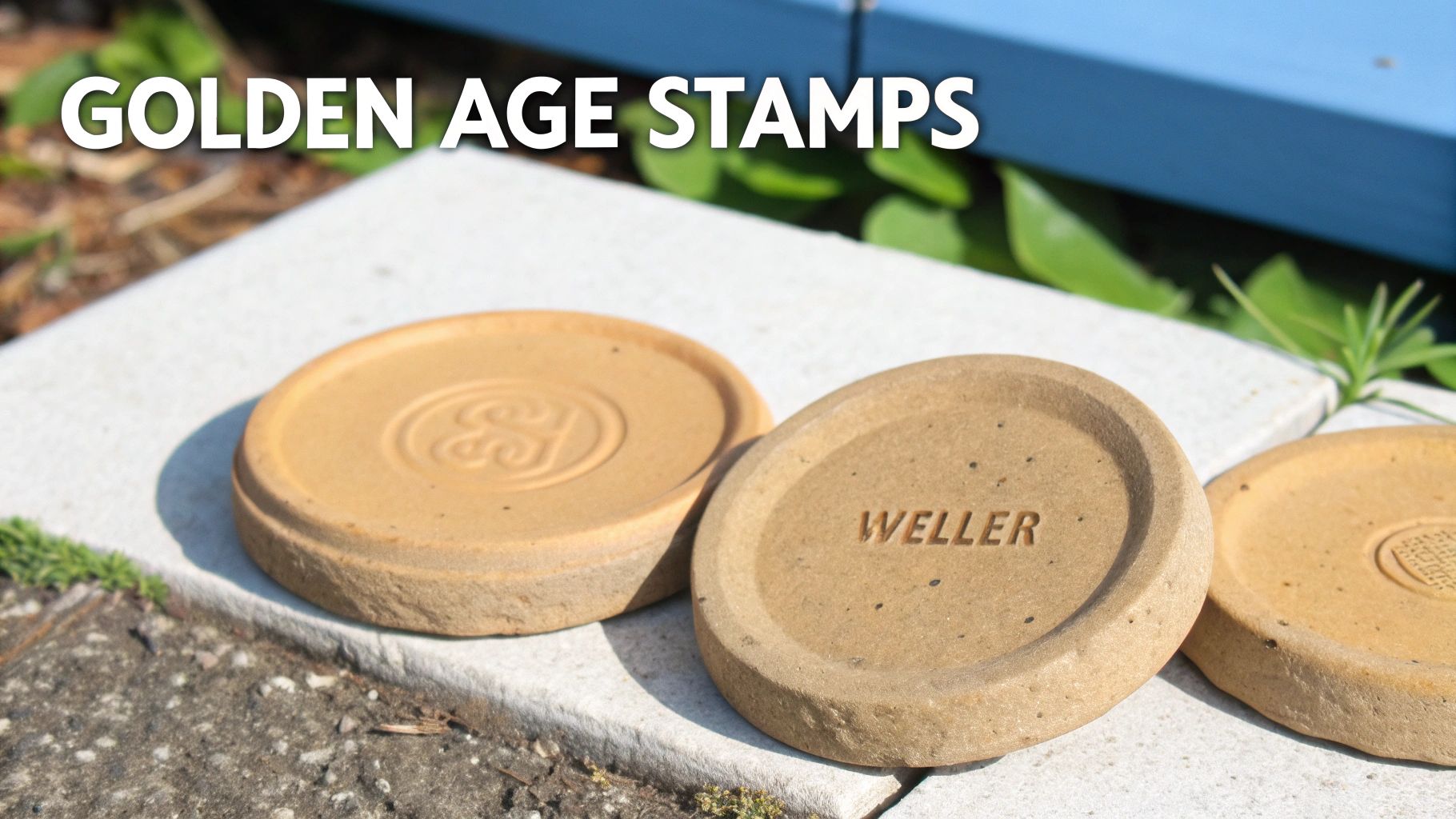
These new, impressed marks were all about consistency and building a recognizable brand. Suddenly, buyers could easily spot a genuine Weller piece on a store shelf. For collectors today, these stamps are gold. They're the best clues we have for dating pottery from this incredibly productive "Golden Age." The specific style, clarity, and depth of a stamp can tell you a surprising amount about when and where a piece was made.
Common Die-Impressed and Stamped Marks
During this boom period, a few key marks started showing up everywhere. Unlike the earlier hand-signed pieces, these marks were pressed into the soft clay with a die, leaving a clean, uniform impression. You'll almost always find them on the bottom of vases, bowls, and jardinières.
The marks you'll run into most often from this time include:
- The Full Circular Seal: This is the one everyone thinks of. It's a simple circle with "WELLER" in block letters inside. This mark is the hallmark of major lines like Aurelian, Eocean, and Hudson.
- The Half-Circle Seal: Basically a variation of the above, with "WELLER" stamped in an arc. It was used right alongside the full circle mark, often on the very same lines.
- "Weller" Block Letters Stamp: Just what it sounds like—the company name stamped in a straight line of capital letters. This straightforward mark typically shows up on their utility ware and some of the middle-period art lines.
The evolution of Weller's marks tells a story, moving from simple hand-scrawled signatures before 1900 to the standardized stamps that came later. For example, early Louwelsa vases might have a hand-incised mark, but later ones will almost certainly have the circular seal. This is a huge help for dating pieces on the fly, whether you're at a flea market or using an app like Curio to identify your finds.
Authentication and Variations
When you're looking at these stamped weller pottery marks, the little details matter. A real mark should have sharp, clear lettering, although the depth of the impression can vary. Don't be too concerned if a thick glaze has pooled and partially filled in the mark—that's a common and perfectly acceptable thing to see.
Expert Tip: If you find a piece with both a die-impressed factory mark and an artist’s incised initials, you've likely got a high-quality item. This combination tells you it was a standard production piece that was then singled out for special, hand-decorated work.
Knowing these factory marks inside and out is crucial. A lot of other potteries in the Ohio Valley used similar marking styles during that era. For more practice, it’s worth checking out our guide on identifying Camark pottery marks, as comparing different makers helps train your eye to spot the subtle details that scream "Weller."
Later Period Script and In-Mold Marks
As Weller Pottery moved into the mid-1920s and headed toward its final years, the way it marked its wares changed dramatically. The crisp, die-stamped seals of its glory days gave way to much simpler methods, driven by the need to speed up production and cut costs, especially with the Great Depression looming. This final chapter, lasting until the factory closed in 1948, is defined by two main types of Weller pottery marks: handwritten script marks and marks made directly in the mold.
The handwritten marks from this era are a far cry from the careful, hand-incised signatures of early artists. Instead, decorators would simply write "Weller" in a flowing script using ink or glaze. It was quick, it was easy, and it got the job done. You’ll see these script marks, sometimes with an artist's initials nearby, on many lines from the mid-1920s through the 1930s.
The Rise of In-Mold Efficiency
To streamline things even further, Weller began building the mark right into the pottery molds. This was the ultimate time-saver. The "Weller" name became a raised part of the pot itself, completely eliminating the extra step of stamping or signing each piece by hand.
These in-mold marks are almost always the word "Weller" in a simple, blocky, all-caps font. It's the go-to mark for many of the popular late-period lines that featured matte glazes and folksy, rustic, or novelty shapes.
- Warwick Line: Known for its classic forms and solid-color glazes, Warwick pieces almost always have a raised, in-mold "Weller" on the bottom.
- Sabrinian Line: Look for the in-mold block letter mark on this line, famous for its unique sea-green and coral textured glazes.
- Novelty Items: Because they were mass-produced, countless figural pieces, planters, and quirky items from the 1930s and 1940s bear this efficient in-mold signature.
This period was a tough one for Weller. The company dealt with a massive factory fire in 1927 and had to pivot from high-end art pottery to more practical items like tiles and beer mugs just to stay afloat. The marks tell that story perfectly—they’re functional, no-frills, and built for a company trying to survive. You can discover more insights about Weller's final chapter and the marks of its decline on artpotteryblog.com.
The table below breaks down some key lines from this era, helping you connect the pottery you find with its likely mark and market value.
Characteristics of Late-Period Weller Lines
| Line Name | Typical Mark Type | Common Forms & Glazes | Collector Notes |
|---|---|---|---|
| Warwick | In-mold block "Weller" | Classic vases, bowls; Smooth, solid matte glazes in greens, blues, and creams. | Common but desirable. Rare colors like red or black command a premium. |
| Sabrinian | In-mold block "Weller" | Urns, vases, wall pockets; Textured sea-green or coral "seafan" glaze. | Highly collectible. Large or unusual forms are particularly sought after. |
| Bonito | Script "Weller" | Vases, bowls, flower frogs; Hand-painted floral designs on a soft, blended background. | Moderate value. Pieces with intricate, well-executed artwork are more valuable. |
| Forest | In-mold block "Weller" | Vases, jardinières, hanging baskets; Realistic tree and woods scenes in relief. | Very popular and collectible. Strong mold detail and crisp glaze are key. |
| Novelty/Figural | In-mold block "Weller" | Animal figures, planters (frogs, squirrels), themed items. | Value varies widely. Condition is everything. Intact, complex figures are valuable. |
This reference should give you a solid starting point for identifying pieces from Weller's later, more production-focused period.
Valuation Note: Generally, pottery from this later era is more affordable and easier to find than the early art lines. However, don't dismiss it! Certain lines like Forest, large Sabrinian forms, or Warwick pieces in rare colors are highly coveted. The clarity of an in-mold mark can also be a great clue to a piece's condition and a sharp mold.
Decoding Artist Signatures and Other Symbols
Beyond the standard factory marks, some of the most exciting finds in the Weller world are the signatures and symbols left by individual artists. Spotting an artist's cipher is a real thrill—it transforms a piece from a beautiful factory product into a documented work of art. As you might expect, these personal marks can send a piece's desirability and value soaring.
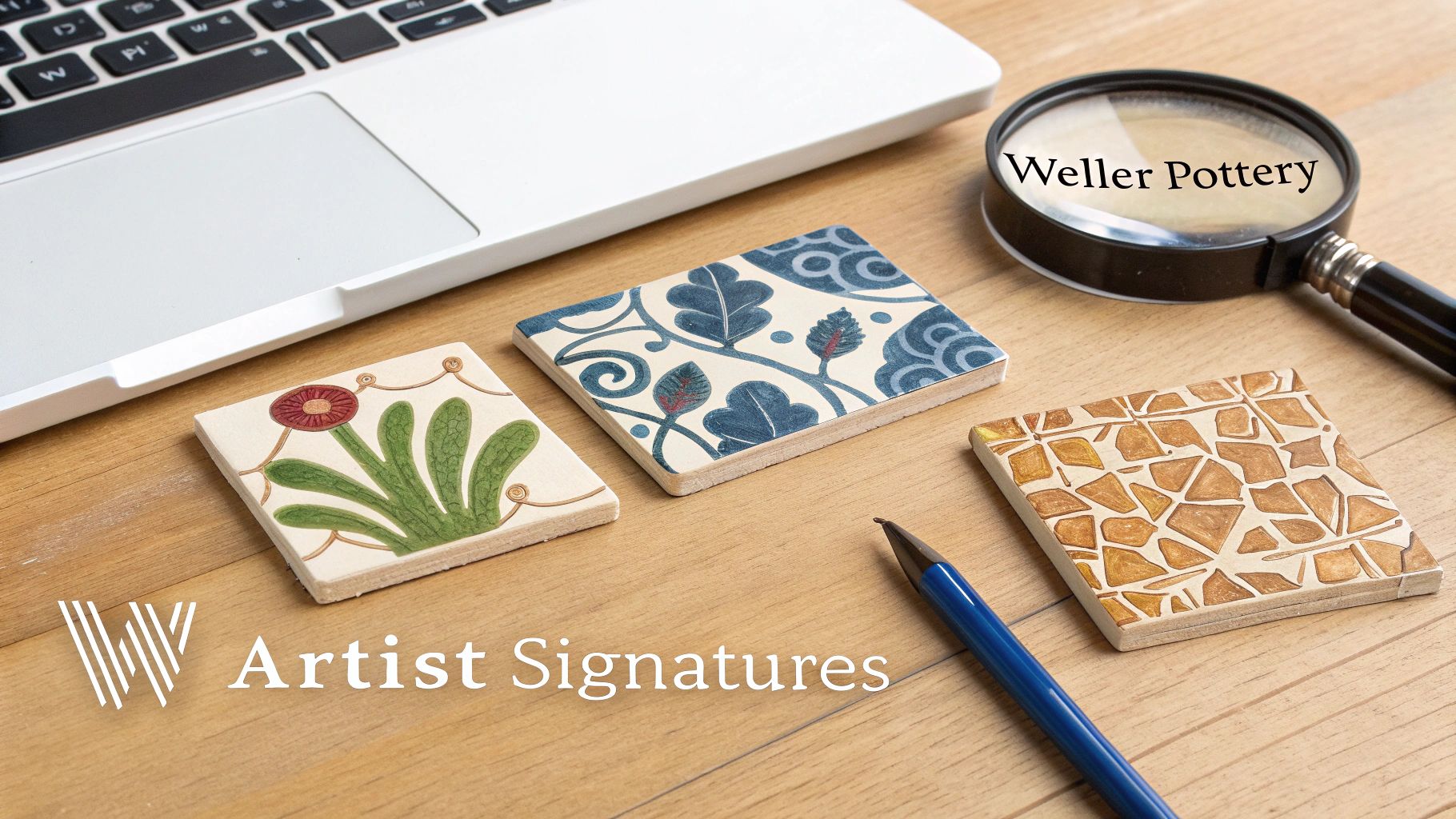
A key skill for any serious collector is learning to tell a valuable artist signature from a simple decorator's tally mark. Artist ciphers are typically incised initials, monograms, or even full names. You'll usually find them near the main factory mark on the higher-end, hand-decorated lines like Louwelsa, Eocean, and Hudson, confirming the piece was finished by one of Weller's most talented hands.
Key Artist Signatures to Know
Weller employed many gifted artists over the years, but a handful of names really stand out. Learning to recognize their marks is the first step to spotting a truly top-tier piece of pottery.
- Frederick Hurten Rhead: A giant in the pottery world, Rhead served as Weller's art director. His incised "FHR" mark appears on early, high-quality experimental pieces from his brief tenure around 1903-1904. His work is incredibly rare and highly sought after.
- Jacques Sicard: Known for the mesmerizing iridescent Sicard line (1902-1907), his pieces are almost always signed. Look for a flowing, handwritten "Sicard," often accompanied by "Weller," right in the glaze.
- Hester Pillsbury: Famous for her delicate and detailed floral painting, particularly on the Hudson line. Her clean, incised "HP" monogram is a true mark of quality.
- Dorothy England Laughead: Her distinctive "DL" cipher is a common sight on beautifully decorated Eocean and Aurelian wares.
Collector's Tip: An artist-signed piece of Weller can easily be worth 25-50% more than an unsigned one from the very same line. The premium depends on the artist's reputation and the execution of the artwork, so always flip a piece over and look closely for these small but mighty marks.
Differentiating Artist and Decorator Marks
Now, it's important to remember that not every initial scrawled on the bottom of a Weller pot is a famous artist's signature. The factory employed hundreds of decorators, and they often used simple initials or symbols as internal production codes—basically, a way to track their work and get paid.
How to Tell the Difference
| Feature | Artist Signature/Cipher | Decorator's Mark |
|---|---|---|
| Appearance | Often a well-practiced monogram, full name, or distinct set of initials. | Usually a simple, single letter, a number, or a basic symbol like a dot or cross. |
| Placement | Typically placed with care, often near the primary factory mark. | Can seem randomly placed on the base, sometimes appearing rushed. |
| Associated Lines | Found on premier art lines like Louwelsa, Hudson, and Sicard. | Common on more mass-produced, simpler floral lines. |
Getting a feel for these subtle differences is crucial. When you find what might be a signature, take a moment to cross-reference it with a list of known artist ciphers. That's how you'll know for sure if you're holding a standard production piece or a valuable, artist-attributed treasure.
How to Authenticate Marks and Spot Fakes
Telling a real piece of Weller from a well-made fake is a skill every collector needs to develop. The mark is your starting point, of course, but forgeries are out there. Your best defense is knowing what to look for beyond just the stamp. Forgers often get tripped up on the little things—the specific feel of the clay, the texture of the glaze, and even the simple heft of a vase in your hands.
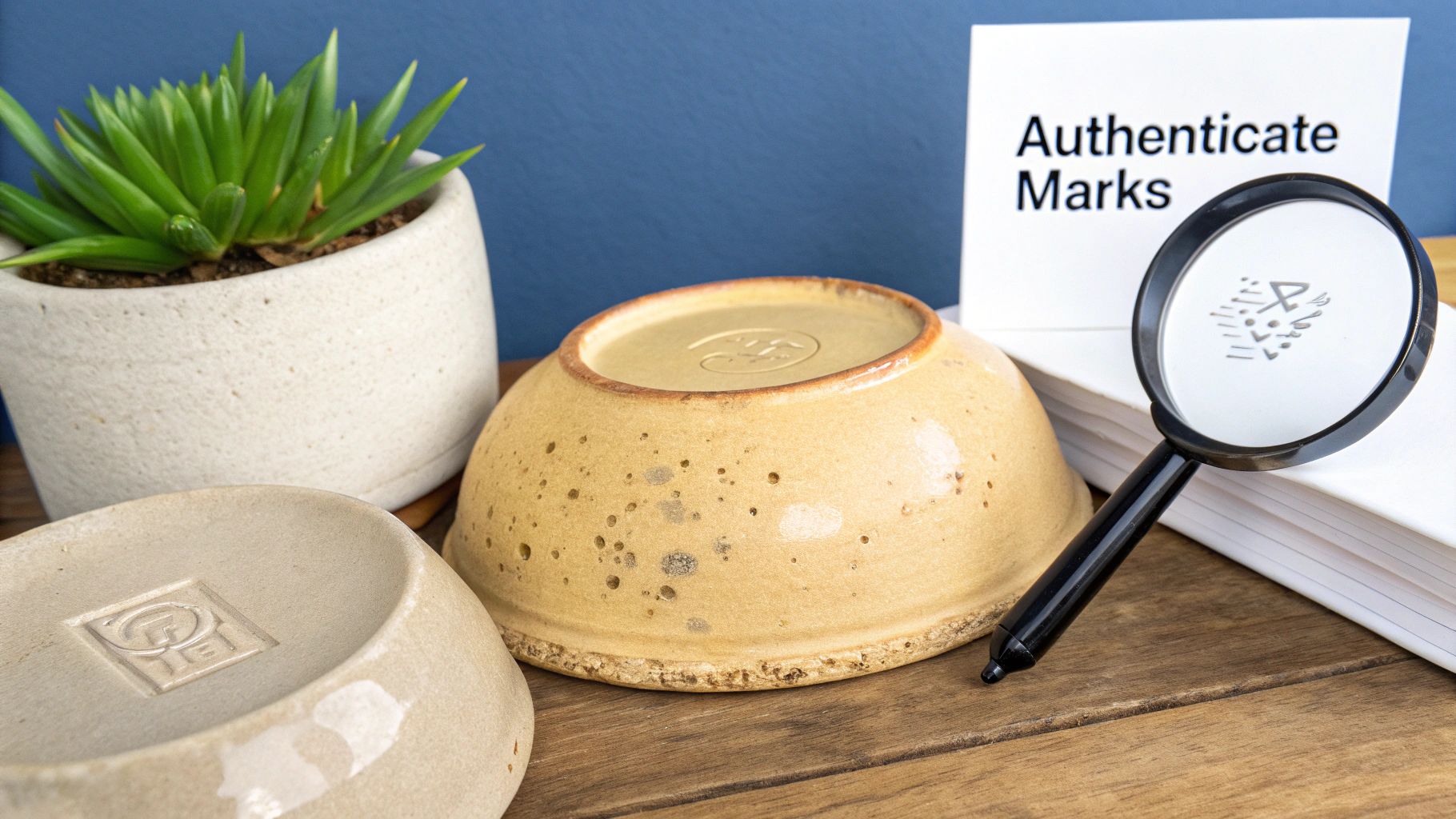
A genuine Weller pottery mark just looks right. Whether it's cut into the clay or impressed with a stamp, it should feel like an integral part of the piece, not an afterthought. One of the biggest giveaways of a fake is a blurry or mushy-looking mark, especially on pieces from Weller’s prime when their die-stamps were known for being sharp and clear.
Key Red Flags to Watch For
When you're looking at a potential Weller piece, don't just zero in on the mark. A forger might get the logo right but completely miss the mark on the fundamentals of the pottery itself. Be methodical and examine the entire object.
Here are the most common signs you might be looking at a fake:
- Incorrect Weight or Form: Authentic Weller has a certain heft and balance you get used to. Reproductions often feel too light, oddly heavy, or have proportions that are just slightly "off" when you compare them to known, documented examples.
- Inconsistent Glaze: The glaze has to match the period of the mark. If a piece is marked as an early Hudson line, for example, it had better have that specific high-gloss vellum glaze. A fake might have a matte finish that simply wasn't used until decades later.
- Modern Clay Body: Weller famously used Ohio clays with a distinct color and texture. Many modern fakes are made from generic white or gray commercial clays that look and feel completely different once you know what to look for.
- Unnatural Wear: Look for aging that doesn't make sense. A genuine antique shows gentle wear from years of use. A fake might have crudely applied "dirt" or scratches that just don't feel consistent with a piece that's been around for 100 years.
Expert Authentication Tip: Always get a good look at a mark under magnification. A real hand-incised mark will often have a sharp, V-shaped groove from a stylus, with glaze pooling inside it. A fake made from a mold might show a soft, rounded U-shaped groove—a dead giveaway of a modern reproduction.
Analyzing the Details
Honestly, the best way to train your eye is to handle as much verified Weller as you can get your hands on. Go to antique shops and pottery shows. Study the pieces in museum collections. Nothing replaces that hands-on experience for developing a true feel for the genuine article. It’s something photos alone can never teach you.
For a deeper dive into these techniques, our comprehensive pottery marks identification guide has more great tips that apply across all kinds of makers. The core principles of examining clay, glaze, and form are pretty universal when it comes to collecting antique pottery.
Understanding What Your Weller Pottery Is Worth
Figuring out the value of a piece of Weller pottery goes way beyond just its visual appeal. The Weller pottery marks on the bottom are your single most important clue, connecting the piece directly to a specific time in the factory's history. These marks, along with the piece's condition and the quality of its artwork, create a clear value structure that every collector needs to know.
An early, hand-incised mark from a prestigious line like Louwelsa, especially if it includes an artist’s cipher, is almost always going to be worth more. Why? Because these marks signify Weller's golden era during the Arts and Crafts movement—a time defined by incredible hand-decorated artistry. On the other hand, a later in-mold mark tells you it was mass-produced, making those pieces far more common and usually less expensive.
What Drives the Market Value?
Several key factors come together to set the final price for any Weller piece. While the mark lays the groundwork, you have to look at the whole picture to get a true sense of its worth. Rarity, for instance, is a massive driver. Vases and bowls from short-lived, experimental lines like Sicard or Lonhuda are naturally much harder to find than items from the popular and long-running Forest line.
To get a handle on valuation, you need to weigh these primary factors:
- The Mark Itself: As we've covered, an early hand-incised signature sits at the top. A crisp, die-impressed seal from the middle period is next, followed by the later script and in-mold marks.
- Artist Signatures: Any verifiable artist’s initials or signature can boost a piece's value by 25-50% or even more compared to an identical, unsigned piece.
- Condition: This is a deal-breaker. A mint-condition piece will always command a much higher price than one with chips, cracks, or repairs. A small, tight crack can easily drop the value of a Forest jardiniere from over $500 down into the $200-$300 range.
- Artistry and Form: The execution of the decoration is huge. A beautifully painted portrait on a Hudson vase is simply more desirable than a basic floral spray. Likewise, large, complex, or unusual shapes almost always fetch more than standard, common forms.
Reseller Tip: Do your homework and check the comps. Always look up recently sold items on auction sites and dealer websites. Find pieces from the same line, in a similar size, and in the same condition. This research is the single best way to understand what the market is actually paying right now.
At the end of the day, learning the subtleties of the different marks is what separates a casual enthusiast from a serious collector. To get a better feel for the bigger picture, exploring guides on other vintage pottery marks can really sharpen your eye, helping you spot valuable pieces from all kinds of makers.
Frequently Asked Questions About Weller Pottery Marks
If you've spent any time looking at Weller pottery, you know that the marks can sometimes leave you scratching your head. You'll run into pieces that don't quite match the textbook examples, which is perfectly normal. Let's tackle some of the most common questions that pop up for both new collectors and seasoned sellers.
Getting a handle on these nuances is what separates a good guess from a confident identification. Here’s what you need to know when you encounter the tricky stuff.
What if a Piece of Weller Pottery is Unmarked?
Finding a beautiful piece of pottery that looks like Weller but has no mark can be confusing. Don't dismiss it just yet! An unmarked piece could be a very early creation, made before the factory settled into a consistent marking routine. It might also be a trial piece or something experimental that never made it into full-scale production.
On the flip side, a missing mark can also be a red flag. It's a common characteristic of reproductions or even pieces made by other Ohio potteries that were heavily influenced by Weller's popular styles. When there's no mark to go by, you have to become a detective. You'll need to rely on your knowledge of Weller's signature shapes, distinctive glazes, and the specific clay they used in different periods.
How Can I Tell Weller and Roseville Marks Apart?
Weller and Roseville were fierce competitors, and their styles sometimes overlapped, but their marks are usually quite different if you know what to look for. Early Weller often features incised, hand-drawn scripts or circular stamps. Roseville, in its early days, frequently used an "RPCo" mark.
As time went on, Weller moved towards in-mold block letters and various ink stamps. Roseville, however, adopted its famous raised "Roseville U.S.A." script, which is probably one of the most recognizable marks in all of American art pottery. The best way to avoid a mix-up is to study the classic forms and glazes of each company right alongside their marks.
Does a Partial or Blurry Mark Lower the Value?
Not always. While a clean, perfectly struck mark is ideal, it’s incredibly common to find marks that are faint, filled in with thick glaze, or worn down over a century of use. As long as enough of the mark is visible to identify the piece as Weller and pin down the line or era, the impact on value is usually pretty small.
Valuation Insight: The overall condition, rarity, and artistic merit of a piece are far more important to its value than the clarity of the mark. For example, a rare, artist-signed Hudson vase with a blurry factory mark will always command a higher price than a common, damaged piece that happens to have a perfect mark.
Trying to identify marks on the fly can be tough. The Curio app makes it easy—just snap a photo of any mark or piece of pottery. You'll get an instant identification, historical details, and a valuation estimate, turning your phone into a pocket-sized antiques expert. Learn more and download Curio today.