Antique Chinese porcelain vases aren't just pretty objects on a shelf. They're tangible history—windows into centuries of incredible artistry, the ambitions of emperors, and the bustling trade routes that connected China to the world. Vases from the Ming and Qing dynasties, in particular, are treasured for their breathtaking craftsmanship, intricate symbolic designs, and the stories they tell.
The Enduring Allure of Chinese Porcelain
Welcome to the captivating world of antique Chinese porcelain. Every single piece holds a story, a whisper of history and cultural exchange. For many people, the fascination starts with a piece passed down through the family or the sudden thrill of spotting a potential gem at a local antique shop. This guide is here to turn that initial spark of curiosity into real, confident knowledge.
We’re going to pull back the curtain on how to identify these beautiful objects. You'll learn to spot the subtle clues—the kind of details that separate a priceless antique from a clever reproduction. Our goal is to give you the tools to appreciate not just the object in your hands, but the deep cultural legacy it comes from.
What You Will Discover
This guide lays out a clear path, whether you're a complete beginner or already know a little. By the time you're done, you'll have a strong grasp of the essentials, allowing you to explore this fascinating field with a much sharper eye.
Here’s what we’ll cover to build your expertise:
- Historical Context: We'll travel back through the great dynasties to see how each era shaped the style, materials, and techniques of the potters.
- Visual Identification: You'll learn how to "read" a vase by its shape, glaze, and decorative patterns—these are its unique fingerprints.
- Decoding Hallmarks: We’ll demystify the reign marks and symbols often found on the base of antique pieces and what they really mean.
- Valuation and Appraisal: Get a handle on the key factors, from rarity and provenance to condition, that drive a vase's market value.
Before we dive in, it helps to know what we're actually talking about. People often use "porcelain" and "ceramic" interchangeably, but they aren't the same. Understanding the fundamental difference between porcelain and ceramic is a crucial first step for proper identification.
Porcelain isn’t just baked clay. It’s a very specific recipe, fired at incredibly high temperatures, that creates something strong, resonant, and almost glass-like. This unique quality is what allowed Chinese artisans to achieve such stunning detail and rich, vibrant colors. It's why antique Chinese porcelain vases remain some of the most sought-after collectibles on the planet.
A Journey Through the Great Porcelain Dynasties
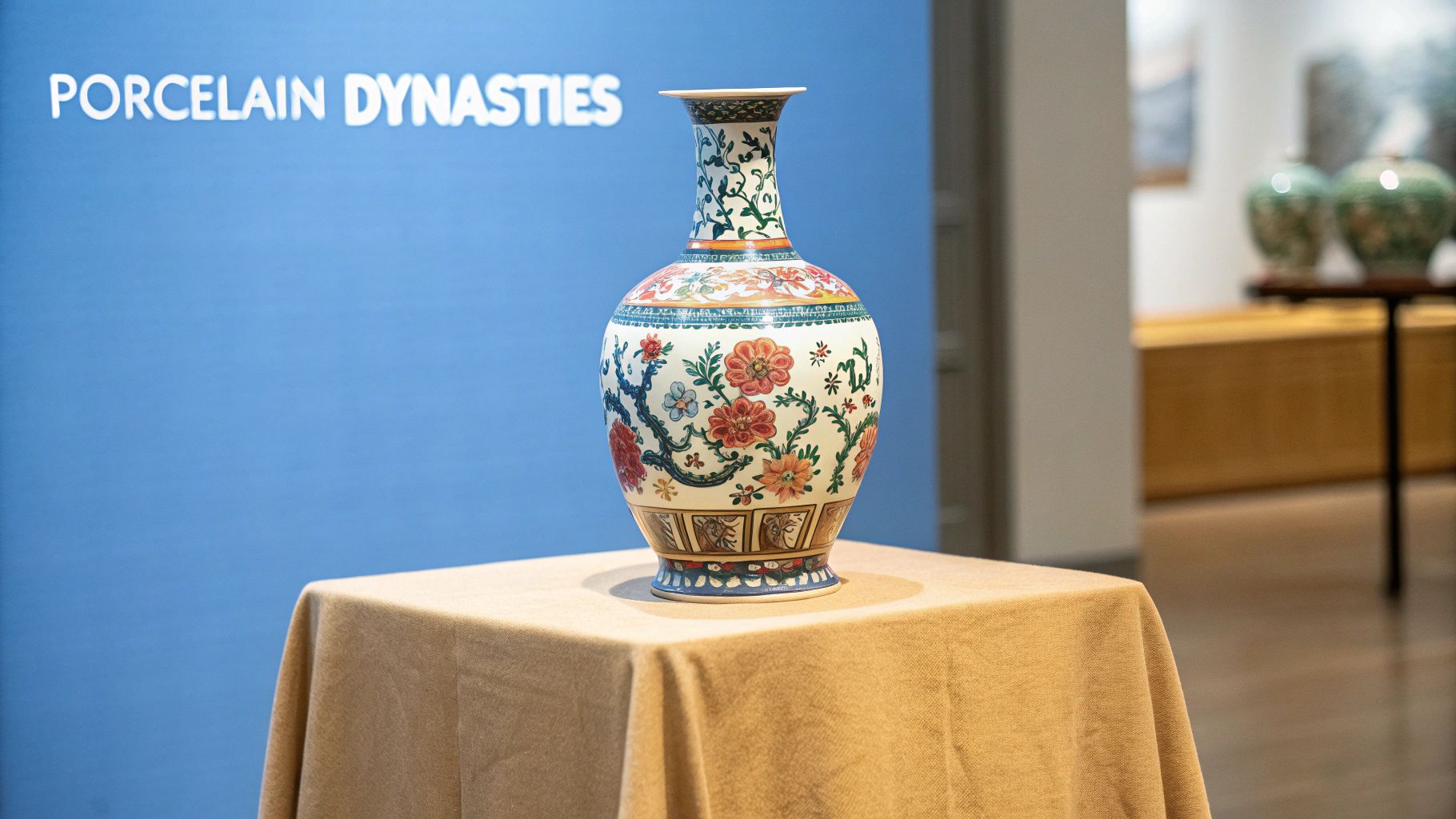
To really get a feel for an antique Chinese porcelain vase, you have to understand the world it came from. Its shape, color, and design aren't just random artistic choices. They're a direct reflection of the era's technology, the emperor's tastes, and even its connections to the rest of the world. The story of these incredible objects is mostly written during two great historical periods: the Ming and Qing dynasties.
These weren't just spans of time; they were the golden ages of porcelain. Over these centuries, the imperial kilns at Jingdezhen grew into a legendary porcelain city—an epicenter of ceramic innovation whose secrets were the envy of the globe. The potters there didn't just make vases; they perfected techniques that would define luxury and beauty for generations to come.
This is the key to understanding why some pieces are so unbelievably rare and valuable. Every vase is a time capsule, holding clues about the emperor on the throne when it was made, the trade routes it might have traveled, and the artistic spirit of its time.
The Ming Dynasty: The Era of Blue and White Perfection
The Ming Dynasty (1368–1644) is probably most famous for perfecting the art of blue and white porcelain. Think of this period as the moment a classic was born, becoming an iconic symbol of Chinese artistry. Potters refined their use of cobalt oxide—the mineral that creates that brilliant blue—to paint designs of incredible clarity and depth against a pure white background.
It was during this time that antique Chinese porcelain vases became a major export, coveted by royalty and wealthy merchants from the Middle East to Europe. The motifs painted on these vases were loaded with meaning and spoke to the stability and cultural confidence of the empire.
- Dragons and Phoenixes: Often shown together, these mythical creatures symbolized the emperor and empress, representing ultimate power and good fortune.
- Lions and Qilins: These powerful beasts were emblems of strength, protection, and prosperity.
- Lush Landscapes: Detailed scenes of mountains, rivers, and scholars in gardens revealed a deep love for nature and philosophy.
The Ming Dynasty essentially created the blueprint for what the world would come to recognize as quintessential Chinese porcelain. The techniques and styles developed during this era set a standard of excellence that potters in the Qing dynasty would strive to match and, in many ways, surpass.
The shapes of Ming vases were often robust and powerful, with a sense of balance that felt both grand and graceful. Forms like the Meiping (a "plum vase" with a narrow neck and broad shoulders) or the sturdy Guan jar became classic silhouettes that are still admired today. Understanding these foundational styles is the first step in learning to spot pieces from this pivotal era.
The Qing Dynasty: An Explosion of Color and Technique
If the Ming Dynasty perfected blue and white, the Qing Dynasty (1644–1912) was an era of spectacular innovation and dazzling color. The kilns at Jingdezhen, under strict imperial watch, pushed the boundaries of what was possible with glazes and enamels. The reigns of three emperors in particular—Kangxi, Yongzheng, and Qianlong—are widely considered the absolute peak of Chinese porcelain production.
During this period, new and complex color palettes completely changed the look of porcelain.
- Famille Verte: Dominating the Kangxi period, this style used a vibrant palette of greens, iron red, and yellow enamels.
- Famille Rose: Introduced later, this palette was defined by its signature opaque pink enamel, which allowed for softer, more delicate shading in paintings.
This explosion of color was matched by an incredible refinement in painting quality. Artists created miniature masterpieces on porcelain, with everything from epic historical scenes to delicate flower arrangements rendered in breathtaking detail. This artistic boom was fueled by imperial demand and a thriving international market hungry for new and exotic designs.
The global reach of these pieces was immense. Long before the internet, antique Chinese porcelain vases were a truly global commodity. The classic blue-and-white wares were perfected under the Ming, but by the 17th and 18th centuries, shiploads of colorful Qing vases were heading to markets in the Netherlands, Britain, and France. This is exactly why important pieces still turn up in European estates and auctions today. You can find more insights about this global journey on Bidsquare.com.
How to Read the Clues on a Porcelain Vase
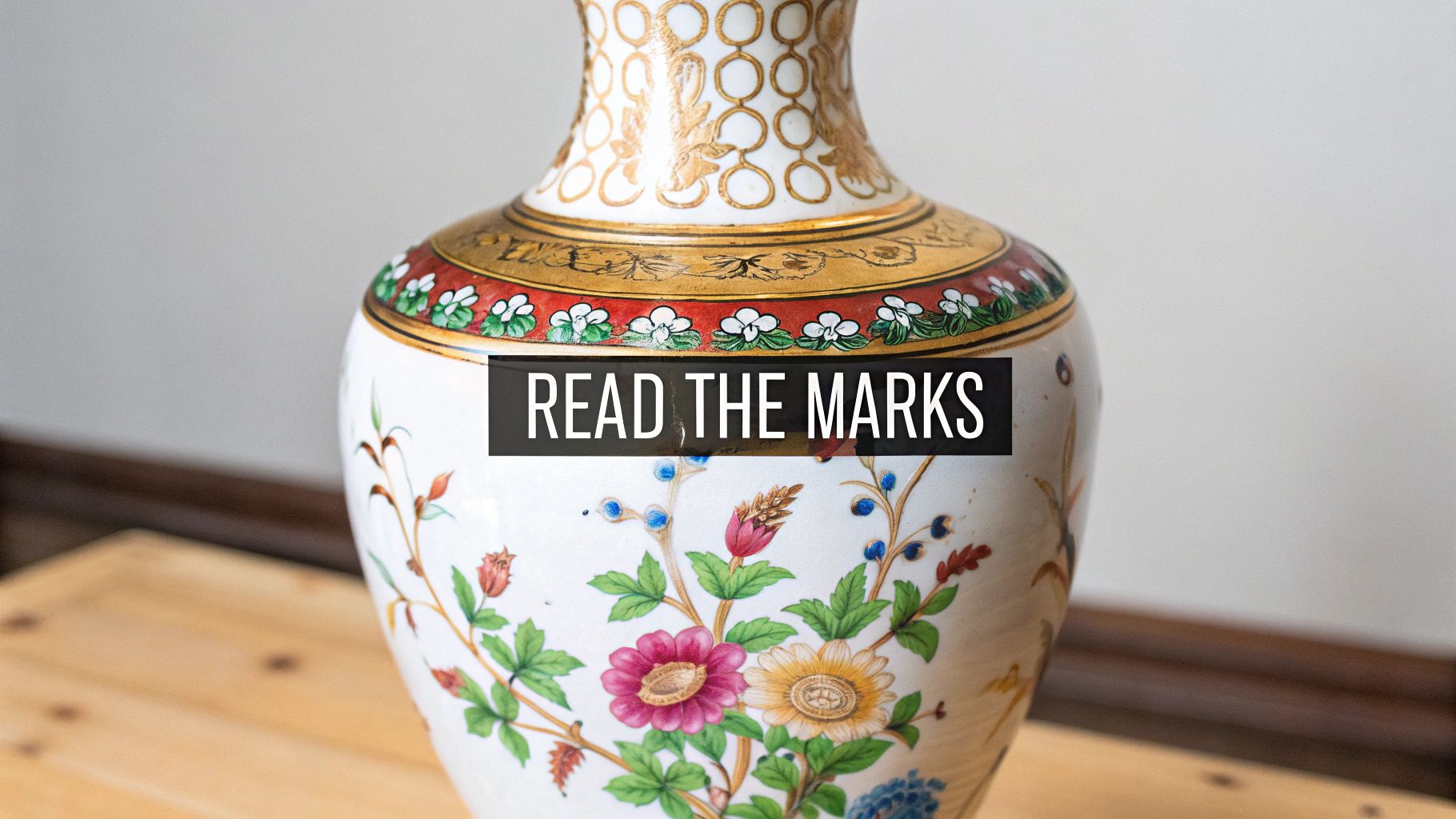
Every antique Chinese porcelain vase is a historical document, telling its story through a silent language of shape, color, and symbols. Once you learn to read these clues, you start seeing each piece not just as a beautiful object, but as a window into a specific time and place. It’s all about knowing what to look for.
Think of it like getting to know a person. The vase's shape is its silhouette, the glaze is its skin, the painted scenes are its clothing, and the mark on the bottom is its signature. When you put all these pieces of evidence together, a surprisingly detailed biography begins to emerge.
Interpreting the Shape and Form
The first thing you’ll notice about a vase is its shape, and this is your first major clue. Far from being arbitrary, specific forms were designed for different purposes and fell in and out of fashion across the dynasties. Getting a feel for these classic silhouettes is a huge first step.
For example, the Meiping vase—with its small mouth, high, rounded shoulders, and graceful taper—was designed to hold a single plum blossom branch. You see this elegant form pop up constantly during the Ming dynasty. On the other hand, the Baluster vase is sturdier, with a pear-shaped body and a flared neck, giving it a commanding presence that was popular in the Qing dynasty.
A few other key shapes you should get to know:
- Rouleau Vase: Basically a "rolling pin" shape. This cylindrical form was a favorite during the Kangxi reign, as it provided a perfect canvas for long, continuous story scenes.
- Gu Vase: This one has ancient roots, inspired by old bronze ritual vessels. It has a distinctive trumpet-shaped mouth, a skinny waist, and a flared base.
- Cong Vase: A really interesting one. It's a square-bodied vase with a round neck and foot, a direct nod to ancient jade ritual objects. This geometric style was a big hit with the Qianlong emperor.
Understanding Glazes and Colors
The glaze is that glassy coating that gives a vase its shine, texture, and color. The specific type of glaze can be a dead giveaway for a vase's age and origin, since certain techniques and color recipes are hallmarks of their time. The iconic blue in blue-and-white porcelain, for instance, comes from cobalt oxide painted on the clay before it goes into the kiln for its final, intense firing.
But there’s a whole world beyond blue and white. The famous celadon glaze, with its soft, jade-green glow, was perfected over a thousand years ago during the Song dynasty. Much later, in the Qing dynasty, artisans truly mastered vibrant enamel palettes. They created the famille verte (green family) and famille rose (pink family), which let them paint with the incredible detail you’d see in a watercolor.
The feel of the glaze can be just as telling as its color. As one seasoned collector put it, "the glaze of an old vessel cannot be duplicated." An authentic antique often has a uniquely smooth, almost silky feel that modern copies just can’t get right.
Decoding Decorative Motifs
The pictures and symbols painted on these vases are rarely just pretty decorations. They are a visual language, packed with meaning and intent—wishes for good luck, a long life, wealth, or high social standing. Learning to decipher these motifs adds a whole other dimension to a piece.
Dragons are probably the most recognizable symbol, representing the emperor, immense power, and good fortune. A five-clawed dragon was a big deal—it was reserved almost exclusively for items made for the emperor. Pieces for lower-ranking officials or for export might feature a three- or four-clawed dragon instead.
Other common symbols include:
- Peonies: Called the "king of flowers," they symbolize wealth, honor, and beauty.
- Lotus Flowers: A powerful Buddhist symbol for purity and enlightenment.
- Bats: This one is a visual pun. The Chinese word for bat (蝠, fú) sounds identical to the word for good fortune (福, fú), making it a popular motif for luck.
- Mythical Lions (Foo Dogs): These are guardians. You'd see them protecting the entrances to temples and palaces, meant to ward off evil spirits.
For a quick reference, this table summarizes some key traits from the major dynasties.
Quick Identification Guide to Chinese Porcelain Vases by Dynasty
This table gives you a snapshot of the common colors, motifs, and reign mark styles you'll see in the major porcelain-producing dynasties. It's a great starting point for making a preliminary identification.
| Dynasty (Period) | Dominant Colors & Glazes | Common Motifs | Typical Reign Mark Style |
|---|---|---|---|
| Ming (1368–1644) | Underglaze blue & white, Wucai (five-color), doucai | Dragons, phoenixes, lotus scrolls, human figures in landscapes | Six-character mark in two vertical columns, often in a double circle |
| Qing - Kangxi (1662–1722) | Blue & white (vibrant "sapphire" blue), famille verte, powder blue | Historical/literary scenes, "lange lijsen" (long elizas), flowers | Six-character mark in regular script (kaishu), often with a calligraphic feel |
| Qing - Yongzheng (1723–1735) | Famille rose (delicate pinks), monochrome glazes (lemon yellow, ruby) | Delicate florals, birds on branches, minimalist designs | Meticulously written six-character marks, often in a double square |
| Qing - Qianlong (1736–1795) | Complex polychromes, famille rose, intricate designs, faux finishes (wood, bronze) | Hyper-detailed landscapes, dense floral patterns, European figures | Six-character seal script (zhuanshu) becomes common, often in iron-red or blue |
| Republic (1912–1949) | Famille rose (often brighter/harsher), transfer prints | Portraits (Mao Zedong), political slogans, copies of earlier styles | Four-character marks, "Made in China," or sometimes spurious older marks |
Remember, this is a general guide. There are always exceptions, but these patterns will help you narrow down the possibilities significantly.
The Importance of Reign Marks
The final piece of the puzzle, and often the most conclusive, is found on the base of the vase: the reign mark. This is a small inscription of Chinese characters that names the emperor and dynasty when the piece was made. An authentic reign mark, written and fired correctly, can pinpoint a vase’s creation to a very specific window of time.
Reign marks are usually written in two vertical columns of three characters each, or sometimes in a single horizontal line of six. They follow a standard formula, like "Da Qing Qianlong Nian Zhi," which translates to "Made in the Great Qing Dynasty during the reign of the Qianlong Emperor." You'll find these marks painted in underglaze blue, overglaze enamel, or even lightly carved into the porcelain itself.
A word of warning, though: because reign marks are so critical to an item's value, they are the single most faked element on modern reproductions. A genuine mark was handwritten by a skilled calligrapher and will have subtle variations in the brushstrokes. A fake often looks too perfect and uniform, almost like a rubber stamp. You have to scrutinize the calligraphy and the quality of the pigment to tell the difference.
What Makes One Vase Worth a Fortune and Another… Not So Much?
Ever wondered why one antique Chinese porcelain vase can spark a bidding war and sell for millions, while another that looks just as lovely might be worth less than a hundred pounds? It’s a great question, and the answer isn't about luck. It’s about learning to see what the experts see.
Think of it like being a detective. You're looking for a specific set of clues that, when they all line up, point to something truly special. The value of any piece of antique Chinese porcelain really boils down to five key things: its age, rarity, artistic quality, condition, and provenance. A vase that hits the mark on all five is the holy grail, but even a strong showing in a few areas can make it incredibly valuable.
The Foundation: Age and Rarity
Age is the first thing most people think of, and for good reason. A vase that has survived from the Ming Dynasty (1368–1644) is naturally going to be much scarcer than something made during the Republic Period (1912–1949). Time itself is a filter; centuries of accidents, wars, and simple wear-and-tear mean fewer pieces survive.
But age is only half the story. Rarity is its crucial partner. You can have a genuinely old vase from the Qing Dynasty, but if it was a common pattern made in the thousands for export, there are simply too many of them out there for it to be exceptionally valuable. True rarity comes from the unusual stuff—pieces made for an emperor’s personal collection, a unique glaze that was a one-off experiment, or a style that was only produced for a few years.
Artistic Quality and Craftsmanship
This is where you really start to separate the good from the great. Two vases can be from the exact same period, with the same imperial mark on the bottom, yet one can be worth ten times more than the other. The difference? The skill of the artist.
Here’s what to look for:
- Confident Painting: Look closely at the brushwork. On the best pieces, the lines are fluid and sure-handed, not shaky or sloppy. The details are crisp, and the shading gives the decoration life and depth.
- A Beautiful Glaze: A top-tier glaze is rich, smooth, and almost glows from within. It should be applied evenly without any major pitting, crawling, or flaws that detract from the overall look.
- Perfect Form: The shape of the vase itself should be elegant and symmetrical. A slight warp or a lopsided feel that happened in the kiln can significantly pull down the value.
A common trap is thinking that any piece with an emperor's mark is a masterpiece. The reality is, even the imperial kilns had good days and bad days. The vases that fetch the highest prices are the ones where the shape, the glaze, and the painting all come together in perfect harmony.
The Make-or-Break Factor: Condition
When it comes to porcelain, condition is everything. It can be the most ruthless factor in determining value. A single hairline crack, a chip on the rim, or a clumsy repair can slash a vase's worth by 90% or more. Because porcelain is so fragile, finding a piece in perfect condition is rare, and collectors will pay a huge premium for it.
When you're looking at a vase, run your finger gently around the top rim and the footrim—you can often feel tiny chips or repairs before you see them. Give the body a light tap with your knuckle. A clear, bell-like ring is a good sign, while a dull thud often means there’s a hidden crack. You can learn more in our guide to identifying old vases that could be worth money.
The Story Behind the Vase: Provenance
Provenance is simply the vase’s life story—its documented history of ownership. A solid paper trail can be pure gold. If you can trace a vase back to a famous collection, a royal family, or a historic auction, its value and desirability skyrocket.
Why? Because good provenance acts as a guarantee of authenticity and connects the object to a fascinating human history. A sticker from a respected old gallery, a mention in a family's letters, or an entry in a 1920s auction catalog provides a layer of trust that’s hard to fake. This documented past can easily double or triple a vase's value.
For collectors, it's helpful to understand the different tiers in the market. A huge number of decorative pieces fall into the £0–£100 range. About 30% of the market is made up of pieces between £100–£500, which are often nice but common items from the late 19th or early 20th century.
Once a vase is valued over £10,000, it almost always has exceptional artistic merit or strong provenance. Those that go beyond £50,000 are the true "museum quality" treasures, representing a tiny fraction—under 0.1%—of all Chinese porcelain out there. It’s a world of extremes: a serious crack can drop a £50,000 vase to under £1,000, but a confirmed imperial link can turn a simple-looking vase into a life-changing fortune.
Spotting Fakes and Modern Reproductions
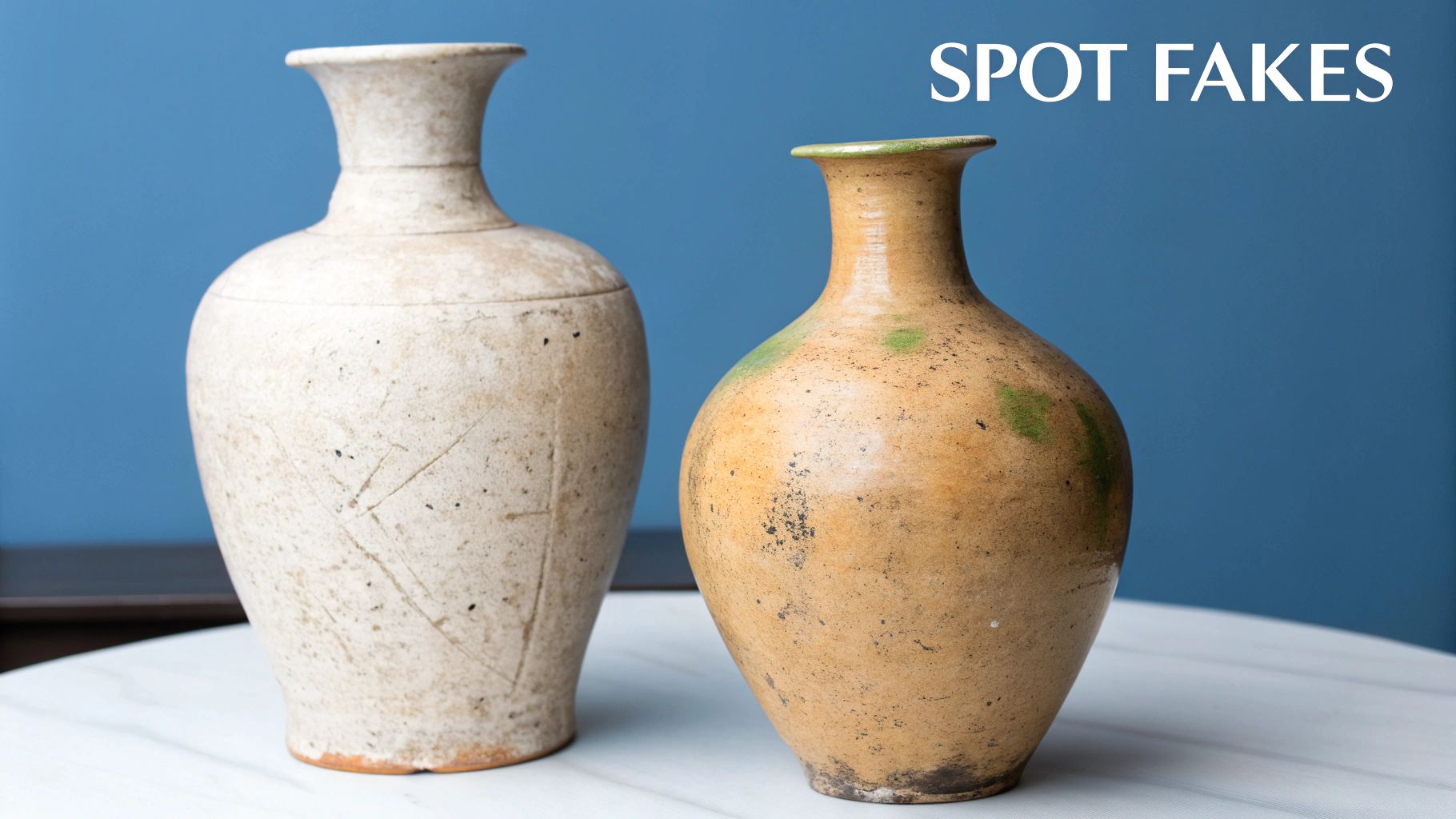
Stepping into the world of antique Chinese porcelain means learning to see the difference between a treasure and a trap. The market is flooded with reproductions, from cheap tourist knock-offs to sophisticated forgeries made to deceive even seasoned collectors. Honing your eye for what’s real is the most important skill you can develop.
Think of it this way: a true antique is a handmade object that carries the subtle story of its time in its imperfections. Fakes, on the other hand, often give themselves away by being too perfect, too clean, or too uniform. Learning to feel the difference takes time, but it starts with knowing exactly where to look.
Examine the Foot Rim First
Always start by turning the vase upside down. The most revealing part of any piece is often its base, specifically the unglazed foot rim it sits on. On a genuinely old vase, this area should show honest, natural wear from decades or centuries of being slid across tables and shelves. It should feel smooth to the touch, maybe with a slightly sandy texture, and might have a warm, rusty-brown color from the original firing process.
Modern copies almost never get this right. Their foot rims often feel sharp, rough, and brand new. Some forgers try to create artificial age by rubbing dirt into the base or chipping it deliberately, but it just looks messy and forced. A real patina is subtle and consistent, earned over a very long time.
A common forger's trick is to apply a brown wash to the foot to simulate age. However, this often looks like a smear of paint rather than the natural oxidation that occurs during firing. Trust your touch; an old foot rim feels different.
Scrutinize the Painting and Glaze
Next, look closely at the artistry. The brushwork on an authentic piece is almost always fluid and confident, flowing from the hand of a skilled artist. You’ll see natural variations in the thickness of the lines and the richness of the colors.
In contrast, the decoration on many fakes looks stiff, lifeless, or even printed on. Keep an eye out for these tell-tale signs:
- Uniformity: The lines are mechanically perfect, lacking the soul and tiny variations of freehand painting.
- Color Quality: The colors, especially on famille rose pieces, can look jarringly bright or synthetic. Genuine mineral-based pigments have a softer, more natural depth.
- Glaze Flaws: While old pieces have minor imperfections, a modern fake often has an overly glossy, almost plastic-like sheen. Be wary of a "crackle" glaze that looks too neat and uniform; natural crazing is always wonderfully irregular.
Be Wary of the Perfect Reign Mark
A reign mark feels like a guarantee of authenticity, but it’s also the single most faked element on Chinese porcelain. A genuine mark was hand-painted by a trained calligrapher and has life and character in its strokes. So many fakes, however, have marks that look like they were applied with a rubber stamp—they’re just too precise, with perfectly even ink.
If you see a crisp, flawless reign mark on a piece that is supposed to be hundreds of years old, that's a huge red flag. Forgers know collectors hunt for these marks, so they’ll often slap a famous emperor’s name onto a low-quality modern vase. Learning to judge the calligraphy is a critical skill. For more general advice, our guide on how to spot fake antiques is a great place to start.
By combining these checks—feeling the foot, judging the artwork, and questioning the mark—you start to build a powerful mental checklist. This methodical approach is what separates a casual buyer from a confident collector.
How to Care for and Preserve Your Collection
When you own an antique, you become its current steward—a caretaker for a fragile piece of history. The good news is that keeping antique Chinese porcelain vases safe and beautiful doesn't demand a lot of fancy equipment. It really just comes down to a gentle touch and some common sense.
Proper care is all about protecting the vase’s integrity and, by extension, its value. Always, always handle a piece with two hands, one supporting the base and the other around its body. Never grab it by the neck, rim, or handles; these are the weakest points and often hide old, invisible repairs just waiting to give way. Take off any rings or bracelets first to avoid a heartbreaking scratch.
The Right Way to Clean and Display
Dust might seem harmless, but it’s actually abrasive. A light, regular dusting with a soft, dry brush (a clean makeup brush works wonders) is your first line of defense. If a piece needs a bit more attention, use a soft cloth with a little distilled water and maybe a single drop of pH-neutral soap.
Whatever you do, don't submerge the vase in water. Moisture has a nasty habit of creeping into tiny cracks, which can compromise old repairs and weaken the entire structure.
When it comes to display, think "stable and safe." Keep your vases away from high-traffic areas, direct sunlight, and places with big temperature swings, like right over a heating vent or next to a fireplace.
- Stable Surfaces: A solid cabinet or sturdy shelf is best. Don't place a valuable piece right on the edge where it can be easily bumped.
- Secure Placement: A small amount of museum wax or putty under the base is a great trick. It provides a bit of grip to protect against vibrations or minor jostles.
- Avoid Overcrowding: Give each vase its own space. You don't want one accidental knock to create a domino rally with your collection.
Owning beautiful porcelain is a joy, but it's meant to be lived with. As designer Suzan Hadaway suggests, don't be afraid to use your pieces. A jar without a lid can hold pens, and a sturdy vase is perfect for flowers—just be mindful and gentle in your daily use.
Understanding Professional Restoration
So, what do you do if a piece is already damaged? This is where things get tricky. Professional restoration can work miracles, stabilizing a piece and making it look whole again. A seamless, nearly invisible repair can prevent further damage and make a vase beautiful enough to display with pride.
But there’s a catch: any restoration affects market value. Serious collectors value originality above all else. Even the most masterful repair will almost always lower a vase's price compared to a perfect, untouched example.
If you're thinking about getting a piece fixed, your first step should be to talk to a reputable ceramics conservator. They can walk you through the options and give you a clear-eyed view of how any work will impact its history and long-term worth.
So, What's Next on Your Antique Adventure?
You’ve traveled through dynasties, figured out how to read reign marks, and learned the secrets of valuation and care. The world of antique Chinese porcelain might have seemed intimidating before, but now you see it for what it is: a fascinating field just waiting to be explored. The trick now is to take what you've learned here and use it in the real world.
The next time you’re in a museum, an antique shop, or even just scrolling through an online auction, stop and really look at a piece. Use what you now know as a mental checklist. Notice the shape, get a feel for the brushwork, and imagine what the foot rim feels like. With a trained eye and a bit of curiosity, you’ll start to see that every vase has a story—and you finally have the tools to start listening.
From Theory to Practice
This is where your real education as a collector begins—with your hands and eyes. The goal isn't just to memorize facts, but to build an instinct for what separates a genuine antique from a clever fake. It’s all about developing your eye for quality, age, and authenticity.
Here are a few simple ways to get started:
- Go to Museums: Seriously, spend some time in the Asian art sections of major museums. It’s the best way to see certified, top-quality examples up close without any pressure to buy.
- Ask to Handle Pieces: If you’re in a reputable antique shop, don’t be afraid to ask if you can gently handle a piece. Feeling the weight, the texture of the glaze, and the balance of a vase tells you things a photograph never could.
- Start Small: You don’t need to go hunting for a million-dollar masterpiece right away. Start by trying to identify smaller, more common items. It's a great way to build confidence and sharpen your skills.
A Glimpse at the Top of the Market
While most of us will be dealing with more modest finds, it’s good to know just how high the ceiling is. The very best antique Chinese porcelain vases can fetch mind-boggling prices, with the rarest pieces selling for tens of millions at auction houses like Sotheby’s and Christie’s. Just to give you an idea, in 2021, an imperial Qianlong vase sold for around US$41.56 million in Beijing, a new world record. These incredible sales make up less than 0.1% of all porcelain out there, but they show what imperial history and perfect condition can do to a piece’s value. You can read more about these jaw-dropping sales on MarkLittler.com.
For the everyday treasure hunter, this context is key. Is it likely you'll find an eight-figure vase at a garage sale? Statistically, no. But is it possible? Absolutely. People have turned a sub-$50 find into a life-changing amount of money before, and it will definitely happen again.
Your journey is about turning that small possibility into a real one. Whether you’re sorting through a family inheritance or digging through dusty shelves at a flea market, the principles in this guide are your starting point. Every vase you pick up is another lesson. So embrace the hunt, trust what you’re learning, and enjoy the incredible thrill of discovery.
Ready to find out what your own pieces are worth? With Curio, it's like having an antique expert in your pocket. Just snap a photo to instantly identify your item, learn its history, and get an estimated value. Stop wondering and start knowing. Download the app and begin your discovery today at https://www.curio.app.