
There's something truly special about holding an antique silver pocket watch. It's not just a timepiece; it's a tangible link to the past, a little machine that blends incredible mechanical skill with the classic beauty of silver. These watches weren't just for telling time—they were a major step forward, taking timekeeping from the mantelpiece to the waistcoat pocket. For a long time, they were essential tools and powerful status symbols.
Why Antique Silver Pocket Watches Captivate Collectors
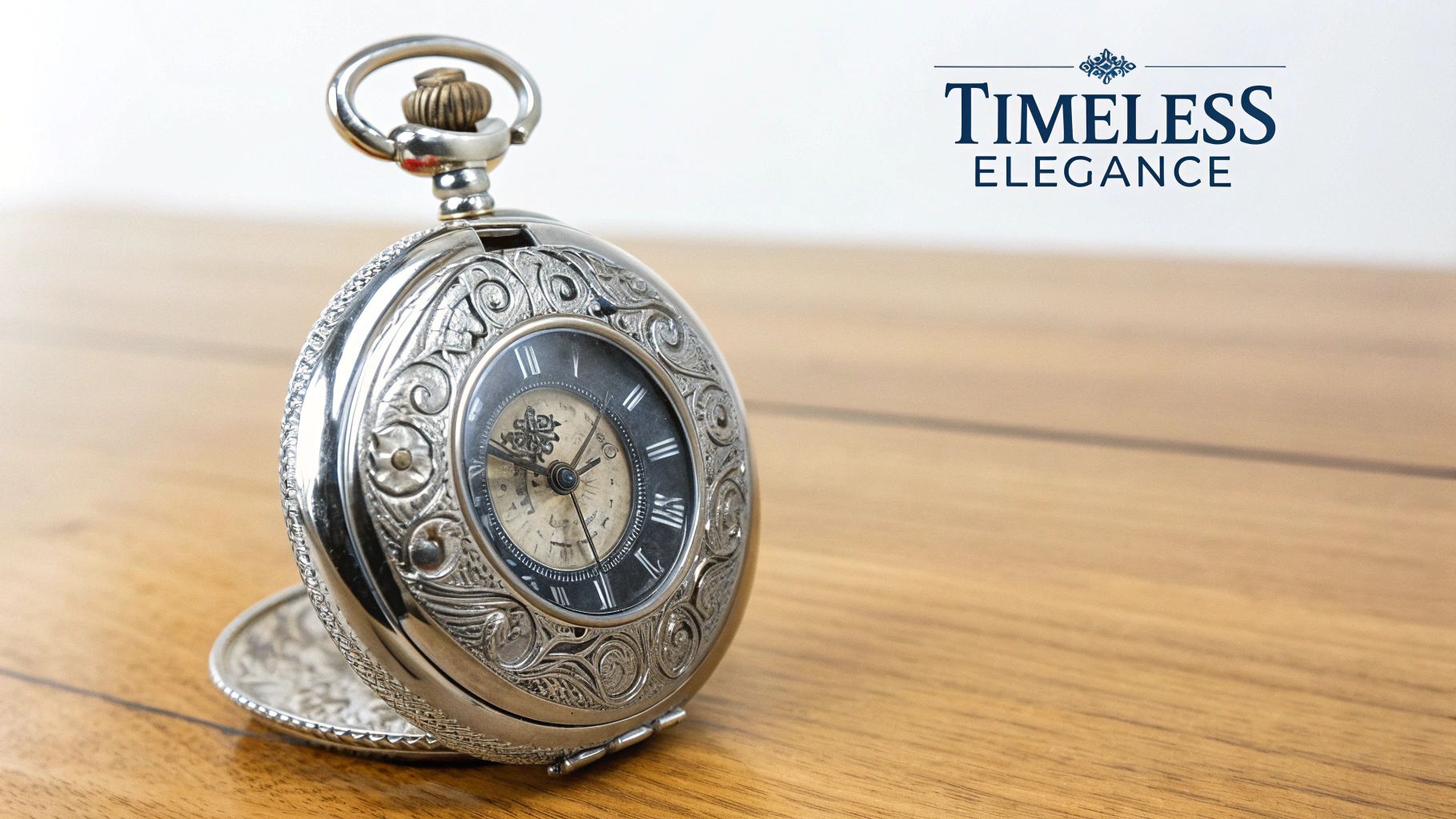
Getting into antique silver pocket watches is like stepping back in time. Each one is a tiny marvel of engineering, squeezing centuries of innovation into something you can hold in your hand. They come from an era when checking the time was a deliberate, almost ceremonial act—a world away from a quick glance at a phone.
But their appeal runs deeper than just mechanics. These watches were once markers of a person's standing, professionalism, and commitment to punctuality. In the 19th century, a gentleman with a fine silver pocket watch was broadcasting his success. That rich history is a huge part of what draws collectors in today; they're after the story as much as the object itself.
A Connection to Craftsmanship
Modern gadgets are often churned out by the million, but every antique pocket watch has a story of human skill behind it. The complex system of gears and springs, known as the movement, was painstakingly assembled by hand. The silver cases weren't just functional; they were often canvases for stunning engravings or sophisticated patterns.
This level of artistry is a huge part of the appeal. Owning one of these pieces connects you directly to a lost world of master craftspeople. It's a real link to the watchmakers who spent their entire careers perfecting their trade, long before automation took over.
Holding an antique pocket watch is like holding a conversation with the past. The gentle tick of its movement is a faint echo from another century, a reminder of the countless moments it has measured and the lives it has accompanied.
The Thrill of the Hunt
For many collectors, the chase is just as exciting as the find. Whether you've just inherited a family heirloom or stumbled upon a gem at an antique fair, every watch is a mystery waiting to be solved. Researching the maker, pinpointing its age from a serial number, and learning to read the tiny hallmarks stamped into the silver—it's all part of the fun.
This guide is here to get you started on that adventure. We'll walk you through everything you need to know to become a confident collector.
We'll cover key areas like:
- History and Evolution: See how they went from elite luxuries to everyday essentials.
- Identification and Marks: Learn to decode the clues hidden inside your watch.
- Valuation Factors: Understand what separates a common find from a rare treasure.
- Proper Care and Maintenance: Keep your piece of history ticking for years to come.
By the end, you'll have a much deeper appreciation for what makes antique silver pocket watches so fascinating and the know-how to start or grow your own collection.
A Journey Through Time: The Story of the Pocket Watch
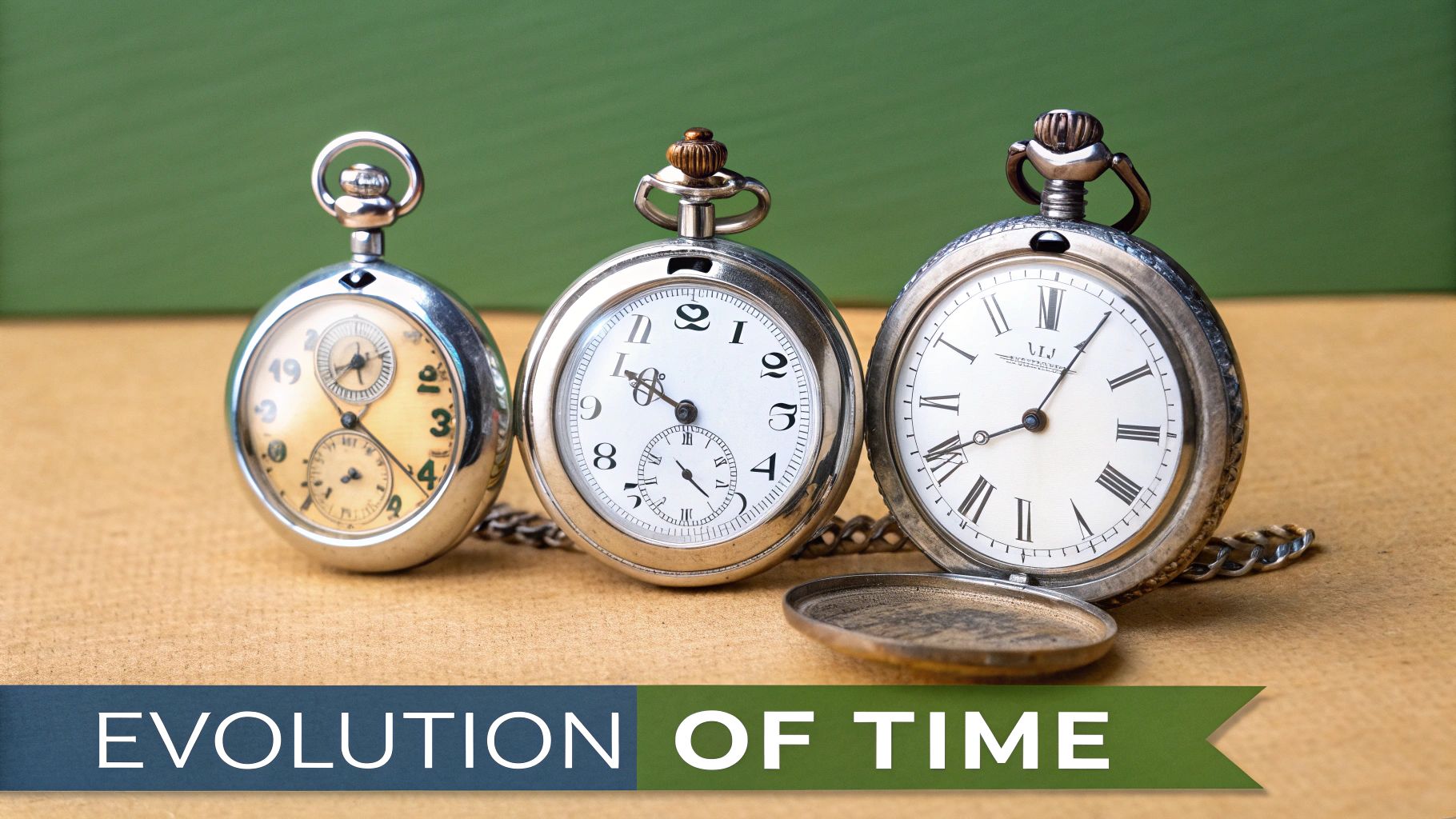
To really get a feel for an antique silver pocket watch, you have to understand where it came from. Before these little time machines existed, telling time was a public event. You listened for the church bells or looked up at the town clock. The idea of carrying time with you was a complete game-changer, altering how people managed their days, their work, and their social lives.
The story starts with something a lot clunkier than the elegant watches we see today. Pocket watches trace their roots back to early 16th-century Europe, with the first portable clocks popping up around 1510 in Nuremberg, Germany. These weren't elegant at all; they were big, drum-shaped brass boxes people wore around their necks, and they were famously inaccurate.
It wasn't until the 18th and 19th centuries that silver pocket watches really hit their stride, becoming both a necessary tool and a mark of class. Despite their rich history, you'll find that top auction sales for silver models often don't reach the heights of their gold counterparts, unless they boast some incredible features or a fascinating backstory. You can find more market insights for these classic timepieces on MarkLittler.com.
At first, these devices were strictly for the elite. Owning one wasn't about being on time—it was about showing off that you could afford such an incredible piece of technology. Think of them as the supercars of their era: stunning to look at, but not exactly practical for the daily grind.
From Luxury Baubles to Essential Tools
The 17th and 18th centuries were a major turning point. A series of brilliant technical innovations started to whip these bulky novelties into shape, turning them into genuinely useful instruments. The real breakthrough came around 1675 with the invention of the balance spring, which dramatically improved accuracy and made personal timekeeping reliable for the very first time.
As the inner workings got better, the outer designs slimmed down. Those awkward neck-worn clocks morphed into the familiar, rounded shape we know today, perfectly designed to slip into a waistcoat pocket. This wasn't just a style update; it marked the pocket watch's evolution from a fancy ornament to a vital piece of kit for merchants, doctors, and military men.
During this time, silver became the go-to material for high-quality watches. It was more understated than gold but still radiated a sense of quality and toughness. This made antique silver pocket watches the perfect accessory for the serious professional.
How the Industrial Revolution Changed Everything
The 19th century was the undisputed golden age for the pocket watch, and we have the Industrial Revolution to thank for it. What was once built one at a time by a master craftsman could now be produced for the masses, all thanks to new manufacturing methods.
The explosion of the railroad system was the real driver behind the pocket watch boom. To keep trains from crashing, everyone needed to be on the same, standardized time. Railroad companies began requiring their employees to carry highly accurate and dependable timepieces.
This sudden demand kicked off a manufacturing frenzy, especially in America. Companies like Waltham, Elgin, and Illinois became masters of mass production, using interchangeable parts to build watches. This approach made their watches more affordable, more reliable, and far easier to fix than the handcrafted European models.
This era brought some key improvements that we now take for granted:
- Stem-Wind, Stem-Set Mechanisms: Gone were the days of fumbling with a separate key to wind your watch. The crown—that little knob at the top—took over, making watches more convenient and better sealed against dust.
- Jeweled Movements: Watchmakers started placing tiny synthetic jewels (like rubies) at high-friction points inside the watch. This simple trick cut down on wear and tear, making the watch last longer and keep better time.
- Standardized Sizing: Watch sizes were finally standardized, which made it a whole lot easier for watchmakers to mix and match cases and movements or find replacement parts for repairs.
By the turn of the 20th century, the pocket watch was everywhere. It was a staple for any professional and a true symbol of modern efficiency. Understanding this history is crucial for any collector because it's the story behind why certain brands, time periods, and features are so sought-after today.
How to Identify Your Silver Pocket Watch
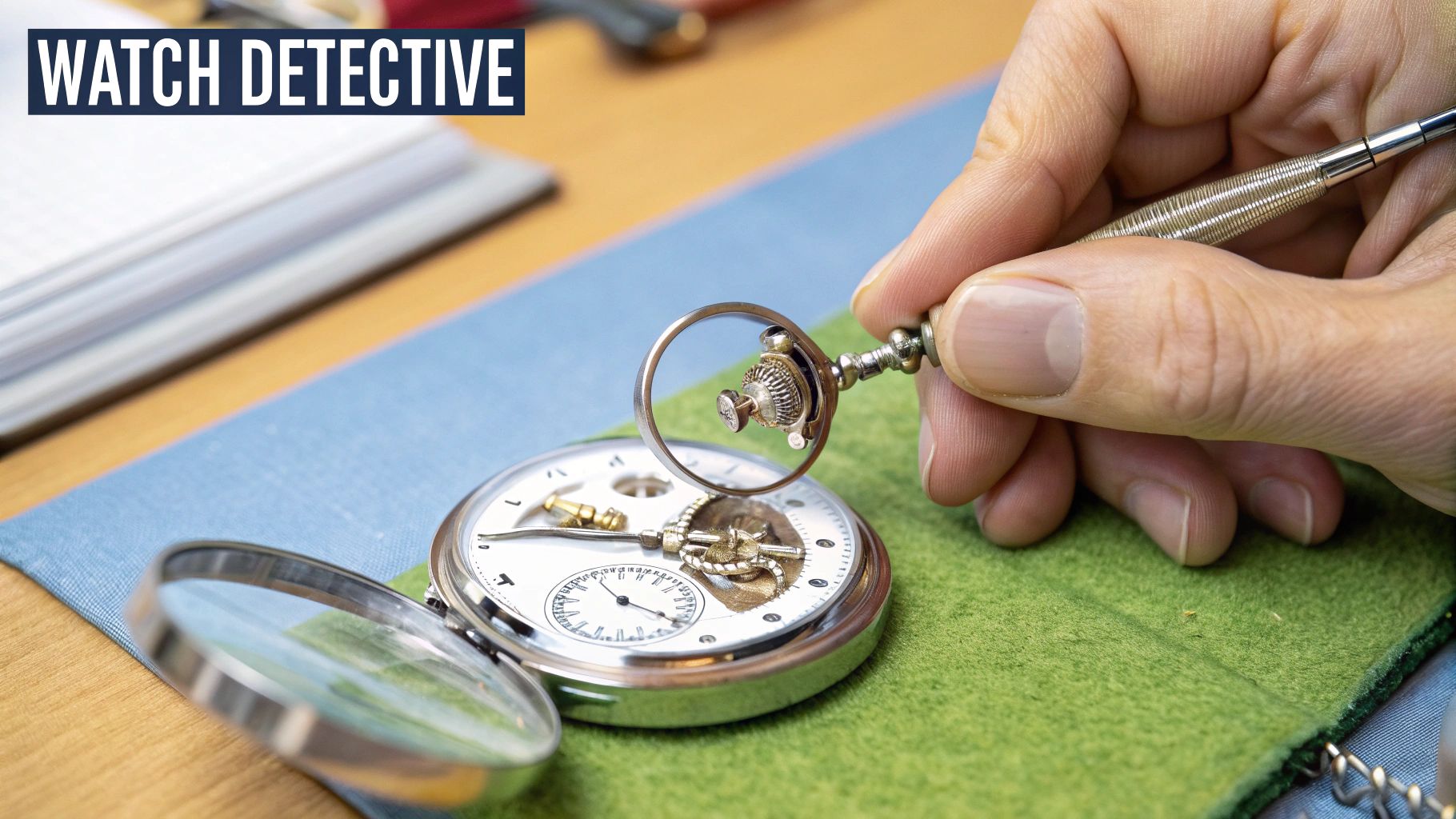
Think of yourself as a detective. Every antique silver pocket watch has a story, and the best clues are hidden inside the case, waiting to be discovered. I'll walk you through how to safely open your timepiece and decipher the secrets that reveal its maker, age, and true material.
First things first, find a soft, clean surface to work on. A microfiber cloth on a table works perfectly. Most antique watch cases unscrew. If the back is a bit stubborn, a simple rubber jar opener can give you the extra grip you need without leaving a single scratch. Some are "swing-out" cases, where you unscrew the front bezel and carefully pry the movement out from the front. The key is to be gentle.
Once it's open, you'll see two key areas: the inside of the case back and the watch movement itself. Both are goldmines of information, stamped with the serial numbers, maker’s marks, and hallmarks that tell you everything you need to know.
Decoding the Case Markings
The inside of the case back is where your investigation begins. Look closely for a series of tiny, stamped symbols. These are hallmarks, and they act as the case's official birth certificate, telling you the purity of the silver, the city where it was tested, and the year it was all made official.
Learning to read these marks is like learning a new language. For instance, a small lion walking sideways (the "lion passant") is the classic mark for English sterling silver, which guarantees the metal is 92.5% pure silver. American cases are often more direct, stamped with "Sterling" or "Coin Silver" (90% pure). For a deeper dive into this fascinating code, our guide on what hallmarks on silver mean is a great resource.
A quick word of warning: be wary of terms like "Silveroid," "Silverine," or "Nickel Silver." These were clever marketing names for nickel alloys made to look like silver but contain none of the precious metal. A genuine silver case will almost always have a clear mark of its purity.
To get you started, here is a quick guide to some of the most frequent marks you'll encounter on old silver watches.
Common Hallmarks on Silver Pocket Watches
| Hallmark Symbol | Meaning | Common Origin (Country) |
|---|---|---|
| Lion Passant | Sterling Silver (92.5% pure) | England |
| Anchor | Assayed in Birmingham | England |
| Leopard's Head | Assayed in London | England |
| Date Letter | Year of hallmarking (specific to city) | England |
| Crescent Moon & Crown | Silver Purity (800 or higher) | Germany (post-1886) |
| Boar's Head | Minimum 800 Silver | France (Paris) |
This table is just the beginning, but it covers many of the hallmarks you're likely to see on European-made cases.
Examining the Watch Movement
Now, let's turn our attention to the heart of the watch: the movement. You'll find a whole different set of markings here, completely separate from the ones on the case. It was very common for a master watchmaker to build the movement while a specialized silversmith crafted the case.
Look for the manufacturer's name engraved on the metal plates. You might see names like Waltham, Elgin, Hamilton, or Longines—all signs of a quality timepiece. Right next to the name, you should find a movement serial number. This number is your single most powerful tool for dating your watch.
With the maker's name and that serial number, you can head online to one of the many pocket watch databases. These amazing resources compile original factory records, allowing you to pinpoint the exact year—and sometimes even the month—your watch's movement was made.
Understanding the Mechanics and Features
While you have the watch open, a few other details can tell you more about its history and quality.
First, how do you wind it? If it requires a separate key, it's a key-wind watch, which generally dates it to the pre-1860s. If it has a little knob (a crown) on top, it's a more modern stem-wind design.
Next, look for the jewel count. You'll often see it engraved right on the movement, saying something like "17 Jewels." These aren't for decoration; they're tiny synthetic rubies used as low-friction bearings for the gears. A higher jewel count (anything over 15 is good) almost always means a higher-quality, more accurate, and more durable watch.
Finally, pocket watches have their own unique sizing system. The most common American size is 18s, with 16s being another popular choice. This measurement refers to the diameter of the movement, not the case, and it's another piece of the puzzle that helps identify the specific model you're holding.
What Determines a Pocket Watch's Value
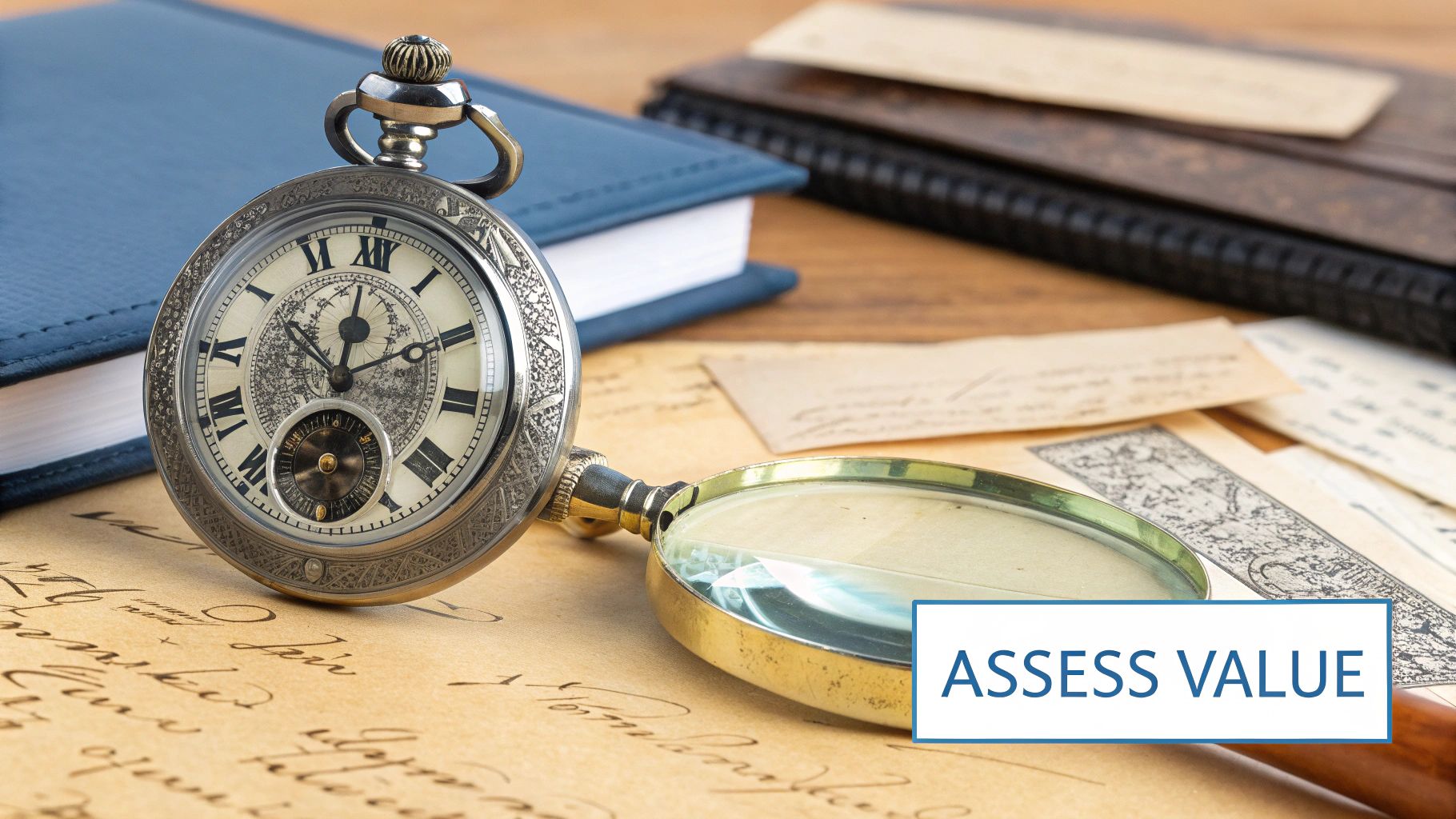
Ever look at two old silver pocket watches and wonder why one is worth a couple of hundred dollars while the other could fetch thousands? It’s not just random chance. The value of an antique timepiece is a fascinating mix of artistry, history, mechanics, and a little bit of magic.
Think of it like appraising a vintage car. Sure, it matters if the engine runs, but the real value is in the details: Who built it? How many are still around? And what kind of life has it lived? Getting a feel for these key factors is the first step to truly understanding what makes a pocket watch special. Let's peel back the layers and see what really builds a watch's worth.
The Maker's Mark and Reputation
The name etched into the movement is often the single biggest clue to a watch's value. Just like today, certain brands from the past built a legendary reputation for quality, innovation, and style that serious collectors will pay for.
The titans of American watchmaking are always in high demand. Names like Waltham, Elgin, Hamilton, and Illinois are revered for their brilliant engineering and high-quality movements that were, amazingly, mass-produced. Across the pond, European makers like Patek Philippe, Vacheron Constantin, and Longines represent the absolute peak of handcrafted luxury, and their prices reflect that.
The maker’s reputation is basically a promise of quality. A watch from a famous brand isn’t just a device for telling time; it's a tangible piece of watchmaking history, and that legacy has real value.
Of course, not all watches from a great maker are created equal. A high-end, railroad-grade Waltham will always be worth more than their basic, entry-level model. This is where the nitty-gritty details, like the specific movement grade and jewel count, really start to matter.
Rarity and Historical Significance
Beyond the brand, rarity is a massive piece of the puzzle. Was this watch part of a small, limited run? Does it have a quirky design or a special complication that you just don't see every day? A watch with a very low serial number or one from a model that was only made for a year or two is naturally harder to find, and that scarcity drives up its price.
A watch's story can also elevate it from a simple antique to a true historical artifact. A pocket watch carried by a famous general or one issued to sailors during a specific war has a story that goes far beyond its gears and springs. This is where provenance—a documented history of who has owned the watch—becomes incredibly important.
The collector's market loves these unique pieces. A well-kept silver pocket watch from a top American brand like Waltham or Elgin, made in the late 1800s or early 1900s, can easily be worth between $150 and over $300. But find that same watch with its original box and papers? The value can shoot up dramatically.
The Importance of Condition and Originality
In the antiques world, condition is king. It doesn't get much simpler than that. Collectors are looking for a timepiece that’s as close to factory-fresh as possible, even if it's over a century old.
When evaluating a watch, you have to look closely at a few key areas:
- The Dial: The watch face should be clean. Hairline cracks in old porcelain dials are common, but they always lower the value. Faded numbers or a botched repair job are also big red flags.
- The Case: For an antique silver pocket watch, the case shouldn't have any major dents or deep gouges. You want to see crisp engravings, not surfaces worn smooth over time. The hinges should be solid and the covers should snap shut securely.
- The Movement: Does it run? A working movement is obviously a huge plus. But more importantly, are all the parts original? A "frankenwatch"—a watch cobbled together from the parts of several others—is a collector's nightmare and has very little value.
Ultimately, the most sought-after watches are the ones that have been cherished and preserved. Finding a piece that still has its original box, sales receipt, or other documents is like hitting the jackpot. This complete set tells a verifiable story, making the watch incredibly desirable. You can dive deeper into the specifics of antique pocket watch value in our more detailed guide.
Essential Care for Your Antique Timepiece
Owning an antique silver pocket watch means you're the current guardian of a small, mechanical marvel. This piece has likely been ticking away for over a century, and with the right care, it can keep going for generations. Proper maintenance isn't rocket science, but it does call for a gentle, consistent hand.
Think of your watch's movement as a tiny, intricate engine. Just like a classic car, it needs to be treated with respect to keep it humming. That means getting the hang of winding it correctly, keeping it clean, and knowing when to call in a professional. These simple steps are everything when it comes to preserving its function and its history.
The Gentle Art of Winding Your Watch
Winding your timepiece is the most frequent interaction you'll have with its delicate guts. The key here is to be smooth and gentle. For a typical stem-wind watch, just turn the crown clockwise until you feel it stop you with firm resistance. Don't ever try to force it past this point—that's how you snap the mainspring.
It's a great habit to wind your watch around the same time each day. This keeps consistent pressure on the movement, which actually helps with its accuracy. A full wind should give you about 24 to 30 hours of power. By making it a daily ritual, you ensure the watch is always ready to go without putting extra stress on its vintage parts.
Keeping the Silver Case Gleaming
An antique silver pocket watch case is going to develop a patina over time, and honestly, that's part of the charm many collectors love. But you do want to keep it free of dirt and the kind of heavy tarnish that hides all the beautiful engraving work. The absolute enemy here is aggressive polishing, which can literally rub away the fine details and tank the watch's value.
For day-to-day cleaning, a soft, dry microfiber cloth is all you need to get rid of fingerprints and dust. If you're up against more serious tarnish, you have to use safe methods. Our guide on how you can remove tarnish from silver walks you through the process without causing damage.
Important Takeaway: Stay far away from liquid silver polishes or chemical dips. These fluids can easily seep through tiny gaps in the case and wreak havoc on the delicate movement inside. It's a recipe for disaster.
Why Professional Servicing Is Non-Negotiable
While you can handle the daily winding and gentle wipe-downs, the internal movement needs an expert. Think of it as a mandatory health check-up for your timepiece. You should have your watch serviced by a professional watchmaker—preferably one who specializes in vintage pieces—every 3 to 5 years.
During a full service, a watchmaker will:
- Completely Disassemble the Movement: Every tiny screw, gear, and spring is carefully removed and inspected for wear.
- Clean All Components: Old, gummy oils and decades of dust are meticulously cleaned from each part.
- Reassemble and Lubricate: The movement is put back together, with fresh, specialized oils applied to all the critical friction points.
- Regulate for Accuracy: Finally, the watch is tested and adjusted to keep the most accurate time it possibly can.
This regular maintenance is the single best investment you can make in your watch's future. It stops parts from grinding themselves into dust and ensures the intricate little machine keeps ticking precisely for many more years.
The final piece of the puzzle is simple storage. When you're not carrying it, keep your watch in a dry place with a stable temperature, away from humidity. A soft pouch or a handsome display dome will protect it from dust and scratches, preserving its condition so this piece of history remains a treasure.
Finding Your Way in Today's Collector's Market
Knowing the history and the inner workings of an old silver pocket watch is a fantastic start, but it's really only half the battle. To become a savvy collector, you have to learn the ropes of today's market—a place that can be both exciting and a little treacherous. This is where your knowledge really pays off, helping you make smart buys and connect with a whole world of people who share your passion.
The market today is a fascinating mix of old and new. You can still find treasures in dusty antique shops and at high-energy auctions, but online marketplaces have completely opened up the game. The flip side of all that access is risk. You've got to learn to look at every potential purchase with a healthy dose of skepticism.
What's Hot Right Now?
Not all old watches are created equal in the eyes of collectors. Right now, there's a huge appetite for well-preserved watches from the golden age of American watchmaking. Think Waltham, Elgin, and Illinois. These were the workhorses of the railroad era, and collectors love them for their solid engineering and rich history. They really were the peak of precision mass production.
The numbers back this up. In just the last couple of years, we've seen some pretty common 18-size American pocket watches, many in silver or silver-plated cases, jump in value. For example, the Waltham Appleton, Tracy & Co. (Model 1877) saw its average price climb by 22.6% to $195. The Waltham William Ellery (Model 1879) wasn't far behind, rising 19.8% to $193. You can dig deeper into these shifts by checking out the pocket watch value trends in the full 2024 report.
If there's one thing to take away, it's this: condition and originality are king. A common watch in pristine, untouched condition will almost always fetch more than a rarer model that's been botched, repaired with the wrong parts, or just plain beaten up.
Sidestepping the Rookie Mistakes
As you start hunting for that perfect silver pocket watch, knowing what not to do is just as important as knowing what to look for. Your biggest defense is being aware of the common traps. The most infamous of these is the dreaded "frankenwatch"—a watch cobbled together from the parts of several different watches. It might tick and look okay from a distance, but to a serious collector, it’s worthless.
Here are a few essential tips to keep you safe and help you build a collection you can be proud of:
- Buy the Seller, Not Just the Watch: Stick to reputable dealers. Look for sellers with a long track record of happy customers and a no-fuss return policy. A good seller is proud of what they sell and will be upfront about any repairs or restoration.
- Demand to See the Guts: Never, ever buy a pocket watch without seeing clear, detailed photos of the movement inside. The serial numbers on the movement and case are your best friends—they should match what the factory records say for that specific model.
- Knowledge is Your Best Armor: The more you learn, the sharper your eye will become for spotting fakes and inconsistencies. Devour books, hang out in online forums, and don't be afraid to ask questions. In this hobby, your own expertise is the best tool you'll ever have.
Got Questions? We've Got Answers
Even with a detailed guide, a few specific questions always seem to pop up. Here are some quick, clear answers to the things collectors most often ask about their antique silver pocket watches.
Is It Real Silver? And Can I Wind It?
How can I tell if my pocket watch is real silver?
The best way is to look for the hallmarks stamped inside the case back. You can't fake these. Genuine silver cases will almost always have a mark, like "Sterling," ".925," or the little English "lion passant" symbol. Just be wary of names like "Silveroid" or "Nickel Silver"—those are just alloys and don't contain any real silver.
Is it safe to wind my antique watch every day?
Absolutely! In fact, it's what they were built for. Winding your watch around the same time each day keeps the mainspring at a consistent tension, which is key for good timekeeping. Just wind it until you feel a firm resistance, and then stop. Don't force it.
Think of daily winding as a gentle morning stretch for your watch. It keeps all the internal parts moving smoothly and consistently, helping it perform its best without putting any undue stress on the mechanism.
Selling Your Watch and Understanding Its Guts
Where's the best place to sell an antique pocket watch?
You have a few solid options, and the right one depends on your watch and your goals:
- Reputable Watch Dealers: These specialists know their stuff and will offer a fair price. They have overhead, so their offer might be a bit under retail, but it's a fast and secure way to sell.
- Auction Houses: If you have a particularly rare or valuable piece, this is the way to go. Auctions attract serious collectors who are often willing to pay a premium.
- Online Marketplaces: Sites like eBay or dedicated watch forums connect you with buyers all over the world. The tradeoff is that you'll be responsible for taking great photos, writing a compelling listing, and handling the shipping yourself.
What does the 'jewel' count in a watch movement mean?
This is a great question. The jewel count refers to the tiny synthetic rubies used as bearings for the gears. They're not there for bling—they're incredibly hard and smooth, which reduces friction and wear on the most critical moving parts.
A higher jewel count, usually 15 or more, is a clear sign of a higher-quality movement. It means the watch was built to be more durable, more accurate, and to last a very long time.
Have an antique you can't identify? Curio puts an expert in your pocket. Snap a photo to instantly learn about your antique's history, origin, and value. Download the Curio app today and uncover the stories hidden in your treasures.