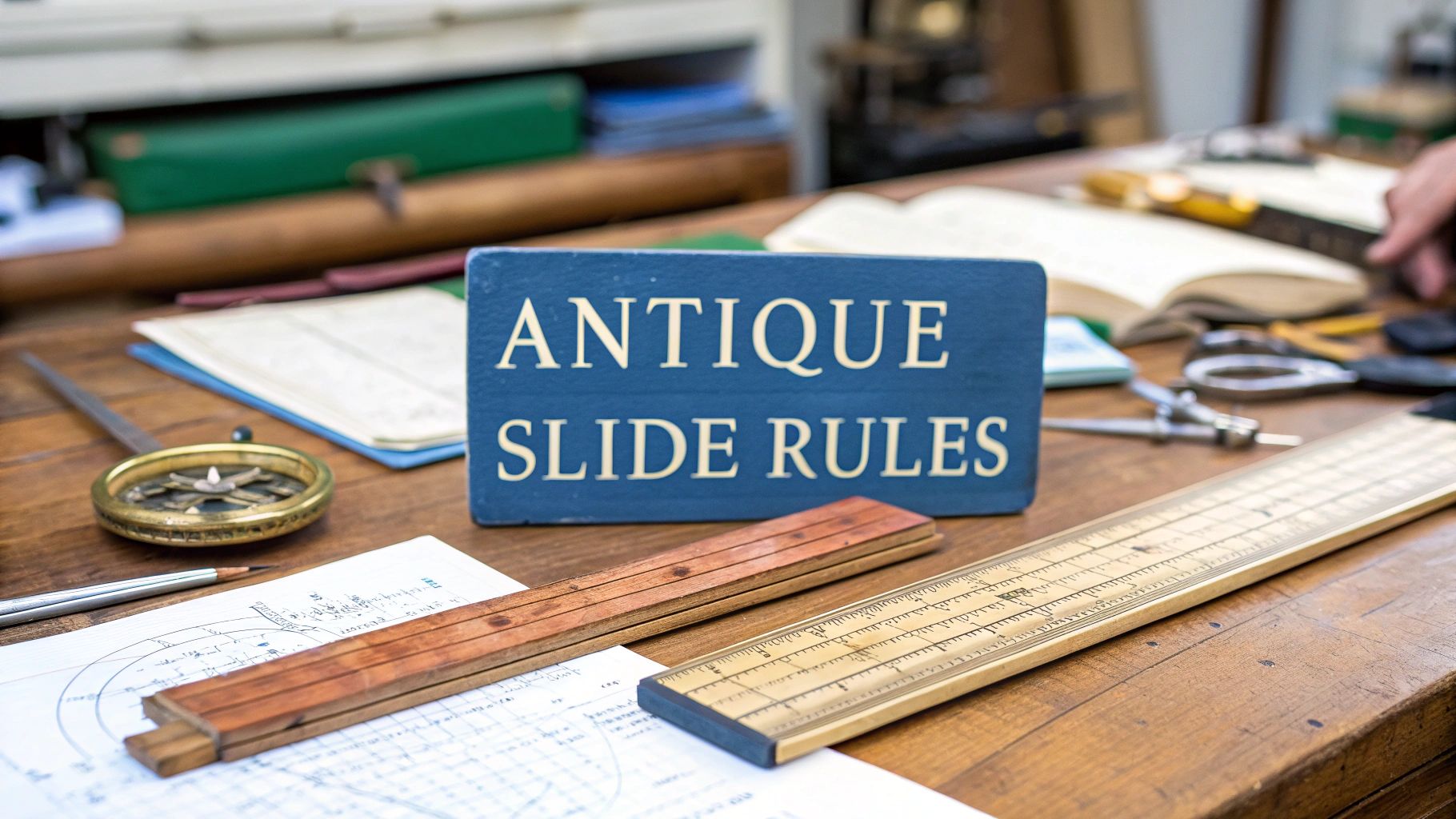
An antique slide rule is, at its heart, a mechanical analog computer. Long before electronic calculators became a staple on every desk, this was the go-to gadget for running complex math problems. It wasn't just a fancy ruler; it was a sophisticated instrument that gave engineers and scientists the power to tackle multiplication, division, trigonometry, and logarithms with impressive speed and accuracy.
Why Antique Slide Rules Are More Than Just Old Calculators
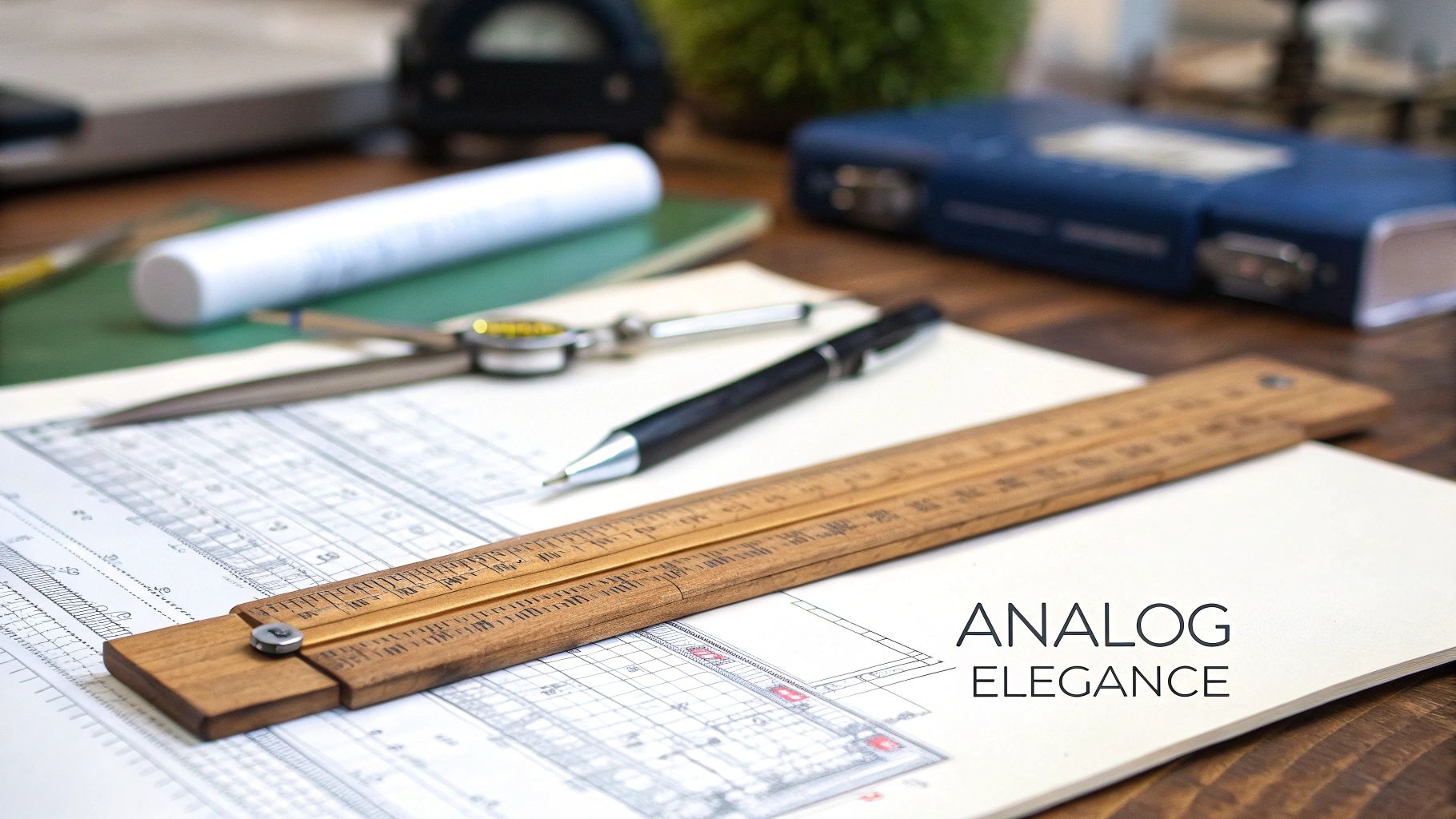
Before we had pocket calculators or smartphones, the slide rule was the workhorse of innovation. It was the trusted sidekick for the scientists, engineers, and mathematicians who literally built the modern world. From the blueprints of iconic skyscrapers to the flight paths of the Apollo moon missions, these elegant tools were right there in the thick of it. Every little scratch and worn spot on an old slide rule tells a story of a problem solved or a discovery made.
Unlike a digital calculator that just spits out an answer, a slide rule demanded real skill and a feel for the numbers. The user had to have a rough idea of the answer's magnitude beforehand, which built a kind of "number sense" that we've largely lost today. It’s like the difference between driving a stick shift and an automatic—one requires a much deeper connection and understanding of the machine you're operating.
The Appeal for Collectors and Enthusiasts
Today, antique slide rules are capturing the imagination of a whole new crowd of collectors, history buffs, and curious minds. They are tangible links to an era of brilliant analog thinking, representing the absolute peak of mechanical calculation right before the digital revolution made them obsolete almost overnight in the 1970s.
What's the draw? It really boils down to a few key things:
- Historical Significance: Owning a slide rule is like holding a piece of history. Many of these instruments were on the front lines of major projects, from wartime engineering to the space race.
- Craftsmanship and Design: These were precision tools, often built from beautiful materials like mahogany, bamboo, boxwood, and early plastics, all featuring intricate, hand-scribed scales.
- Intellectual Curiosity: Learning to use one is a fantastic mental workout. It gives you a real appreciation for the mathematical principles that make our world tick.
A slide rule user was forced to consider whether the answer they were seeing made sense in the context of the question. They’d outsourced their common sense to a device and ceased to realize that their own mistakes could lead the device to give answers no thinking person should have believed.
Your Gateway to a Fascinating Hobby
Maybe you found a dusty slide rule in a grandparent's desk, spotted one at a flea market, or you're just a fan of vintage tech. Whatever your story, this guide is for you. Especially for those using apps like Curio to identify hidden gems, knowing what makes a slide rule special can turn a quick scan into a thrilling discovery.
We’ll dig into what to look for, how to spot the key models, and what makes these beautiful instruments so compelling. This isn't just about collecting old tools—it's about connecting with the elegant, hands-on thinking that built the world we live in today.
Recognizing the Legendary Slide Rule Manufacturers
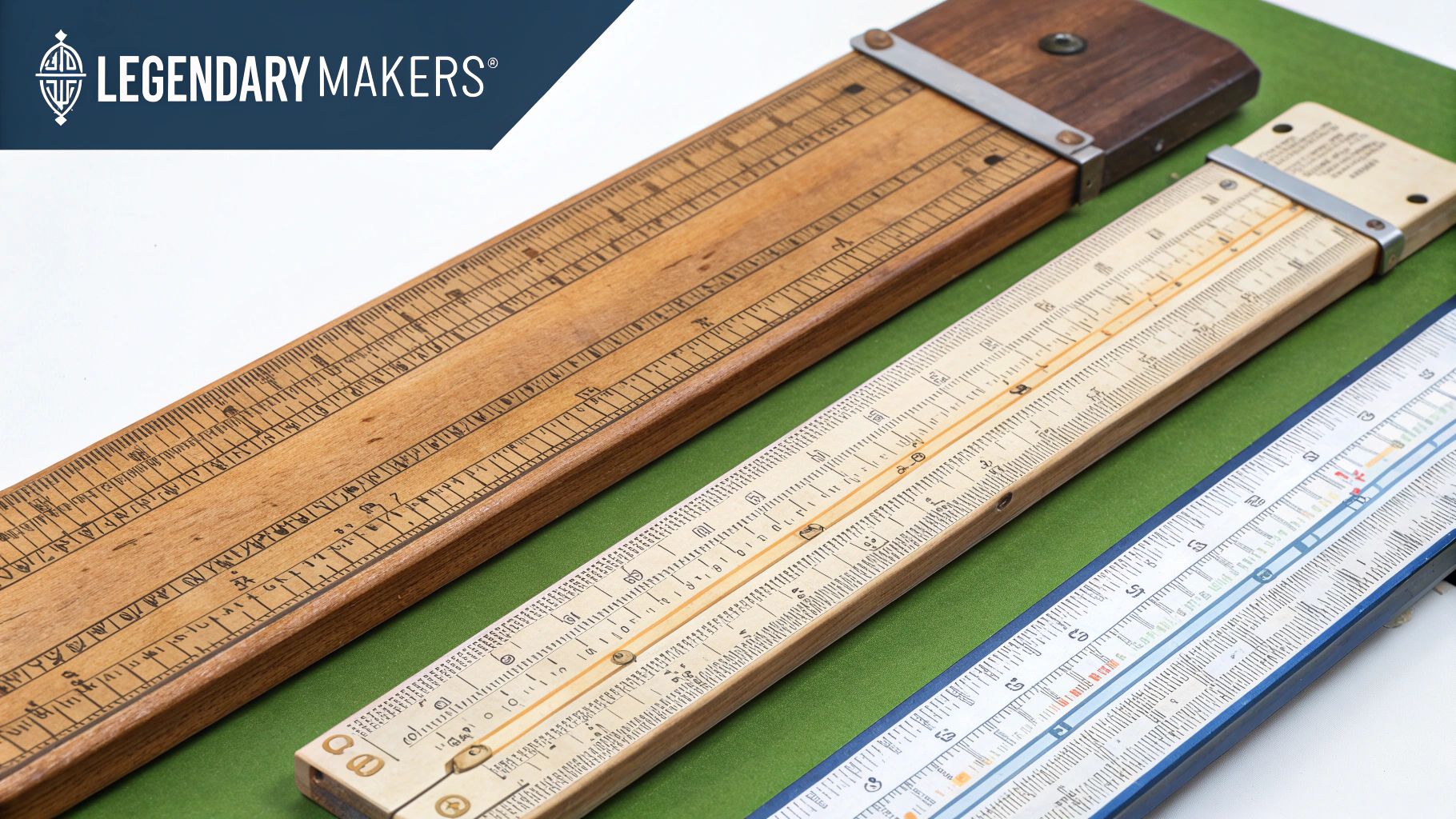
Just as a car enthusiast can spot a classic Ford from a mile away, a seasoned slide rule collector learns to recognize the titans of the trade. That little manufacturer’s name stamped on a rule is far more than just a brand. It’s a mark of quality, a clue to its origin, and a key that unlocks its story.
Knowing these legendary makers is the first step toward understanding any antique slide rules you come across. From American powerhouses to German precision masters and Japanese innovators, a handful of names dominated the industry. When you spot one in a dusty box at an estate sale, identifying the maker instantly tells you whether you're holding a common student tool or a professional-grade artifact.
Keuffel & Esser: The American Giant
In the United States, one name stands above all others: Keuffel & Esser, or K&E. Founded way back in 1867, K&E wasn’t just a manufacturer; it was an institution that set the standard for quality and innovation in the American market for nearly a century. They were known for their relentless pursuit of perfection.
Their most iconic models were built on a mahogany base and then laminated with brilliant white celluloid. This combination gave the rules exceptional stability against changes in temperature and humidity, ensuring the finely engraved scales remained dead-on accurate. The famous K&E Deci-Lon, a favorite of NASA engineers during the Apollo program, is a perfect example of their complex, high-end designs.
Finding a K&E slide rule is often a collector's first major discovery. Their sheer market dominance means they are relatively common, yet the quality of their top-tier models, like the Log Log Duplex Decitrig, remains a benchmark for slide rule craftsmanship.
German Engineering Precision
Germany was the undisputed heartland of slide rule production in Europe. It was home to several manufacturers whose names became synonymous with precision engineering, and their rules were celebrated for their crisp markings, smooth operation, and robust construction.
Two of the most prominent German makers were:
- Faber-Castell: A company famous for its art supplies, Faber-Castell also produced some of the finest slide rules you could buy. They were pioneers in using plastics, and their later models are known for their bright white finish and excellent readability.
- ARISTO (Dennert & Pape): Founded in 1862, ARISTO was a giant. They eventually transitioned from mahogany-celluloid construction to their proprietary all-plastic material, "Aristopal," in 1936 and never looked back.
The scale of production from these European workshops was staggering. Over its long history, ARISTO sold an estimated 5.4 million school rules and 2.4 million professional models. Another German giant, Nestler, was cranking out over 100,000 rules annually by the 1950s. You can explore more about these production histories to get a sense of just how massive the demand was before the electronic era took hold.
Hemmi: The Japanese Bamboo Master
While wood and plastic were the materials of choice in the West, Japan’s Hemmi blazed a different trail. In 1895, they pioneered a unique process of laminating celluloid onto a specially treated bamboo core. This innovation was a game-changer.
Bamboo offered the perfect combination of qualities for a precision instrument. It was dimensionally stable, strong yet lightweight, and the natural oils in the wood gave the slide an incredibly smooth, self-lubricating action. Hemmi’s bamboo slide rules were so well-regarded that they were exported globally, often rebranded for other companies like the American distributor Post. In 1967 alone, Post sold 52,000 Hemmi-made rules in the U.S.
To help you keep these major players straight, here’s a quick-reference table.
Major Slide Rule Manufacturers At A Glance
| Manufacturer | Country of Origin | Known For | Common Materials |
|---|---|---|---|
| Keuffel & Esser (K&E) | USA | Dominant American brand; high-quality professional models used by NASA. | Mahogany with celluloid laminate. |
| Faber-Castell | Germany | Precision engineering; crisp, readable scales. | Wood with celluloid, later all-plastic. |
| ARISTO | Germany | High-volume production for educational and professional markets. | All-plastic ("Aristopal") after 1936. |
| Hemmi | Japan | Innovative use of bamboo, providing a uniquely smooth slide action. | Bamboo core with celluloid laminate. |
By learning to recognize these key manufacturers—K&E for its American legacy, Faber-Castell and ARISTO for their German precision, and Hemmi for its ingenious bamboo designs—you can quickly assess the significance of almost any slide rule you encounter. Each name carries a legacy of quality and a unique place in the history of technology.
How to Identify and Date Your Slide Rule

Every old slide rule tells a story, with clues to its past etched right onto its surface. To most people, it’s just an interesting old measuring stick. But for a collector, it’s a historical puzzle waiting to be solved. Learning to identify and date a slide rule is like being a detective, piecing together evidence from its markings, materials, and design.
This process turns a dusty flea market find into a genuine artifact with a known history and purpose. It's an incredibly rewarding skill that builds a deeper connection with your collection and is absolutely essential for anyone who truly wants to understand these fantastic analog computers.
Start with the Obvious Clues
Your investigation should always start with the most prominent markings. Almost every slide rule will have the manufacturer's name and a model number printed or engraved somewhere on the body—usually on the front face, the back, or along one of the edges. Think of these as your primary leads.
Finding a name like Keuffel & Esser, Faber-Castell, or Hemmi immediately places the rule within a specific time and place. The model number, like a K&E 4081-3 or a Pickett N600-ES, is your next critical piece of information. With that, you can jump into online databases and collector forums to look up specific production details.
Of course, markings can be faint or worn down over time. A good magnifying glass and bright, angled light are your best friends here. Tilting the rule back and forth under a lamp can often make faded engravings pop right out. For more general tips that apply to all sorts of collectibles, you can learn more about how to identify antiques in our comprehensive guide.
Read the Materials and Construction
The very materials a slide rule is made from are a fantastic giveaway of its age. The evolution from wood to plastic directly mirrors the technological advancements of the era, giving you a powerful tool for narrowing down a production timeline.
Early Wood Rules: The earliest slide rules, from the 19th and early 20th centuries, were often crafted from solid woods like boxwood or mahogany. They have a wonderful, warm feel but were notoriously susceptible to warping with humidity changes.
Laminated Construction: To combat the warping problem, makers like K&E began laminating a thin veneer of white celluloid over a stable mahogany core. This became the gold standard for high-end rules from the early 1900s all the way through the 1950s.
The Bamboo Innovation: Japan's Hemmi perfected a unique method using a bamboo core faced with celluloid. This approach, popular from the 1920s onward, created a slide rule that was not only incredibly stable but also had a famously smooth, almost self-lubricating action.
The Age of Plastic: By the 1950s and 60s, plastic technology had come a long way. This led to all-plastic rules from makers like ARISTO (with their "Aristopal" material) and Pickett & Eckel, famous for their signature yellow-green bodies. This shift defined the final generation of slide rules.
Don't forget to check the cursor, or "indicator." It’s another great dating tool. Early cursors from before 1900 were often simple brass frames with no glass at all. Framed glass cursors became the norm in the early 20th century, and by the 1930s, sleek "frameless" all-glass indicators appeared, giving a much clearer view of the scales.
Decode the Scales and Markings
The arrangement of scales on a slide rule tells you what it was designed for and how complex it is, which offers even more clues about its age. A simple, early design looks worlds apart from the function-packed rules that were common by the mid-20th century.
Key Scale Arrangements to Know:
- Mannheim Layout: This is a basic, one-sided layout with A, B, C, and D scales that was developed in the mid-19th century. If you find a rule with only these fundamental scales, it often points to an older model or a basic version made for students.
- Duplex Layout: A huge leap forward, the Duplex design put scales on both the front and back of the slide rule's body and slide. K&E was a pioneer of this design around 1900, which allowed for far more complex calculations and specialized scales.
- Log-Log Scales: The arrival of Log-Log (LL) scales in the early 20th century was a game-changer for scientists and engineers, finally letting them calculate powers and roots easily. Their presence tells you you're looking at a professional-grade rule made after this innovation.
Finally, hunt for any patent dates stamped on the rule. A patent date isn't the manufacturing date, but it gives you a firm "no earlier than" point. For instance, a K&E rule with a 1934 patent date was definitely made sometime after that year. For Keuffel & Esser rules in particular, dedicated collectors have compiled incredibly detailed serial number lists, which can often date a rule to its exact year of production. A quick search for "K&E serial number dating" can give you a very precise answer for these common and beloved antique slide rules.
Determining the Value of Your Slide Rule
So, what separates a dusty old measuring stick from a prized collectible? For antique slide rules, it all comes down to a few key things: its condition, whether it has all its original parts, and just how rare it is.
Not every slide rule is a hidden treasure. A common student model you find rattling around in an old desk drawer is worlds apart from a specialized, high-end rule that once belonged to a top engineer. Learning to spot the difference is the first step to becoming a savvy collector. Think of it like any other antique—a flawless piece with its original box will always be worth more than a beat-up, incomplete one. The same logic applies here.
Condition Is Everything
Let's get one thing straight: condition is king. I can't stress this enough. A rare slide rule in terrible shape is almost always worth less than a more common model that looks like it just came out of the box. Collectors want instruments they can display proudly, and maybe even use.
When you get your hands on one, here’s what to check for:
- Readable Scales: Are the markings crisp and clear? If they’re faded, stained, or worn away, the value plummets.
- Smooth Action: The middle part, the slide, should move back and forth easily—not too tight, not too loose. A warped body or a slide that sticks is a huge red flag.
- Body Integrity: Look closely for any cracks, chips, or deep gouges on the body, slide, or the cursor (the little sliding window). The cursor is often the most fragile part, so inspect its glass or plastic carefully.
- Stains and Discoloration: A bit of yellowing from age is perfectly normal, but big, ugly stains from ink, water, or who-knows-what are serious deal-breakers.
A slide rule in fantastic condition tells a story. It shows it was well-made and well-cared for, a true testament to its original owner.
A Complete Kit Is a Collector's Dream
Ever found an old toy car still in its original packaging? It’s a special feeling, right? It's the same with slide rules. Finding one with all its original pieces—what collectors call a "full kit"—can easily double or even triple its value.
A slide rule with its original case, instruction manual, and any other accessories is a little time capsule. It gives you the full picture of how the tool was sold and used, which is exactly what serious collectors are looking for.
The case is the most common accessory you’ll find. If it’s leather, check for scuffs, broken stitches, or a busted clasp. But the real bonus is finding the original instruction manual. Most of these were thrown away decades ago, so having one adds a ton of historical context and value.
Rarity and Specialization: The Big Money-Makers
Sure, millions of slide rules were made, but most were standard, mass-produced models for students and engineers. The real value lies in the rare and specialized rules that were made in much smaller numbers. A basic Mannheim-style rule is a dime a dozen compared to one built for a very specific job.
Look for models designed for niche professions. These are often much scarcer and more valuable:
- Electrical Engineering Rules: Packed with unique scales for complex circuit calculations.
- Surveying or Artillery Rules: Built for specific tasks in the field, either for military or civil projects.
- Chemistry or Statistical Rules: Highly specialized tools for scientists and researchers.
The sheer number of slide rules produced was staggering. In 1967 alone, the U.S. market bought 260,000 new ones, and the giant Keuffel & Esser had a whopping 38% of that market. With tens of millions made worldwide, it's the weird, low-production models that really get a collector's heart racing.
Ultimately, putting a price on an antique slide rule takes a trained eye. But if you need a quick gut check at a flea market or an estate sale, a modern tool like an antique value estimator can give you a solid starting point from just a photo. It can help you figure out in seconds if you’re holding a common classroom tool or a rare professional artifact worth a much closer look.
Preserving and Caring For Your Collection
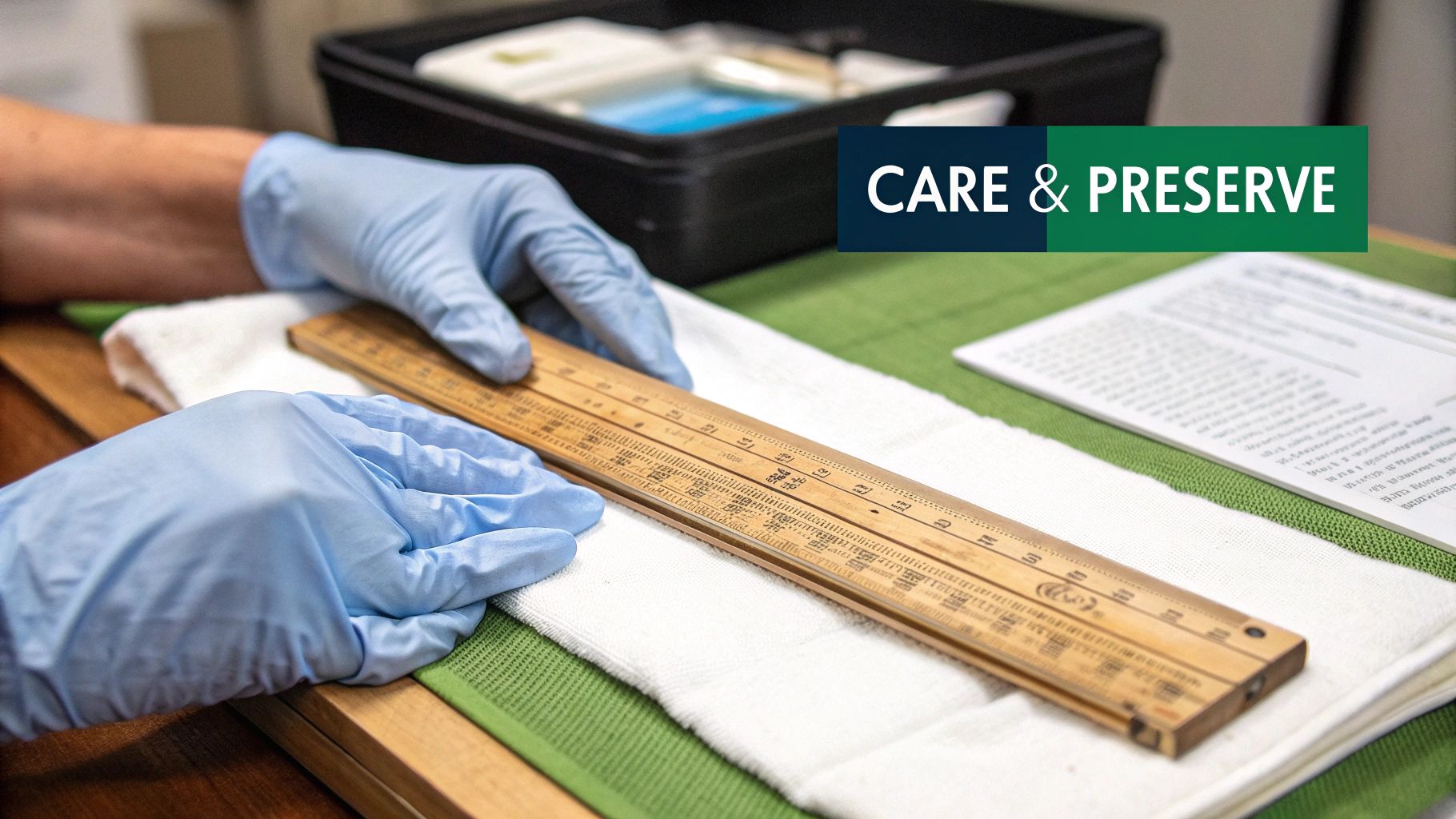
Proper care is what turns a simple collection into a lasting legacy. When it comes to antique slide rules, your main job is to shield them from the very things that wear down historical objects: light, moisture, and extreme temperatures. A little mindful maintenance will keep their delicate markings sharp and their action smooth, preserving their story for the next generation.
These aren't modern electronics. Most are made from wood, bamboo, or early plastics—materials that breathe and react to their environment. A bit of preventative care now will pay off massively in the long run.
Gentle Cleaning Techniques
Let's get one thing straight: aggressive cleaning will destroy an antique slide rule. Harsh chemicals, abrasive pads, and even too much water can fade the scales, warp the wood, or cause the celluloid facings to lift and crack. The golden rule here is to always start with the gentlest method first.
For most situations, a soft, dry microfiber cloth is your best friend. It’s perfect for lifting away decades of dust from the body, slide, and cursor without snagging anything. You'd be surprised how much of a slide rule's original beauty can be revealed with just this simple step.
If a dry wipe doesn’t quite cut it, you can slightly dampen a corner of the cloth with a bit of clean water. Wring it out until it’s barely damp to the touch. Never apply water directly to the slide rule itself. Moisture is the enemy—it can easily seep under the scales and into the joints, causing permanent damage.
Storing Your Collection Properly
How you store your slide rules is just as critical as how you clean them. The sweet spot is a place with stable temperature and humidity, and most importantly, away from direct sunlight. UV rays are brutal; they'll bleach the wood, turn the celluloid yellow, and make old plastics incredibly brittle.
Here are a few simple tips for safe storage:
- Avoid Extreme Environments: Attics, basements, and garages are off-limits. The constant fluctuations in temperature and humidity are a recipe for disaster. A closet inside the main, climate-controlled part of your house is a far safer bet.
- Use the Original Case: If a slide rule still has its original case, use it! These cases were made to protect them and are a key part of the item's history and value.
- Keep Them Flat: Always store your slide rules lying flat on a level surface. This prevents the body from bowing or warping over time. And whatever you do, don't stack heavy items on top of them.
Proper storage isn't just about preventing damage; it's about preserving the story. Each slide rule is a tangible piece of history, and protecting it from environmental harm ensures that its narrative of innovation and precision remains clear for years to come.
Wooden slide rules sometimes need a little extra TLC. If you're working with wood, our guide on how to clean antique wood safely provides more specific tips to help you care for it without ruining its historical character. A few simple habits will keep your collection in fantastic shape for years to come.
Understanding How a Slide Rule Actually Works
To really appreciate a beautiful old slide rule, it helps to understand the brilliant, simple idea that makes it tick. You don't need to be a math whiz—the concept is surprisingly elegant. It’s all about turning complex calculations into simple physical movements.
At its heart, a slide rule is a clever analog computer. It uses special scales, known as logarithmic scales, to turn multiplication and division problems into basic addition and subtraction. Think of it as a mechanical shortcut where adding two lengths together actually multiplies the numbers they represent.
Imagine you have two regular rulers. To add 2 and 3, you'd just place the start of one ruler at the "2" mark on the other and look for the "3" mark. A slide rule does the same thing, but because of its logarithmic numbering, adding those lengths results in multiplication.
A Quick Multiplication Example
Let's walk through a simple problem: 2 x 3. On most any antique slide rule, you’ll use the two primary scales, usually labeled C and D. These are your go-to scales for most calculations.
Here’s how it works in three simple steps:
- Set your starting point. Find the number 1 (called the "index") on the sliding C scale. Slide it so it lines up perfectly over the number 2 on the stationary D scale.
- Find your second number. Now, without moving the slide, look along that same C scale until you find the number 3.
- Read the answer. Look directly below that 3 on the C scale to the number it's pointing at on the D scale. You'll find it's pointing right at 6. Just like that, you've multiplied 2 x 3 by adding their logarithmic lengths.
The real art of using a slide rule was knowing the "order of magnitude." The scales might tell you the answer involves a "6," but it was up to you to figure out if the actual answer was 0.6, 6, or 60. This developed a kind of "number sense" that modern calculators have made obsolete.
This simple exercise reveals the magic of the device. It’s not a black box spitting out an answer; it’s a hands-on tool that makes the relationships between numbers tangible. By sliding a piece of wood or plastic, you're performing the very same kind of calculations that helped send humanity to the moon.
Your Antique Slide Rule Questions, Answered
As you get deeper into the world of antique slide rules, you're bound to have questions. Maybe you’re a new collector wondering where to start, or you've just stumbled upon an old family heirloom and want to know its story. This section is here to clear up some of the most common curiosities with straightforward, practical answers.
Think of it as a quick chat with an experienced collector. Let's tackle those questions and help you feel more confident on your collecting journey.
Are Old Slide Rules Worth Any Money?
They absolutely can be. While a basic student model might only be worth $10 to $20, some antique slide rules are highly valuable. The final price really depends on a few key things.
For example, a rare, specialized model in mint condition from a big-name maker could fetch hundreds. A top-tier professional model like a Keuffel & Esser Deci-Lon, complete with its original case and manual, can easily go for $100 to over $500 at auction. It all comes down to a mix of rarity, brand, condition, and whether you have all the original parts.
What Is the Most Famous Slide Rule?
That's a tough one, as many models have a dedicated following. But if you had to pick just one, the Keuffel & Esser (K&E) Deci-Lon is probably the most iconic slide rule ever produced. It was a sophisticated, powerful instrument that was the gold standard for engineers and scientists back in the day.
Its place in history was sealed during the NASA Apollo program. Engineers used the Deci-Lon for the critical calculations needed to land a man on the moon, giving it a legacy that's hard to beat. That connection to the space race makes it a holy grail for many collectors.
How Can I Tell How Old My Slide Rule Is?
Dating a slide rule is like a little bit of detective work. The best clues are usually right there on the instrument. Start by looking for the manufacturer's name, a model number, or any patent dates stamped on the body or the slide.
The material it's made from also tells a big part of the story. The oldest rules were typically boxwood or mahogany. Later, manufacturers started laminating celluloid over wood or bamboo cores. By the 1950s and 60s, all-plastic models were the norm. For major brands like K&E, dedicated fans have even put together serial number lists that can help you nail down the exact year it was made.
When Did They Stop Making Slide Rules?
The slide rule’s reign ended surprisingly quickly in the mid-1970s. The arrival of the first affordable handheld scientific calculator, the Hewlett-Packard HP-35 in 1972, was the beginning of the end.
In just a few short years, electronic calculators became so cheap and common that the slide rule was rendered obsolete for almost all professional and school work. Major companies like K&E officially stopped making them around 1975, closing a fascinating chapter in the history of calculation.
Have an old slide rule you can't identify? Curio makes it easy. Just snap a photo, and our app will give you its history, origin, and an estimated value in seconds. Uncover the story behind your find by downloading Curio today.