Have you ever dusted off an old family heirloom and thought, "I wonder what this is really worth?" You're definitely not alone. This guide will walk you through how to appraise antiques online free, helping you turn that curiosity into a solid value estimate without spending a penny.
Uncovering the Value of Your Heirlooms Online
It's a common myth that getting an antique appraised means booking a pricey appointment with a specialist. The truth is, a whole host of online tools and communities now make it possible to get a surprisingly reliable preliminary valuation right from your living room. The trick is knowing where to look and how to present your item to get the best feedback.
Think of this as your starting point. I'll show you how to:
- Prep and photograph your items like a pro to show off what matters.
- Dig into digital resources like auction archives and collector forums.
- Realistically assess an item's condition and history to create an accurate value range.
The Growing Demand for Online Appraisals
The antiques and collectibles market has absolutely exploded in recent years. In fact, the wider collectibles market was valued somewhere between $300 billion and $450 billion globally in 2023. This incredible growth has created a huge demand for easy-to-access valuation tools, with more people than ever before turning to online auction results and market data to get a free antique appraisal.
From my experience, the best strategy isn't to rely on just one source. A quick scan with an image search tool, cross-referenced with what similar items actually sold for at auction, gives you a much more complete and realistic picture of your antique's worth.
This approach puts you in the driver's seat. For example, knowing the tiny details that matter for specific collectibles can make all the difference. To see just how deep this can go, check out this expert guide to UK coin valuation and accurate appraisal. By pulling together information from different sources, you can confidently figure out if that old family piece is a cherished keepsake or a valuable asset just waiting to be discovered. Let's turn that curiosity into clarity.
Getting Your Antique Ready for Its Online Close-Up
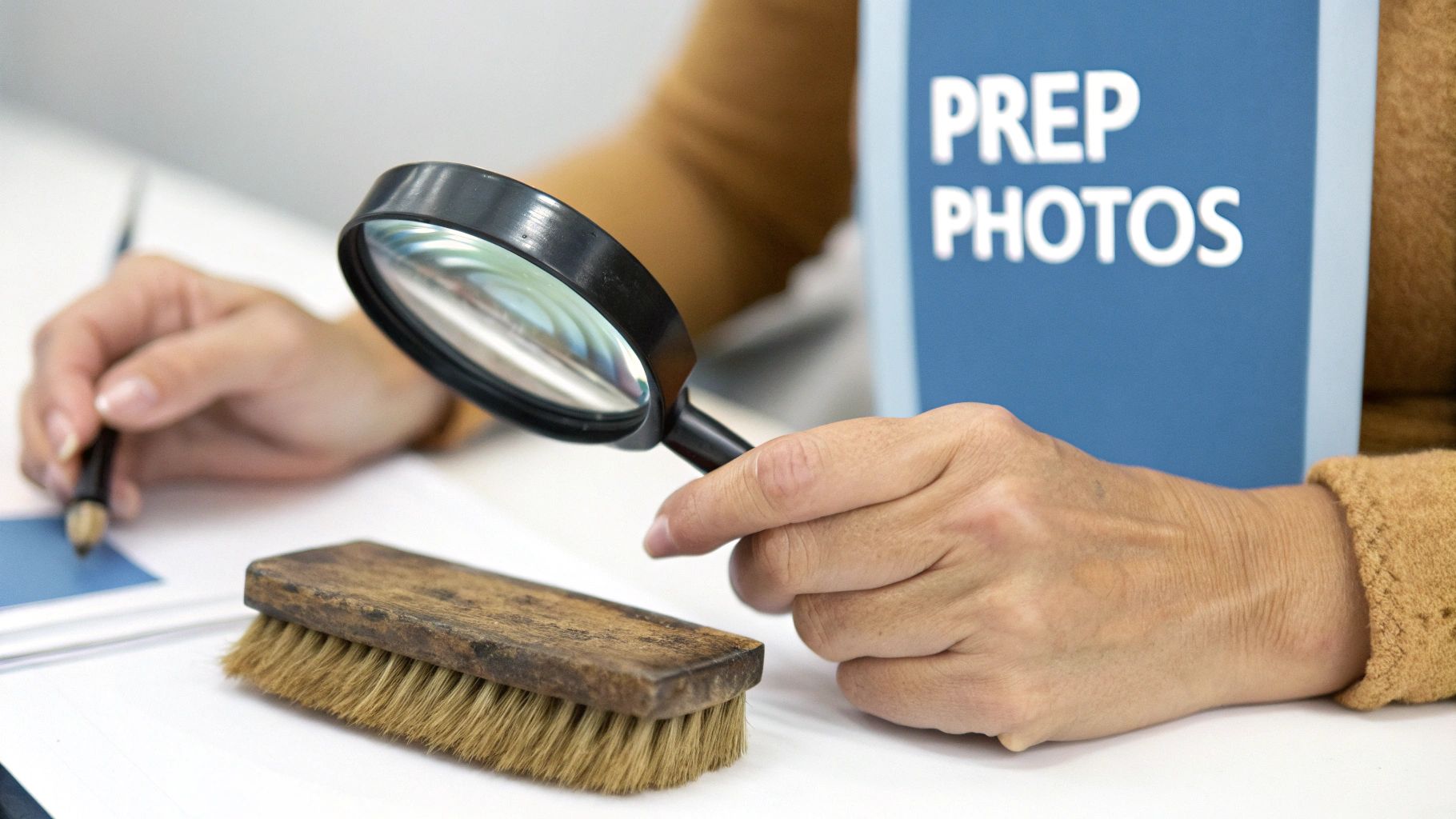
Before you can get a solid free online appraisal, you have to do a little prep work. Think of it like getting your item ready for a job interview. How you present it directly affects the outcome, because the expert on the other end of the screen can only judge what you show them.
First things first: a gentle cleaning. And when I say gentle, I mean it. The golden rule here is less is more. Aggressive scrubbing or harsh chemicals can destroy an item's value in seconds by stripping away its patina—that beautiful, subtle aging on wood and metal that collectors prize.
For most things, a soft, dry microfiber cloth is all you need to get rid of dust. If you’re dealing with something non-porous like glass or ceramic with a bit of grime, you can use a cloth that’s barely damp with a touch of mild soap, but be sure to dry it completely right away.
Playing Detective: Documenting the Details
With your piece clean, it’s time to put on your detective hat. Grab a good light and maybe a magnifying glass, and start hunting for the clues that tell your item’s story. These little details are everything for a proper appraisal.
- Maker's Marks: Flip over that vase or peer inside a furniture drawer. These are the logos or names of the company that made it.
- Signatures: On artwork, check the corners and even the back. You'd be surprised where artists hide their names.
- Hallmarks: For silver or gold, look for tiny stamped symbols. These tell you about the metal's purity, who made it, and often, when it was made.
- Patent Numbers: These are fantastic for dating an item, sometimes down to the exact year.
Jot down everything you find, exactly as you see it. It’s just as important to be honest about the flaws. Make note of every chip, scratch, crack, or old repair. A realistic valuation depends on a realistic assessment of its condition.
Taking Photos That Tell the Whole Story
Your photos are, without a doubt, the most important part of this whole process. An appraiser can’t hold your item, so your pictures have to do all the talking. If your shots are blurry or dark, you’ll either get a wild guess or no appraisal at all.
Your goal isn't to take an artistic photo but a documentary one. Every shot should serve a purpose, clearly showing the item's form, condition, and identifying features without any distractions.
Find a spot with a neutral background—a plain wall or a simple piece of fabric works great. Use natural daylight coming from a window, but avoid direct sun, which creates harsh shadows. Never use a flash; it washes out all the important details.
Take pictures from every possible angle: front, back, top, bottom, and each side. Then, zoom in. Get crystal-clear close-ups of every single mark, signature, and bit of damage you found earlier. The more visual proof you provide, the better. For a deeper dive into this, check out our complete guide on how to properly photograph antiques.
Tapping into Free Digital Tools for Your Initial Research
With your item prepped and photographed, you can now start the real detective work right from your couch. The goal here is to find what we in the business call "comparables"—items nearly identical to yours that have recently sold. For common antiques and collectibles, this is hands-down the most reliable way to figure out what you've got and what it might be worth.
A great first move is a reverse image search. Tools like Google Lens are surprisingly powerful. Just upload one of your best photos, and it will scour the web for anything that looks similar. It’s a game-changer for identifying a mystery piece. For example, that funky vase you inherited could turn out to be a classic piece of West German pottery from the 1970s, instantly giving you the keywords you need to dig deeper.
This method is fantastic for matching patterns, shapes, and styles that are tough to put into words. You’ll often land on collector forums, museum pages, or old sale listings that can finally put a name, maker, or date to your item.
Digging into Auction Archives and Sold Listings
Okay, this is the most important part. While identifying your item is fun, the real value comes from what people have actually paid for one like it. This is where you need to become best friends with auction archives and marketplace "sold" filters. Skipping this step is the biggest mistake I see people make.
You have to look at sold prices, not what people are asking for. Anyone can list an old chair for $1,000, but what truly matters is the final price when the hammer fell. The entire online appraisal market is built on this data. Some platforms have massive archives; for example, a major player like WorthPoint has cataloged over 1.2 billion images and tracks millions of auction results every month. It’s a treasure trove of information.
Here are the best places to find this data for free:
- eBay's "Sold Items" Filter: After you search for an item, look at the filter menu on the left side of the page. Scroll down and check the box for "Sold Items." This will show you what similar pieces have sold for in the last 90 days.
- LiveAuctioneers Price Results: This is an incredible free database with millions of sold lots from auction houses all over the world. It’s an essential tool for serious research.
Using these databases, you can search for specific makers or item types and see a real history of sale prices, which is exactly what you need to establish a realistic value range.
Refining Your Search Strategy
Just typing "old clock" into a search bar will get you nowhere fast. You have to be specific. Use all those little details you found during your initial inspection and your reverse image search.
Pro Tip: Combine your keywords to get laser-focused results. Instead of searching "silver spoon," try "Gorham Chantilly sterling silver teaspoon." The more precise you are, the better your comparables will be.
As you sift through the results, look closely at the condition described in the listings. Be honest with yourself—is your item in better or worse shape? That context is crucial for figuring out where your piece falls on the value spectrum. It takes a bit of effort, but doing this homework will give you a solid, fact-based foundation for your valuation. If you want to dive deeper, exploring dedicated price guides for antiques can also be a huge help.
Getting to the Bottom of Value: Condition, Provenance, and Rarity
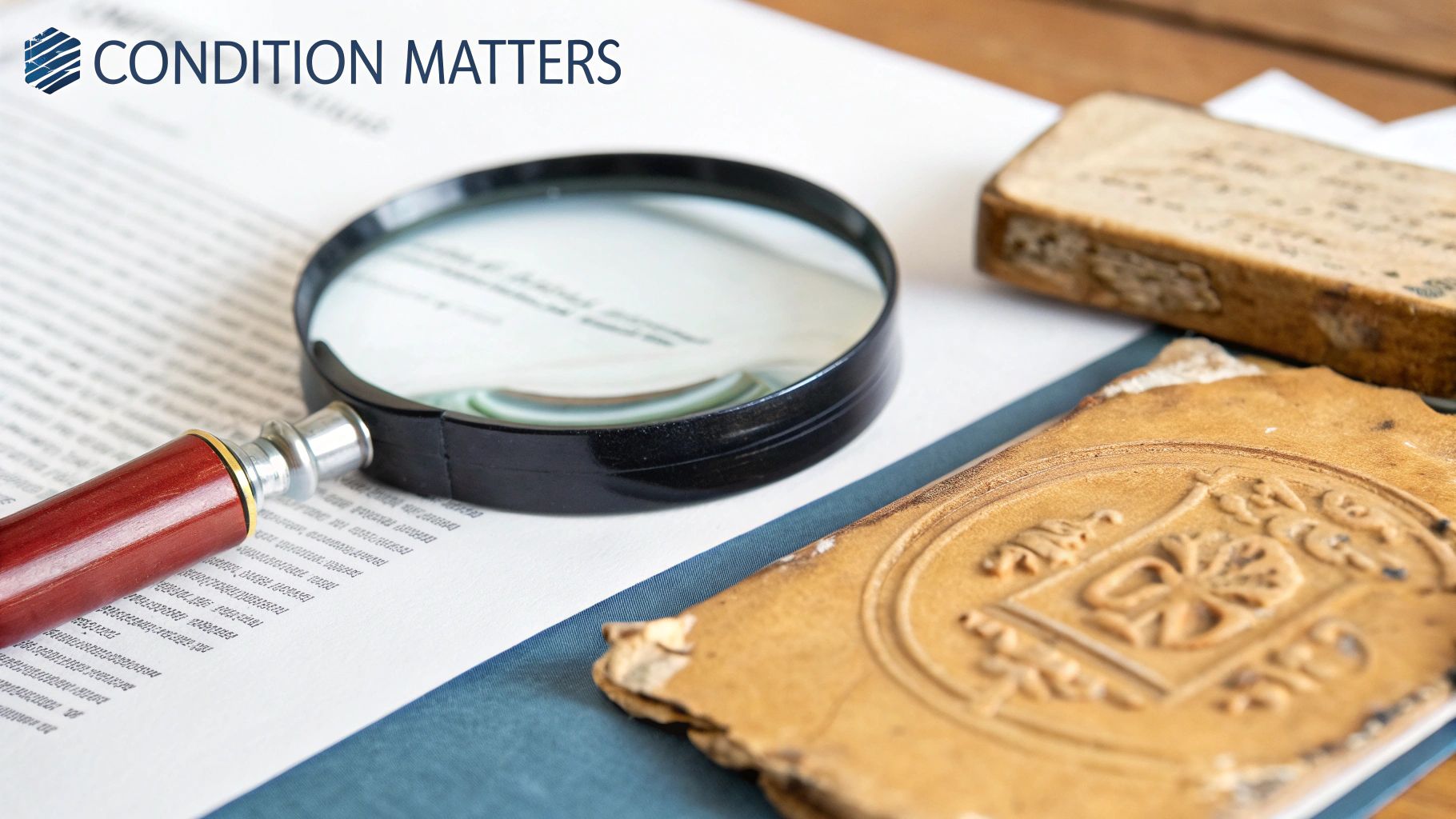
So, you've been digging through sold listings and found a few items that look just like yours. But then you notice something strange: one sold for $50, while another fetched a whopping $5,000. What gives?
The answer almost always comes down to three things that professional appraisers live by: condition, provenance, and rarity. Understanding these is what separates a casual guess from a truly informed appraisal.
Be an Honest Judge of Condition
An item's condition is so much more than a quick look for chips or cracks. The real devils are in the details. A hairline crack in a piece of porcelain, a skillfully hidden furniture repair, or even slight fading on a vintage print can slash an item's value by more than 50%.
You need to be your own toughest critic here. Get out a magnifying glass and document every single scuff, stain, and sign of wear. Look for tell-tale signs of restoration—things like modern screws in old wood, patches of paint that don't quite match, or one area that looks suspiciously cleaner than the rest. Being brutally honest about the flaws is the only way to get a realistic value.
Chasing the Story: Provenance and Rarity
Next up is provenance, which is really just a fancy word for the item's life story. This is where an object’s history can dramatically increase its value. Think about it: a simple wooden rocking chair is just that... until you find a letter proving it once belonged to a famous author. Suddenly, it’s not just a chair; it’s a piece of history.
Start digging for any kind of paper trail you can find:
- Old receipts or pages from a catalog
- Paperwork from a past appraisal
- Family photos or letters that show the item in use
- A certificate of authenticity
This documentation is the bridge connecting your object to a person, place, or time, and that connection is what collectors pay a premium for. Without it, you’re just selling an object. With it, you’re selling its story.
Finally, you have to consider rarity. Just because something is a century old doesn't automatically make it rare. Many factories in the Victorian era were masters of mass production, and their goods are still quite common today. Your research into auction results should give you a good feel for this. If you’ve found hundreds of similar items, yours probably isn’t rare. But if you’ve searched high and low and only found one or two others? You might be onto something special.
An item's value is a delicate balance of these three pillars. A rare piece in poor condition may be worth less than a common item in pristine condition. Likewise, an item with stellar provenance can overcome minor condition issues.
What’s It Made Of? Intrinsic Value
Beyond what a collector might pay, some antiques have a baseline value based purely on what they're made of. This is most obvious with items made from precious metals. An old, broken piece of gold jewelry might not have much appeal as a wearable antique, but the gold itself is still worth its weight.
To figure this out, you'll need to look for hallmarks—those tiny stamps that indicate purity. Getting this right is crucial, and robust systems offer functionalities for accurately validating metal type, karat, and purity values. For example, an "18K" stamp on a piece of gold means it’s 75% pure. This gives you a "melt value" floor, ensuring the item has a tangible worth even if its history remains a mystery.
When Is a Free Appraisal Not Enough?
Free tools are a fantastic starting point. They give you a solid ballpark figure and some much-needed context, especially when you're sorting through an inherited collection or trying to figure out if that flea market find is a treasure. But it’s crucial to know where they fall short.
Think of a free online valuation as a well-informed opinion based on publicly available sales data. It's not a legally binding document. If you need a value for anything official, it's time to bring in a professional.
High-Stakes Scenarios That Demand a Pro
Some situations just require more than a market estimate. They need a certified appraisal—a formal document from a qualified expert. It’s the difference between a friendly handshake and a signed contract.
You'll definitely want to hire a pro in these cases:
- Insurance Coverage: To properly insure a valuable piece against damage or theft, you'll need a formal appraisal. Insurance companies won't just take your word for it; they require this detailed documentation to write a policy rider that covers the item's full replacement value.
- Estate Planning and Distribution: When it comes to settling an estate, a certified appraisal is non-negotiable. It ensures assets are divided fairly among heirs and satisfies the legal requirements for probate court.
- Charitable Donations: Planning to donate a valuable antique and claim a hefty tax deduction? The IRS will want to see a qualified appraisal to back up the value you're claiming.
- Selling a High-Value Item: If your research points to your item being particularly rare or valuable (we're talking thousands of dollars), investing in a professional appraisal can pay for itself. It provides potential buyers with undeniable proof of authenticity and value, helping you get the best possible price.
A free online estimate tells you what your item might be worth to a collector. A paid, certified appraisal is a legally defensible document that establishes its value for insurance companies, lawyers, and government agencies.
Even with all the amazing modern tools at our disposal, most experts agree that for truly unique or high-value items, a formal paid appraisal is still the only way to go. This is especially true when large sums of money are involved, a point echoed in research about the internet's impact on the antiquities market.
To help you decide which path is right for you, here’s a quick comparison:
Free vs. Paid Appraisals: When to Choose Each
| Factor | Free Online Appraisal | Paid Professional Appraisal |
|---|---|---|
| Purpose | Casual curiosity, initial research, low-value sales | Insurance, legal matters, estate planning, high-value sales |
| Accuracy | Ballpark estimate based on market data | Precise, well-researched value based on physical inspection |
| Legality | Not legally binding | Legally defensible document |
| Process | Quick; submit photos online | In-depth; often requires physical inspection and research |
| Cost | Free | Varies, typically $100 - $300+ per hour or item |
| Best For | Common items, quick checks, personal knowledge | Rare artifacts, fine art, high-value antiques |
Ultimately, a free appraisal is a fantastic tool for discovery, but a paid appraisal is an essential investment for protection.
Finding a Qualified Appraiser
When you're ready to make that investment, don't just pick the first name you find online. Look for professionals affiliated with reputable organizations like the Appraisers Association of America (AAA) or the International Society of Appraisers (ISA). These groups hold their members to strict ethical codes and require ongoing education to ensure they're at the top of their game.
The process usually involves an in-person inspection where the appraiser can examine your item's condition, materials, and maker's marks up close. They then dive into deep market research to produce a comprehensive report. It’s an investment, for sure, but a necessary one. You can learn more by reading our guide on the typical cost of an antique appraisal. Taking this step ensures your most valuable treasures are properly valued and protected.
Got Questions About Free Online Appraisals?
Diving into the world of online appraisals for the first time? It's natural to have a few questions. Even when you follow all the right steps, you can still hit a few confusing roadblocks. Let's walk through some of the most common things that trip people up when they try to appraise their antiques online for free.
My goal here is to help you clear those hurdles. From figuring out why you're seeing wildly different prices to what to do with a piece that has no markings, we'll get you the answers you need to feel confident about your valuation.
Just How Accurate Are These Free Tools, Anyway?
This is the million-dollar question, isn't it? Can you actually trust what a free online tool tells you? The short answer is yes, for a certain purpose. Free tools are fantastic for getting a solid "ballpark" figure, especially for items that are fairly common. They work by crunching data from massive databases of past sales, which is exactly how professional appraisers start their research.
The big catch, though, is that they can't physically touch or examine your item. No camera or AI can feel the subtle hairline crack in a vase, spot a well-disguised modern repair on a piece of furniture, or confirm with absolute certainty that the signature is authentic.
Think of a free online appraisal as an excellent first step. It gives you a strong sense of what your item might be worth on the open market. But if you're dealing with something potentially very valuable, or need a figure for insurance, you'll still want a formal, in-person appraisal from a human expert.
It’s the perfect tool for satisfying your curiosity or for putting a price on something you're selling in a local marketplace.
What if My Piece Has No Maker's Mark?
It’s a classic moment of frustration: you flip over a beautiful vase or open a drawer and find... nothing. No signature, no stamp, no label. Many people assume this means the item is worthless, but that's rarely the case. In fact, tons of valuable antiques, particularly older furniture or unique folk art, are completely unmarked. So don't lose hope.
When there's no mark, you just become more of a detective. You have to shift your focus to the other clues the piece is giving you:
- Style & Design: Does it scream a particular era? Is it clearly Art Deco, or does it have the clean lines of Mid-Century Modern design?
- Materials: Get up close and personal. What kind of wood is it? Can you identify the metal? How is the fabric woven?
- Construction: Look at how it was made. Are there hand-cut dovetail joints on the drawers? That's a classic sign of an older, pre-industrial piece.
This is where your reverse image search becomes a superpower. Instead of a general photo, upload clear shots of these specific details. Collector forums, like Reddit's r/antiques, are also brilliant for this. The experienced folks there can often identify an item based on the way a leg is turned or a handle is attached. Just be sure to give them plenty of detailed pictures, including the back, the bottom, and the inside.
Why Am I Seeing So Many Different Prices?
You’ve done it! You found your exact item online. But then your heart sinks. One sold for $50, another for $250, and a third person has one listed right now for $800. What gives? This is completely normal, and learning to read the market is the key.
First things first: completely ignore "for sale" listings. An asking price is just what someone hopes to get. It’s meaningless until cash actually changes hands. You should only ever focus on confirmed "sold" prices from auction sites and marketplaces.
Next, you have to accept that value is almost always a range, not one specific number. That final sold price gets pushed and pulled by a few key factors:
- Venue: An item sold through a major auction house will almost always fetch more than the same item sold on Facebook Marketplace.
- Condition: That $250 piece was probably in mint condition. The $50 one? It likely had chips, cracks, or serious wear.
- Demand: Trends come and go. What was hot last year might have cooled off, and prices will reflect that.
To find a realistic value for your item, you need to find several sold examples that are in a similar condition. Throw out the highest and the lowest prices you see—those are the outliers. The average of what's left in the middle will give you a much more stable and defensible estimate of its true market value.
Ready to get a fast, data-driven starting point for your antique's value? For an easy way to appraise antiques online free, give Curio a try. Our AI-powered tool analyzes your photos in seconds to provide a quick estimate and historical context. It’s the perfect first step in your valuation journey. Visit the Curio website to see what your items are worth today.