Avon jewelry marks are the little signatures the company stamped onto its pieces. Think of them as a vital sign of authenticity. These marks, usually the 'Avon' name in block or script letters, changed over the decades, and they're the secret key to unlocking a piece's history, when it was made, and what it might be worth to a collector.
Decoding the Story Behind Avon Jewelry Marks
Treat an Avon jewelry mark like an artist’s signature on a painting. It tells you who made it and, with a little know-how, when they made it. Whether you're sorting through an inheritance, treasure hunting at a flea market, or carefully curating a collection, learning to read these tiny symbols is your first step. It's how you'll tell a common find from a rare collectible.
These marks are so much more than a simple brand logo; they are historical breadcrumbs.
Back in the 1960s, Avon jewelry was often unmarked because it was given away as a freebie with perfume or makeup. But when the company officially launched its dedicated jewelry line in the early 1970s, they knew they needed a consistent, recognizable mark. That's when the familiar 'AVON' stamp started showing up on everything.
The Evolution of Avon Signatures
As the years went on, that simple brand name started to include more details, giving collectors much richer clues. This evolution is exactly what makes identifying Avon pieces both a fun challenge and a genuinely rewarding hunt.
Here are a few key developments you'll see in Avon jewelry marks:
- Block vs. Script: The font of the "Avon" name itself is a big clue. Different styles were popular in different eras, so the font can help you narrow down the date.
- Copyright Symbol (©): When Avon started adding the copyright symbol next to its name, it created another easy-to-spot timestamp for dating their jewelry.
- Designer Initials: The most sought-after pieces often carry the initials of famous designers who collaborated with Avon, like "K.J.L." for Kenneth Jay Lane or a beautiful script "E" for Elizabeth Taylor.
Understanding these subtle variations transforms a simple piece of costume jewelry into a tangible piece of fashion history. It lets you connect a necklace or brooch to a specific decade and a particular designer's vision.
Keep in mind, these brand marks are different from the stamps you'd find on precious metals. For a deeper dive into that world, check out our guide on what hallmarks on silver mean. For now, let's keep unraveling the story your vintage Avon jewelry has to tell.
The Story Behind Avon's Jewelry Empire
How did a company known for perfumes and lipstick end up in everyone’s jewelry box? The story of Avon's rise in the jewelry world is a masterclass in smart marketing, turning a simple thank-you gift into a global phenomenon. The history of Avon jewelry marks doesn't start with a price tag, but with a clever freebie.
Back in the 1960s, Avon representatives would often give customers a small piece of jewelry as a gift with their cosmetics purchase. These early items, usually unmarked, were meant to build loyalty and encourage repeat business. What Avon quickly realized was that customers loved the jewelry just as much as the makeup.
From Free Gift to Flagship Product
Seeing a golden opportunity, Avon made a huge move. In 1970, the company officially launched its first dedicated jewelry line, stepping out from the beauty counter and into the world of fashion accessories.
This wasn't a half-hearted effort. The launch was headlined by the iconic 'Precious Pretenders' collection, which was advertised in major magazines. The line gave everyday women the look of high-end jewelry—gleaming gold plating and sparkling stones—at a price they could actually afford. It was from this point on that pieces were consistently stamped with the signature "AVON" mark, a stamp of quality and authenticity.
The leap from a simple promotional giveaway to a marked, standalone product line is what truly marks the birth of Avon as a serious jewelry brand. This bit of history is why collectors and resellers get so excited about finding pieces from this era.
The Power of the Avon Lady
What really set Avon's jewelry business on fire was its unique direct-sales model. An army of entrepreneurial "Avon Ladies" brought these stylish and affordable pieces right into living rooms across America. This person-to-person approach made fashionable jewelry accessible like never before.
By 1974, this brilliant strategy made Avon the biggest distributor of costume jewelry in the entire United States. The company's success story is deeply connected to the empowerment of women; its sales force ballooned to over 600,000 representatives by 1972, creating a billion-dollar industry from the ground up. This is why finding an early Avon jewelry mark feels like discovering a small piece of American entrepreneurial history. You can explore more of this incredible story in Avon's detailed interactive timeline.
The momentum was unstoppable. By 1979, Avon proudly declared itself the world's largest distributor of costume jewelry. It’s a legacy built on smart marketing, accessible style, and the pioneering spirit of countless women.
A Timeline of Common Avon Jewelry Marks
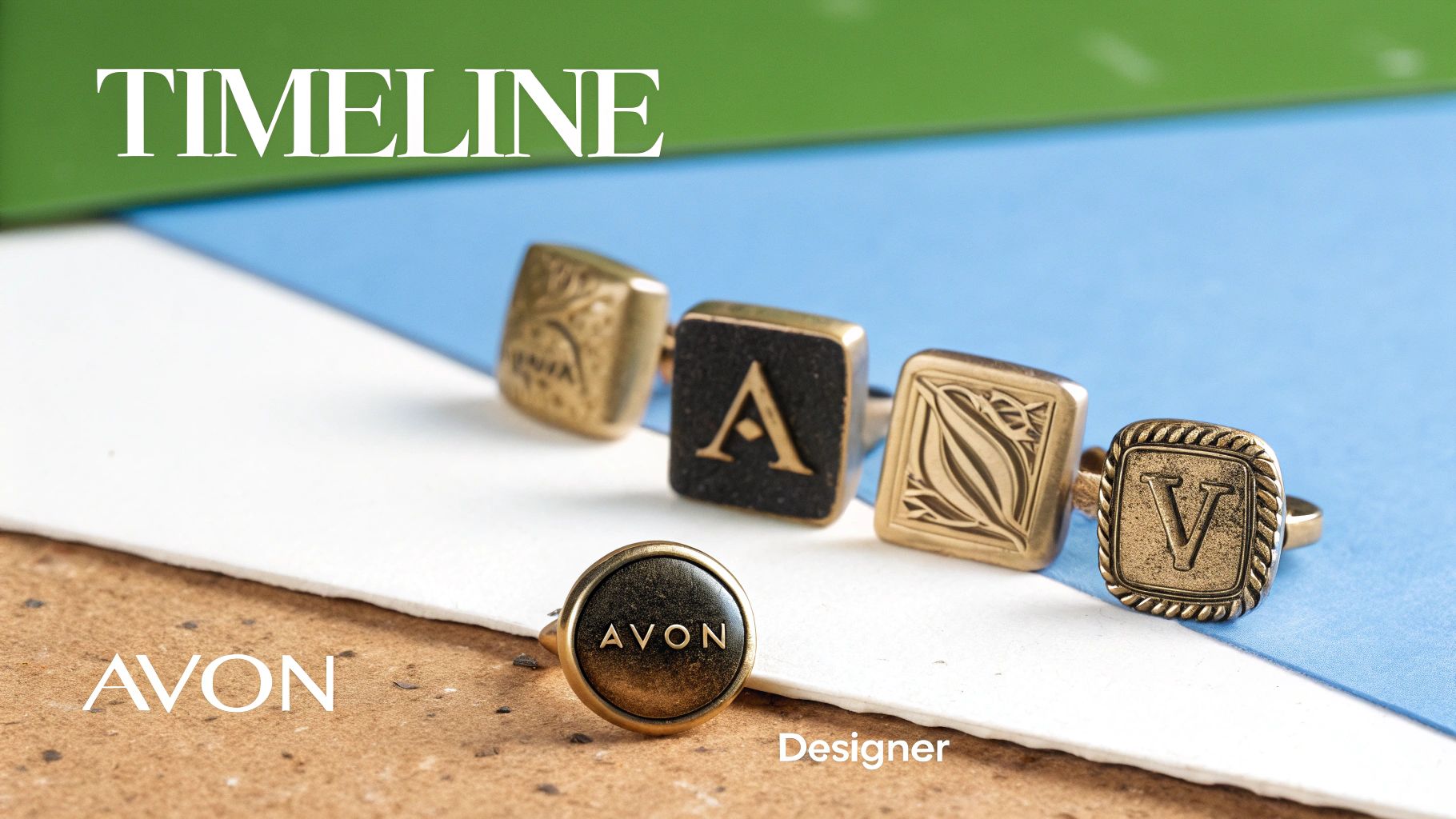
Think of Avon jewelry marks as a time machine. Each tiny stamp, font choice, and symbol is a breadcrumb that leads back to a specific era. Learning to follow this trail is the single best way to accurately date your finds and truly appreciate their place in Avon’s long history.
The real story begins in the early 1970s. Before then, Avon jewelry was usually an unmarked little gift included with a cosmetics purchase. But once the company started launching dedicated collections, a consistent brand mark became a necessity.
The Foundational Era: 1970 to 1980
The very first and most basic mark is simply “AVON” stamped in block capital letters. If you spot this, you're almost certainly holding a piece from the company's official jewelry debut, a period stretching from roughly 1970 through the early 1980s. You’ll often find this stamped on a small metal hangtag near the clasp or pressed directly into the back of a brooch or pendant.
Sometimes, you'll see a copyright symbol (©) right next to the block letters. The addition of the © is a great clue, as it generally places the piece squarely in the 1970s. This was the decade when Avon’s growth exploded, and they began protecting their unique designs more formally.
The Script and Designer Era: 1980s and 1990s
As fashion evolved, so did Avon's branding. The 1980s ushered in a more elegant, cursive “Avon” script logo. This simple change mirrored the sophisticated, brand-conscious trends of the time. This script mark is a dead giveaway for pieces made from the mid-1980s through the late 1990s.
This period was also the golden age of Avon's designer collaborations. These pieces are what collectors get really excited about, and they feature special marks that are a genuine thrill to find.
- K.J.L. for AVON: This mark means the piece was designed by the legendary Kenneth Jay Lane sometime between 1986 and the mid-1990s. His work brought a dose of celebrity glamour to the brand.
- BARRERA for AVON: From 1989 to 1996, Jose and Maria Barrera created stunning, high-fashion pieces for Avon. Their name on a piece is a sign of exceptional craftsmanship.
- The Script 'E' for Elizabeth Taylor: One of the most coveted marks of all. A script 'E', often paired with "Elizabeth Taylor for Avon," identifies pieces from her famously luxurious collections, which ran from 1993 to 1997.
Finding a designer co-brand on an Avon piece is like discovering a hidden signature on a work of art. It instantly elevates the item’s historical significance and potential value.
Modern Marks and Special Notations
From the late 1990s to today, the Avon jewelry marks became less standardized. You might find the script logo, the old block logo, or just the initials "AVON." Some items, especially those made for international markets, might even have different markings or none at all.
Avon Jewelry Marks and Their Eras
Dating Avon jewelry becomes much easier when you know what to look for. The stamp on the back of a brooch or the clasp of a necklace tells a story about when it was made and who might have designed it. This table is a quick reference to help you pinpoint the era of your piece at a glance.
| Mark Appearance | Era / Date Range | Significance and Notes |
|---|---|---|
| AVON (Block Capitals) | 1970–early 1980s | The original mark. The presence of a © symbol often points to the 1970s. |
| Avon (Cursive Script) | Mid-1980s–late 1990s | A more elegant logo reflecting the sophisticated fashion trends of the era. |
| K.J.L. for AVON | 1986–mid-1990s | Collaboration with famed designer Kenneth Jay Lane. Known for glamour. |
| BARRERA for AVON | 1989–1996 | High-fashion pieces designed by Jose and Maria Barrera. |
| Script 'E' / Elizabeth Taylor for Avon | 1993–1997 | Highly collectible items from Elizabeth Taylor's luxurious collections. |
| AVON or varied marks | Late 1990s–Present | Marking became less consistent; can include block, script, or just initials. |
Keep this guide handy when you're sorting through a jewelry box—it's the fastest way to start identifying those hidden gems.
These little marks tell the story of a company hitting its stride. The official launch of jewelry sales in 1971 coincided with Avon's sales force reaching 600,000 people and the company hitting $1 billion in annual sales—a first for a business led entirely by women. By 1974, Avon was the top costume jewelry distributor in America, and its evolving stamps reflect that incredible journey. You can learn more about this history of impressive growth on heraldnet.com.
How to Inspect Your Avon Jewelry
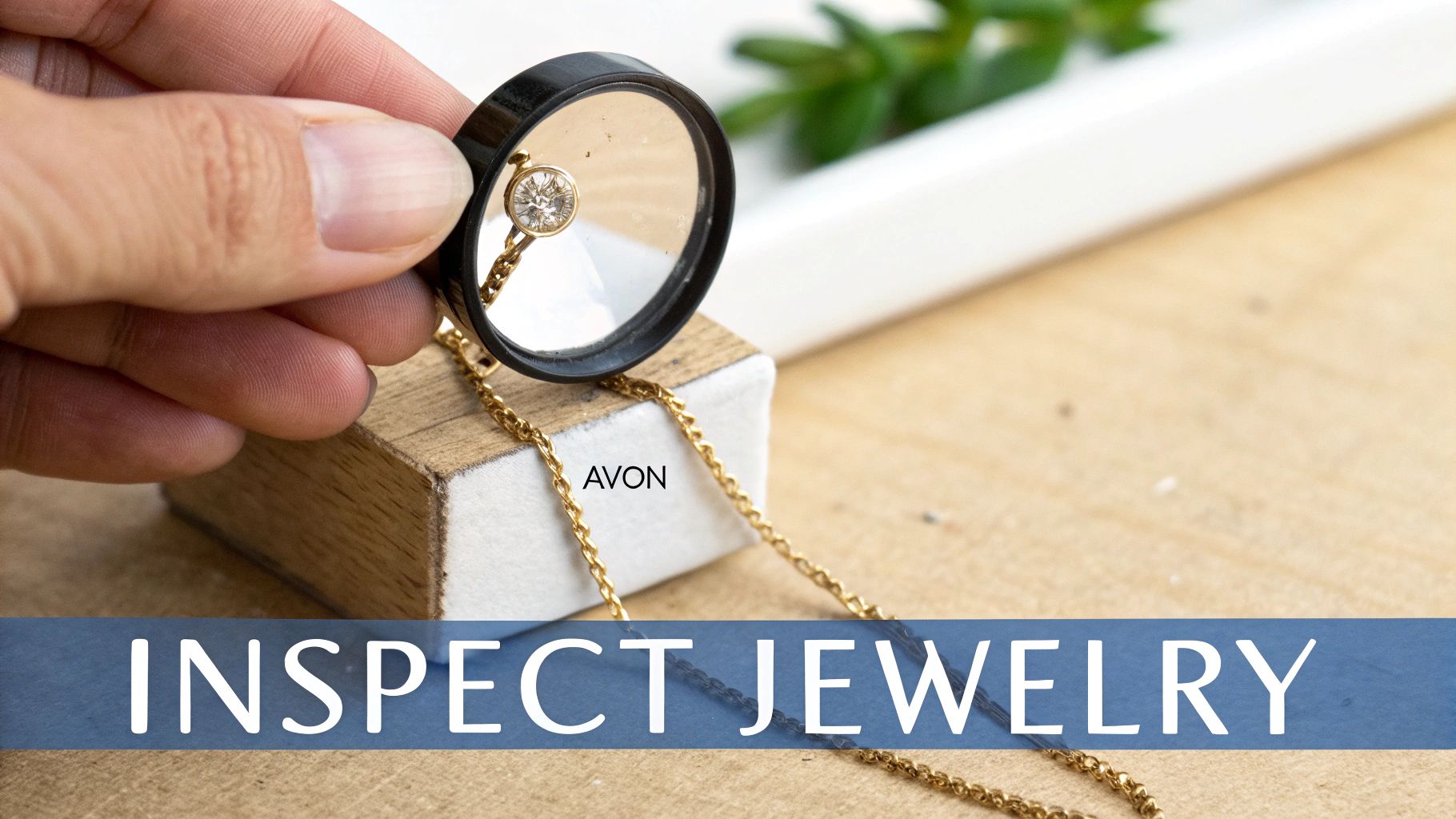
Finding the tiny signature on a piece of Avon jewelry can feel like a little treasure hunt. The Avon jewelry marks are your best clues for dating and authenticating a piece, but they’re often tucked away in clever spots so they don't spoil the design.
Start by flipping the piece over. Manufacturers almost always stamp jewelry in out-of-the-way places, usually on a flat, stable surface that won't interfere with how the piece looks when worn.
Common Hiding Spots for Avon Marks
The functional parts of the jewelry are prime real estate for a maker's mark. Don't get discouraged if you don't spot it right away—some of these stamps can be incredibly faint or worn down over time.
Here are the first places you should always check:
- Necklace and Bracelet Clasps: Look for a small metal tag hanging next to the clasp, often called a hang tag. If there's no tag, check the flat surfaces of the clasp itself.
- Backs of Pendants and Brooches: The back of a pendant or brooch provides the largest, flattest canvas, making it a very common spot for a clear "AVON" stamp.
- Earring Backs: On post earrings, the mark is usually on the little clutch or "butterfly" back. For clip-ons or screw-backs, it's typically stamped on the flat part of the finding.
- Inside Ring Bands: Just like fine jewelry, Avon stamped the inside of their ring shanks. This is often one of the easiest places to find a clear mark.
Think of yourself as a detective. Your most important tools are good light and magnification. Sometimes, a tiny detail is all you need to unlock the story of a piece.
Essential Tools for a Clear View
Even if you have perfect vision, some Avon jewelry marks are just too small or worn to read without a little help. You don't need a professional setup; a couple of simple tools can be a game-changer, especially if you're hunting for treasures at a dimly lit flea market.
To get a much better look, try one of these:
- A Jeweler's Loupe: This is what the pros use, and for good reason. A loupe with 10x magnification is the sweet spot for reading tiny stamps without any distortion.
- Your Smartphone Camera: The zoom on your phone's camera is a surprisingly powerful tool. Just snap a photo of the area and zoom in on the picture for a steady, magnified view.
- A Basic Magnifying Glass: When in a pinch, even a simple magnifying glass can help you make out a faded or complex mark.
Once you’ve found the mark, the next step is to look at the piece's overall condition. Our guide on how to identify antique jewelry has some great tips that apply here, too. Checking for wear and tear, like fading on the gold plating or chipped stones, is just as crucial as reading the stamp.
So, What's My Avon Jewelry Actually Worth?
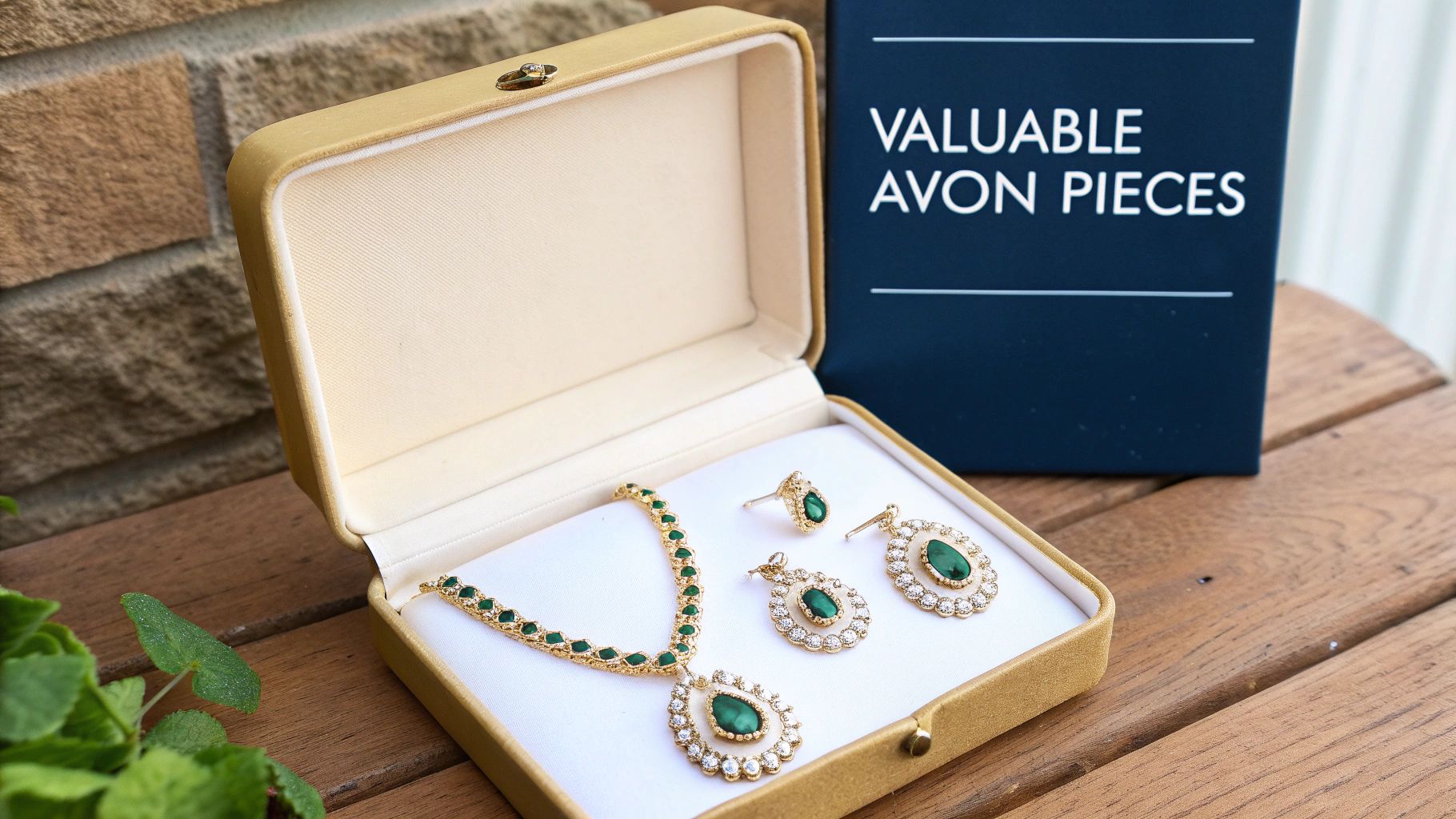
Alright, so you’ve figured out the Avon jewelry marks on your piece. The next question is always the big one: "What's it worth?" Let's be clear—the value of Avon jewelry almost never comes from precious metals or real gemstones. Its worth is all about design, history, and pure collectibility.
Most Avon jewelry is fantastic costume jewelry. That means it’s made from a sturdy base metal with a gold or silver-toned plating. They look great and were built to last, but the metal itself isn’t what fetches the high prices. The real value, both in terms of money and history, comes from a few key things that collectors go wild for.
The Magic of a Famous Designer's Name
If there's one thing that can make an Avon piece truly valuable, it’s a collaboration with a world-famous designer. Avon was brilliant at this, partnering with huge names to create exclusive collections. These are the pieces that are hunted down by collectors today.
When you see a co-branded mark on a piece, its value can skyrocket. These are the names that really get a collector's attention:
- Elizabeth Taylor: This is the holy grail. Her collections from 1993-1997, often marked with a script 'E', are the most coveted pieces in the Avon world. Her designs were bold, lavish, and can easily fetch $100 to over $500 for a full set in good condition.
- Kenneth Jay Lane (K.J.L.): A legend in costume jewelry, K.J.L. created glamorous and eye-catching pieces for Avon. Anything with his mark is a fantastic find and commands a higher price.
- Barrera: The husband-and-wife team of Jose and Maria Barrera were known for their high-fashion, intricately crafted designs. Their work is prized for its unique, artistic flair.
Finding a piece from a designer collaboration is like discovering a limited-edition print from a famous artist. The designer's reputation and unique vision elevate it from a simple accessory to a true collector's item.
Scarcity and Condition are Everything
Beyond the designer's name, simple rarity is a huge factor. Some Avon lines were only produced for a short time or in small batches, which makes them much harder to find now. Early pieces from the 1970s, especially from the "Precious Pretenders" line, are often more valuable just because of their age and place in Avon’s history.
And then there's condition. This is a deal-breaker. A piece that looks like it just came out of the box—no scratches, no missing stones, no worn-off plating—will always be worth more than something that’s been well-loved. If you have the original Avon box? Even better. That little piece of cardboard can significantly bump up the value for a serious collector.
For some solid basics on appraisal, this guide on how to value jewelry is a great place to start.
The Power of a Complete Set
Finally, never underestimate the appeal of a full set. Many Avon pieces were sold as a matching group, known as a 'parure.' This could include a necklace, bracelet, earrings, and maybe even a brooch, all designed to be worn together.
Finding a complete, matching set in great condition is a collector's dream. Why? Because it’s so incredibly rare for all the pieces to stay together over the decades. A full parure isn't just worth the sum of its parts—it's worth significantly more because of its completeness.
If you want to learn more about the general principles of valuing vintage pieces, check out our guide on valuing antique jewellery.
Common Questions About Avon Jewelry Marks
As you start digging into the world of vintage jewelry, you'll find that certain questions come up over and over again. This is especially true for Avon jewelry marks. Whether you're sorting through a flea market find or evaluating a family heirloom, these are the questions that collectors and sellers ask most.
Let’s clear up the confusion with some straightforward answers. Think of this as your go-to cheat sheet for your next treasure hunt.
Is All Avon Jewelry Marked?
For the most part, yes. Nearly every piece of authentic Avon jewelry made since its official launch in the early 1970s will have a mark. That stamp—usually "AVON" in block letters or a flowing script—is your best friend for confirming it's the real deal and figuring out its age.
But there's a small exception. Some of the very early promotional items from the 1960s, often given away as freebies with perfume or makeup, might not have a mark. If you're looking for something that can be easily identified and valued as a collectible, you really want to see that clear Avon stamp.
What Does the N R Mark Mean on Avon Jewelry?
If you spot an "N.R." next to the Avon mark, you've found something special. Those initials stand for Nina Ricci, the famous French fashion house. This wasn't just any piece; it was a high-end designer collaboration that brought Parisian style to Avon's customers.
Keep an eye out for other initials, too. These signal other exciting partnerships:
- K.J.L. for the legendary Kenneth Jay Lane
- W.N. for the whimsical Wendy Gell
- E for the one and only Elizabeth Taylor
These dual-marked pieces are a huge hit with collectors. They capture a unique moment where accessible style met high fashion, and finding one is always a great score.
An Avon piece with a designer's initials is more than just jewelry; it's a wearable piece of a partnership between a beloved brand and a creative visionary. These collaborations are often the most valuable finds in the Avon world.
How Do I Know If My Avon Jewelry Is Real Gold?
This is a big one. The overwhelming majority of Avon jewelry is what we call "costume" jewelry. That means it’s made from a sturdy base metal and then plated with a rich gold or silver tone to give it that luxurious look. It’s beautifully made, but it’s not solid precious metal.
On the rare occasion that Avon produced a sterling silver item, it will be clearly stamped with "925" or the word "Sterling." If you don't see one of those marks, you can safely assume the piece is plated. The real value in Avon jewelry comes from its design, its history, and its collectibility—not the raw materials.
Are Avon Pieces from the 1990s Valuable?
Absolutely! It’s easy to focus on the 1970s, but the 1980s and 1990s gave us some of Avon’s most impressive and valuable collections. The lines designed by Elizabeth Taylor between 1993 and 1997 are the superstars of this era. You'll know them by the elegant, scripted 'E' mark.
These collections are famous for their opulent designs, hefty feel, and incredible craftsmanship. Their value is tied to Taylor's iconic status, the complexity of the design, its condition, and whether it’s part of a complete set. Don't ever pass over a piece from the 90s—it might just be your most rewarding find.
Feeling confident about your Avon finds? The next step is uncovering their full story. Curio makes it easy. Just snap a photo, and our app provides instant identification, historical context, and a quick appraisal. Stop guessing and start knowing. Download Curio today and let your antiques tell their story!