That old brooch tucked away in your grandmother's jewellery box? It's more than just a sentimental trinket. It’s a tiny piece of history, and it could be surprisingly valuable. Learning how to value antique jewellery means leaving the guesswork behind and focusing on what truly matters: its story, materials, and condition. Let's walk through how to look at a piece the way a seasoned expert would.
Uncovering Your Jewellery's Hidden Story
Before you can even think about a price tag, you have to play detective. Every antique tells a story through its design, the metals and gems it’s made from, and the tiny marks left by its creator. Your job is to piece together those clues to build a complete profile of the item.
Think of it this way: you’re not just looking at a pretty object. You're examining it like a historian, a collector, and an appraiser all rolled into one. You'll soon learn to see beyond the initial sparkle and spot the subtle signs of age, origin, and quality that can make all the difference.
The Core Factors of Valuation
To get a real sense of what an antique piece is worth, you need to understand the key ingredients that determine its value. It's never just one thing; it's a combination of factors that, when taken together, paint a full picture.
Here's a quick breakdown of what you need to be looking for.
Core Factors Influencing Antique Jewellery Value
| Valuation Factor | What It Means | Why It Matters |
|---|---|---|
| Provenance and History | The documented history of the piece—who owned it, where it came from. | A famous owner or a compelling story can dramatically increase value. |
| Rarity and Demand | Is the piece one-of-a-kind? Was it made by a small, sought-after designer? | Scarcity drives up desire. The fewer there are, the more people want them. |
| Materials & Craftsmanship | The intrinsic value of the metals and gemstones, plus the skill of the artisan. | High-quality materials are the foundation, but exceptional skill makes a piece art. |
| Condition | The state of the piece. Are there repairs, missing stones, or alterations? | Original, untouched pieces are the most desirable and valuable to collectors. |
Looking at these factors together gives you a solid framework for understanding what you have.
The market for these treasures is stronger than you might think. The global estate and antique jewellery retail market has climbed to $5.5 billion and continues to grow each year. This isn't just a niche hobby; it's a serious market driven by collectors looking for unique, sustainable luxury with a soul. You can learn more about these market trends and how they might affect your own pieces.
What to Look For in Your First Inspection
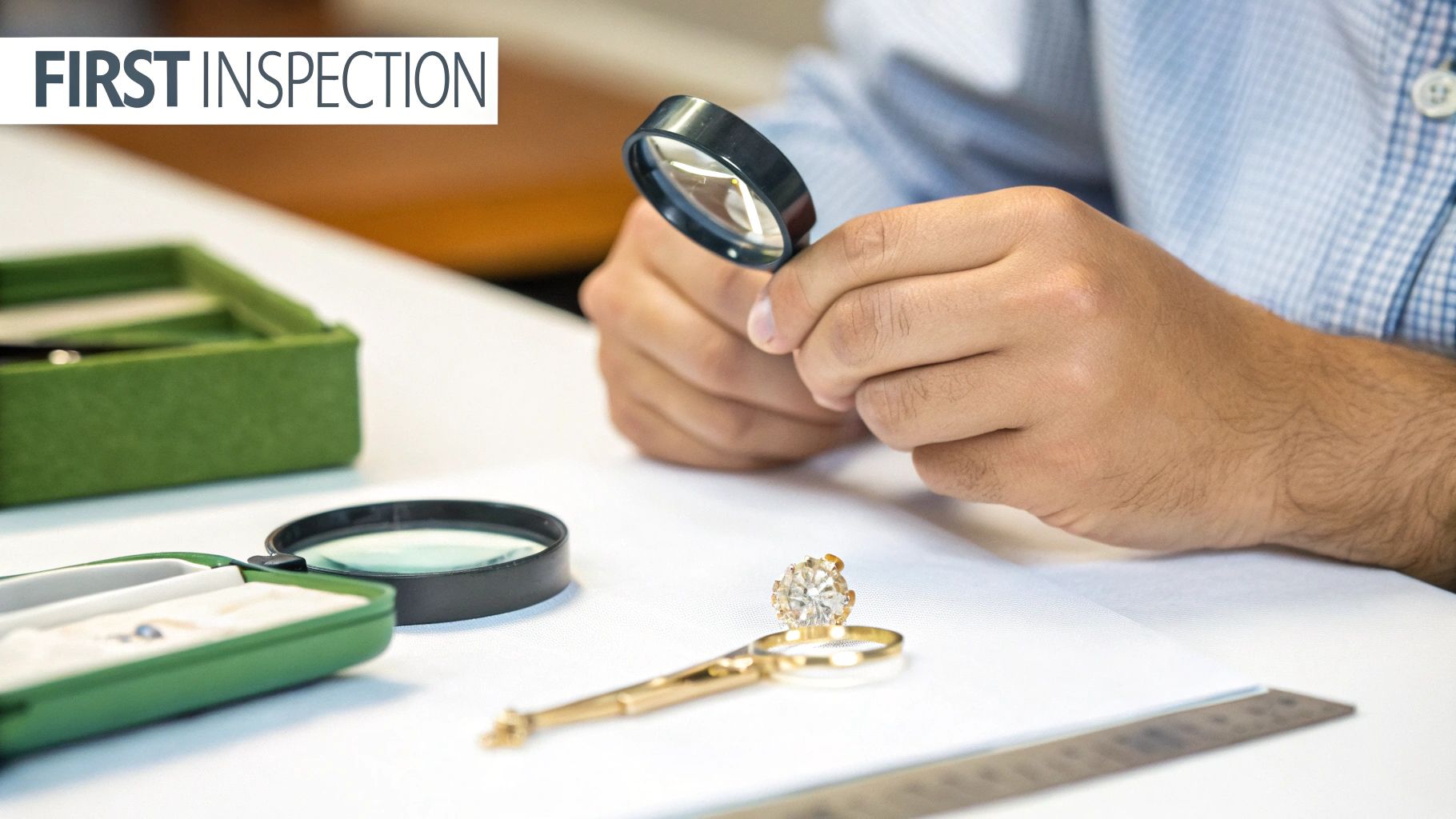
The moment an antique piece is in your hands, the real detective work begins. This is where you start gathering the clues that tell its story—long before you pull out any special tools. It's about training your eye to spot the subtle details that separate a true antique from a modern reproduction.
Start by just feeling it. Does it have some heft? Antique jewellery often has a certain weight and substance that you just don't find in many mass-produced items today. Take a moment to appreciate its overall construction and how it was put together, keeping an eye out for tell-tale signs of hand-craftsmanship.
Assessing Construction and Gemstone Settings
Look closely at how the gemstones are held in place. The setting style is a huge clue to a piece’s age. Many older items feature bezel or collet settings, where a thin rim of metal wraps all the way around the stone. This is a world away from the prominent claw or prong settings you see everywhere in modern jewellery.
Don't forget to flip it over! The back of a piece can reveal a lot. You're looking for signs of careful, manual work, such as:
- Hand-engraved details: Look for the charming, slight imperfections that you'll never see with machine engraving.
- Soldering points: You might see neat but visible signs of hand soldering, especially where different parts of the piece are joined together.
- Clasps and findings: The style of a clasp can often date a necklace or bracelet instantly. You can learn to spot these by exploring different types of vintage necklace clasps to narrow down the era.
A crucial step in your first inspection is understanding the distinctions between solid gold, gold filled, and gold plated jewelry, as this profoundly impacts an antique piece's material value. This knowledge helps you identify what you’re really looking at.
Identifying Patina and Wear
Next, you'll want to look for patina. This isn't just tarnish; it's the soft, warm glow that metals like silver and gold develop over many decades of being handled and exposed to the air. Patina settles into the crevices and fine details, giving the piece a depth and character that only time can create.
Genuine patina is nearly impossible to fake and is something collectors truly value. It's a sign of authenticity and age, suggesting the piece has been cared for but has also lived a life—which is exactly what gives it a unique story.
Finally, consider the natural signs of wear. Look for softened edges on intricate metalwork or gemstone facets that are slightly rounded from years of loving use. While serious damage will lower the value, this kind of gentle, even wear is often a good thing. It’s a positive sign of an authentic antique, and it builds the foundation for the next steps in your valuation process.
Decoding Hallmarks and Maker's Marks
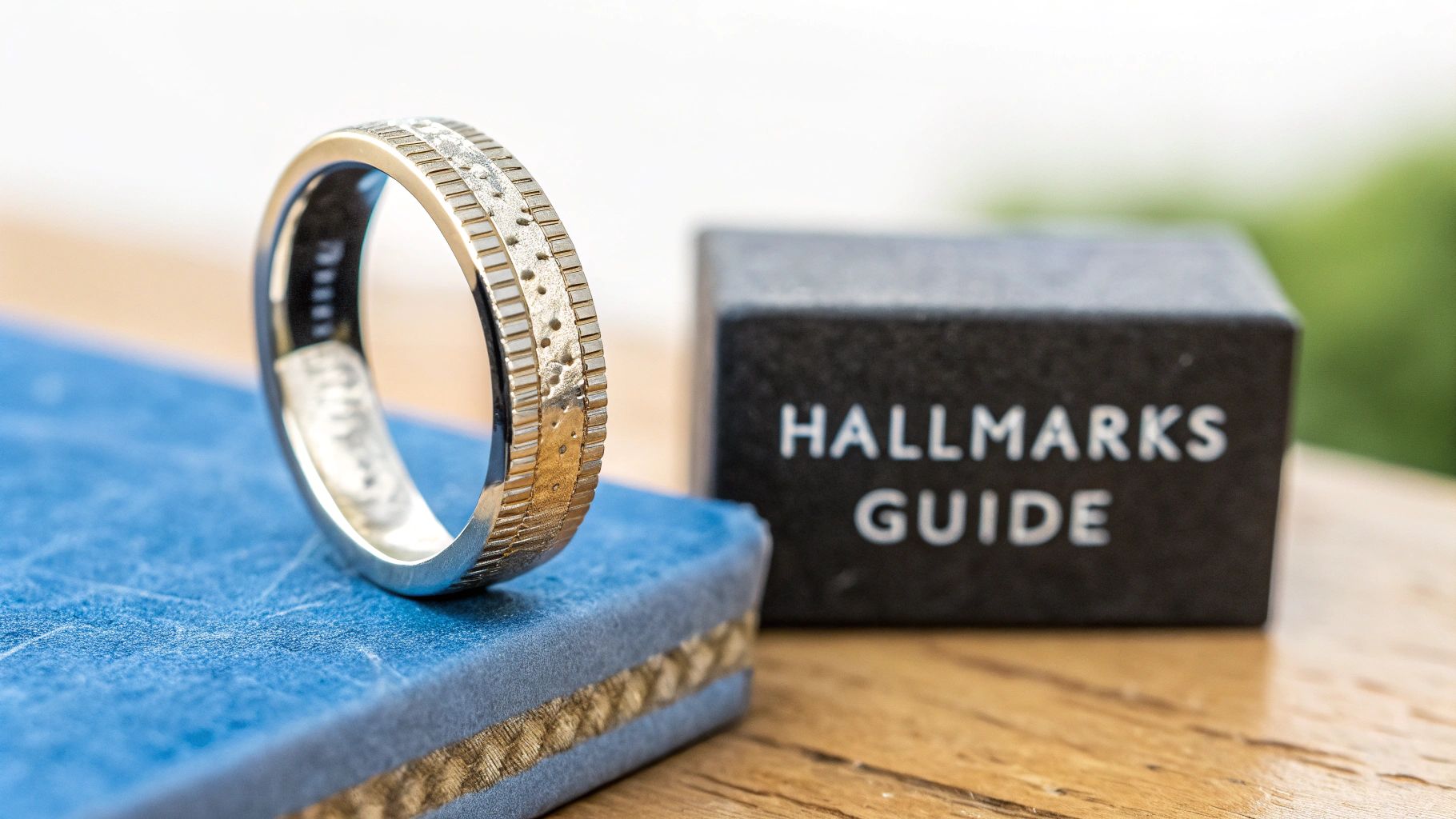
Often, the biggest secrets of an antique piece are hidden in its tiniest stamps. These are its hallmarks and maker's marks, and for anyone trying to figure out what a piece is worth, they're pure gold. The first hunt is just to find them; they’re usually tucked away on the inside of a ring band, the back of a brooch, or right on the clasp of a necklace.
Think of these symbols as the jewellery's birth certificate. They can tell you where it came from, what it's made of, and sometimes even the exact year it was made. You'll need a good magnifying glass or, even better, a jeweller's loupe to get a clear look. You're searching for small, stamped impressions that will start to tell you the story of the item in your hands.
Understanding the Language of Marks
Once you've spotted the marks, the real fun begins: figuring out what they mean. Every symbol, letter, and number is a piece of the puzzle. The most common marks you'll find are for purity, which tell you about the quality of the metal.
- Gold Marks: For gold, you might see "18k" or "750." Both mean the same thing: 18-karat gold, which is 75% pure. A lower number like "9k" or "375" means it's 9-karat gold.
- Silver Marks: The word "Sterling" or the number "925" is the tell-tale sign of sterling silver, which is always 92.5% pure silver. We dive much deeper into this in our guide explaining https://www.curio.app/blog/what-are-hallmarks-on-silver.
- Platinum Marks: If you see "Plat," "PLAT," or "950," you're looking at platinum that's 95% pure.
Beyond metal content, you'll want to look for other important symbols. Assay office marks—like a leopard's head for London or an anchor for Birmingham—tell you which city tested and certified the metal. There are also date letters, a clever system used for centuries that can pinpoint the year the piece was hallmarked.
For pieces from outside of Europe, the markings can be quite different. For example, a guide to Chinese gold marks on jewelry is a fantastic resource for understanding the unique characters that indicate purity and origin.
Using Online Resources to Identify Marks
You don't need to be a professional appraiser to crack the code on these marks. The internet is your best friend here, with a wealth of websites dedicated to cataloging hallmarks from all over the world. These are indispensable tools for any collector.
Online databases are packed with images that let you visually match the tiny stamps on your piece to known records. It's like a detective game, and these sites help you piece together your jewellery's history with a lot more confidence.
A maker's mark is often the most exciting discovery. This mark identifies the specific jeweller, silversmith, or company that created the piece. Researching this can connect your item to a famous name like Cartier or a celebrated independent artisan, which can send its value soaring. Proving who made a piece is a cornerstone of accurate antique jewellery valuation.
Reading the Story in the Design
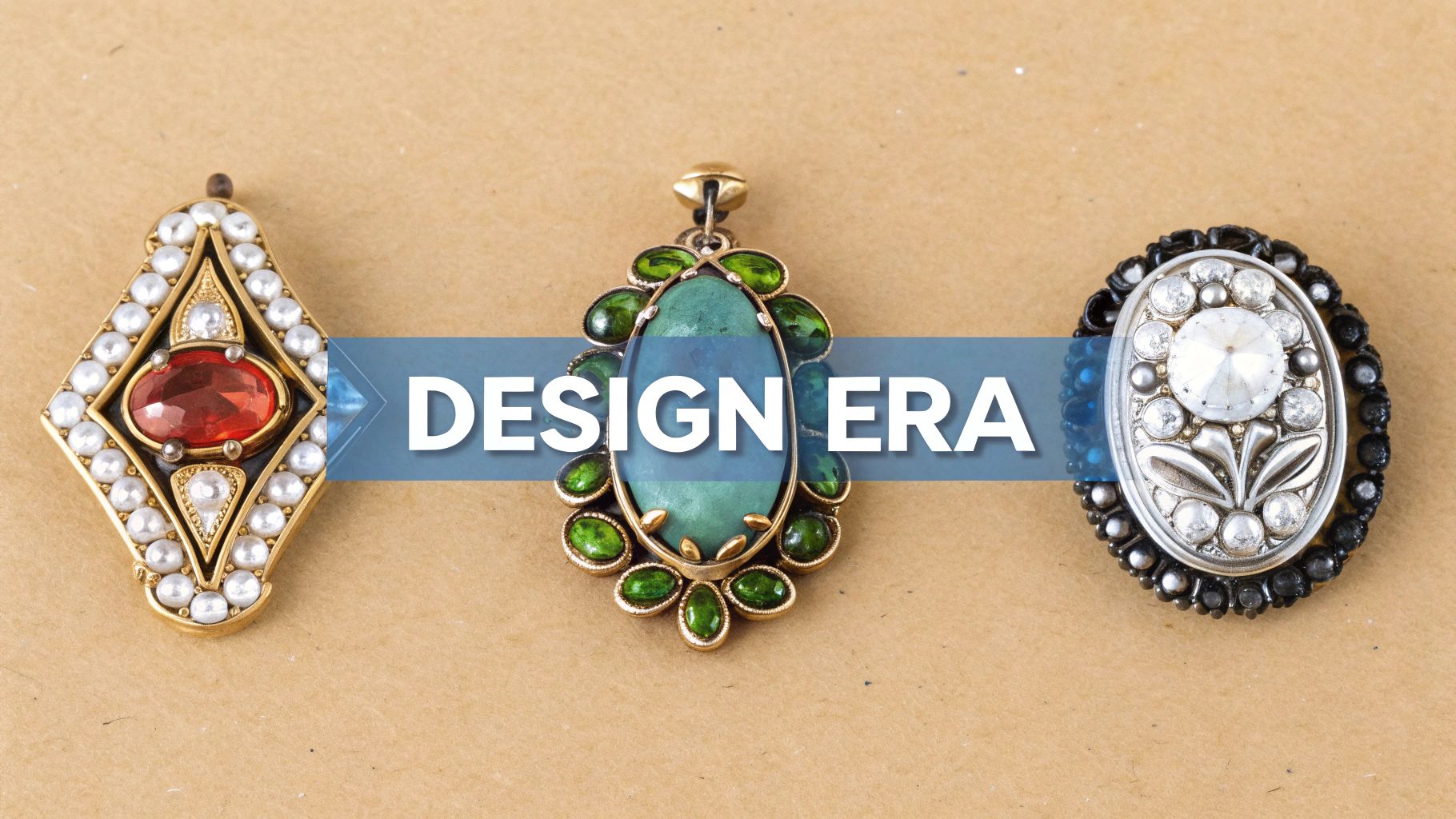
One of the most exciting parts of valuing antique jewellery is figuring out when it was made. Even if you can't find a single clear hallmark, the design itself is like a time capsule. It tells you a story about the world it came from.
Learning to spot the visual cues of different eras is like learning a new language. You start to see how art movements, social changes, and even new technologies shaped the way a piece looks. This context is everything—it helps you understand the piece's rarity, its appeal to collectors today, and what it might be worth.
A Quick Tour Through Jewellery History
Let's walk through the defining styles of the most important periods. Getting a feel for these motifs and materials will give you a huge head start in your assessment.
The Victorian Era (1837–1901)
Queen Victoria's long reign covered a lot of ground, so we usually break it into three parts. Early on, jewellery was romantic and sentimental, full of flowers, serpents, and detailed goldwork called repoussé. The middle period got a bit bolder, but it's the late Victorian era that's most distinct, defined by mourning jewellery made from black enamel, jet, and sometimes even woven human hair.
Art Nouveau (1890–1910)
This was a rebellion against the stuffy, industrial age. Art Nouveau is all about nature, sensuality, and flowing lines. Think graceful curves that mimic plants, insects, or the female form. Key giveaways include:
- Whiplash Curves: Asymmetrical, S-shaped lines that give a feeling of movement.
- Enameling: Especially the delicate, stained-glass look of plique-à-jour enamel.
- Organic Materials: Artists preferred materials like horn, ivory, and moonstone over big, flashy diamonds.
The Edwardian Era (1901–1915)
Pure elegance. This was the age of high society, and the jewellery reflected it. Platinum became the go-to metal, which allowed jewellers to create incredibly fine, almost lace-like settings. This "garland style" is often dripping with diamonds and pearls, featuring motifs like bows, ribbons, and tassels.
Art Deco pieces often command high prices due to their timeless appeal and strong collector demand. A geometric brooch from a known maker, for instance, can be worth significantly more than a Victorian piece of similar material value simply because the design is so iconic and sought-after.
The Bold Geometry of Art Deco
Art Deco (1920–1935)
Swinging out of the Roaring Twenties, Art Deco is the complete opposite of the flowing Art Nouveau style. It's bold, geometric, and symmetrical, capturing the energy and glamour of the machine age.
You can spot an Art Deco piece a mile away once you know the signs. Look for sharp angles, straight lines, and repeating patterns. You'll notice powerful colour contrasts—think black onyx next to white diamonds, or bright blue sapphires set against cool platinum. The craftsmanship is crisp and precise. Recognizing these stylistic signatures isn't just a fun history lesson; it's a critical tool that directly impacts the piece's market value.
Researching Current Market Value
Now that you have a good handle on your piece's history—its era, materials, and maker—it's time to connect that knowledge to the present-day market. At the end of the day, an antique is only worth what someone is willing to pay for it now. This is where market research becomes your most valuable tool, helping you turn an educated guess into a solid, confident estimate.
The whole point of this exercise is to find comparable sales, or "comps." This is just a fancy term for records of what similar pieces of jewellery have recently sold for. It’s the exact same method professional appraisers use, and it's not all that different from valuing a house by looking at recent sales in the neighbourhood.
Where to Find Comparable Sales Data
Your search for comps will almost certainly lead you online, where there's a goldmine of sales data waiting, provided you know where to dig. The most important thing to remember is to focus on sold prices, not what sellers are asking. The final sale price is the only true measure of market demand.
Here are the best places to start your hunt:
- Major Auction House Archives: Websites for giants like Sotheby's, Christie's, and Bonhams have fantastic, searchable archives of past auctions. This is the go-to resource for high-end or signed designer pieces.
- Online Auction Platforms: Don't overlook the power of sites like eBay and LiveAuctioneers. Just be sure to use the "sold" or "completed items" filter. This will give you access to a huge database of real-world prices for a massive variety of jewellery.
- Specialist Dealer Sites: Many reputable antique jewellery dealers proudly display their sold archives. It's a great way to see what pieces similar to yours have fetched from a retail perspective.
When you start searching, be specific. A query like "Art Deco platinum diamond filigree ring" will give you much more relevant results than a generic "old diamond ring."
It’s absolutely crucial to compare apples to apples. A good "comp" isn't just about a similar style. You need to match the era, maker, materials, size, and especially the condition. A pristine piece will always sell for more than one showing obvious damage or clunky repairs.
The global antique market is enormous, projected to hit $54.2 billion, which shows just how much demand is out there. Jewellery accounts for a hefty 28% of all antique sales, and with online transactions growing by 18% each year, the digital world is where the action is. This online shift also means that proof of authenticity is more important than ever; a recent study found that 78% of buyers are heavily influenced by an authenticity certificate. You can discover more insights about these antique marketing statistics to see how trends are shaping values today.
Interpreting the Data to Find a Value Range
As you gather your comps, you'll probably notice a range of prices, not one consistent number. That's completely normal and expected. Your final task is to place your own piece within that range.
If your item is in better condition than most of the examples you found, you can confidently aim for the higher end of the spectrum. If it has some visible wear or minor issues, it’s more realistic to place it at the lower end.
For anyone wanting a quick starting point, there are even tools that let you appraise antiques online for free to get a preliminary ballpark figure. By doing this research, you’re no longer just guessing—you're building a solid, evidence-based understanding of what your jewellery is truly worth.
When You Need a Professional Jewellery Appraisal
Doing your own homework on a piece of antique jewellery is fantastic—it connects you to its history and gives you a solid ballpark idea of its worth. But there comes a point where a well-researched estimate just isn't enough. Certain situations call for a formal, legally recognized document that only a qualified appraiser can provide.
This is where you move beyond personal curiosity and into official territory, turning your estimate into a protected, actionable figure.
Insurance: The Non-Negotiable Appraisal
One of the biggest reasons to get a formal appraisal is for insurance purposes. Let's be honest, accidents happen. If a precious family heirloom is lost, stolen, or damaged, your insurance company won't just take your word for its value.
They will require a detailed, official appraisal to process a claim for what it’s actually worth. Without that paperwork, you could end up with a settlement that doesn't even come close to covering the true cost of your loss. It’s a simple step that provides critical financial protection.
Estate Planning and Fair Distribution
An appraisal is also essential for estate planning and distribution. When it's time to divide assets among heirs, emotions can run high. A certified valuation provides a clear, unbiased monetary value for each piece of jewellery.
This helps ensure fairness, prevents family disputes, and makes the entire process of settling an estate much smoother and more transparent for everyone involved.
Understanding the Different Types of Value
When you go to an appraiser, you need to be very specific about what you need, because not all valuations are created equal. The two most common types serve very different purposes.
Insurance Replacement Value: This is almost always the highest figure. It represents the full retail cost to buy a comparable piece from a specialized antique jewellery dealer. Think of it as the "worst-case scenario" value—what it would cost to replace that exact item today.
Fair Market Value (FMV): This number reflects what a knowledgeable buyer would realistically pay a willing seller on the open market, like at an auction or in a private sale. FMV is typically lower than the insurance value and is the standard for calculating estate taxes or setting a fair asking price.
Be crystal clear with your appraiser about which valuation you need. Asking for a Fair Market Value appraisal for your insurance policy will leave you dangerously underinsured. On the flip side, using a high insurance replacement value to price an item for sale will likely scare off potential buyers.
Finding the Right Appraiser
So, how do you find someone you can trust?
Look for an independent appraiser, preferably one with credentials from a respected organization like the Gemological Institute of America (GIA). A true professional will charge a flat fee or an hourly rate for their work.
If an appraiser wants to charge a percentage of the item's final value, walk away. That’s a major conflict of interest. A proper appraisal is a detailed, multi-page document that gives you definitive proof of value and, more importantly, total peace of mind.
Common Questions We Hear All the Time
When you're first diving into the world of antique jewellery, a few questions always seem to pop up. Let's tackle some of the most common ones I hear from collectors and inheritors alike.
"Will a Repair Hurt the Value of My Piece?"
The short answer is yes, but how much depends entirely on the repair itself. A shoddy, obvious fix or a modern alteration can absolutely tank the value.
Imagine someone replacing a beautiful, hand-faceted old-mine-cut diamond with a generic modern brilliant cut. To a serious collector, that's a deal-breaker. They're paying for originality and historical integrity, and that change just erased it. On the other hand, a skillful, period-correct repair done by a master jeweller might have a much smaller impact. The key is to be transparent and document everything you know about its history.
A quick note on terminology: For a piece to be truly "antique," it needs to be at least 100 years old. Jewellery that's between 20 and 99 years old falls into the "vintage" category. This isn't just semantics; that antique status often brings a higher value because of the piece's rarity and history.
"What Should I Expect to Pay for a Professional Appraisal?"
This is a great question, and the cost can vary quite a bit depending on where you are and the appraiser's reputation.
Most reputable appraisers charge by the hour, not as a percentage of the item's value. This is a good thing—it keeps the valuation honest and objective. You can expect to see hourly rates anywhere from $150 to $350. It's an investment, but for a potentially valuable piece, it’s worth every penny for the peace of mind.
Ready to uncover the story behind your own treasures? Let Curio be your guide. Snap a photo to instantly identify, learn about, and get an estimated value for your antiques. Download the app and start your discovery.