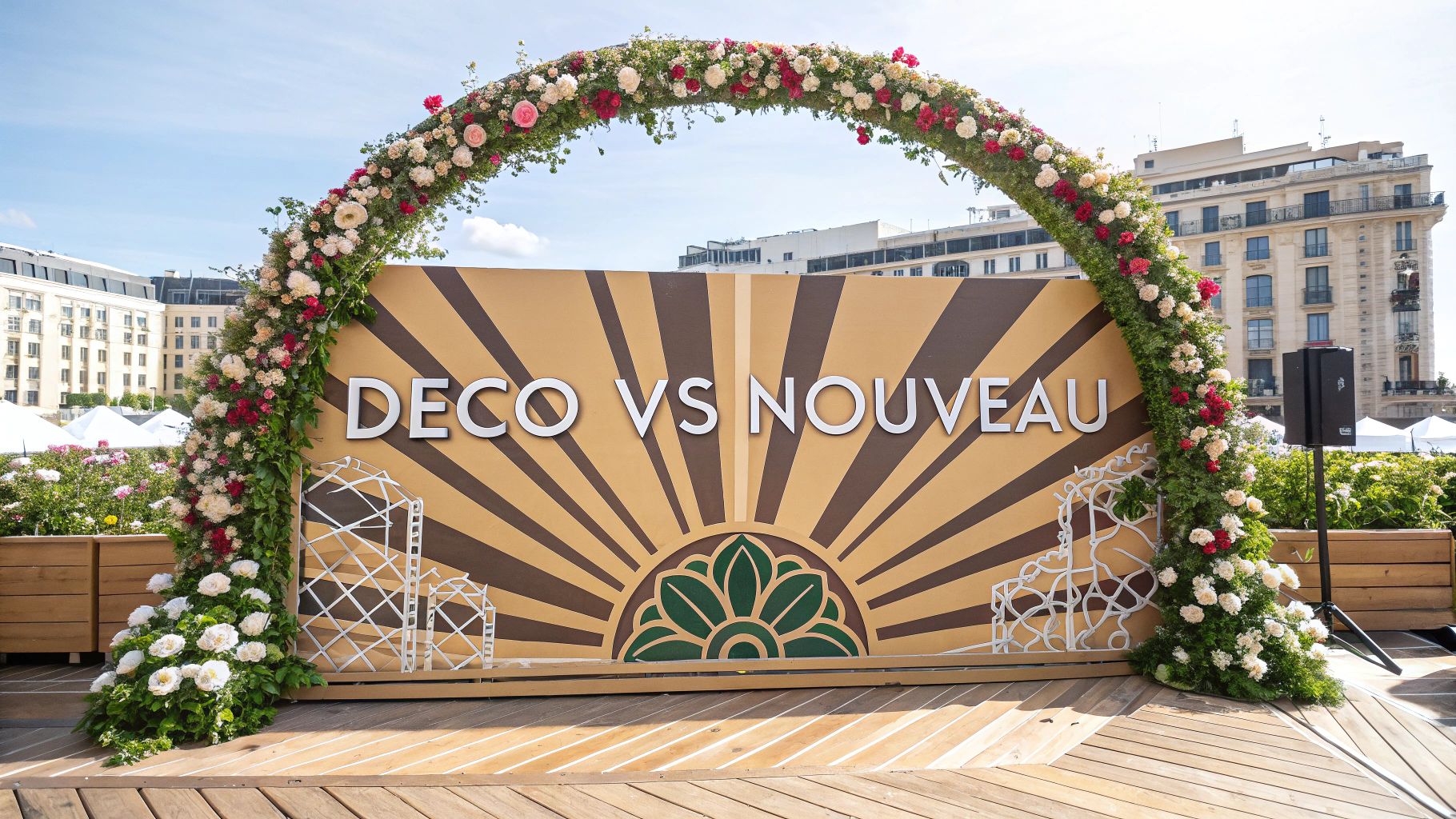
At its heart, the difference between art deco and art nouveau boils down to their core inspiration. Art Nouveau (c. 1890–1914) is all about flowing, organic lines pulled directly from nature, while Art Deco (c. 1920–1940) champions the bold, geometric shapes of the machine age. Just think of it as nature's curves versus industrial angles.
Understanding The Essential Differences
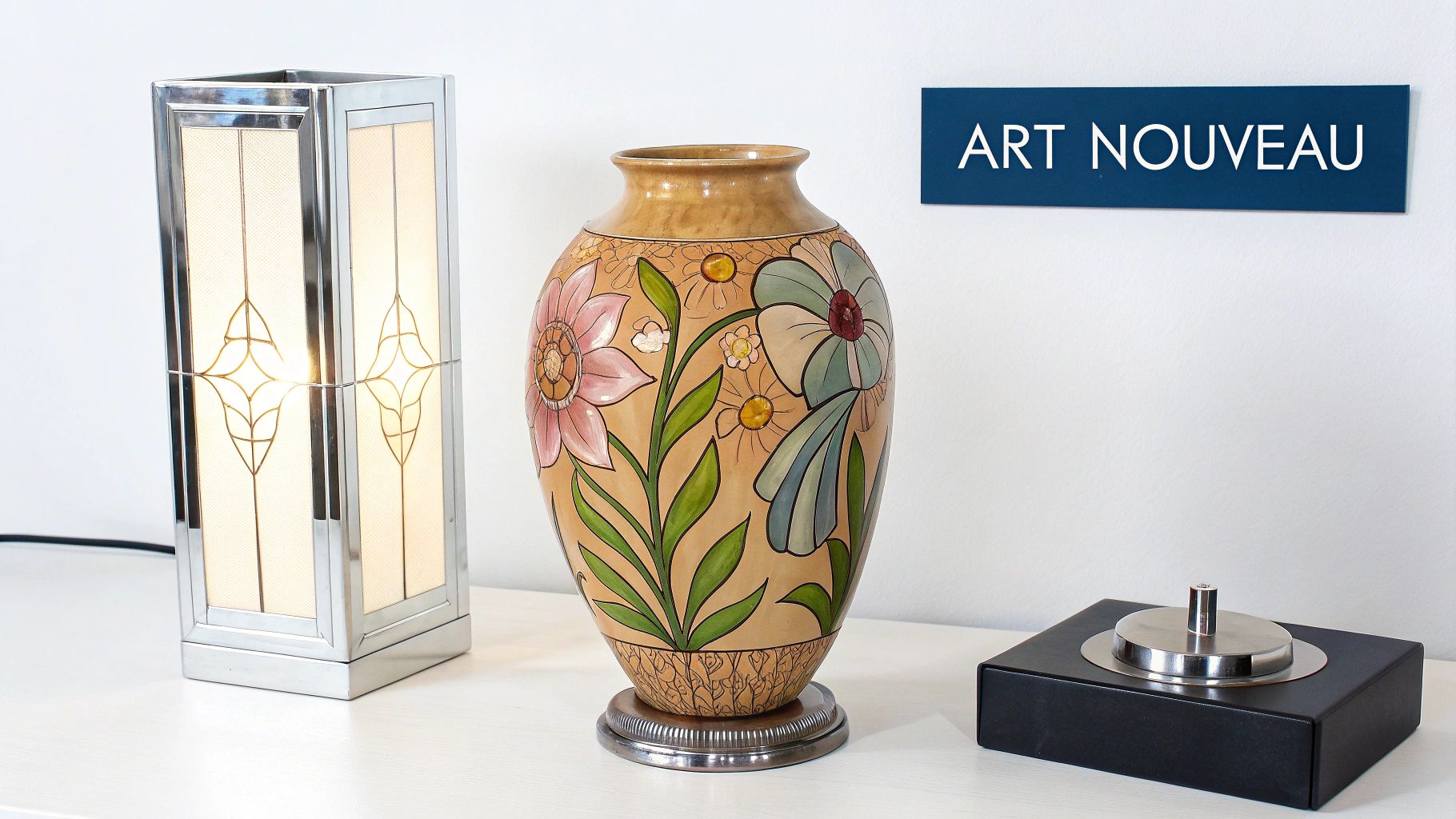
For anyone buying or selling antiques and collectibles, telling these two styles apart is absolutely crucial. If you can't, you might make a poor buy at an estate sale or misrepresent an item you're trying to sell. Both styles were a reaction to what came before, but they spoke in completely different visual languages.
Art Nouveau was a full-blown rebellion against the stuffy, academic art that dominated the 19th century. Its artists and designers wanted something new—a modern style grounded in the natural world. This gave birth to pieces that feel romantic, handcrafted, and almost alive with movement.
Art Deco, on the other hand, burst onto the scene after World War I. It was a celebration of a new age of technology, glamour, and progress. It captured the roaring energy of the Jazz Age with sleek lines, symmetrical patterns, and lavish materials that looked to an optimistic, fast-paced future.
Core Distinctions for Quick Identification
The quickest way to tell them apart is to look at the lines and shapes. If you see long, asymmetrical "whiplash" curves, flowing floral motifs, or insect-inspired details, you’re almost certainly looking at Art Nouveau. But if the piece has sharp angles, zigzags, sunbursts, and a strong sense of symmetry, those are the unmistakable hallmarks of Art Deco.
This simple table breaks down the fundamental differences, giving you a quick reference for making an initial assessment on the spot. Use it as your go-to guide when you stumble upon a potential find.
The contrast is stark: Art Nouveau is about organic asymmetry and handcrafted detail, while Art Deco is about geometric precision and machine-age luxury. One feels like a walk through an enchanted forest; the other feels like a night in a glamorous metropolis.
To help you train your eye, the comparison below highlights the defining characteristics of each movement. Learning to spot these patterns is the first step toward identifying and appraising pieces with confidence.
Art Nouveau vs Art Deco At a Glance
| Characteristic | Art Nouveau | Art Deco |
|---|---|---|
| Timeline | c. 1890–1914 (Belle Époque) | c. 1920–1940 (Jazz Age) |
| Inspiration | Nature, plants, insects, flowing water | Machines, technology, ancient cultures (Egyptian, Aztec) |
| Lines & Shapes | Asymmetrical, long, sinuous "whiplash" curves | Symmetrical, geometric, sharp angles, straight lines |
| Common Motifs | Lilies, vines, dragonflies, graceful female forms | Sunbursts, chevrons, zigzags, repeating patterns |
| Materials | Wrought iron, iridescent glass, carved hardwoods | Chrome, Bakelite, lacquer, stainless steel, exotic woods |
| Overall Feel | Romantic, organic, handcrafted, whimsical | Sleek, glamorous, modern, opulent, industrial |
To really get a feel for the difference between Art Nouveau and Art Deco, you have to go deeper than just what they look like. These styles weren't born in a vacuum; they were products of their time, forged in the fires of massive cultural change, new technology, and social unease. Think of them as historical documents, but written in glass, iron, and wood.
Art Nouveau showed up during a strange and beautiful moment in history. The late 19th century, known as the Belle Époque or "Beautiful Era," felt peaceful and prosperous on the surface. But just underneath, the Industrial Revolution was churning out mass-produced goods, and many felt that craftsmanship and soul were getting lost in the process.
A new generation of artists and designers decided to fight back. They were tired of the stuffy, historical styles taught in the academies and looked for inspiration in the one place a factory couldn't copy: the wild, untamed beauty of nature. This burning desire to create something new, modern, and alive became the very heart of Art Nouveau.
Art Nouveau: The Romantic Rebellion
The movement was a deliberate break from the past. Its followers aimed to create a Gesamtkunstwerk—a "total work of art"—where everything from the building's facade to the forks on the table shared a single, harmonious vision. This philosophy put the individual artisan back on a pedestal, celebrating handcrafted details and one-of-a-kind forms over the soulless perfection of the assembly line.
It was a deeply romantic, almost spiritual style. Artists found their muses in the flowing stems of a lily, the intricate wings of a dragonfly, and the soft curves of the female form. The goal was to inject the beauty and energy of the natural world back into everyday life, offering a lush escape from the grime and noise of the new industrial city.
Art Nouveau wasn't just a style; it was a philosophy. It championed nature and human artistry as an antidote to the cold, hard reality of the machine age, aiming to wrap the modern world in organic, handcrafted elegance.
The style truly had its coming-out party at the 1900 Exposition Universelle in Paris. This was where Art Nouveau stepped onto the world stage, with visionaries like Hector Guimard unveiling his now-iconic Métro station entrances. The event cemented the movement's global reach, forever tying it to the hopeful, turn-of-the-century spirit. You can see how this fits into the bigger picture in our art history periods timeline.
Art Deco: The Roar of the Machine Age
If Art Nouveau was a soft-spoken rebellion against the machine, Art Deco was a loud and glamorous celebration of it. It burst onto the scene after the First World War, perfectly capturing the high-octane energy of the Jazz Age. The world had been turned upside down, and Art Deco became the visual soundtrack for a new era defined by speed, innovation, and a powerful sense of optimism.
The post-war generation was obsessed with progress. The sleek lines of airplanes, the powerful profiles of ocean liners, and the streamlined bodies of automobiles were the new icons of human achievement. Designers took this mechanical aesthetic and ran with it, creating a style defined by bold geometry, crisp symmetry, and clean, powerful lines. It was a look built for a world that was moving faster than ever before.
The mood was all about liberation, luxury, and looking forward. Art Deco also greedily borrowed from global cultures, mixing in motifs from ancient Egyptian, Aztec, and African art. The discovery of King Tutankhamun's tomb in 1922, for instance, sent a jolt through the design world, and soon Egyptian-inspired patterns like sunbursts and ziggurats were everywhere.
The timelines tell the whole story. Art Nouveau had its moment from roughly 1890 to 1914, while Art Deco took over from 1920 to 1940. That gap between them represents a monumental shift in thinking. Art Nouveau’s peak was the 1900 Exposition Universelle in Paris, which drew an incredible 50 million visitors. In contrast, Art Deco’s defining event, the 1925 Exposition Internationale des Arts Décoratifs in Paris, attracted 16 million—a smaller crowd, but one that witnessed the birth of a new, machine-age modernism. You can dig into more on these exhibitions and their attendance numbers over at Rug & Kilim.
Decoding the Visual Language of Each Style

If you want to truly tell Art Deco and Art Nouveau apart, you need to learn their visual languages. Each style uses a distinct vocabulary of shapes, lines, and patterns to express its philosophy. Once you train your eye to spot these signature elements, you’ll be able to identify a piece with confidence, whether you're digging through an estate sale or scrolling through an online auction.
Art Nouveau speaks the language of the natural world. It threw out the rulebook of rigid, straight lines and instead embraced organic, flowing forms. Everything has a sense of life and movement, as if it was shaped by the wind or grown from the earth. Asymmetry is a guiding principle here, celebrating the beautiful imperfections you find in nature.
Art Deco, on the other hand, is all about industrial precision and modern glamour. It’s a full-throated celebration of the machine age, built on symmetry, order, and bold geometry. This style isn’t trying to capture the wildness of a forest; it’s celebrating human ingenuity and the dawn of a streamlined new world.
Art Nouveau: The Grace of Nature
The single most iconic element in the Art Nouveau playbook is the "whiplash" curve. Think of a long, sinuous, S-shaped line that seems to snap back on itself with a burst of energy. You'll see it everywhere—in the wrought-iron tendrils of a balcony, the carved legs of a chair, or the delicate handle of a silver vase.
The rest of the style's imagery comes directly from Mother Nature. Artists found endless inspiration in the world around them.
- Floral Motifs: Look for long-stemmed flowers like lilies, irises, and poppies. They’re often stylized, but still clearly recognizable.
- Insect Life: Dragonflies and butterflies were huge favorites. Their intricate wings were the perfect canvas for detailed metalwork and stained glass.
- Graceful Figures: The female form—often with long, flowing hair that melts into those signature whiplash curves—is a central and recurring theme.
This deep bond with organic forms is what gives Art Nouveau its romantic, almost whimsical feel. The look is inseparable from the craftsmanship, creating pieces that feel personal and handmade.
The core visual idea of Art Nouveau is fluidity. It’s all about capturing the essence of life and movement, rejecting the static, historical forms of the past for something new, dynamic, and alive.
Art Deco: The Power of Geometry
Art Deco completely flips the script. Where Art Nouveau is soft and flowing, Art Deco is sharp, clean, and powerful. Symmetry is king. Designs are almost always built around a central axis, creating an immediate sense of balance and order.
Its motifs are pulled from the machine age, mathematics, and ancient cultures re-imagined for a modern world. The style's visual vocabulary is bold and unapologetic, designed to make a strong statement.
- Geometric Patterns: Chevrons (V-shapes), zigzags, and repeating triangles are hallmark patterns that create a feeling of speed and energy.
- Sunbursts and Fans: The rising sun or a stylized fan shape is one of the most common Art Deco motifs, appearing on everything from mirrors and clocks to the tops of skyscrapers. Many of these pieces radiated luxury, a look found in some striking antique lamp shade styles.
- Stepped Forms: Ziggurats, or stepped pyramid shapes, became incredibly popular after major archaeological discoveries, adding a touch of exotic grandeur.
The difference in how they used these motifs is night and day. Art Nouveau artists built their work on organic asymmetry; that iconic 'whiplash' curl shows up in an estimated 70% of major works, like Hector Guimard's famous Paris Métro entrances. In contrast, Art Deco thrived on vibrant contrasts like black lacquer paired with gold (seen in around 60% of furnishings) and exotic inlays that nodded to Aztec and Egyptian art.
A Tale of Two Workshops: Materials and Craftsmanship

If you really want to understand the heart of these two movements, look no further than the materials they used and how they were made. Art Nouveau and Art Deco didn't just look different; they felt different. This physical distinction comes from two completely opposite views on industry, skill, and what "luxury" even means.
Art Nouveau’s mission was to elevate craftsmanship to the level of high art. It was a direct pushback against the soulless, mass-produced goods of the Industrial Revolution. This philosophy called for materials that an artisan could shape by hand, ensuring their personal touch was visible in every curve and detail.
Art Deco, on the other hand, threw its arms wide open to the machine age. Its designers found beauty and excitement in new, man-made materials and cutting-edge industrial techniques. The focus shifted from one-of-a-kind masterpieces to a new kind of luxury—one that was sleek, modern, and reproducible, bringing high style to the masses.
Art Nouveau: The Artisan's Touch
Art Nouveau championed the unique and the handmade. Artisans were true masters, and their material choices show a deep commitment to intricate, personal expression.
- Carved Hardwoods: Woods like mahogany, oak, and walnut were painstakingly carved into flowing, organic shapes. The natural grain of the wood often became part of the design itself, adding to the naturalistic feel.
- Wrought Iron: This pliable metal was perfect for creating the style’s famous "whiplash" curves. Just look at Hector Guimard’s iconic Paris Métro entrances—they’re a masterclass in twisting iron to look like tangled vines and budding flowers.
- Iridescent Glass: Artists like Louis Comfort Tiffany and Émile Gallé pioneered stunning new glassmaking techniques. Their Favrile and cameo glass shimmered with nature-inspired colors, mimicking everything from dragonfly wings to lily petals.
- Semi-Precious Stones and Horn: Jewelers like the great René Lalique often looked beyond traditional gems, using materials like horn, ivory, and opal to create unique textures and colors that diamonds alone couldn't achieve.
This obsession with handcrafted artistry means no two Art Nouveau pieces are ever exactly the same. Each object bears the unmistakable mark of its maker, which is a huge part of why collectors prize them so highly today.
Art Nouveau’s material philosophy was a full-blown rebellion against industrialization. It valued the slow, deliberate work of the artisan's hand over the cold, efficient factory, embedding a soul into every object created.
Art Deco: The Factory's Finest
Art Deco was the soundtrack to a new, faster world, and its materials reflected that modern spirit. The movement celebrated technological progress and global travel, leading to a palette that was both industrial and incredibly glamorous.
Designers unapologetically used materials that could be manufactured with precision, which was essential for creating the sharp lines and bold symmetry the style is famous for.
- Chrome and Stainless Steel: These shiny, reflective metals were the ultimate symbols of the machine age. Their slick finish gave everything from furniture trim to cocktail shakers a feeling of speed and modernity.
- Bakelite: As one of the very first synthetic plastics, Bakelite was a game-changer. It could be molded into perfect geometric shapes and produced in brilliant colors, making it a go-to for jewelry, radios, and all sorts of decorative items.
- Lacquer and Inlays: A high-gloss lacquer finish, often in dramatic black, created a polished, sophisticated look. This was frequently paired with exotic wood veneers and inlays of ivory or mother-of-pearl for a shot of pure opulence.
Embracing industrial materials made Art Deco far easier and cheaper to produce on a large scale. While the most luxurious pieces remained exclusive, the style’s core ideas could be adapted for mass consumption, bringing modern design to a much wider audience. For more context on how these styles came to define their eras, exploring designer furniture as cultural artifacts can offer some fascinating insights.
Iconic Artists and Works That Define the Eras

To really get a feel for the differences between these styles, it helps to put a face to the name. Associating each movement with its star players and signature creations builds a mental gallery you can draw from. Suddenly, abstract concepts become tangible reference points, making you a much more confident and knowledgeable collector.
Art Nouveau was championed by artisans who saw no line between craftsmanship and high art, each bringing their own vision rooted in the natural world. Art Deco, on the other hand, was shaped by designers and architects who were mesmerized by the dawn of a new, mechanized age.
The Visionaries of Art Nouveau
The masters of Art Nouveau were famous for their almost magical ability to infuse everyday objects with organic beauty. They turned everything from advertising posters to subway entrances into captivating works of art.
Alphonse Mucha (1860–1939): If there's one artist who is the face of Art Nouveau, it's Mucha. His iconic posters, especially those he designed for the actress Sarah Bernhardt, are the epitome of the style—think graceful women with impossibly long, flowing hair, framed by intricate floral patterns.
Hector Guimard (1867–1942): The man who brought Art Nouveau to the streets of Paris. Guimard designed the unforgettable Métro entrances, using cast iron to mimic twisting plant stems and delicate flower buds. He turned the mundane act of catching a train into an artistic experience.
René Lalique (1860–1945): A true master of glass and jewelry, Lalique famously turned his back on traditional diamonds and gold. Instead, he favored materials like horn, enamel, and semi-precious gems to create his masterpieces. His dragonfly and peacock brooches are legendary, perfectly capturing the fragile beauty of nature.
These artists all shared a common mission: to erase the boundaries between the fine and decorative arts. They wanted to create a totally unified, beautiful environment, and their work stands as a powerful testament to handcrafted detail.
Art Nouveau’s pioneers were really storytellers using nature as their language. Mucha’s posters didn’t just sell a show; they sold a romantic dream. Guimard’s gateways didn’t just mark a station; they welcomed you into a different world.
The Pioneers of Art Deco
The key figures behind Art Deco were forward-thinkers who wholeheartedly embraced the glamour, speed, and energy of the Jazz Age. Their work is all about bold geometry, rich materials, and an undeniable sense of modernity.
Émile-Jacques Ruhlmann (1879–1933): Widely considered the undisputed master of Art Deco furniture. Ruhlmann’s pieces are legendary for their flawless proportions, use of rare woods, and exquisite ivory inlays. His work was the very definition of French luxury, made for a sophisticated and wealthy clientele.
Tamara de Lempicka (1898–1980): This Polish painter’s portraits perfectly captured the cool, liberated spirit of the era. De Lempicka is perhaps the quintessential Art Deco artist. Her subjects are bold and statuesque, rendered with sharp, clean lines and a dramatic, almost metallic finish.
William Van Alen (1883–1954): As the architect of New York’s magnificent Chrysler Building, Van Alen cemented Art Deco's place on the skyline. The building’s terraced crown, with its sunburst-patterned triangular windows and stainless-steel eagle gargoyles, is a monument to machine-age ambition.
These creators weren't looking to the natural world for ideas—they were looking to the future. Their work celebrates human ingenuity, from the precision of a newly-built machine to the soaring height of a skyscraper, defining a bold new vision for modern life.
A Collector's Guide to Market Value and Rarity
When you're navigating the antiques market, knowing the difference between art deco and art nouveau is about more than just aesthetics. It has a real impact on value, rarity, and what you can expect as an investment. The two movements were built on such different philosophies that they created two completely separate markets, which we still see today. One is a great entry point for new collectors, while the other is all about those rare, high-ticket masterpieces.
Art Nouveau’s whole deal was bespoke, handcrafted artistry. That means the most valuable pieces are the truly exceptional, one-of-a-kind items. Because they were never meant for mass production, their scarcity alone drives prices through the roof. An unsigned but beautifully made Art Nouveau lamp is a great find, sure, but a signed piece by a master like Gallé or Tiffany? That’s going to fetch an exponentially higher price at auction.
On the flip side, Art Deco welcomed the machine age with open arms. While top-tier designers like Émile-Jacques Ruhlmann were still creating unbelievably luxurious furniture, the style’s geometric lines were easy to adapt for wider manufacturing. This means there's a much larger supply of Art Deco items out there, making it a far more accessible and affordable market if you're just starting a collection.
Understanding Market Drivers and Valuation
A few key things determine what a piece from either era is actually worth. Provenance—the documented history of an item—can add tremendous value, especially if it was owned by someone famous or shown in a major exhibition. In the Art Nouveau world, the artist's signature is everything. It acts as a guarantee of both authenticity and master-level craftsmanship.
Condition is, of course, another huge factor. A little patina from age is expected and often desirable, but significant damage like cracks in glass, deep scratches in wood, or missing original hardware will tank the value. For a deeper dive into assessing what an item is worth, our complete https://www.curio.app/blog/antique-value-guide has some practical tips.
At its core, the market for each style reflects its original purpose. Art Nouveau offers rare, high-investment art pieces for the seasoned collector. Art Deco, on the other hand, provides a broader, more liquid market with stylish, functional items for a wider range of buyers.
Investment Potential Art Nouveau vs Art Deco
The fundamental split in their design philosophies—Art Nouveau's organic, anti-industry rebellion versus Art Deco's sleek, pro-machine modernism—shaped their markets from day one. You can see this play out in auction results today, where the best Art Nouveau pieces often demand a premium. For example, a 1900 Lalique necklace might average $250,000 at Christie's, while a top piece of Art Deco furniture from Ruhlmann could hit $1.2 million.
Globally, Art Deco's adaptability means there are up to 50% more surviving pieces, making them sell about twice as fast on platforms like eBay. But they often come with 20-40% lower entry prices, as detailed in this analysis on Art Nouveau vs Art Deco style explained.
Learning how to value a collection involves similar principles, whether you're dealing with art or coins. For more on that, you can discover the true value of your collectibles. This kind of knowledge helps you make smart decisions, whether you're buying your first piece or selling a treasured part of your collection.
Frequently Asked Questions
Even with a comprehensive guide, a few common questions always seem to pop up when collectors are trying to nail down the differences between Art Deco and Art Nouveau. Let's tackle some of the most frequent ones to clear up any lingering confusion.
Can a Piece Have Both Art Deco and Art Nouveau Elements?
It’s not common, but yes, you can find pieces that straddle both worlds. These fascinating items usually come from the transitional period between 1910 and the early 1920s. This was a time when Art Nouveau was on its way out, but Art Deco hadn't fully arrived yet.
You might see a piece of furniture, for instance, with the curvy, organic legs of Art Nouveau but featuring the more streamlined, geometric inlays that were a sign of things to come. These pieces are a real treat for collectors because they capture a specific moment in design history. Still, they're definitely the exception, not the rule. Most items fall squarely into one camp or the other.
What Is the Easiest Way to Tell Them Apart Quickly?
If you need a quick answer, just look at the lines. Cut through all the noise and ask yourself one simple question: am I looking at a curve or an angle?
- Art Nouveau is all about flowing, organic curves. Think swirling vines, flower petals, and whiplash lines.
- Art Deco is defined by sharp, geometric angles and bold, symmetrical shapes.
This is by far the most reliable shortcut. Picture Hector Guimard's twisting Métro entrances in Paris (Nouveau) and then think of the soaring, rigid spire of the Chrysler Building (Deco). It’s that clear.
A key takeaway for any collector is this: Art Nouveau is rooted in natural, asymmetrical beauty, while Art Deco is a celebration of mechanical, symmetrical precision. Understanding this core philosophical split makes visual identification much simpler.
How Do You Identify an Unsigned Piece?
When there's no signature to go by, you have to play detective and look closely at the materials and how the piece was made.
For an unsigned Art Nouveau item, focus on the craftsmanship. You're looking for signs of a human touch—intricate hand-carved details in the wood, hand-wrought iron, or that one-of-a-kind iridescent shimmer in glass that can only come from an artisan. The whole movement was about bespoke creation, and those little imperfections are your clues.
With an unsigned Art Deco piece, the materials often tell the story. Look for hallmarks of the machine age, like Bakelite, chrome, and high-gloss lacquers. The construction will feel precise and clean, built around the kind of symmetrical, repeating geometric patterns that were perfect for machine production.
Ready to uncover the stories behind your own treasures? Curio acts as an antique expert in your pocket, helping you identify, value, and understand your finds with just a photo. Download Curio today and let your antiques tell their story.