Think of French bronze foundry marks as the signatures of the workshops that cast these beautiful sculptures. These marks—often a name, a small symbol, or a set of initials—are absolutely vital for authenticating, dating, and valuing a piece.
A mark connects a bronze to a specific foundry, like the famous Barbedienne or Susse Frères, which is not just a name but a guarantee of quality. For any serious collector, understanding these marks isn't just a skill; it's a necessity.
Decoding the Signatures of French Bronze Artistry
If you're a collector, have inherited a piece, or simply love the art form, that little stamp on a bronze sculpture is much more than a simple inscription. It's a crucial part of the artwork's story, a confirmation of its origin and the skill that went into it.
French foundries, especially during the 19th and early 20th centuries, were really the masters of the craft, setting the world standard for bronze casting. Their marks quickly became hallmarks of excellence, turning a beautiful object into a documented piece of art history.
Think of a foundry mark as a seal of approval directly from the master craftsmen who brought an artist's vision to life in metal. This guide is your reference for navigating the intricate world of French bronze foundry marks. Whether you're looking at a family heirloom or considering an auction purchase, learning to identify these symbols is your first step to understanding what you truly have.
What This Guide Will Cover
This guide gives you the tools you need to confidently identify and make sense of these critical marks. We'll walk through several key areas to build your expertise:
- Historical Context: We'll trace the evolution from the old guild systems of the 18th century to the industrial-scale production that marked the golden age of French bronze casting.
- Identification Techniques: You'll learn where to look for and how to read the names, symbols, and edition numbers that make up a foundry's signature.
- Major Foundry Catalog: Get to know the marks of legendary workshops like Barbedienne, Susse Frères, and Rudier, complete with examples.
- Authentication and Valuation: We'll explore how a legitimate foundry mark can significantly affect a sculpture's market value and help you spot fakes.
The process of making these incredible pieces is just as fascinating as the marks they bear. To get a better sense of the craftsmanship involved, you can learn more about how bronze statues are made in our detailed article. With this guide, you'll be equipped to read the stories cast in bronze.
What to Look For in a Foundry Mark
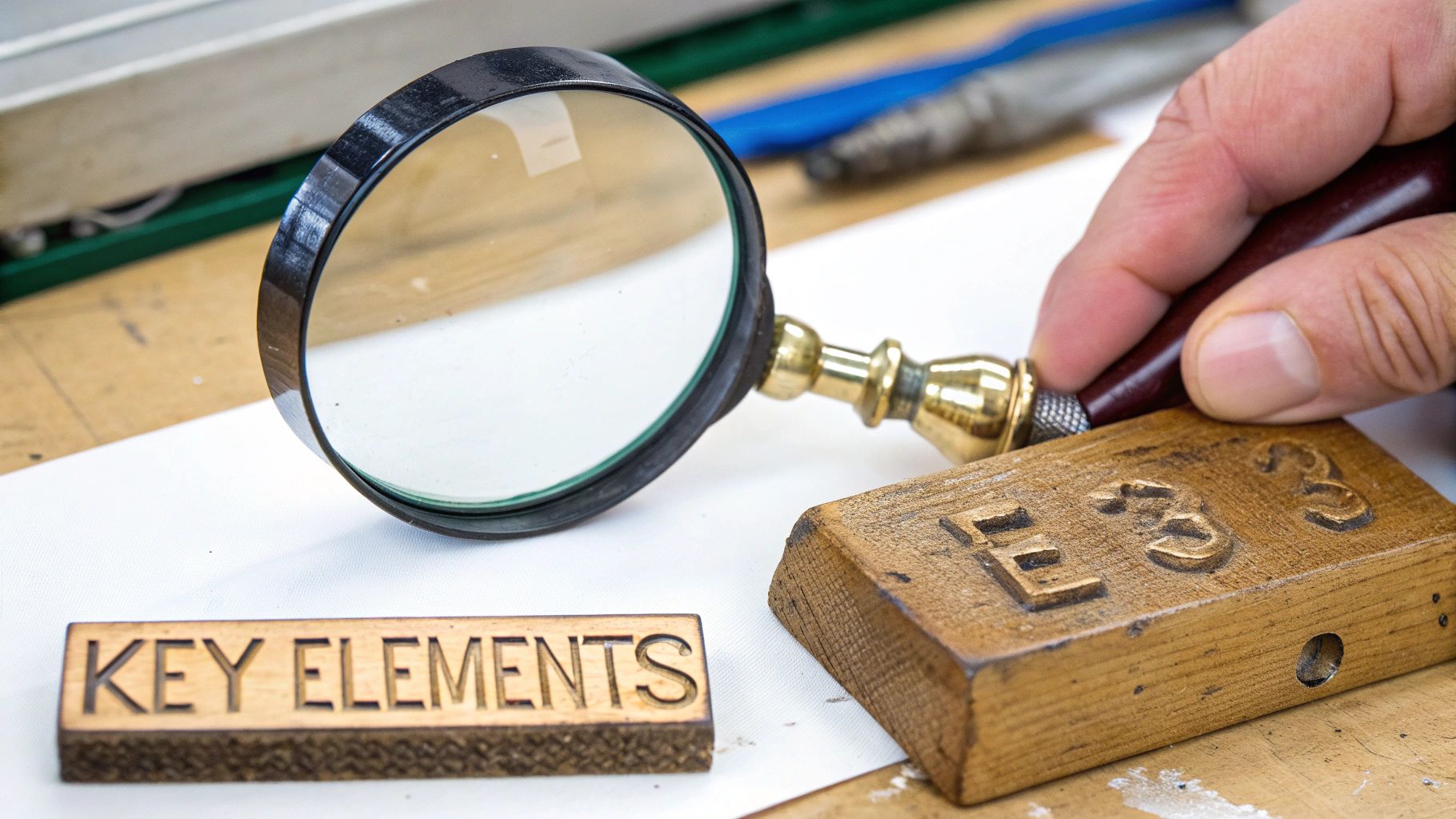
Before you can identify a French bronze foundry mark, you have to know what you’re looking for. These aren't just simple stamps. Think of them as a collection of clues that, when pieced together, tell the story of the sculpture’s creation.
You’ll need to get up close and personal with the piece, as marks are often tucked away in less obvious spots—the side of the base, the back of a figure, or even hidden within a fold of cast drapery. Each element tells you something different. The artist’s signature points to the mind behind the original model, while the foundry’s mark is a stamp of approval from the workshop that cast it. It’s a permanent record of the collaboration.
Decoding the Key Elements
To really understand what you're seeing, you need to break down the markings into their individual parts. Not every bronze will have every single element, but finding even one or two is a huge step toward authenticating your piece. Here’s what to keep an eye out for:
- The Foundry Name or Stamp: This is your most direct link to the caster. It might be spelled out, like "F. Barbedienne, Fondeur" (the French word for founder), or it could be a set of initials or a unique symbol. This is the workshop’s signature.
- The Artist's Signature: You'll usually find the sculptor's signature etched or cast directly into the bronze. You should always compare it to known, authentic examples of that artist's signature—forgers often slip up on the small details.
- The Edition or Cast Number: A fraction like 4/8 tells you this was the fourth cast made in a limited edition of eight. Collectors often value lower numbers more highly, as they were cast earlier in the production run when the mold was at its sharpest.
- Seals or "Cachets": Some foundries added a special seal, which was often pressed into the wax model right before casting. For instance, the Susse Frères foundry used a very recognizable circular cachet that often included the words "CIRE PERDUE" (lost wax).
To help you get started, this table breaks down the most common components you'll encounter on a French bronze and what they mean for the piece's story and value.
Key Elements of French Bronze Foundry Marks
| Mark Element | What It Signifies | Example | Impact on Value |
|---|---|---|---|
| Foundry Name | The workshop that cast the bronze. | "F. Barbedienne, Fondeur" | A top-tier foundry mark can significantly increase value. |
| Artist Signature | The creator of the original model. | "A. Rodin" | Essential for attribution; a clear, authentic signature is critical. |
| Edition Number | The specific cast number and the total edition size. | "4/8" or "IV/VIII" | Lower numbers in a small, finite edition are highly desirable. |
| Casting Technique | Indicates the method used, most often lost wax. | "CIRE PERDUE" | Denotes a high-quality, traditional casting process. |
| Foundry Seal/Cachet | A unique symbol or emblem used by the foundry. | Susse Frères' circular stamp | Acts as a secondary verification of the foundry's involvement. |
Looking at these elements together gives you a much clearer picture. A signed Barye sculpture cast by Barbedienne with a low edition number is a completely different animal from an unsigned piece with no foundry mark at all.
How to Find and Read the Marks
Locating these marks takes a bit of patience and a good light source. They were designed to be discreet, so they wouldn't interrupt the beauty of the sculpture itself. The base is always the first place to look. Turn the piece slowly under a bright, angled light, which will help catch any faint inscriptions.
If the base comes up empty, don't stop there. Check the vertical sides of the plinth, the lower back of a figure, or even an object within the scene.
Expert Tip: Be careful not to confuse a true foundry mark with an inventory number or a collector’s tag. Those are added later. A real mark is integral to the bronze itself—it was either cast along with the piece or stamped into the metal right after it cooled. Getting this right is fundamental to proper identification.
By methodically searching for these elements, you start to build a complete profile of your sculpture. This is the vocabulary you need to trace its history, confirm its authenticity, and ultimately understand its place in the world of fine art.
Quick Reference for Major French Foundries
The moment you can put a name to the mark on a bronze sculpture, you start to uncover its story and, of course, its value. This quick guide will walk you through the giants of French bronze casting—the foundries whose names became a guarantee of quality and artistic vision.
Think of this as your starting point. While hundreds of foundries operated across France, a select few truly dominated the golden age of bronze production in the 19th and early 20th centuries. Knowing these names is the first step for any serious collector.
The Barbedienne Foundry
Ferdinand Barbedienne set up his Paris workshop in 1838, and it didn't take long for his foundry to become the gold standard in bronze casting, a reputation it held until it closed in 1954. Known for its absolutely flawless quality, the foundry was the go-to for many of the era's most famous sculptors, like Antoine-Louis Barye and Emmanuel Frémiet. Seeing the Barbedienne mark is a strong clue you're looking at a high-value, masterfully executed sculpture.
The Barbedienne Foundry was more than just a workshop; it turned the foundry mark into a hallmark of excellence that collectors still hunt for today. Ferdinand Barbedienne was a master of sand-casting techniques, which allowed for perfect large-scale reproductions. He worked with masters like Rodin, whose pieces often carried the distinct 'F. Barbedienne Fondeur' oval stamp.
In France, limited editions of eight casts or fewer were legally considered 'originals,' and they fetch a premium. For instance, a numbered Barye lion from the Barbedienne foundry sold for an incredible €1.2 million at Christie's—a price 300% higher than similar, unmarked casts. You can find more details on why these marks matter so much at HTDECO.
- Active Years: 1838–1954
- Key Artists: Antoine-Louis Barye, Auguste Rodin, Emmanuel Frémiet
- Typical Mark: "F. BARBEDIENNE, Fondeur," often stamped inside an oval or rectangle.
The Susse Frères Foundry
As one of Europe's oldest art foundries still in operation, Susse Frères has a legacy stretching all the way back to 1758. These Parisian masters specialized in the traditional cire perdue (lost-wax) method, a process celebrated for its ability to capture incredibly fine details. Their mark is usually a circular stamp, or cachet, that reads "Susse Frs Edts Paris," which tells you they both cast and "edited" (or published) the work.
The term "Edts" (for Éditeurs) on a mark from a foundry like Susse Frères is important. It means they owned the rights to produce and sell a sculptor's work, confirming the piece is an authorized, high-quality cast.
Because the foundry has been around for so long, you can find their mark on bronzes from a huge range of artistic movements, from Neoclassicism all the way to Modernism, including works by artists like Alberto Giacometti.
The Rudier Foundry
The Rudier family foundry, especially under the leadership of Alexis Rudier, holds a very special place in art history. Active from 1874 to 1952, the workshop became the exclusive caster for the legendary Auguste Rodin after 1902. This was a monumental partnership, producing some of the most iconic bronze sculptures ever created, including "The Thinker" and "The Kiss."
The foundry mark is just as elegant as the work it produced: a simple, incised signature reading "Alexis RUDIER Fondeur PARIS." If you find this mark on a sculpture, particularly one by Rodin or his contemporaries like Aristide Maillol, you're looking at a piece of immense historical and artistic significance.
Other Notable Foundries
While Barbedienne, Susse, and Rudier were the titans, plenty of other foundries produced incredible work. Keep an eye out for their marks, as they are also valuable finds.
- Hébrard: Best known for casting the dynamic works of Impressionist sculptor Rembrandt Bugatti, the Hébrard foundry was a major force in the early 20th century.
- Siot-Decauville: This Parisian foundry was incredibly active from the late 19th into the early 20th century and was a favorite among many Art Nouveau sculptors.
This reference should give you a solid foundation for identifying the big names. For more examples and to dig a little deeper, take a look at our comprehensive guide on bronze foundry marks.
How to Date Your Bronze Sculpture
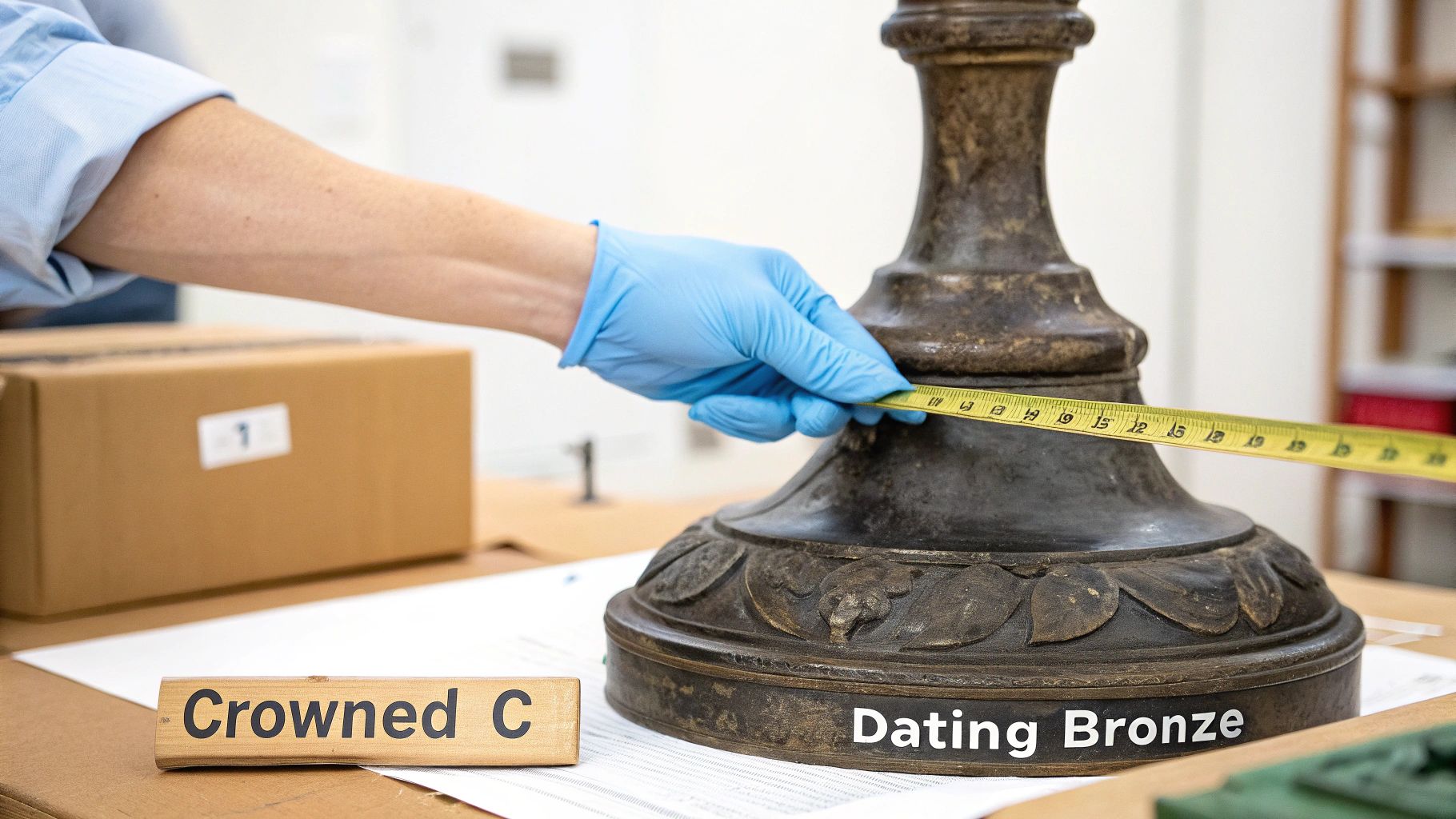
Trying to figure out the age of a French bronze can feel like a bit of detective work, especially when the artist didn't stamp a specific date on it. But don't worry. The sculpture itself holds plenty of clues in its style, casting method, and sometimes, very specific historical marks. You just need to know what to look for.
The overall style is always your first big hint. Does the piece have an ornate, flowing design with lots of asymmetrical details? You're likely looking at something from the Rococo period. If it has clean lines, classical themes, and a sense of perfect balance, it’s probably Neoclassical. Fast forward a bit, and you get the organic, nature-inspired forms of Art Nouveau, which dominated the turn of the 20th century. Pinpointing the artistic movement gives you a solid starting timeframe.
The Crowned C: A Definitive Tax Mark
Now and then, you get lucky and find an unmistakable clue. For 18th-century French bronze, the Crowned C mark is the gold standard. This isn't a foundry mark, but rather a tax stamp, and finding one is a fantastic discovery. It allows you to date your piece to a very specific, narrow window.
In the 18th century, French decorative arts were governed by a powerful guild system that kept a close eye on quality. A key mark from this era is the Crowned C, which stood for cuivre (copper), the primary metal in bronze. This stamp was a tax levied on any item containing a certain weight of copper between February 1745 and February 1749. Its presence is a rock-solid way to date these bronzes, especially when so many 19th-century surmoulage (recasts) are out there. If you're interested in the world of gilt bronze, The Met offers great insights into its use in the French interior.
The mark itself is just what it sounds like: a letter 'C' topped with a small crown, stamped right into the metal. Finding one is a rare thrill and instantly places your piece in the mid-18th century.
Reading Clues in Patina and Finishing
Beyond official marks, the physical condition of the bronze tells its own story. The patina—that colored layer on the surface—is one of the best indicators of age. A genuine, old patina forms slowly over centuries, creating subtle shifts in color and texture that are almost impossible to fake convincingly. Always look for wear and rubbing in the spots where the piece would have been handled the most.
You should also take a close look at how the piece was finished.
- Chasing and Filing: Older bronzes often show the fine marks of hand tools. This is called "chasing," and it was done to sharpen the details after the piece came out of the mold.
- Mounting and Screws: Even the way a bronze is put together can give away its age. Are the screws hand-cut, with slightly irregular slots? Or do they look like modern, machine-made fasteners?
By piecing together all these observations—from the broad artistic style to the tiniest construction details—you can build a very strong case for your sculpture’s age, turning visual evidence into a real historical timeline.
How to Spot Fakes and Reproductions
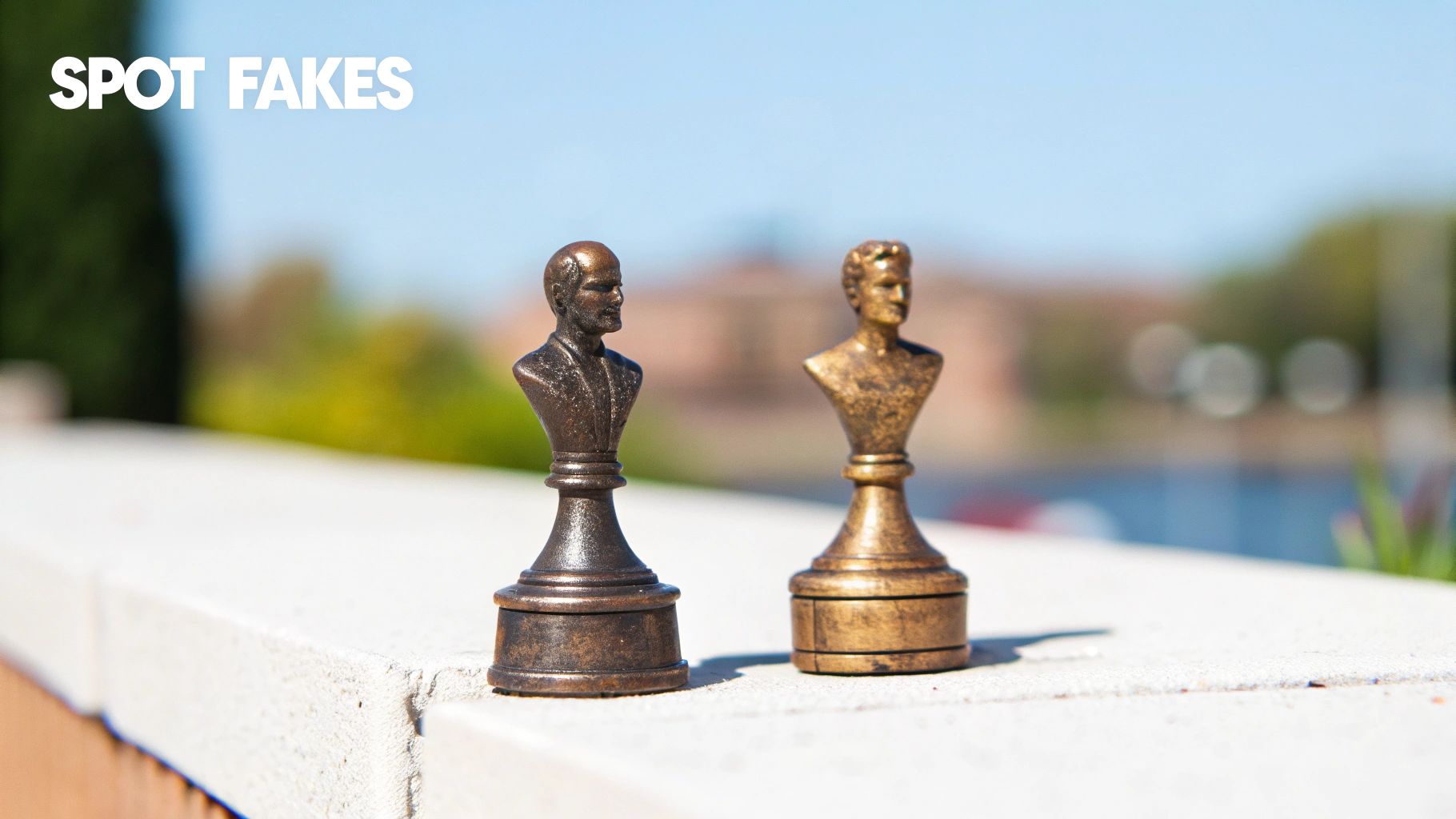
Learning to tell an authentic piece from a clever fake is the first step in protecting your investment. The French bronze market has always had its share of forgeries and reproductions, but with a trained eye, you can avoid a costly mistake.
Often, the biggest red flags are in the details. A genuine foundry mark, whether it's stamped or cut into the metal, should be crisp and clean. Be suspicious of any marks that look fuzzy, soft-edged, or just poorly struck—this is a classic sign of a copy.
Understanding Surmoulage Recasts
One of the most common issues you'll run into is the surmoulage. This is a recast made from a mold taken from an original, finished sculpture, not from the artist's master model. This technique was widely used back in the 19th century and it's still done today.
The problem with a surmoulage is that it loses detail. Every time a new mold is pulled from an existing bronze, the next cast comes out slightly smaller and the details get softer. You'll see this in blurred facial features, muted textures, and a general lack of sharpness—a far cry from what a top foundry would produce.
Common Red Flags for Reproductions
When you're looking at a piece, it pays to have a mental checklist of warning signs. Being systematic can help you quickly spot inconsistencies.
- Poorly Executed Marks: Forgers frequently mess up the small stuff. Watch for misspelled foundry names, incorrect logos, or a style of mark that doesn't fit the supposed era of the piece.
- Modern Hardware: Always check the screws, nuts, and bolts holding the sculpture together or attaching it to its base. Perfectly uniform, machine-made screws are a dead giveaway on a piece that claims to be an antique.
- Incorrect Patina: A real patina forms over many decades, with subtle color shifts and natural wear where the piece has been touched. Fakes often have a patina that looks too even, like it was painted or chemically sprayed on, and it just won't have the same depth.
- Unnatural Weight or Temperature: Solid bronze is dense and feels heavy for its size. It also feels cool to the touch. If a piece feels surprisingly light or warm, you might be holding a reproduction made of resin or spelter with a bronze-colored finish.
Here’s a simple trick I’ve used for years: the sound test. Gently tap the sculpture with your fingernail. Solid bronze should make a clear, bell-like ring. A dull thud usually points to a lesser material like spelter or a resin composite.
Final Checks Before You Buy
Go beyond just looking. Run your fingers over the surface. The hand-finishing work, or chasing, done to sharpen details after casting should feel crisp on an original. On a surmoulage, those same details will feel rounded and soft.
By combining what you see with what you feel and hear, you get a much clearer picture of the bronze's true identity. This multi-sensory approach is your best defense against ending up with a well-made fake.
Using Technology for Bronze Identification
While nothing replaces a well-trained eye, today's technology gives us some incredibly powerful shortcuts for identifying French bronze foundry marks. Having access to vast digital databases and expert knowledge right from your phone can be a game-changer, whether you're in an auction house or a dusty antique shop. It's the perfect blend of old-world expertise and modern convenience.
The first step, and the most important one, is getting a great photo of the mark. A clear picture is everything; even the most sophisticated app can't do much with a blurry or poorly lit image.
How to Photograph Foundry Marks
Good documentation starts with a good photo. A crisp, detailed image is what allows an identification app to effectively scan its library and find a match. For the best results, follow these simple steps:
- Use Angled Lighting: Grab a flashlight and hold it at a sharp angle to the mark. This technique, called raking light, casts shadows that make even the faintest details pop. It's a professional trick that works wonders.
- Get a Sharp Focus: Tap your phone's screen directly on the foundry mark to tell the camera exactly what to focus on. Brace your hand or use a small tripod to eliminate any chance of blur.
- Take a Few Shots: Snap several pictures, moving the light and your camera angle slightly each time. Sometimes a tiny shift is all it takes to reveal a crucial detail in a worn or intricate mark.
Putting an App Like Curio to Work
Once you have your photos, an antique identification app like Curio can take it from there. You just upload your best shot, and its visual search engine starts scanning. The app compares your mark against a huge database of known French bronze foundry marks, artist signatures, and symbols.
In just a few seconds, Curio can often pull up the foundry's name, the artists they worked with, their active dates, and sometimes even a value estimate based on recent auction results. It's an essential tool for making quick, informed decisions on the spot.
By the late 19th century, new production methods had cut the time to make a bronze from months down to weeks. This led to a huge increase in output, but it also meant that marks from top-tier foundries like Ferdinand Barbedienne became critical signals of quality. This is where a visual search really proves its worth. Curio can compare your piece to records of sold items, helping you determine if you have a top-quality original or a more common reproduction. As you can learn more about the history of bronze collecting, understanding these marks is the key to spotting true value.
Frequently Asked Questions
When you're dealing with antique bronzes, a lot of questions come up. The world of French bronze foundry marks is filled with subtle details that can make a huge difference, and it's easy to get turned around. Here are some clear answers to the questions I hear most often, designed to help you feel more confident when you're looking at a piece.
What If a Sculpture Has a Signature But No Foundry Mark?
This is a classic "it depends" situation. Finding an artist's signature without a foundry mark can point in a few different directions. It could be a very early cast, made before foundries started marking their work consistently. Sometimes, an artist would cast a unique piece themselves in their own studio.
But, you also have to be cautious. An unmarked piece can be a red flag for a later, unauthorized reproduction or just a poor-quality copy.
When there's no foundry mark to guide you, you have to play detective with other clues:
- Look at the Quality: Get up close and examine the details. An authentic, period cast will have sharp, crisp lines. Copies often look soft, blurry, or just a bit "off."
- Check the Patina: A genuine patina develops over a century or more. It should look natural, with subtle variations in color and wear in places you'd expect, like a figure's hand or knee. A flat, uniform, painted-on finish is a dead giveaway for a fake.
- Compare It: This is the most important step. Find photos of known, authenticated works by that same artist. Compare everything—the style of the signature, the casting quality, and how the surface is finished.
A good visual identification tool is a huge help here. Matching your piece against a database of confirmed examples, like with Curio, can give you the evidence you need to figure out its real story.
How Much Does a Foundry Mark Increase a Bronze's Value?
A lot. A legitimate mark from a top-tier foundry like Barbedienne or Susse Frères can easily increase a bronze's value by 30% to over 300%. That’s compared to an identical sculpture by the same artist that happens to be unmarked.
Why such a huge jump? Because that little mark is an ironclad guarantee of quality and authenticity. It’s provenance. It tells a collector that the piece isn't some knock-off and connects it directly to a famous workshop known for its incredible craftsmanship. People will always pay a serious premium for that kind of certainty.
The effect is most dramatic when you have a famous artist paired with their preferred, elite foundry. Think of a Rodin sculpture bearing the mark of Alexis Rudier, who cast almost exclusively for him. That mark tells a story and provides a historical context that makes the piece immensely more desirable to serious collectors.
Are All Foundry Marks Stamped Into the Bronze?
Not at all. While a stamped impression is very common, it's just one of several methods foundries used. The way a mark was applied often depended on the workshop's own traditions.
You’ll see French bronze foundry marks in a few different forms:
- Incised Marks: Sometimes the mark was scratched right into the original wax or clay model before it was ever cast. This means the mark becomes an integral part of the bronze itself.
- Applied Seals: Other foundries used a little cast seal or emblem, often called a "cachet." They would press this into the wax model, leaving a distinct impression. The circular "CIRE PERDUE" seal used by Susse Frères is a perfect example of this.
- Integrated Signatures: Less commonly, the foundry's name was actually incorporated into the design of the base as part of the original sculpture.
Knowing which method a particular foundry typically used is a key piece of the puzzle. For example, Ferdinand Barbedienne's workshop is known for a very distinct oval stamp, while others might have just used simple initials.
Should I Clean a Bronze Sculpture to See the Mark?
My advice is to be extremely careful here. You should never aggressively clean a bronze sculpture. The patina—that surface color and texture—is a huge part of its history, character, and value. One wrong move with a harsh cleaner can cause permanent damage and tank its worth.
If you think a mark is just hidden under a layer of dust, try this first:
- Get a Soft Brush: Use a soft, dry artist's paintbrush to gently flick away any loose dust from the area. Don't scrub.
- Use Angled Light: Grab a flashlight and hold it at a very low angle to the surface. This technique, called raking light, creates shadows that can make the faint indentations of a mark pop.
If that doesn't work, stop. Don't be tempted to use water, polish, or anything else. For anything more than a light dusting, you absolutely need to consult a professional art conservator. They have the knowledge and tools to clean the piece without destroying its valuable, time-worn surface.
Ready to figure out the story behind your own bronze? With Curio, you can identify foundry marks in a snap, learn about the artists who made them, and get an idea of what they're worth, all from your phone. Download Curio today and let your antiques start talking.