
If you've ever found a tall, peculiar glass vessel at an antique shop and thought it was just an odd-looking flower vase, you might have stumbled upon a piece of Victorian history. The first step in identifying a celery vase is understanding its unique features: a tall, slender body, typically between 6-12 inches, a solid, often footed base to keep it stable, and a slightly flared rim.
These design choices weren't accidental. They were purpose-built to show off celery stalks, making them distinct from your average vase.
What Is a Celery Vase and Why Was It So Popular?
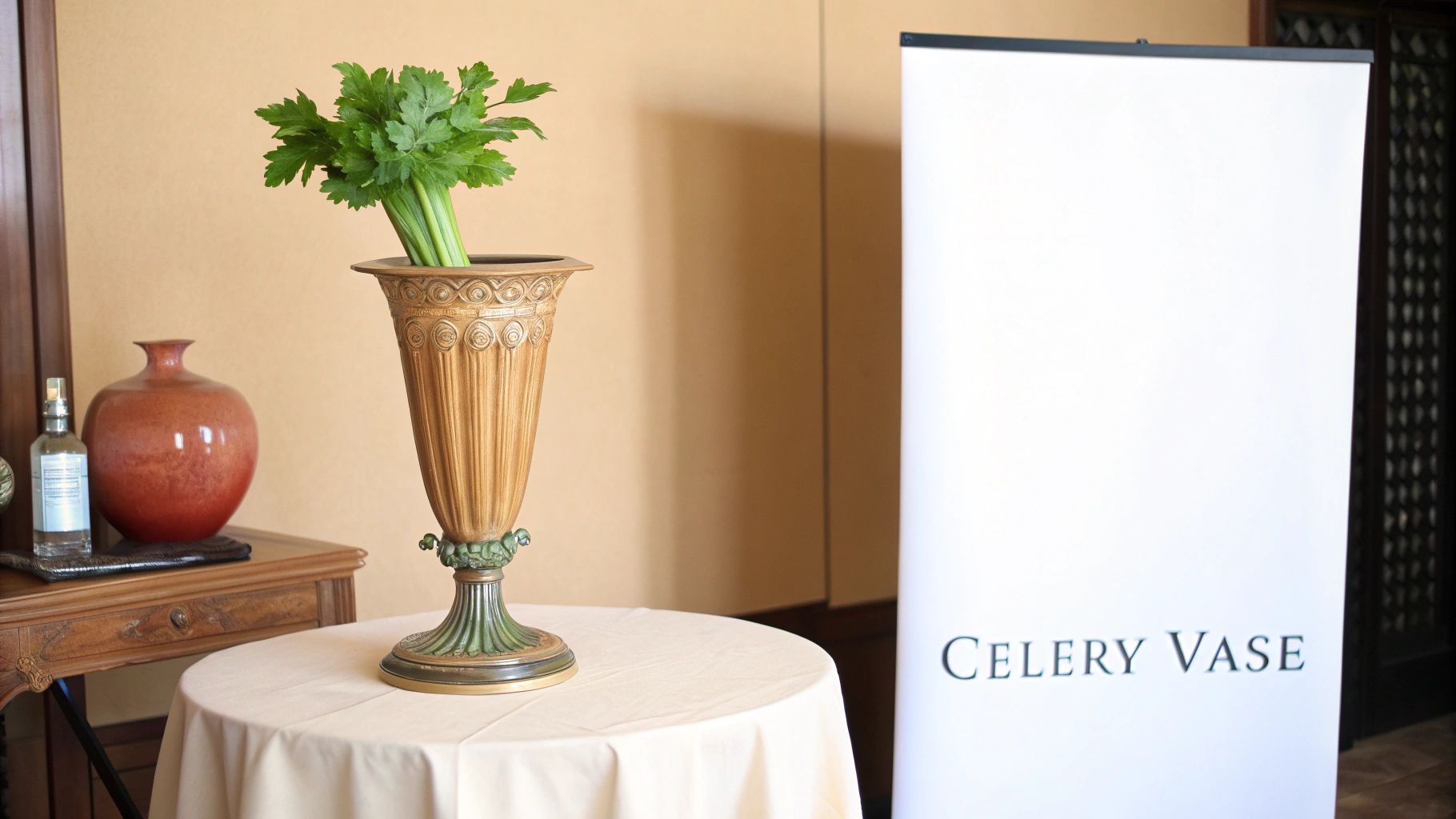
That elegant glass container wasn't just for holding a vegetable; it was a status symbol. Back in the 19th and early 20th centuries, celery wasn't the everyday snack food it is now. It was a luxury item—difficult to grow, expensive to buy, and a sign that you had both taste and money.
Putting fresh celery on the dinner table was a way for a host to subtly (or not-so-subtly) broadcast their wealth and worldliness to guests. The vase was designed to make this presentation as grand as possible, transforming a simple garden vegetable into a stunning centerpiece. Its tall, narrow form kept the stalks standing upright and crisp, often with a little water at the bottom to maintain freshness throughout a long, formal dinner.
A Staple of the Victorian Table
Think of a Victorian dining room. Right there on the table, alongside the fine china and silver, would have been a celery vase. Popular from the 1880s to the 1920s, these became a fixture in middle-class homes across the United States and Europe. Their popularity was immense; antique dining surveys suggest that over 70% of households in 1890s America owned at least one. If you want to dive deeper into historical glassware, you can find more insights about antique vase trends on VasesHub.com.
This widespread production means you're likely to encounter a huge variety of styles and patterns today. When you're looking, keep an eye out for these key traits:
- Height and Shape: They almost always stand between 6 and 12 inches tall and have that signature slim profile.
- The Base: A heavy, weighted, or footed base was crucial. It kept the top-heavy arrangement from toppling over mid-meal.
- Materials: Most are made of glass—pressed, cut, or etched. You might occasionally find rarer examples in silver plate or even porcelain.
To give you a quick reference, here’s a breakdown of what to look for at a glance.
Celery Vase at a Glance Key Identifiers
| Feature | What to Look For | Common Era |
|---|---|---|
| Height | Typically 6-12 inches (15-30 cm) | Late 1800s - Early 1900s |
| Shape | Tall, slender, cylindrical, or trumpet-like body | Victorian, Edwardian |
| Base | Weighted, footed, or pedestal style for stability | Victorian, Edwardian |
| Top Rim | Often slightly flared or ruffled to splay the stalks | Late 1800s - Early 1900s |
| Material | Primarily glass (pressed, cut, etched); less common in silver or porcelain | Victorian, Edwardian |
Knowing this history is the first real step in learning how to identify a celery vase. It helps you appreciate not just the object itself, but also its fascinating role in the evolution of dining culture.
Reading the Clues in Glass Shape and Form

Before you even think about maker's marks or pulling out a magnifying glass, the first clues are right there in the vase's silhouette. The overall shape and form can tell you a surprising amount about whether you're holding the real deal. A genuine celery vase wasn't just decorative; its design was all about function.
The most obvious feature is its height. These vases are tall, typically standing a proud 6 to 12 inches. This wasn't for drama—it was a practical way to hold long celery stalks upright at the dinner table. The body is almost always slender and cylindrical, often flaring out toward the top like a trumpet.
That flared or ruffled rim wasn't just a pretty touch, either. It was designed to splay the celery leaves for a grander presentation. Now, look at the base. It will almost always feel heavy for its size, or be set on a distinct pedestal or footed design. This was crucial to keep the top-heavy arrangement from tipping over during a bustling meal.
Distinguishing Different Glass Types
Once you've got a feel for the shape, it's time to look closer at the glass itself. The material is a huge indicator of the vase's era and quality. Most celery vases you'll find fall into a few key categories, each with its own character.
If you're interested in learning more about this, our guide on how to spot and identify antique coloured glass bottles has some great tips on material analysis.
Pressed Glass: This was the workhorse of celery vases, especially for middle-class homes. Molten glass was pressed into a mold, creating pieces with intricate geometric or floral patterns. They usually feel thick and heavy. If you run your fingers up the side, you can often feel a faint seam left by the mold.
Cut Crystal: This was the high-end stuff. Cut crystal celery vases are all about brilliance and clarity. The patterns were cut into the glass—by hand or machine—creating sharp facets that catch the light beautifully. A gentle tap on the rim should produce a clear, satisfying ring.
Carnival Glass: Produced from about 1908 to 1925, you'll know this glass when you see it. It has that signature iridescent, oil-on-water sheen, which was created by spraying hot glass with metallic salts. Big names like Northwood, Fenton, and Imperial all made carnival glass celery vases.
Examining Manufacturing Imperfections
Some of the most telling clues are hiding in plain sight as small imperfections. These so-called "flaws" are your best friends when authenticating a piece, because modern reproductions are often just too perfect.
Flip the vase over and take a good look at the base. You might find a pontil mark—a small, often rough scar where the glassblower’s rod was snapped off. A rough, unpolished pontil is a classic sign of hand-blown glass made before the early 1900s.
Here's a pro tip: always check the bottom. Research shows that pontil scars appear on a staggering 90% of pre-1900 hand-blown celery vases. These rough marks are a dead giveaway, as an estimated 68% of modern fakes have a perfectly smooth, machine-finished base.
These handmade tells aren't just on the base. True antique pieces often have a slight asymmetry. It's not unusual for a genuine vase's height to deviate by 2-5% from one side to the other, a result of handcrafting. Compare that to the tiny 0.5% variance in machine-made glass produced after 1925.
You might also spot tiny air bubbles, known as "seeds," trapped inside the glass. While considered a defect today, these bubbles are found in over 62% of authentic antique pieces, signaling their age and handmade origin. You can find more great insights about these antique vase identification details on SellingAntiques.co.uk.
Cracking the Code: Maker's Marks and Glasshouse Signatures
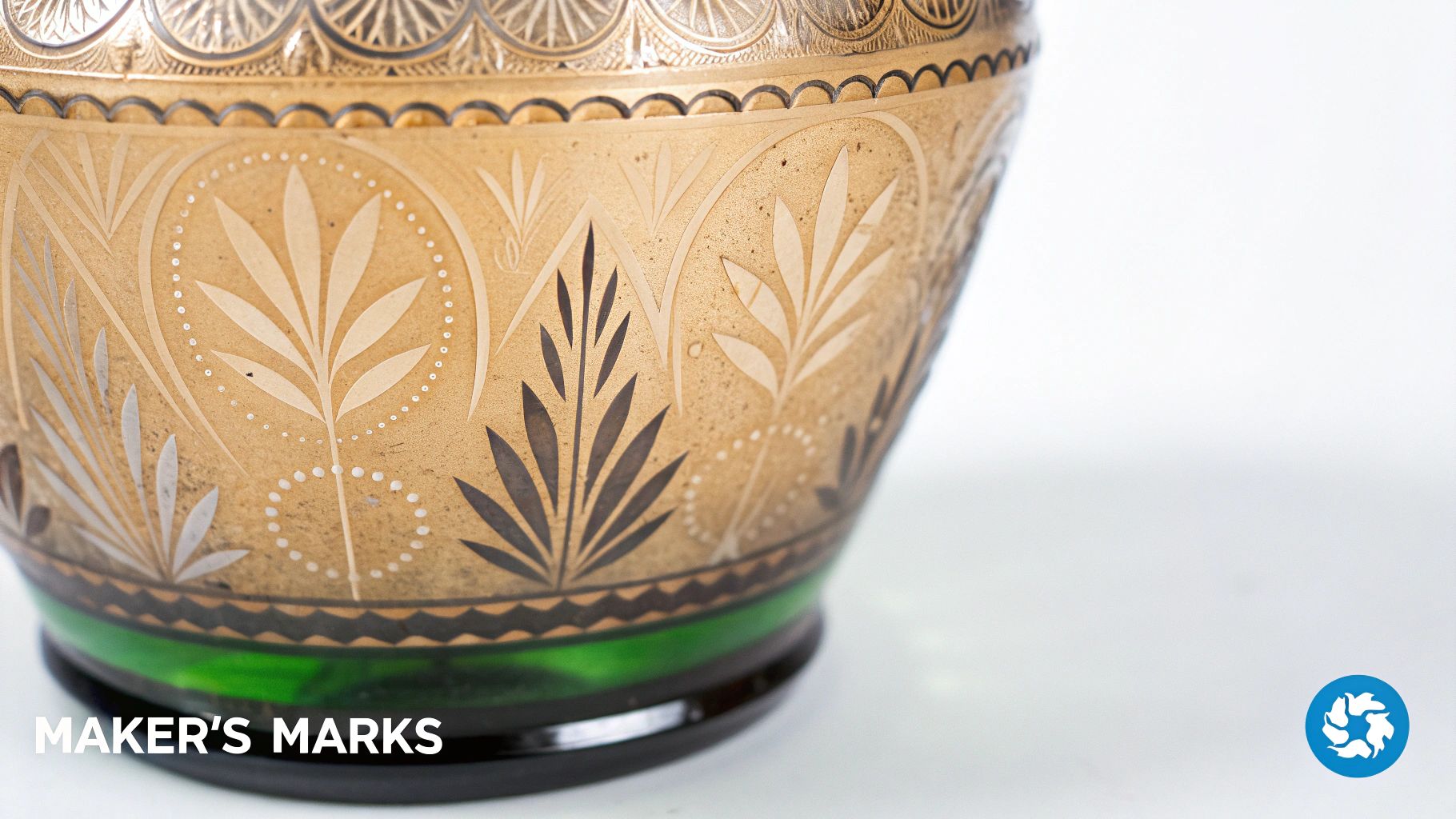
Alright, you've given the vase a good once-over and have a feel for its physical qualities. Now for the exciting part—the hunt for a signature. Think of maker's marks as the fingerprints of the glass world. Finding one can be a real breakthrough, instantly connecting your piece to a specific creator, time, and place.
These marks aren't always obvious. They come in all shapes and sizes, from bold stamps to nearly invisible etchings. So, grab a good light source, maybe a magnifying glass, and get ready to do some detective work. The base of the vase is almost always the best place to start looking.
Where and What to Look For
Glassmakers have used a variety of methods to sign their work over the years, and the type of mark you find is a major clue in itself. Here’s what you might encounter:
- Acid-Etched Marks: This is a classic. Makers like Libbey and Moser would use acid to create a soft, frosted signature on the glass. If you run your finger over it, it should feel completely smooth.
- Engraved or Cut Marks: Created with a diamond point or a cutting wheel, these signatures are physically carved into the glass. You’ll be able to feel a slight indentation or a bit of sharpness.
- Stamped or Molded Marks: Common on pressed glass, these marks are part of the mold itself. The signature will appear as raised letters or a symbol, often on the bottom of the piece.
- Paper Labels: Finding an original paper label is like hitting the jackpot. They are incredibly fragile and rarely survive decades of use and washing. A surviving label is a fantastic clue, but be warned—they're also the easiest type of mark for forgers to fake.
Famous Signatures and Common Fakes
Knowing what to look for is half the battle. Some glasshouses have iconic marks that are instantly recognizable to collectors. For example, the Northwood Glass Company often marked their famous carnival glass with an underlined capital “N” inside a circle. Libbey’s Brilliant Period cut glass frequently features a graceful, acid-etched “Libbey” script.
But here’s where you need a healthy dose of skepticism. Forgers love to copy famous marks, but they almost never get them quite right. An "N" in a circle might be the wrong size or proportion, or a "Libbey" signature might look clunky and heavy-handed instead of elegant.
My best advice? Trust your gut. If a mark on a supposedly high-end piece looks sloppy, too new, or just off, it’s a major red flag. Weird letter spacing, a font that looks too modern, or a signature in a bizarre spot are all signs you need to investigate further.
Always compare a mark you find to verified examples from reputable sources online. If you want to dive deeper, you can learn more about antique glass maker's marks and how to spot the fakes in our detailed guide.
Using Modern Tools for Antique Identification
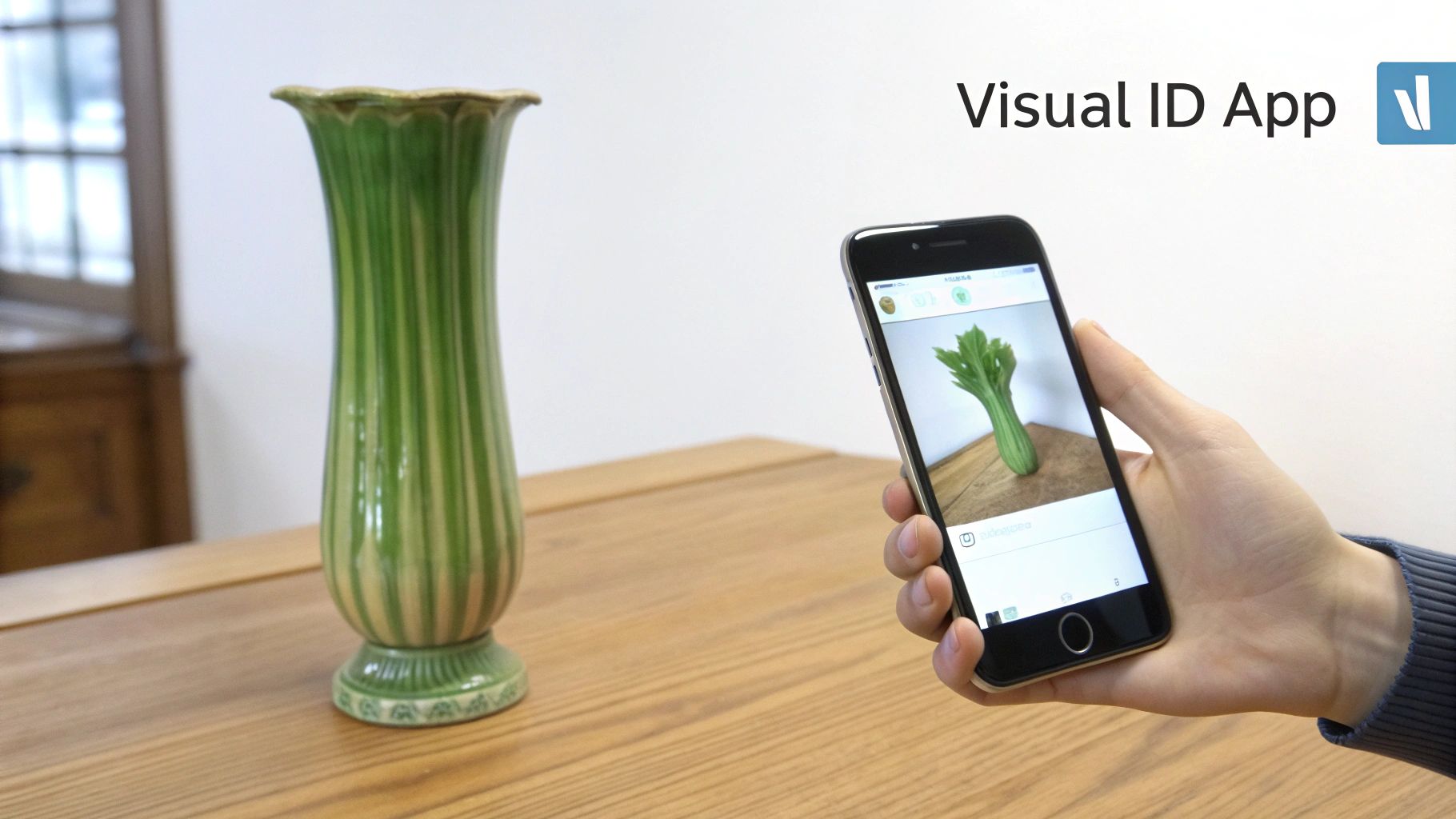
Old guidebooks are fantastic, but technology has given us a whole new way to identify antiques. It’s like having an expert in your pocket, blending what you’re learning with powerful image recognition. This is especially helpful for getting a quick read on a potential celery vase at a busy flea market or while sorting through an estate.
Picture this: you're at a garage sale and find a tall, slender vase. Is it a true Victorian antique or just a modern flower holder? Instead of just guessing, you can use an app like Curio to snap a picture. In seconds, you get a potential ID, some historical context, and maybe even a ballpark value. For the collector who needs to make decisions on the fly, this kind of speed is a huge advantage.
Mastering the Perfect Photo for Identification
The old saying "garbage in, garbage out" absolutely applies here. The quality of your photo is everything. A blurry, dark, or cluttered shot will just confuse the app and leave you with a frustratingly vague answer.
I always recommend a simple three-shot process for the best results:
- The Full View: First, get a clear, well-lit photo of the entire vase. Put it against a plain background—a solid-colored wall or a simple tablecloth works great. This shot gives the app the overall shape and proportions to work with.
- The Detail Shot: Next, zoom in. Capture a close-up of any interesting patterns, etchings, or decorative touches. This is where the app can spot specific designs tied to a particular maker or era.
- The Base Shot: This is the most critical photo of all. Carefully flip the vase over and get a sharp, focused picture of the bottom. You want to clearly capture any maker's marks, signatures, or the tell-tale pontil scar.
If you’re tasked with cataloging a family collection, these digital tools are a lifesaver. You can log each item, save its identification, add personal notes about its history, and track its value. It’s a wonderful way to create a digital archive that preserves your family’s legacy.
Beyond just giving you a name, these tools can really deepen your knowledge. Their visual search features can pull up similar pieces that have sold recently, which is perfect for comparing your find against known examples. It’s an incredibly practical way to spot common reproductions or confirm that you might have something truly rare on your hands.
By pairing good photography with a powerful app, your phone transforms into an essential part of your antique-hunting kit. It gives you the information you need to move from simple curiosity to confident collecting.
What's My Celery Vase Worth?
So you've figured out what you have. The next question, naturally, is what it’s worth. The value of an antique celery vase isn’t just about how old it is; it’s a delicate dance between its maker, how rare it is, its condition, and the material it’s made from.
A simple, unmarked pressed glass vase is a lovely decorative piece, but a signed, iridescent carnival glass vase by a famous maker like Northwood? That's in a completely different league.
The biggest single factor that can drive up the price is the maker's mark. A signature from a powerhouse glasshouse—think Libbey, Moser, or Tiffany Studios—instantly turns a pretty vase into a serious collector's item. Rarity is a close second. Was the pattern churned out by the thousands, or was it a special, limited run in a wild color? A common marigold or green carnival glass vase is easy to find, but one in a scarce amethyst or aqua opalescent shade is a true treasure.
Condition, Condition, Condition
This is the great equalizer in the antiques world. Even the rarest piece will take a major value hit if it's damaged. We're talking chips, cracks, or that dreaded "sickness"—a cloudy, etched film inside the glass that’s basically impossible to clean.
Minor shelf wear on the base from a hundred years of sitting on a sideboard is perfectly normal and usually doesn't affect the price much. But a noticeable chip on the rim? That can slash its value by 50% or more, sometimes completely.
Be ruthlessly honest when you assess the condition. What looks like a tiny "flea bite" to you is a deal-breaker for a discerning collector. Always check your glass in bright, natural light, tilting it to catch every angle.
The material and artistry matter immensely, too. American Brilliant Period (ABP) cut glass celery vases, with their dazzling, hand-cut geometric patterns, are often highly prized because of the incredible skill and labor they required. To get a better feel for what makes certain glassware pop, our guide on the most valuable antique glassware offers some great examples and context.
Celery Vase Value Factors
To put it all together, here’s a quick cheat sheet for what pushes a celery vase’s value up or down. Think of it as a sliding scale—the more boxes you can tick in the "High Value" column, the better.
| Factor | Low Value Indicator | High Value Indicator |
|---|---|---|
| Maker | Unmarked or from a common, mass-producer. | Signed or attributed to a famous maker (e.g., Libbey, Tiffany). |
| Condition | Chips, cracks, significant scratches, or glass "sickness." | Pristine, with only minor, expected shelf wear on the base. |
| Rarity | A common pattern made in large quantities. | A rare pattern, unusual color, or a limited production piece. |
| Material | Simple, plain pressed glass. | Hand-cut ABP glass, iridescent carnival glass, or art glass. |
| Artistry | Basic molded design with little detail. | Intricate hand-cutting, detailed etching, or unique frosting. |
This table helps visualize how different attributes contribute to the final market price. A piece doesn't have to be perfect in every category, but a strong showing in areas like Maker and Condition will always make a significant difference.
So, What's Next?
Once you have a good idea of its history and value, what do you do with it? Your next move really depends on your goal.
- If you're a reseller: Use your research to price it competitively. Make sure your listing details the maker, pattern, and condition—be upfront about any flaws! And remember, clear, well-lit photos are non-negotiable.
- If you're a collector: Congratulations! Maybe this piece fills a long-standing gap in your collection. Get it cataloged (apps like Curio are great for this) and find a safe, beautiful spot to display it.
- If you inherited it: Now you can make an informed choice. Do you love it enough to keep it and enjoy its story? Or would you rather sell it to someone who will cherish it just as much? Knowing its value empowers you to make a decision you won't regret later on.
Common Questions About Identifying Celery Vases
Even after you get the hang of the basics, you'll run into specific questions out in the wild. I see them pop up all the time. Whether you've been collecting for years or just found your first piece, getting clear answers can be the difference between walking past a hidden gem and confidently snapping it up. Here are some of the most common questions I hear.
How Is a Celery Vase Different from a Flower Vase?
This is the big one, and it's an easy mistake to make at first glance. The secret is in the design, which was totally driven by its purpose. A true celery vase has a very distinct form: it’s tall (usually 6-12 inches), skinny, and has a heavy, footed base to keep it from tipping over. The top flares out just a little. This whole shape was engineered to do one thing perfectly: hold celery stalks upright and make them look grand on the dining table.
Flower vases, on the other hand, come in all shapes and sizes. Sure, some are tall and slender, but they don't have that consistent, purpose-built profile. A real celery vase feels less like a generic container and more like a specialized piece of equipment from a bygone era.
Are All Antique Celery Vases Made of Glass?
The vast majority you’ll come across will be glass. Think of all that beautiful pressed glass, brilliant cut crystal, and flashy carnival glass from back in the day. Glass was the go-to material because it was relatively cheap and perfect for the ornate patterns Victorians loved.
But don’t stop there. The fanciest households sometimes had celery vases made from other materials. You might, if you’re lucky, stumble upon a rare one in silver plate or even stunning porcelain from a legendary maker like Meissen. These are much harder to find and are the kind of thing serious collectors get really excited about.
Don't automatically dismiss a piece just because it isn't glass. While glass is the standard, finding a porcelain or silver plate celery vase is an exceptional discovery that points to a more luxurious origin.
Do Bubbles in the Glass Mean It Is a Flaw?
Absolutely not! In the world of old, hand-blown glass, those little bubbles are your friend. We often call them "seeds," and they’re just tiny imperfections that happened during the manufacturing process before everything was done by machine. Finding them is a great sign you're holding a genuinely old piece.
Modern, machine-made glass is almost always perfectly uniform and clear. Those charming little bubbles are one of the best clues you have for authenticating an antique and separating it from a recent reproduction.
How Do I Spot a Modern Reproduction?
Modern fakes often give themselves away by being a little too perfect. The dead giveaway is usually on the bottom. An original 19th-century hand-blown vase will almost always have a rough pontil mark—that little scar where the glassblower snapped the rod off. Reproductions? They almost always have a smooth, polished base.
Another thing to check is the feel and the signs of age. Fakes can feel lighter and just won't have the subtle evidence of a long life. I always look for tiny scratches on the base from being slid across tables for a hundred years. A real antique should show its age, even if it’s been well cared for.
Ready to take the guesswork out of your next find? The Curio app puts an antique expert in your pocket. Snap a picture of your vase, and get instant identification, historical context, and a value estimate in seconds. Download Curio today and let your antiques tell their story!