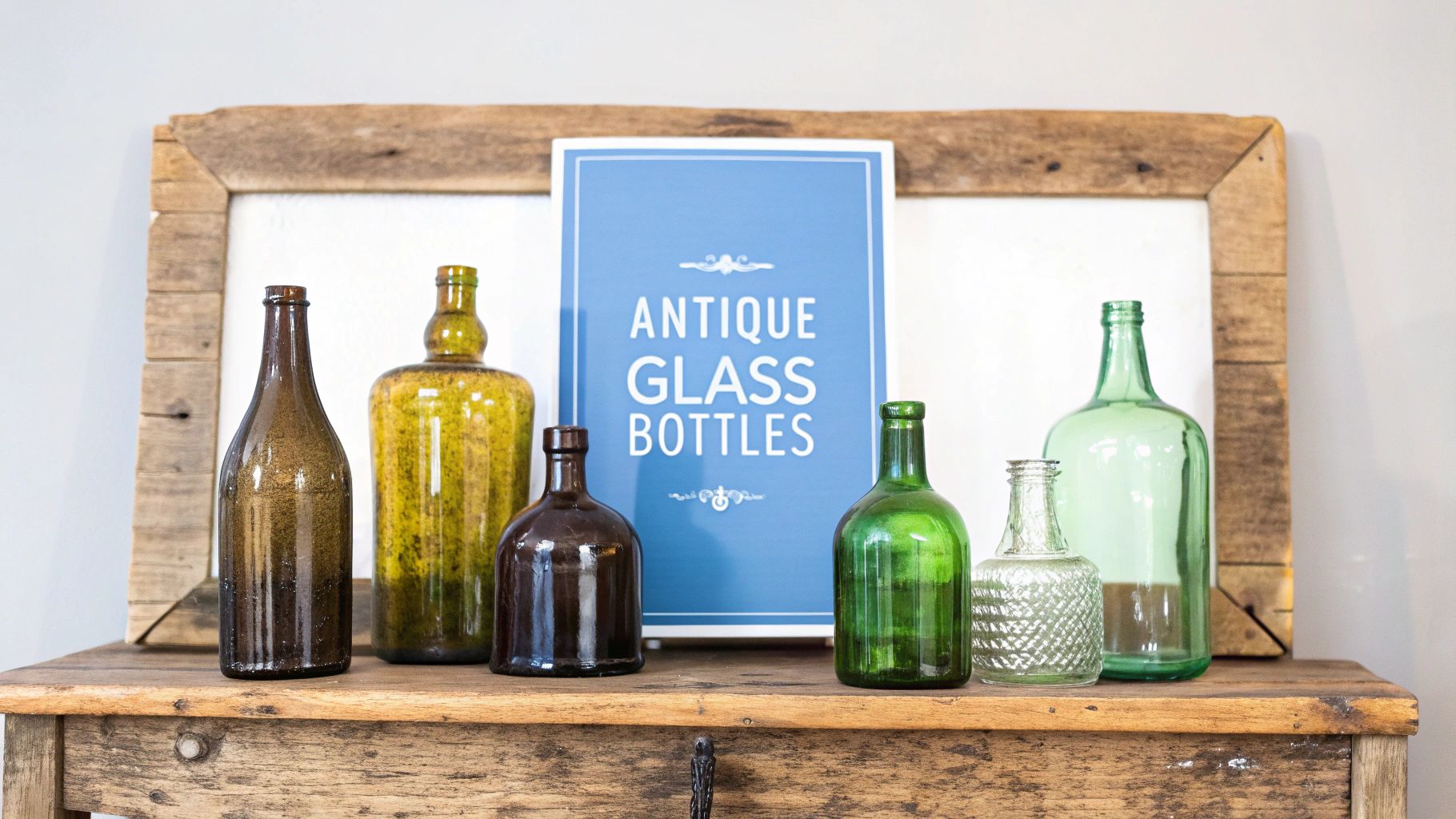
Old glass bottles aren't just pretty shelf-sitters; they're genuine pieces of history. The color of a bottle is often the very first clue you get about its age, what it was made for, and whether you've stumbled upon a rare find. That specific hue can tell a story, hinting at whether it held a questionable patent medicine, a prized whiskey, or a simple bottle of soda. For any collector, color is where the investigation begins.
The Hidden Stories in Coloured Glass Bottles
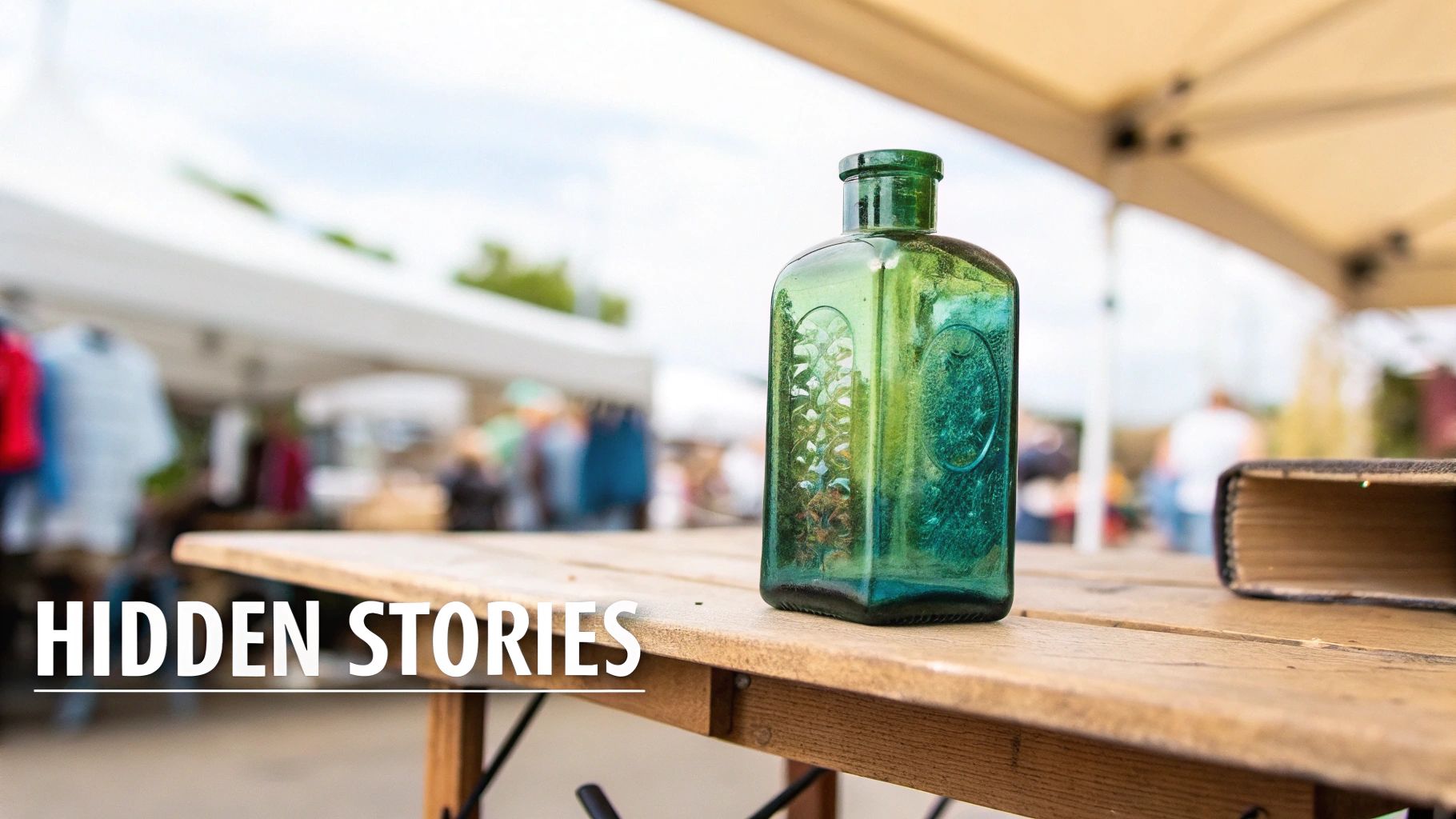
Picture this: you're at a flea market and spot a bottle glowing with a deep, vibrant color. That shade isn’t just for looks; it’s the opening chapter of a story waiting to be told. This guide will help you peel back the layers of history sealed within these beautiful glass artifacts, turning you from a casual admirer into a savvy collector.
Back in the day, a bottle's color was often a practical choice, not just a decorative one. Think of it like modern-day packaging. Amber glass, for example, was the original UV filter, protecting light-sensitive contents like beer and medicine from going bad. A stunning cobalt blue made a bottle leap off the crowded apothecary shelf, practically shouting "buy me!" to customers looking for a cure.
More Than Just a Pretty Color
Understanding why a certain color was used is the first step in decoding a bottle's past. A shelf full of antique coloured glass bottles is a visual timeline of commerce, medicine, and everyday life from a world long gone. Each shade and tint came from adding specific minerals to the glass mix—some of which are rarely, if ever, used today.
- Practicality: Darker colors like deep amber and forest green were workhorses, used to preserve everything from potent elixirs and poisons to spirits.
- Marketing: Brilliant blues and rich reds were expensive to produce, often signaling a high-end or powerful product inside.
- Availability: The common aqua or "bottle green" hue came from iron impurities naturally found in sand. This made it the cheap, default color for everyday items like soda and mineral water bottles.
For the collector, color is the primary clue. It helps narrow down a bottle's potential age, use, and even where it was made before you even look for a seam or a pontil mark. A rare color in an otherwise common bottle design can make its value skyrocket.
This guide will teach you how to "read" the glass. We’ll explore how specific colors tie into different historical periods and what they reveal about a bottle's journey. This knowledge is crucial, whether you're hunting for treasures at an estate sale or just want to better appreciate the pieces you already own. While we're focused on man-made glass, it's interesting to note how naturally formed materials like Libyan Desert Glass also tell their own fascinating stories. Our journey starts by seeing color not just for its beauty, but for the rich history it holds.
Decoding the Meaning Behind Bottle Colors
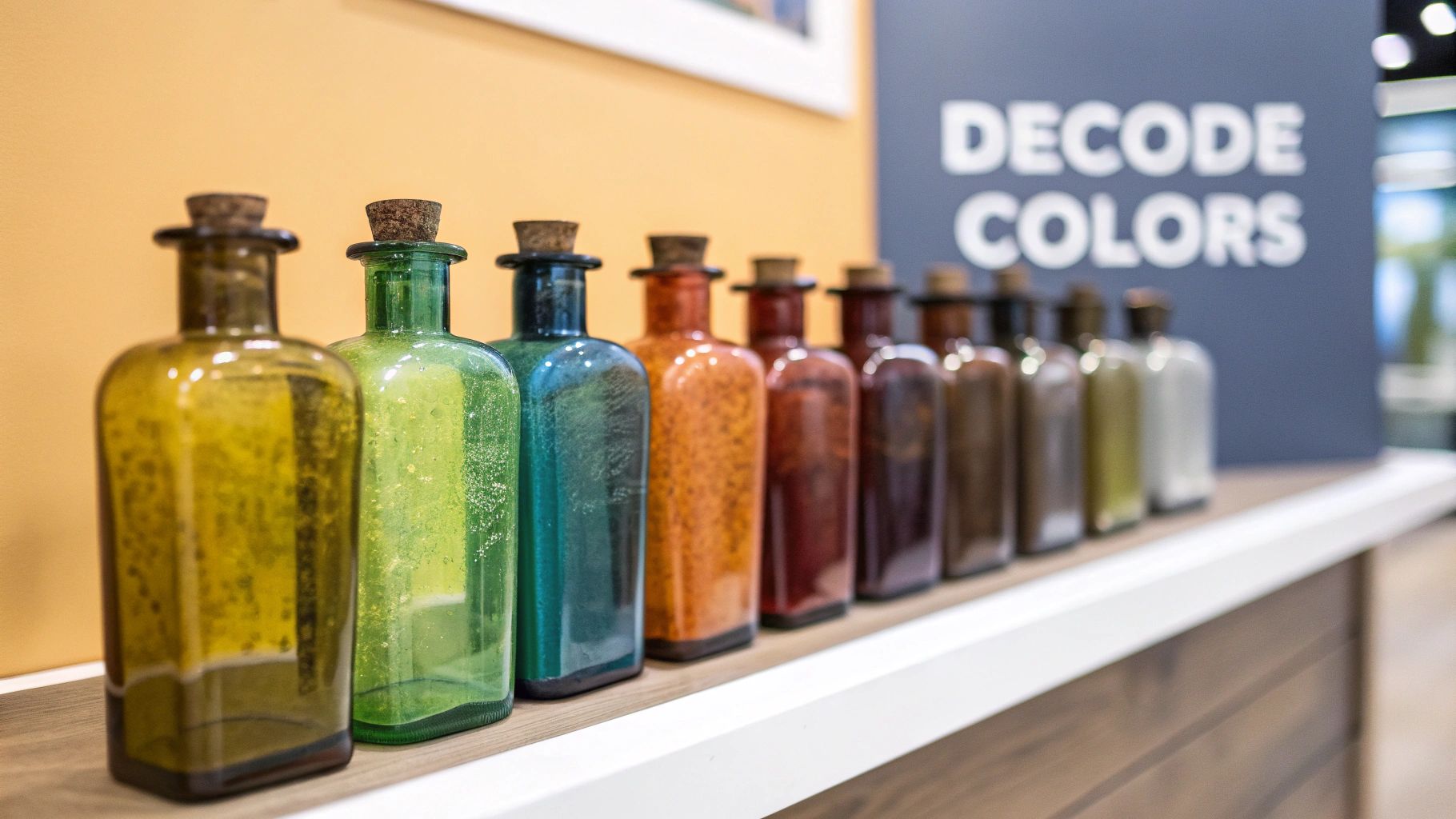
When you look at an old glass bottle, its color is telling you a story. It's so much more than just a pretty shade; it’s a clue to the bottle’s original purpose, what it held, and the time it was made. Learning to read these colors is like unlocking a secret language that reveals the bottle’s past.
Think of an old-time glassmaker as part chemist, part artist. To get those beautiful hues, they had to carefully mix different metallic oxides and minerals into the molten glass. This was a process guided by science, but sometimes, happy accidents created the most memorable results.
The Science Behind the Shade
Coloring glass wasn't just for show—it was a deliberate and often expensive step in the manufacturing process. Each mineral additive would react with the intense heat of the furnace to create a specific, predictable shade.
Here are a few of the key players:
- Iron: This was a common impurity found in most sand, and it’s the reason so many early utility bottles have that classic light green or aqua color. It was cheap and easy.
- Cobalt Oxide: You only needed a tiny bit of this powerful mineral to create the stunning, deep blues found in old medicine and poison bottles.
- Manganese Dioxide: Glassmakers called this "glassmaker's soap" because it helped remove the greenish tint from iron, creating clearer glass. But it had a secret: over many years of exposure to sunlight, it slowly turns a beautiful amethyst or lavender shade.
- Carbon and Sulfur: When mixed just right, these elements produced the rich amber and brown tones that were perfect for protecting liquids from sunlight. Think beer and whiskey.
Some colors, like the unique greens of certain soda bottles, can even point to where a bottle was made. Different glassworks often had their own "secret recipes" for coloring agents. You can dive deeper into how specific minerals create unique colors, like the uranium used in fluorescent Vaseline glass, by reading our guide on the value of Vaseline glass.
Common Bottle Colors and Their Meanings
Below is a quick reference table to help you understand the typical uses and historical context behind some of the most common antique bottle colors you'll encounter.
| Color | Common Use | Typical Era | Coloring Agent |
|---|---|---|---|
| Aqua | Soda, Mineral Water, Food Jars | 1840s-1920s | Iron (natural impurity) |
| Amber/Brown | Beer, Whiskey, Bleach, Medicine | 1870s-Present | Carbon, Sulfur, Iron |
| Cobalt Blue | Poisons, Medicines (Bromo-Seltzer) | 1880s-1930s | Cobalt Oxide |
| Amethyst/Lavender | General Use (originally clear) | 1880s-1920s | Manganese Dioxide |
| Olive Green | Wine, Spirits, Bitters | 1800s-1900s | Iron Oxide, Chromium |
| Clear | Food, Milk, Prescription Drugs | 1900s-Present | Selenium, Refined Sand |
This table is a great starting point, but remember that bottle-making was never an exact science, and you'll always find fascinating exceptions to the rules.
Common Colors and Their Stories
While there are always exceptions, most old bottles followed certain color conventions based on what they were designed to hold. This makes color one of your best first clues for figuring out what you’ve found.
Amber and Brown Bottles
Deep amber was the undisputed workhorse of the bottle world, especially from the 1870s onward. Its main job was to block UV light, which could easily spoil products. This made it the perfect choice for things like beer, whiskey, household chemicals, and certain patent medicines.
The rule of thumb was simple: the darker the amber, the better the protection. This practical fact made brown bottles a staple in pantries and medicine cabinets for decades.
Cobalt and Bristol Blue Bottles
That brilliant, deep blue of a cobalt bottle was impossible to miss. It was expensive to make, so it was usually reserved for products that needed to grab attention or clearly signal a warning. Finding a cobalt blue bottle almost always means you’ve found something interesting, like a poison or a high-end medicine.
This vibrant color served two purposes: it protected the contents from light while also acting as powerful, eye-catching marketing on a crowded shelf. By the 1880s, a huge number of patent medicines came in these colorful containers, which helped them stand out.
Green and Aqua Bottles
The green family is probably the most diverse when it comes to antique bottles. Aqua, a pale blue-green, was the default color for decades simply because of the natural iron impurities in sand. This made it cheap and easy to produce, so it was used for everything:
- Soda and mineral water
- Pickles and other jarred foods
- All kinds of general-purpose utility jars
Deeper greens, like olive and forest green, usually meant the glassmaker was being more intentional. These richer colors required adding specific coloring agents and were often used for spirits like wine and gin. Learning to spot these subtle differences can help you quickly tell an everyday jar from a more specialized container.
How to Date Your Bottle with Manufacturing Clues
While a bottle's color can hint at its purpose, the physical marks left behind during manufacturing are what truly tell its age. Think of every antique glass bottle as a time capsule, holding subtle clues from the moment it was crafted. By learning to read these marks, you can piece together its story and pinpoint when it was made. It's a bit like being a detective, with the glass itself providing all the evidence you need.
The best way to approach this is to follow the path of the glassblower, starting at the bottom and working your way up to the top. Each step in the process left a distinct mark, and those marks changed dramatically over the decades.
Start with the Base and Pontil Mark
The first place any seasoned collector looks is the bottom of the bottle. Flip it over and inspect the very center of the base. You're searching for a pontil mark—the tell-tale scar left when the bottle was snapped off the glassblower's pontil rod.
The presence and style of this mark are one of the surest signs of a bottle's age.
- Rough Pontil: If you feel a jagged, sharp scar in the middle of the base, you’re almost certainly holding a very old, hand-blown bottle. This crude mark is a hallmark of bottles made before the 1860s. The roughness is literally from the moment the finished bottle was broken away from the rod.
- Smooth or Molded Base: A perfectly smooth base, perhaps with embossed letters or numbers but no rough scar, means the bottle was made after the Civil War era. A new tool called the "snap case" allowed glassmakers to hold the bottle securely without the pontil rod, leaving a clean, finished bottom.
A pontil mark is your first major clue. Finding a rough, broken scar on the bottom instantly places your antique coloured glass bottles in the pre-1860s era, making it a truly early piece of glassmaking history.
This one feature creates a clear dividing line between early, fully handcrafted bottles and the more modern, semi-automated ones that came later. If you find a pontil mark, you know you've got something special.
Follow the Seams Up the Side
Next, run your fingers along the faint vertical lines on the sides of the bottle. These are mold seams, and where they end tells you everything about how the bottle was finished. Seams are simply the imprints left where the different pieces of a mold met.
When a bottle was made in a two-piece mold, the molten glass would be blown inside, creating seams where the mold halves joined. The top, or lip, however, was usually finished separately by hand.
- Seam Stops Below the Lip: On bottles made between roughly 1850 and 1900, the mold seam usually stops on the neck, well below the top rim. This tells you the body was blown in a mold, but the lip was shaped afterward by a craftsman with a special tool.
- Seam Runs Through the Lip: If the seam travels all the way up the side, over the top of the lip, and continues down the other side, you're looking at a fully machine-made bottle. This is the signature of the Owens Automatic Bottle Machine, which became common around 1903.
This clue provides another clear timeline. A seam that vanishes at the neck means a human hand finished the piece, while a seam that goes all the way over the top points to full automation. For a deeper look at these details, our comprehensive guide to antique glass bottle identification offers even more examples.
Examine the Lip and Finish
Finally, take a close look at the very top of the bottle. The style of the lip—also known as the "finish"—is another critical piece of the puzzle. Early bottles had crude, simple lips, while later ones became much more uniform and refined.
- Applied Lip: This looks exactly like it sounds: a separate ring of hot glass was literally applied to the top of the neck. You can often see a distinct seam or even drippy, uneven glass where it was attached. This method was common from the 1840s to the 1870s.
- Tooled Lip: A tooled lip is much neater. After being freed from the mold, the bottle's neck was reheated, and a worker used a special tool to shape the hot glass into a clean, uniform collar. This technique was popular from the 1870s into the early 1910s.
- Machine-Made Lip: As we mentioned, a machine-made bottle has mold seams running right over the lip. The finish is perfectly uniform and shows no signs of being shaped by hand.
By combining these three clues—the pontil mark, the seams, and the lip—you can confidently narrow down the manufacturing era of just about any antique bottle you come across.
Exploring Famous Eras of Coloured Glass
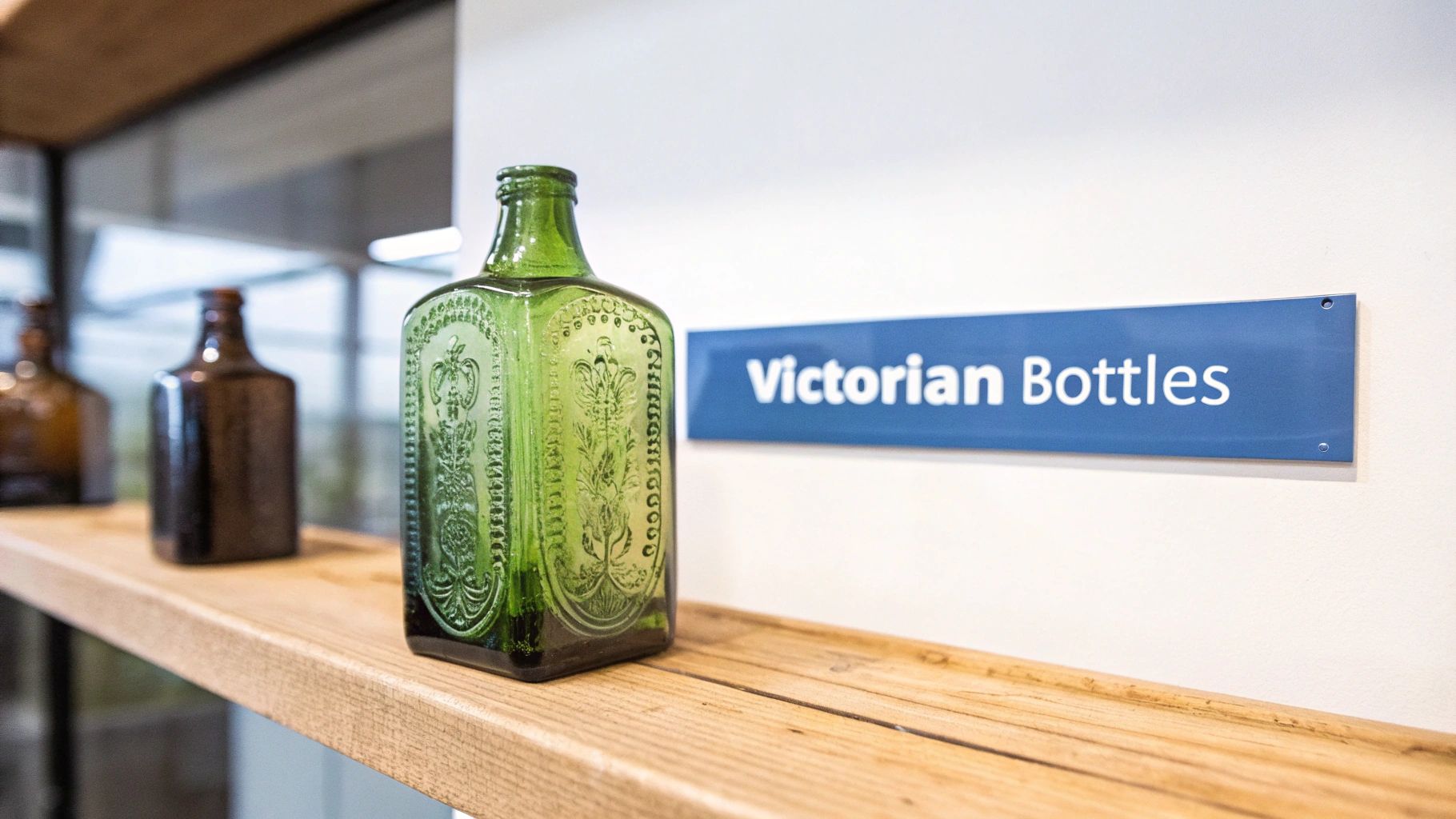
To really get a feel for an antique coloured glass bottle, you have to picture it in its original time. Every bottle is a little time capsule, a product of the culture, commerce, and concerns of its day. When you explore these eras, the stories behind the glass come alive, turning a simple object into a real piece of history.
Think of it this way: a modern plastic water bottle says something about our on-the-go lifestyle today. In the same vein, a coffin-shaped cobalt blue bottle from the 1880s tells a chillingly practical story about life before modern medicine and safety standards. These bottles weren’t just containers; they were born from the world around them.
Victorian Poison Bottles: Warnings in the Glass
The Victorian era (1837-1901) was a time of huge industrial leaps, but daily life was filled with hazards. Homes were lit by kerosene lamps, and potent chemicals were common household items. Tragically, accidental poisonings were all too frequent, which sparked a life-saving innovation in bottle design.
Glassmakers started producing bottles with very distinct shapes and colours meant to act as a clear warning. The idea was simple but brilliant: even in a dark room, you could identify a dangerous substance by touch alone.
You can spot Victorian poison bottles by these common features:
- Vivid Colors: Cobalt blue and deep emerald green were go-to choices, making them stand out from the typical clear or aqua glass used for safe products.
- Odd Shapes: Many were shaped like coffins or hexagons—unmistakable and frankly, a bit menacing.
- Textured Surfaces: Raised patterns like latticework, hobnails, or prominent ribs gave them a unique feel.
- Embossed Warnings: They often had bold, raised lettering that spelled out "POISON" or "NOT TO BE TAKEN."
These design choices were literally a matter of life and death, and today they make these antique coloured glass bottles some of the most historically rich and collectible pieces you can find.
Early Soda Pop Bottles: The Rise of Refreshment
As cities boomed in the mid-to-late 19th century, people developed a thirst for mass-produced drinks. The early soda and mineral water business was fiercely competitive, and the bottle itself became a huge part of the brand. Most of these bottles came in shades of aqua or light green, a natural result of the iron impurities found in the sand used to make them.
These early soda bottles are well-known for their strange and wonderful shapes, which were often patented designs meant to solve one big problem: how to keep the fizz inside.
Before the modern bottle cap came along, bottlers had to be seriously inventive. The shape of an early soda bottle wasn't just for looks—it was a clever piece of engineering designed to keep a cork stopper moist and tight, trapping the carbonation.
This challenge led to some truly iconic designs:
- Hutchinson Stopper Bottles: These had a wire loop stopper inside the bottle. You’d push it down to open it, making a satisfying "pop."
- Codd-Neck Bottles: A smart British invention that used a glass marble and a rubber washer to seal the bottle. This design became a massive hit around the world.
- Blob Top Bottles: These had a thick, rounded lip made to hold a wired-down cork stopper in place, a common sight from the 1870s into the early 1900s.
Pre-Prohibition Era Bottles: The Amber Age
Before Prohibition kicked off in 1920, the beer and whiskey industries were thriving. Their biggest concern was protecting the flavor of their product from sunlight, which could spoil it. This practical need led to the widespread use of sturdy amber or dark brown glass.
These bottles were built to last. They usually had thick walls to handle the rough and tumble of shipping and being reused. Embossing was the main way to advertise, with the names of breweries, distilleries, and saloons proudly molded right into the glass.
Finding an embossed pre-Prohibition whiskey bottle from a long-forgotten local distillery is like holding a direct link to a town’s social history—a perfect snapshot of an era right before it all changed.
So, What's My Bottle Actually Worth?
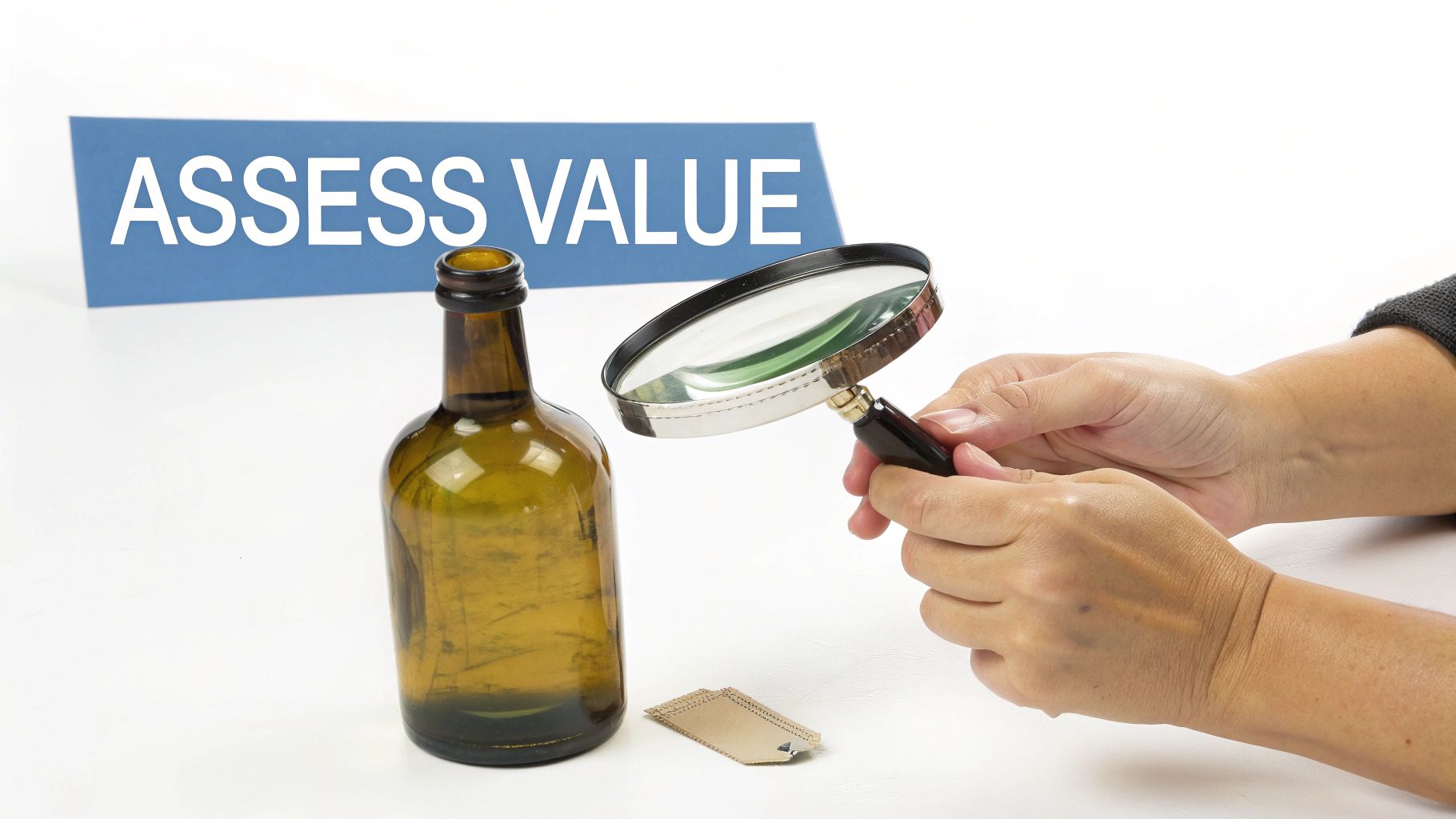
You've played detective with the color and manufacturing marks, and now we get to the big question: what is this old bottle worth? Figuring out a bottle's value isn't about finding a single price tag. It’s about learning to see the bottle through a collector's eyes.
Think of it like a three-legged stool—the legs being rarity, condition, and desirability. If any one of those is weak, the bottle's value can tumble. Once you know what to look for, you can start making a solid guess about what you've found.
Color and Rarity
More often than not, color is the first thing that determines a bottle's value. You could have two identical bottles from the exact same mold, but if one is a common color and the other is a rare one, their values will be worlds apart. Rarity is king in the collecting world, and some glass colors were just much tougher to produce.
A standard aqua medicine bottle, for instance, might only fetch a few dollars. But find that same bottle in a brilliant teal, a fiery red, or a deep puce (a sort of brownish-purple), and you could be looking at hundreds, maybe even thousands, of dollars.
Condition and Completeness
A bottle’s physical shape is hugely important. While a super-rare piece might still be valuable with some damage, most bottles need to be in great condition to be worth much. Collectors are always hunting for "attic mint" examples that look like they were just made yesterday.
Here’s what to check for:
- Chips and Cracks: Scan the bottle carefully, especially around the lip and base. Even tiny nicks or faint hairline cracks can slash the value.
- Stains and Sickness: "Sickness" is that cloudy, rainbow-like film that can form on old glass. It's caused by chemical reactions from the contents or environment, and heavy cases of it are a real turn-off for buyers.
- Original Closures: Is the original stopper, cork, or cap still with the bottle? A complete piece is always more exciting—and more valuable—than an orphan bottle.
A bottle's condition is a lot like the grade on a collectible comic book. The closer it is to its original, untouched state, the more a collector will pay. Every flaw might tell a story, but it almost always lowers the price.
Embossing and Uniqueness
Finally, read the story told by the embossed glass. You want lettering that is sharp, deep, and easy to read. Bottles with cool pictures—like eagles, portraits, or old ships—are especially popular.
The uniqueness of the company matters, too. A bottle from a tiny, long-gone pharmacy in a small town is usually much rarer than one from a national brand that pumped out millions of them. When you're looking at your bottle, remember that the specific details molded into the glass can be just as crucial as its color. To see how these factors come together, take a look at our guide on what makes vintage bottles valuable.
Here's a quick cheat sheet to help you weigh these different factors when looking at a bottle.
Factors Influencing Antique Bottle Value
| Valuation Factor | Low Value Indicator | High Value Indicator |
|---|---|---|
| Color | Common shades like aqua, clear, or light green. | Rare, vibrant hues like deep puce, teal, red, or cobalt blue. |
| Condition | Chips, cracks, heavy staining, or "sickness" on the glass. | "Attic mint" condition; no damage, clear glass, minimal wear. |
| Embossing | Faint, weak, or generic lettering (e.g., "POISON"). | Crisp, detailed embossing, especially with pictures or unique logos. |
| Age | Machine-made bottles (post-1915) with visible seams to the top. | Hand-blown bottles with pontil scars and applied lips (pre-1860s). |
| Rarity | Mass-produced by a large, well-known company. | Made by a small, short-lived, or local business. |
| Completeness | Missing its original stopper, cork, or label. | Includes the original closure and, in rare cases, the paper label. |
Ultimately, a bottle's value is what someone is willing to pay for it, but by understanding these key points, you'll have a much better idea of whether you're holding a common piece or a true treasure.
Common Questions From New Bottle Collectors
Diving into the world of antique bottle collecting is exciting, but it's natural to have a few questions. The journey is full of "what ifs" and "how do I know...?" moments. Getting a few simple answers can give you the confidence you need to start your hunt. Let's tackle some of the most common questions I hear from new collectors.
Are All Old Coloured Bottles Valuable?
Not necessarily. While age is a big piece of the puzzle, a bottle's age doesn't automatically make it valuable. The real drivers of value are rarity, condition, and demand.
Think of it this way: a common, mass-produced medicine bottle from 120 years ago might only be worth a few dollars because there are still thousands of them floating around. On the other hand, a much younger bottle from 80 years ago, made by a small-town company in an unusual color, could be worth a whole lot more. It all boils down to classic supply and demand.
How Should I Clean My Antique Bottles?
Be gentle. That's the golden rule here. The best approach is usually a simple soak in warm, soapy water. If you have some stubborn gunk inside, a soft-bristled bottle brush will do the trick. Whatever you do, stay away from harsh chemicals, steel wool, or any abrasive scrubbers.
These can easily scratch the surface or, even worse, cause "sickness"—that cloudy, iridescent film that permanently damages the glass. Proper care is key to making sure your bottles keep their beauty and their value for years to come.
Some of the most interesting parts of bottle collecting are the little quirks of glassmaking history. One of my favorites is how perfectly clear glass can change color over time, telling a story all its own.
What Does Sun Colored Amethyst Mean?
That lovely lavender tint you sometimes see is actually a fascinating chemical accident. Back between the 1880s and the 1920s, glassmakers used manganese dioxide to get rid of the natural aqua or green tint caused by iron in the sand. Their goal was crystal-clear glass.
What they didn't know was that decades of exposure to the sun's UV rays would cause that manganese to slowly oxidize, turning the glass a beautiful light purple or amethyst shade. For collectors, this is a genuine, baked-in sign of a bottle's age and history.
Where Can I Find Antique Bottles?
You'd be surprised where great finds can turn up. Some of the best hunting grounds for antique coloured glass bottles include:
- Old farm dumps and privy sites: These were the trash pits of their day and can be goldmines.
- Riverbeds and coastlines: Moving water has a way of unearthing old bottles, often smoothing them into beautiful sea glass.
- Flea markets and antique shops: These are the classic spots where treasures often surface.
- Estate sales: You never know what you'll find when sorting through someone's lifelong collection.
Just remember to be a responsible collector. Always get permission before digging on private property, and be mindful of the environment you're exploring.
Feeling curious about that bottle you found at a flea market? Instead of spending hours guessing, get a clear answer in seconds. The Curio app can identify your antiques, tell you their story, and give you an estimated value right from your phone. Download Curio today and let your antiques talk