If you've ever picked up a Hummel figurine, you've probably noticed the little stamps and symbols on its base. These aren't just random marks; they're the key to unlocking the figurine's entire story. For collectors, these trademarks—often called TMKs—are everything when it comes to identifying, dating, and figuring out the value of a piece.
Your Essential Guide to Hummel Markings
Learning to read the markings on the bottom of a Hummel is the single most important skill you can develop, whether you're a seasoned collector, a reseller, or someone who's just inherited a box of them. These little stamps are a timeline, telling you exactly when and where your figurine was made. Each symbol reveals another chapter in the long-standing collaboration between Sister Maria Innocentia Hummel and the Goebel company.
Think of this guide as your decoder ring. We'll walk through every major Hummel trademark so you can confidently identify what you have, whether it's a family heirloom or a lucky find at a flea market.
The Foundation of Hummel Markings
The story of these markings really kicks off in 1935. That's when Goebel struck a deal with Sister Maria Innocentia Hummel to bring her delightful drawings to life. The first three figurines ever produced were Puppy Love (HUM 1), Little Fiddler (HUM 2), and Bookworm (HUM 3). These early pieces laid the groundwork for a collecting craze that exploded after World War II.
Figurines from this very first period (1935-1950) are identified by the TMK-1 Full Crown mark. You'll see an incised crown symbol with the initials “WG” (for Wilhelm Goebel) intertwined beneath it. Finding this mark is a sure sign of an authentic, early-production piece.
For anyone hunting for treasures, spotting an early TMK-1 is a game-changer. Resellers and thrifters using apps like Curio can do a quick photo scan on the spot, potentially turning a common-looking piece into a rare find worth thousands.
Only about 10-15% of all Hummels still in existence have this early mark, which is why they are so desirable. For these early collectibles, the combination of the TMK-1 stamp and the embossed M.I. Hummel signature—which should be on all genuine pieces—is your ultimate proof of authenticity. You can find more details on these early marks and what they mean for value over at Antique-Marks.com.
The Complete Hummel Trademark Identification Chart

Being able to correctly identify the trademark, or TMK, on the bottom of a Hummel figurine is the single most important skill for figuring out its age and what it might be worth. Each little stamp tells a story, marking a specific chapter in the Goebel company's long history. Think of this chart as your go-to reference, whether you're sorting through a family collection or hoping to spot a hidden gem at an antique shop.
This guide breaks down the eight major Hummel figurine markings, starting with the very first Crown mark from 1935 and going all the way to the final Goebel mark used until 2009. Use it as a quick visual cheat sheet. If you're curious about why those early pieces are often so valuable, be sure to check out our detailed look at early Hummel marks from 1935 to 1959.
For a quick reference, here's a table summarizing the key Hummel trademarks. It’s perfect for when you're on the go and just need a fast way to date a piece.
Hummel Trademark (TMK) Quick Identification Chart
| Trademark (TMK) | Years of Use | Key Identifier |
|---|---|---|
| TMK-1 | 1935-1950 | The Full Crown |
| TMK-2 | 1950-1959 | The High Bee |
| TMK-3 | 1960-1972 | The Stylized Bee |
| TMK-4 | 1964-1972 | The Three Line Mark |
| TMK-5 | 1972-1979 | The Last Bee |
| TMK-6 | 1979-1991 | The Missing Bee |
| TMK-7 | 1991-2000 | The New Crown |
| TMK-8 | 2000-2009 | The Final Goebel Mark |
This table gives you the basics, but the real details are in the descriptions below. Little variations can tell you a lot, so let's dive into what makes each mark unique.
The Crown Marks
The very first Hummel figurines were stamped with a crown, a clear signal of their pre-WWII beginnings. This mark alone makes them incredibly desirable for serious collectors.
- TMK-1 The Full Crown (1935-1950): This is it—the original mark. Look for a crown with the letters "WG" (for Wilhelm Goebel) intertwined just below it. You might find it incised (carved right into the porcelain) or stamped on with ink. Any piece bearing this mark is a rare find and can often fetch top dollar.
The Bee Marks
After the Crown era, Goebel introduced the famous bee. This little insect became an iconic symbol for decades, and its design changed just enough over the years to help us date the figurines.
TMK-2 The High Bee (1950-1959): On these pieces, you’ll see a large, distinct bee flying high inside a V-shape. The earliest ones, from about 1950 to 1955, have a particularly big bee. This is another highly prized mark, as it instantly tells you the figurine is well over 60 years old.
TMK-3 The Stylized Bee (1960-1972): Here, the bee got a bit of a modern makeover. It’s smaller, more abstract, and still sits inside the V. The key difference is that its wings are now parallel to its body, giving it a sleeker look. This is one of the most common vintage marks you’ll come across.
TMK-4 The Three Line Mark (1964-1972): For a few years, this mark was used right alongside the TMK-3. It’s easy to spot: you’ll see the company name and location printed in three neat lines, often right next to the stylized bee.
TMK-5 The Last Bee (1972-1979): The V is now gone. Instead, the Goebel name sits directly above the bee. This was the last trademark to feature the beloved bee, truly marking the end of an era for collectors and the company.
Collector's Insight: The switch from one TMK to the next wasn't always a clean break. You can sometimes find "transitional" figurines with elements of two different marks. This is especially common during the TMK-3 and TMK-4 overlap period.
The Modern Marks
In the final decades of Goebel's production, the company's marks went through a few more changes. The bee disappeared for a while, only to return later as a nod to the brand's heritage.
TMK-6 The Missing Bee (1979-1991): As the name suggests, the bee is gone. The mark was simplified to just the Goebel name with "W. Germany" printed underneath. This was a major change and is a clear dividing line between the vintage and modern collecting eras.
TMK-7 The New Crown (1991-2000): After German reunification, "W. Germany" was no longer needed. To celebrate the brand's history, Goebel brought back a crown symbol, this time printed next to the company name.
TMK-8 The Final Goebel Mark (2000-2009): For its last act, Goebel removed the crown again and brought back a large bee for a short time to honor Sister Hummel. This was the very last trademark used by Goebel before production was handed over to other companies.
Identifying Early Hummel Marks From 1935 To 1959
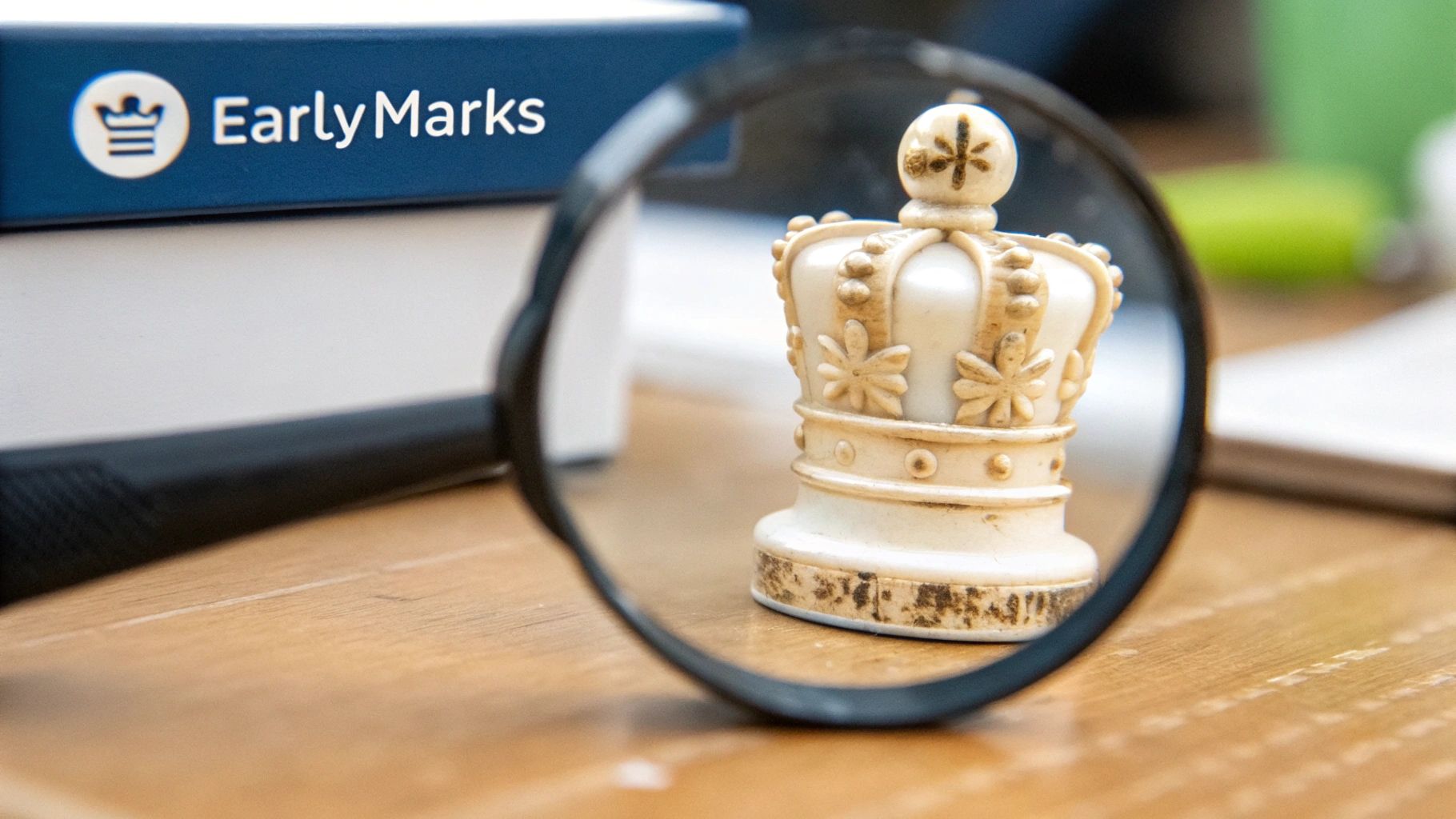
For serious collectors, the earliest Hummel figurines are the holy grail. Pieces made from the mid-1930s all the way through the 1950s are by far the most sought-after, telling a story of pre-war artistry and post-war resilience that makes them historically fascinating and incredibly valuable. Knowing how to read these early Hummel figurine markings is what separates a casual enthusiast from a true expert.
This era is really broken down into two main trademark periods: the original Full Crown (TMK-1) and the various Bee marks that came next (TMK-2). If you find a figurine with one of these marks, you're looking at a piece from the brand's formative years, when craftsmanship was at its peak. Their rarity and historical weight are exactly why collectors are willing to pay top dollar for them.
TMK-1 The Full Crown (1935-1950)
The Full Crown, or TMK-1, is the very first trademark ever used on a Hummel figurine. It’s an immediate sign that you have a piece from the initial production run—a time of meticulous hand-painting before the collecting craze truly took off. Finding a figurine with this mark is always an exciting moment.
This mark is easy to spot: a detailed crown with the initials "WG" (for Wilhelm Goebel, the founder) tucked underneath. You'll generally find two versions, and knowing the difference can help you pinpoint the production date even more accurately.
- Incised Crown: The earliest pieces, made from about 1935 to 1949, often have an incised crown. This means the mark was physically pressed into the soft porcelain before it was fired in the kiln.
- Stamped Crown: Later in this period, you might see a stamped crown, which was applied with ink. It’s just as authentic, but it usually points to a piece made a bit later within that same era.
There’s also a key historical detail to watch for. After World War II, some TMK-1 marks from 1946 to 1948 will include the words "U.S. Zone Germany." This was a requirement for any goods made in the American-occupied zone of Germany for export. For collectors, this small addition provides a tangible link to a specific moment in history, making these pieces especially desirable.
TMK-2 The Bee Marks (1950-1959)
After the Crown era, Goebel introduced the bee symbol, which would become an iconic part of the brand's identity for decades. The TMK-2 period is defined by a prominent bee flying inside a V-shape. The way this bee changed over the decade gives us the clues we need to date a figurine.
The first Bee marks, often called the "High Bee," are the most valuable of the bunch. Used from 1950 to 1955, this mark features a large bee with its wings flying high, almost touching the top edges of the V. Its size and placement make it pretty hard to miss.
Then, from 1956 to 1959, the bee started to evolve in subtle but significant ways:
- The Small Bee: The bee itself became noticeably smaller.
- The Low Bee: The bee was positioned much lower inside the V.
- The V Bee: The wings took on a more pointed, stylized shape.
For collectors and appraisers, the specific version of the TMK-2 bee mark directly influences value. An "Adventure Bound" figurine with an early High Bee mark (TMK-2) can be valued between $6,000 to $9,000, while the same model with a later mark might be worth a fraction of that price.
It’s these small shifts that experts zero in on. Being able to tell the difference between a large High Bee and a later Small Bee can translate to a difference of thousands of dollars in an appraisal.
The Popular "Bee" Marks: 1960 to 1979
If you've ever found a Hummel at an estate sale or inherited one from a relative, there's a good chance it was made between 1960 and 1979. This was the golden age of Hummel collecting, when the figurines were at the peak of their popularity and production was in full swing. Because of this, the Hummel figurine markings from this era are the most common ones you'll run into.
These two decades saw the "Bee" mark go through a few makeovers before it disappeared entirely. Getting to know these marks—the TMK-3, TMK-4, and TMK-5—is your key to dating the vast majority of vintage Hummels out there. While they aren't as rare as the older pieces, they're the heart and soul of many collections.
TMK-3: The Stylized Bee (1960–1972)
The TMK-3 mark, better known as the Stylized Bee, was a big change from the more realistic bees of the 1950s. It was a move toward a cleaner, more modern logo, and since it was used for over a decade, you’ll see it all the time.
It’s easy to spot once you know what to look for:
- A simple, abstract bee: The bee is much smaller, with its wings reduced to simple, straight lines.
- Still inside the V: Just like its predecessor, the bee sits snugly inside a large "V".
- Includes "W. Germany": You'll almost always see "W. Germany" printed somewhere near the mark, a clear historical timestamp.
So, if you pick up a "Merry Wanderer" with this mark, you know it came out of the factory sometime between 1960 and 1972. It’s a true vintage classic, though not particularly hard to find.
TMK-4: The Three Line Mark (1964–1972)
Here’s where things get a little tricky. For about eight years, Goebel used the TMK-4 mark, or the Three Line Mark, at the same time as the TMK-3. You’ll often find them side-by-side on the same figurine, which can throw new collectors for a loop.
The TMK-4 is exactly what it sounds like: a trademark made of three stacked lines of text. It was a straightforward branding stamp used in tandem with the Stylized Bee.
Collector's Tip: Don't mistake a figurine with both a TMK-3 and TMK-4 mark for a rare transitional piece. Finding both together was just standard procedure at the factory for much of the 1960s. It simply confirms the piece was made within that 1964-1972 window.
TMK-5: The Last Bee Mark (1972–1979)
By 1972, it was time for another change. The TMK-5, famously called the Last Bee Mark, was the final design to feature the iconic bee symbol. This mark signals the end of an era for Hummel figurine markings.
The design is sharp and easy to identify, as it’s a major departure from what came before:
- The big "V" is gone for good.
- The Goebel name is now printed right over the top of the little stylized bee.
This clean, simple stamp was the standard for the rest of the decade. Hummels with the TMK-5 are extremely common, but they hold a special place for collectors as the last generation of figurines to carry the beloved bee.
Modern Hummel Marks: 1979 to Present
The collecting frenzy of the 60s and 70s eventually cooled, ushering in a new, modern era for Hummel figurine markings. Starting in 1979, the marks began to change pretty significantly, reflecting big shifts at the Goebel company and in what collectors were looking for. If you have newer figurines, getting to know these modern marks is crucial for setting realistic value expectations and understanding the final years of Goebel's production.
This period is all about the disappearance of the famous bee, a short-lived return of the crown, and the eventual handover of production to other companies. These later marks create a clear dividing line between the modern pieces and their much older, often more valuable, vintage cousins.
TMK-6: The Missing Bee (1979–1991)
One of the most surprising twists in Hummel history came in 1979 with the TMK-6 mark, which collectors quickly dubbed "The Missing Bee." After being a staple for nearly thirty years, Goebel dropped the bee symbol entirely, stripping its trademark down to just the company name. This wasn't just a minor tweak; it was a clear signal that the vintage era was over.
You can spot this mark easily. Just look for:
- The name "Goebel" printed on the base.
- "W. Germany" appearing right below the name.
- A complete lack of any bee or V symbol.
Figurines with the TMK-6 stamp are everywhere, making them a great and affordable starting point for new collectors. While their monetary value is typically modest, they're a key part of the brand’s story.
TMK-7: The New Crown (1991–2000)
When Germany reunified in 1990, the "W. Germany" on Hummel bases was suddenly out of date. This major historical event pushed Goebel to redesign its trademark again, leading to the TMK-7, or the "New Crown Mark." In a nod to its own history, Goebel brought back a crown symbol, something that hadn't been seen since the original TMK-1 mark.
This one is easy to identify: it has the Goebel name printed next to a sleek, modern-looking crown. Underneath, you'll see the word "Germany." It was a nice way for the company to honor its deep roots as it headed into the last decade of the 20th century.
TMK-8: The Final Goebel Mark (2000–2009)
The last trademark Goebel ever used before it stopped making Hummels is known as the TMK-8, or "The Final Goebel Mark." As a tribute to Sister M.I. Hummel on what would have been her 90th birthday, the company decided to bring back the bee one last time.
This final mark features a large, unmistakable bee flying next to the Goebel name, bringing the company's long journey full circle. It was used right up until 2008, when Goebel officially ceased production and passed the legacy on to new manufacturers.
After 2009, production was first taken over by Manufaktur Rödental and then Hummel Manufaktur. Pieces made during this time have their own distinct backstamps, like the word "Rödental" or the full "Hummel Manufaktur" name, marking a brand-new chapter for these beloved figurines.
Looking Beyond The Trademark: Other Key Markings

While the main Goebel trademark (the TMK) is the quickest way to get a rough date for your Hummel, it's really just the beginning of the story. To truly understand a figurine's history and potential value, you have to play detective with all the other little marks, numbers, and signatures on its base.
Think of it this way: the TMK tells you the era it was made, but these other marks provide the specific details—the model number, the size, and sometimes even the very artist who painted it. Learning to read these secondary Hummel figurine markings is what separates a casual admirer from a serious collector.
The Essential M.I. Hummel Signature
First things first, look for the incised M.I. Hummel signature. This isn't just a nice touch; it's a non-negotiable mark of authenticity. If a figurine is missing this signature etched into its base, you can be almost certain it's not a genuine piece made by Goebel.
This signature is a direct link back to Sister Maria Innocentia Hummel, the artist whose charming drawings inspired every single figurine. It’s the foundational proof that the piece is an authorized creation based on her work.
Decoding Mold And Size Numbers
Every genuine Hummel has a mold number, which collectors often call the HUM number. This number, typically between one and four digits long, is stamped or incised into the base and identifies the specific character design. For instance, the beloved "Apple Tree Girl" is always assigned the mold number #141.
But the mold number is often just part of the code. You'll frequently find other numbers or letters right next to it that give you even more information:
- Size Designators: A Roman numeral (like I or V) or a slash followed by a number (like /0 or /1) tells you the figurine's size. Many designs were made in several sizes over the years, and the larger, less common versions are often worth significantly more.
- Decoration Designators: Occasionally, you might see a letter tacked on at the end. This usually points to a specific variation in color or decoration.
Putting it all together, a piece marked "141/I" tells you it's the "Apple Tree Girl" design (141) in one of its smaller sizes (/I). This level of detail is critical for an accurate valuation. The art of appraisal often boils down to tiny details like these, a concept that applies broadly to many collectibles, as you can see by learning about general markings on pottery.
Finding The Artist’s Touch
Last but not least, you might spot some small, hand-painted initials or symbols on the base. These are known as painters' marks or artist ciphers. They identify the individual Goebel artist who hand-painted that specific figurine.
While these personal marks don't usually have a major impact on the price, they add a wonderful human element to the piece. It's a direct connection to the skilled craftsperson who brought your figurine to life, adding a unique and personal layer to its history.
How Markings Directly Impact Figurine Value
When you're trying to figure out what a Hummel figurine is worth, the first place you should look is the bottom. The specific Hummel figurine markings stamped on the base are, without a doubt, the single most important clue to its value.
You could have two "Merry Wanderer" figurines that look completely identical side-by-side, but the tiny trademark underneath can mean one is worth $20 and the other $2,000. This trademark, or TMK, is a direct signal of the figurine’s age, production era, and ultimately, its rarity.
An early TMK-1 Full Crown mark (1935-1950) or a TMK-2 High Bee mark (1950-1959) immediately tells a collector this piece comes from a highly sought-after period. These older figurines were made in smaller numbers and featured incredibly detailed hand-painting, which makes them scarce today. In contrast, a TMK-6 Missing Bee mark (1979-1991) points to a modern piece made during the peak of mass production, making it much more common and less valuable to serious collectors.
Rarity and Collector Demand
At its core, the Hummel market runs on simple supply and demand. Far fewer figurines were produced during the early TMK-1 and TMK-2 periods compared to the collecting boom of the 1970s and 80s. This scarcity drives up demand for the older, historically significant pieces.
A perfect example is the "Adventure Bound" figurine (HUM 347). If you find one with a TMK-2 mark, its value can range from $6,000 to $9,000. The exact same figurine with a later TMK-5 mark is often valued closer to $600. The design hasn't changed, but that nine-fold difference in value comes down entirely to the rarity and desirability tied to that earlier trademark.
A common myth is that all old Hummels are incredibly valuable. The truth is, the market is sharply divided by the trademark. The vast majority of figurines you'll find at flea markets or estate sales carry later marks (TMK-5 and up) and usually have only modest value.
How Condition Affects Value
Finding a desirable trademark is a fantastic start, but the figurine's physical condition is just as crucial. A final appraisal is always a combination of the two. Even a rare, early piece can see its value plummet if it's damaged.
Here are the key condition issues to watch out for:
- Crazing: This is a network of fine cracks in the glaze. It's very common on older pieces, but severe crazing can definitely lower the value.
- Chips and Cracks: Any structural damage is a major red flag. A single chip or crack can slash a figurine's worth, often by 50% or more.
- Repairs: Poorly done or obvious repairs can sometimes diminish the value almost as much as the original damage.
- Fading: The colors on a Hummel should be bright and vibrant. Significant fading from sun exposure is a serious drawback for collectors.
To help you put it all together, here’s a quick checklist to run through when you’re assessing a piece.
Valuation Checklist for Hummel Figurines
| Assessment Factor | What to Look For | Impact on Value |
|---|---|---|
| Trademark (TMK) | Look for early marks like TMK-1 (Full Crown) or TMK-2 (High Bee). | The single most significant factor. Early marks command the highest prices. |
| Crazing | Check the glaze for a web of fine cracks under bright light. | Minor crazing is often acceptable on old pieces, but heavy crazing will reduce value. |
| Chips & Cracks | Inspect every edge, tip, and delicate part (like fingers or flower petals). | Any structural damage causes a major drop in value, often by 50% or more. |
| Repairs | Look for mismatched paint, glue lines, or areas that feel rough. | Obvious or poorly done repairs significantly decrease collector interest and price. |
| Color Fading | Compare the color vibrancy to online photos of pristine examples. | Faded or dull colors from sun exposure are undesirable and lower the value. |
| Original Box | Check if the original packaging and any certificates are present. | Having the original box can add a premium, especially for post-war figurines. |
Ultimately, a professional appraiser synthesizes all these data points to arrive at a final value. If you want to learn more about how experts do it, our guide on how to appraise antiques gives you a deeper look into the valuation methods they use. Remember, a pristine figurine with a common mark may actually be worth less than one with a rare TMK-1, even if it has a bit of crazing.
Common Questions About Hummel Markings
Even with a detailed chart in hand, trying to decipher Hummel figurine markings can leave you scratching your head. It's totally normal. Whether you're trying to figure out if a piece is real, pin down its age, or just learn its story, a few common puzzles always seem to surface.
This section is your go-to guide for those tricky situations. We'll walk through the most frequent questions collectors run into, from missing marks to what certain words on the base actually mean. Think of it as a quick troubleshooting manual for your Hummel mysteries.
What If My Hummel Has No Mark?
The very first thing to look for on any potential Hummel is the incised M.I. Hummel signature. If you can't find it, the figurine is almost certainly not a genuine Goebel product. Every authentic Hummel has to have this signature, as it's the official nod to Sister Maria Innocentia Hummel's original art.
Now, what if the signature is there, but the Goebel trademark (the TMK) is missing? This happens. Over decades of dusting and handling, the ink stamp can simply wear away. In very rare cases, it might have been missed at the factory. As long as the M.I. Hummel signature is present, the piece is likely authentic. Just know that the missing TMK makes it much harder to date precisely and might slightly lower its value for collectors who insist on perfect markings.
Does A West Germany Stamp Increase Value?
Seeing "West Germany" or "W. Germany" stamped on the bottom is a great clue, but it doesn't automatically boost a figurine's value. All that stamp tells you is when it was made: sometime between 1949 and 1990, after Germany was divided but before it was reunified.
What really drives the value is the TMK mark that appears alongside it. For instance, a TMK-2 High Bee with a "West Germany" stamp is worlds apart in value from a TMK-6 Missing Bee that also has the same country stamp. The country marking is a helpful piece of the puzzle, but it’s the main trademark that really determines rarity and desirability.
How Can I Spot A Fake Hummel?
Knowing how to spot a fake is a crucial skill for any collector. While some forgeries are quite sophisticated, most knock-offs have obvious flaws that give them away. In fact, learning how to spot fake antiques is a skill that will serve you well far beyond just Hummels.
Here are the biggest red flags to watch out for:
- Missing M.I. Hummel Signature: This is the ultimate deal-breaker. If that signature isn't etched into the base, it's not the real deal.
- Poor Painting Quality: Authentic Hummels are known for their soft, matte colors and delicate, precise brushwork. Fakes often look too glossy, with loud, garish colors and clumsy, thick details.
- Incorrect Markings: Counterfeits often trip up on the details. Look for misspelled "Goebel" names, oddly shaped TMKs, or stamps that don't align with known production periods.
- Lightweight Feel: Genuine Hummels are made from high-quality porcelain and have a certain heft. Fakes are sometimes made from cheaper materials like plaster, making them feel surprisingly light.
Expert Tip: Always trust your gut. If a figurine just feels "off" or the price seems way too good to be true, it’s time to get skeptical. Double-check any suspicious markings against a reliable identification chart.
What Is The Difference Between Stamped and Incised Marks?
You'll often hear the terms "stamped" and "incised" used to describe markings, and they simply refer to how the mark was put on the figurine. Knowing the difference can help you narrow down the production timeline.
- Incised Marks: These are marks that were pressed or carved into the porcelain while it was still soft, before it went into the kiln. The M.I. Hummel signature is almost always incised, as are the very early TMK-1 crowns.
- Stamped Marks: These are ink marks applied to the figurine after it has been fired and glazed. Most of the TMKs, especially from the Bee era forward, are stamped on.
Neither method is better or more authentic than the other; they're just different manufacturing techniques used by Goebel at different points in its history.
Ready to uncover the story behind your own finds? Curio puts an antique expert in your pocket. Just snap a photo to instantly identify your items, learn their history, and get a quick appraisal. Download the app today and let your antiques tell their stories! Find out more at https://www.curio.app.