Putting a price on antique furniture isn't just about guessing its age—it's a delicate mix of art, science, and a deep understanding of the market. If you're feeling uncertain about what your pieces are truly worth, this guide will give you a clear path to pricing them with confidence. We'll start with the five core elements that every expert looks at: age, condition, rarity, provenance, and the maker.
How To Determine The Value Of Your Antique Furniture
It can be a little daunting to put a price tag on a piece of history. Maybe you've inherited a family heirloom, stumbled upon a treasure at an estate sale, or you're just curious about that old chair you've had for years. The question is always the same: "What is this actually worth?" The truth is, the answer isn't just a number; it's a story told by the furniture itself.
This guide is designed to cut through that confusion and give you a practical framework for valuation. Think of it as your roadmap—it will take you from pure guesswork to informed, confident pricing, whether you’re a casual seller, a serious collector, or managing an estate.
The Foundation of Antique Valuation
Before you start digging into sales records and price guides, you need to understand the fundamental principles that drive all antique furniture pricing. Every piece, from a grand Chippendale desk to a simple Shaker chair, is assessed using a consistent set of criteria. Getting a handle on these is your first step toward an accurate valuation.
These are the five pillars that form the basis of every appraisal:
- Age and Era: The historical period it comes from is huge. Some eras, like Art Deco or Mid-Century Modern, are in high demand right now.
- Condition: This requires an honest look at wear, tear, repairs, and most importantly, originality.
- Rarity: Is it a one-of-a-kind piece, or are there thousands like it floating around?
- Provenance: This is the documented history of ownership. A paper trail linking a piece to a famous person or historic home can add immense value.
- Maker or Manufacturer: A signature, label, or mark from a renowned craftsman like Stickley or a top-tier company can dramatically increase the price.
Once you get a feel for these five core concepts, you'll have the knowledge to interpret market data and set a price that reflects your furniture's true story and value. It turns a daunting task into a fascinating process of discovery.
Why Accurate Pricing Matters Now
Don't underestimate the market for antiques; it's robust and it's growing. Antique furniture is the undisputed king of collectibles, commanding a massive 42% of all sales worldwide. This is largely thanks to the incredible craftsmanship you see in pieces from eras like the Victorian, Georgian, and Mid-Century Modern periods.
The broader antiques market is projected to hit USD 402.9 billion by 2034, and furniture is riding that wave. You can dig into more of these market trends over at AMRA & ELMA.
Understanding these market dynamics is key. For those just starting out, we've also put together a more detailed breakdown on how to value antique furniture that covers these concepts in greater depth. Here, though, we're going to focus on turning that knowledge into a practical pricing strategy you can use today.
The Five Pillars Of Antique Furniture Valuation
To really get a handle on the pricing for antique furniture, you have to look past its age. The true value of a piece is built on five core pillars, and each one plays a part in determining its final market price. Once you understand these, you stop seeing just an old table and start seeing an asset with a clear, justifiable value.
Think of these as the questions every seasoned appraiser or dealer mentally checks off. By learning to answer them yourself, you can move from guesswork to making confident, informed pricing decisions.
Let's break them down.
Pillar 1: Age, Era, and Maker
First up are the intertwined elements of age and the maker's mark. Sure, anything over 100 years old is technically an antique, but the specific era and who made it are what really start to build value. Every style tells a story about its time, and right now, some stories are simply more popular than others.
For example, the market has gone wild for Mid-Century Modern designs from creators like Eames or Wegner, with prices that can easily rival much older Georgian furniture. A signature, a label, or even a known design quirk from someone like Thomas Chippendale or Gustav Stickley can instantly transform a piece from merely "old" into a collector's dream, sometimes doubling or tripling its price overnight.
Part of this is also about the materials they chose. A deep dive into topics like Choosing The Right Hardwood For Longevity And Style can give you a much better appreciation for the quality you’re looking at.
Pillar 2: Condition
Condition is king. This is probably the most objective pillar, and it can have a massive impact on the price. What collectors and serious buyers want is originality—pieces that have weathered the centuries with minimal meddling.
I've seen it countless times: an over-restored chest with a stripped and heavily refinished surface can be worth 50% less than an identical one that still wears its original, albeit worn, patina.
To help you get a quick read on a piece, here is a simple grading table.
| Grade | Description | Impact on Value |
|---|---|---|
| Mint | Appears as it did the day it was made. Incredibly rare for true antiques. | Highest potential value. Often commands a significant premium. |
| Excellent | Minor signs of use but structurally perfect. Original finish and hardware. | Top-tier value. The standard for high-end collectors. |
| Good | Shows honest, age-appropriate wear (e.g., minor scuffs). May have had small, professional repairs. | Strong market value. This is a very desirable state for old furniture. |
| Fair | Visible problems like deep scratches, replaced hardware, or noticeable repairs. | Significantly reduced value. Appeals more to decorators or restorers. |
| Poor | Major structural damage, missing parts, or a terrible refinishing job. | Lowest value. Often priced for parts or as a major project piece. |
Remember to be realistic in your assessment. A 200-year-old table in "Good" condition is fantastic, but that same grade on a 50-year-old chair might be a cause for concern. Context is everything.
Pillar 3: Provenance
Provenance is the documented history of a piece—its life story. While most antiques have lost their history to time, a verifiable paper trail can make its value absolutely skyrocket. This is what separates a piece of furniture from a historical artifact.
Picture two nearly identical 18th-century desks. One has no known history. The other comes with a letter proving it belonged to a famous historical figure. That second desk could fetch ten times the price, all because of its story.
Look for documentation like:
- Original sales receipts
- Old family letters or diary entries that mention the piece
- Photographs of the furniture in a historic home
- Listings in old auction catalogs
Pillar 4: Rarity
This one is all about simple supply and demand. Was the piece a common, mass-produced item for its time, or was it a special one-off commission? A standard Victorian washstand, one of thousands made, will always have a lower price ceiling than a unique, handcrafted Arts & Crafts sideboard from a small, celebrated workshop.
Figuring out rarity often means digging into the maker's history and the style itself. Keep an eye out for unusual design flourishes, exotic wood choices, or a shape that just doesn't quite match the standard models from that period. Those are the little clues that you might have something special.
Pillar 5: Market Desirability
Finally, we have the most fickle pillar: market desirability. Or, more simply, trendiness. The pricing for antique furniture is hugely influenced by what’s hot in interior design right now. The clean, minimalist lines of Mid-Century Modern are in high demand, while the heavy, ornate feel of some Victorian pieces can be a much tougher sell. This directly impacts what people are willing to pay, regardless of age or rarity.
Auction results show this dance in real-time. For instance, 18th-century Georgian dining tables often go for $2,000-$15,000, while their Victorian counterparts might only bring $800-$5,000. At the same time, a sought-after Mid-Century Modern table can easily command $1,000-$6,000. It just goes to show how a strong design trend can elevate "newer" antiques to the same level as older ones. Staying on top of these market shifts is the key to setting a price that makes sense today.
Practical Research: How to Find What Your Furniture Is Really Worth

Alright, you've given your furniture a thorough once-over. Now it's time to play detective. Guessing what a piece is worth is a recipe for disappointment; the real secret to pricing for antique furniture is backing it up with hard data. We do this by finding "comparables"—or "comps," as they're known in the trade—which are records of what similar items have actually sold for.
This is single-handedly the most critical part of the process. Your mission is to find sold pieces that mirror yours in style, age, condition, and maker. The closer the match, the more confident you can be in your price. Think of it like real estate: you wouldn't price your home without checking what the neighbor's house just sold for. Same idea here.
Start With a Smart Shortcut: Visual Search
Years ago, this meant hours spent digging through dusty auction catalogs. Today, technology gives us an incredible head start. I always begin with a visual search app like Curio. You just take a picture of your piece, and the app scans its database and the web for matches, giving you a quick reality check on its value based on past sales.
It’s a game-changer for getting your bearings. The app can help identify the style, give you some historical context, and show you similar-looking pieces from online marketplaces. This quick scan tells you whether you're dealing with a common find or something a bit more special, saving you a ton of time and pointing your research in the right direction.
My Two Cents: Use the visual search results as your starting point, not the finish line. Look closely at the details in the matches. A subtle difference in the carving, the presence of an original label, or a pristine finish can mean a price difference of hundreds, if not thousands, of dollars.
Master the Art of the Marketplace Hunt
With a baseline established, it's time to roll up your sleeves and dive into the big online marketplaces. This is where you'll find the most current and relevant data, but you have to know how to search effectively. Vague searches get you vague results.
Forget searching for "old wood chair." You need to get specific. Use the key identifiers you've gathered to drill down to the good stuff. For instance:
Instead of: "brown side table"
Try: "Hepplewhite shield-back mahogany dining chair"
Instead of: "fancy dresser"
Try: "American Empire flame mahogany chest of drawers"
Dig for Gold in eBay's Sold Listings
eBay is a goldmine for real-world sales data, but there's a trick to it. The price on an active listing is just what a seller hopes to get. What you care about is the sold price—what a real buyer actually paid.
To unearth this crucial info, run your specific search, then look for the filter options (usually on the left side of the page). Scroll down until you find the "Sold Items" checkbox and click it. Suddenly, you're looking at a concrete record of market reality. Pay attention to the final prices and compare them to the condition shown in the photos and the quality of the description. You’ll start seeing clear patterns very quickly.
Check the High-End Marketplaces and Auction Houses
If you're dealing with a higher-end or designer piece, you need to look where those items are sold. Expand your search to curated marketplaces like 1stDibs and Chairish. The prices here are retail and definitely on the high side, but they give you an excellent feel for the top of the market for a specific style or maker.
For something you suspect is truly rare or valuable, your next stop should be the archives of major auction houses like Sotheby's or Christie's. Their past auction results are often searchable online and provide rock-solid price points for top-tier antiques. Finding your piece's twin in their records is the ultimate confirmation of value. For a broader overview, you can also check out our price guides for antiques.
You've done the hard work of researching your piece and have a solid number in mind for its value. But hold on—that number isn't the price tag. Think of it as your starting point, because the right price depends entirely on where you sell it.
The price you list on Facebook Marketplace for a quick weekend sale is going to be completely different from what a high-end consignment shop would ask. Each sales channel attracts a different crowd with unique expectations. Getting this right is the secret to making a great profit instead of sitting on an unsold piece for months.
Let's break down how to tailor your pricing strategy for the most common sales channels.
Pricing For Direct Sales and Online Marketplaces
When you’re selling directly to a buyer on a platform like Facebook Marketplace, Craigslist, or even eBay, you’re the one in control. That's the upside. The downside is that you’re doing all the work, and the buyers on these platforms are almost always looking for a bargain. Negotiation is part of the game.
Because of this, you should always price your item a bit higher than your rock-bottom price. A 10-20% negotiation buffer is a good rule of thumb.
So, if your research suggests your antique dresser is worth about $500, and you'd be happy with that, list it for $575 or $600. This gives a potential buyer the satisfaction of "talking you down" a bit, while you still hit the number you wanted all along.
- Be Ready to Haggle: You're going to get lowball offers. Don't take it personally; it's just how these platforms work. Respond politely with a counteroffer that’s closer to your goal.
- Don't Forget the Fees: If you're using a platform like eBay, remember to factor in seller fees, payment processing costs (like PayPal's cut), and potential shipping expenses. These can easily chip away 10-15% of your final sale price.
Pro Tip: In a direct sale, your price isn't just about the item's value. It's also about the convenience you offer. If you provide great photos, a detailed history, and maybe even offer local delivery, you can command a slightly higher price.
Calculating Your Price For Consignment Shops
Selling through a consignment store is a fantastic hands-off approach. These shops do the selling for you and have a built-in customer base that trusts their curation. People walking into these stores are often prepared to pay a bit more for a piece they can see and touch.
Of course, this service comes at a price. Consignment shops take a hefty commission, typically anywhere from 40% to 60% of the final sale price. That means you need to price your item high enough to cover their cut and still walk away with the profit you want.
Here’s the simple formula to get it right:
Your Target Profit / (1 - Commission Rate) = Final Asking Price
Let’s say you want to pocket $500 from the sale, and the shop has a 50/50 split (a 50% commission). You wouldn’t just double the price. You’d calculate it like this:
$500 / (1 - 0.50) = $1,000
You’ll need to price the item at $1,000. When it sells, the shop takes its $500, and you get your target $500. Always, always confirm the commission structure in writing before you agree to anything.
Navigating Auctions and Setting a Reserve
Auctions are a different beast entirely—they can be exhilarating but also incredibly risky. The final price is whatever the bidders in the room decide it is. You could walk away with double your estimate or, if it’s a slow day, barely anything at all.
Your best protection here is the reserve price. This is a confidential minimum price that you agree on with the auction house. If the bidding doesn’t reach your reserve, the item simply doesn't sell. Think of it as your financial safety net.
To set a smart reserve, look at the low end of your valuation. If your research put the piece in the $800 to $1,200 range, setting a reserve at $750 or $800 is a very reasonable move. It protects you from a total loss while still encouraging bidding to start.
Also, remember that auction houses have their own fees. There’s often a seller's commission taken from your end, and a "buyer's premium" added to the final bid (which can influence how high someone is willing to go). Get a clear breakdown of all costs upfront.
Pricing Strategy Comparison By Sales Channel
To really see how this works, let's use our example of an Art Deco "waterfall" vanity. After solid research, you've determined its fair market value is around $450. Here’s how you might price it across different channels.
| Sales Channel | Initial Asking Price | Typical Fees/Commission | Pros | Cons |
|---|---|---|---|---|
| Facebook Marketplace | $550 | ~3% (payment processing) | You keep most of the profit; quick sale potential. | Lots of lowball offers; you handle all logistics. |
| Consignment Shop | $900 | 40-60% | Access to serious buyers; hands-off process. | Very high commission; can take a long time to sell. |
| Local Auction House | $400 (Reserve) | 10-25% (seller's commission) | Potential for a bidding war to drive the price up. | High risk; final price is unpredictable. |
| eBay (Direct Sale) | $525 + Shipping | ~13-15% | Reaches a huge national/international audience. | High fees; shipping furniture is complex and costly. |
As you can see, there is no single "right" price. Your pricing strategy must be flexible and directly tied to the sales channel you choose. By understanding the nuances of each platform, you can set a price that attracts the right buyers and puts the most money back in your pocket.
How To Present Your Furniture To Get The Best Price
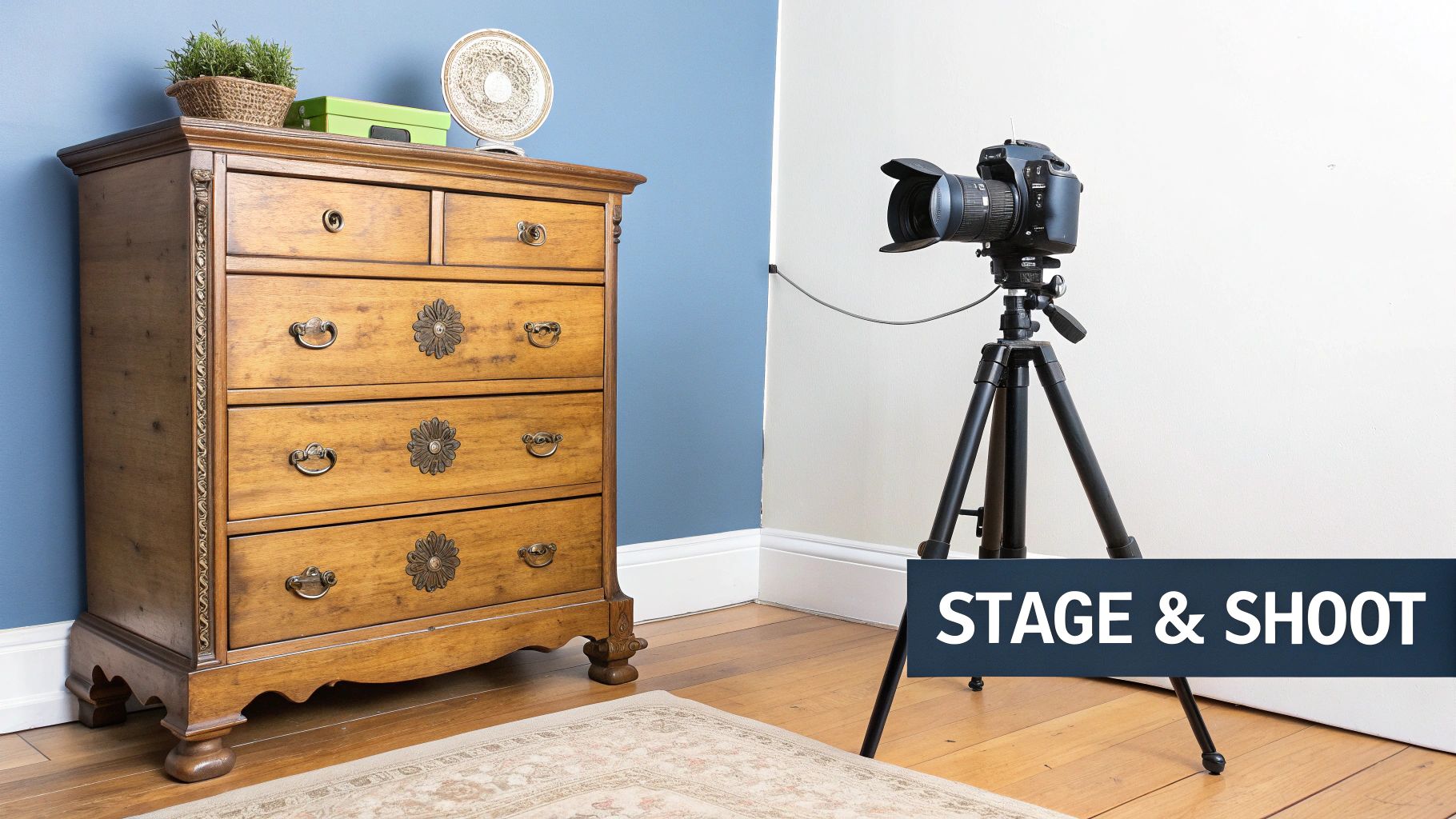
You’ve done the hard work of researching and setting a fair price, but don't stop there. When it comes to pricing for antique furniture, perception is reality. A truly fantastic piece presented poorly will always struggle to sell, while a thoughtful presentation can turn a good piece into a "must-have" item that fetches a premium.
The difference between a quick sale and a piece that collects dust for months often comes down to the story you tell with your photos and words. You need to help buyers see it in their own home, and your job is to make that vision impossible to resist.
Master Your Photography
Forget about needing a professional studio. The phone in your pocket is more than capable, as long as you stop taking blurry, poorly-lit photos in a cluttered garage. Great photos build trust and start justifying your price before a potential buyer even reads a single word of your description.
Here’s what you need to get right:
- Find the Natural Light: This is non-negotiable. Pull the piece near a large window, but try to avoid harsh, direct sun. You want soft, indirect light that shows off the true color and wood grain without creating dark, distracting shadows.
- Show Every Angle: Give them the full 360-degree tour. Take clear shots from the front, back, both sides, and a three-quarter view. This kind of transparency tells buyers you have nothing to hide.
- Zoom In on the Details: This is where you prove its quality. Get close-ups of the good stuff—dovetail joints, a maker's mark, original brass hardware, or intricate carvings. These shots are your evidence.
For a deeper dive, check out our complete guide on how to take amazing pictures of your finds: https://www.curio.app/blog/photographing-antiques.
Here’s a real-world example: I saw a beautiful mahogany sideboard languish online for two months with a $400 price tag. The photos were taken in a dark room, surrounded by clutter. The seller finally moved it into a well-lit dining area, staged it simply, and retook the photos. They relisted it for $550, and it sold in three days. That's the power of good presentation.
Craft a Compelling Story
Once your photos have grabbed their attention, the description needs to seal the deal. This is your chance to tell the story of the piece, connecting with the buyer on an emotional level while also giving them all the practical details they need. A great description builds value and cuts down on all the back-and-forth questions.
Think about how you're setting the scene. A clean, appealing background can make a world of difference. There are plenty of effective staging strategies you can use to make the piece shine.
Here’s a simple formula for a description that sells:
- Lead with a Strong Hook: Start with the style and a key feature. Something like, "A stunning American Empire flame mahogany chest of drawers, circa 1840."
- Tell Its Story: This is where you make a connection. Mention its historical context or unique journey. Use evocative language to paint a picture: "Imagine this piece in a Federal-style home, its rich wood grain glowing in the evening light."
- Give Them the Facts: List the dimensions—width, depth, and height—right away. This is a critical detail that sellers constantly forget, and it's often the first question a serious buyer will ask.
- Be Honest About the Condition: Don't hide the "age-appropriate wear." Be upfront about minor scuffs, dings, or professional repairs. Honesty builds trust and prevents headaches down the road.
- Help Them Envision It: End by suggesting how it could be used. "Perfect as an entryway statement piece, a unique media console, or a beautiful dresser in a guest bedroom."
When you combine great visuals with a story-driven description, you're no longer just selling a piece of furniture—you're selling a piece of history. This simple shift changes the entire conversation from "What's your lowest price?" to "When can I come get it?"
Navigating Market Trends And Price Fluctuations
The antique furniture market isn't a static museum. It’s a living, breathing ecosystem where tastes and trends shift like the seasons. Getting the pricing for antique furniture right means understanding these fluctuations. What's flying off the shelves today might be a tough sell tomorrow, and vice versa.
Take the recent explosion in popularity for Mid-Century Modern. The clean lines and minimalist vibe of designers like Eames just work with today's interiors, and their prices have soared as a result. At the same time, the market for heavier, more ornate Victorian furniture has cooled off a bit, simply because it's a harder fit for most modern homes.
This constant change means pricing isn't a "set it and forget it" task. It's a continuous process of evaluation. You've got to keep your finger on the pulse of what's happening. Staying informed is your best defense against mispricing a piece.
Staying Ahead of the Curve
So, how do you actually track these trends without getting lost in the noise? It's all about knowing where to look.
- Follow the Tastemakers: Keep an eye on prominent interior design magazines and popular design blogs. They often give you a sneak peek at what styles are about to hit the mainstream.
- Watch the Auction Block: Major auction house results are like a real-time report card on the market's health for specific eras and makers. You don't need to pore over every single report, but when you see a particular style consistently fetching high prices, that's a powerful signal of growing demand.
Market trends are the invisible hand that guides antique furniture pricing. A piece that was worth $500 last year could be worth $800 this year simply because its style is suddenly featured in every design magazine. Ignoring these shifts means leaving money on the table.
Understanding Historical Context and Modern Data
If you look back, the antique market has always had its dramatic peaks and valleys. The 2005 market correction is a perfect example. The Antique Furniture Index dropped by 7%—its steepest fall in over a decade. This created a huge buyer's market, especially for those bulky Georgian and Victorian pieces that were falling out of favor.
But the market is nothing if not resilient. It has grown significantly since then, with some studies even showing antique furniture outperforming equities by a factor of 2:1 during certain periods. You can dig deeper into these historical shifts in the Antique Furniture Price Index.
That historical perspective is valuable, but you need current data to make smart pricing decisions today. This is where modern tools really shine. An app like Curio gives you a real-time snapshot of what's happening right now. It lets you adjust your prices based on current comparable sales and demand, not on outdated assumptions from a year ago. It helps you stay agile, responding to trends as they happen and ensuring your pricing is always sharp and competitive.
A Few Lingering Questions
Even with the best research, a few questions inevitably come up when you're trying to put a final price tag on a piece. Let's tackle some of the most common ones I hear.
How Much Does a Professional Appraisal Actually Cost?
This is a classic "it depends" situation, but you can generally expect to pay somewhere between $150 and $500 per hour. The final cost really hinges on the appraiser's reputation and where you're located.
For just one or two pieces, many appraisers will offer a more manageable flat fee.
Should I Restore a Piece Before I Sell It?
Tread very carefully here. A simple, gentle cleaning is almost always a good move. But a full-blown restoration? That can be a value-killer for serious collectors who prize the original finish and the story it tells.
The exception is when a piece is so damaged it’s practically unusable. In that case, a professional restoration might be your only path to getting a decent price.
What’s the Single Biggest Pricing Mistake People Make?
Hands down, the most common mistake is letting emotion drive the price. Your personal attachment to grandma's old rocking chair, unfortunately, adds zero to its market value.
Running a close second is simply not doing the homework. Guessing at a price or going with a "gut feeling" without looking at what similar pieces have actually sold for is a surefire way to either leave money on the table or have an item sit for months.
Ready to price your pieces with real data, not guesswork? Let Curio be your expert in your pocket. Just snap a photo to instantly identify your furniture, learn its history, and get a data-backed appraisal. Download the Curio app and start valuing your collection with confidence.