Figuring out what a piece of antique furniture is worth is part art, part science. It’s about much more than just how old it is. You're really piecing together a story where every detail—from who made it to who owned it—plays a role in its final value.
What Really Determines Antique Furniture Value
Ever find yourself scratching your head, wondering why one old chair is marked for a few bucks at a flea market while another fetches thousands at auction? The difference isn't random. It comes down to a handful of key factors that professional appraisers use to build a complete picture of an item's worth.
Think of it like being a detective. Each factor is a clue that helps you understand not just how much a piece might sell for, but why it's significant. Once you learn what to look for, you stop seeing just old furniture and start seeing assets with a real, tangible story.
The Core Valuation Factors
At its heart, valuing an antique is all about verification and analysis. Appraisers are trained to spot the subtle signals that tell a piece’s story—its history, its quality, and its place in today’s market.
Let’s quickly run through the big five—the absolute cornerstones of antique furniture valuation.
- Provenance: This is the fancy term for the item's ownership history. A paper trail linking a piece to a famous person or a significant historical event can send its value skyrocketing.
- Maker or Attribution: Was it crafted by a master like Thomas Chippendale or a well-known company like Stickley? A verifiable maker's mark is like a designer label on a couture dress.
- Condition and Restoration: Originality is king. A piece in excellent, untouched condition is almost always worth more than something that's been heavily repaired or refinished.
- Rarity and Demand: Simple supply and demand. Is it a one-of-a-kind creation or one of thousands? Unique, hard-to-find pieces are what collectors fight over.
- Materials and Construction: The quality of the wood, the skill in the details (like hand-cut dovetails), and the overall craftsmanship speak volumes about its intended quality and worth.
The real secret is understanding that these factors don't exist in a vacuum—they all work together. A rare piece by a famous maker is great, but if it's in terrible shape, the value plummets. A true valuation requires looking at the whole picture.
To help you remember these key elements, here’s a quick summary table.
Quick Guide to Antique Furniture Valuation Factors
| Valuation Factor | What It Means | Impact on Value |
|---|---|---|
| Provenance | The documented history of ownership. Who had it before? | High. A link to a famous person or event adds immense value. |
| Maker/Attribution | Who created the piece? Is there a maker's mark? | High. A known, respected maker dramatically increases worth. |
| Age & Period | When was it made and does it represent a specific style? | Significant. True period pieces are more valuable than later copies. |
| Condition | Its physical state. Are there breaks, repairs, or refinishing? | Crucial. Original, untouched condition is the gold standard. |
| Materials | The type and quality of wood, hardware, and upholstery. | Significant. Exotic woods and original hardware boost value. |
| Rarity | How many similar pieces exist? | High. One-of-a-kind or limited-run items are highly sought after. |
This framework is your starting point. As you learn to spot these clues, you're not just looking at wood and fabric anymore. You're decoding a puzzle of history, artistry, and market trends. To get started with the basics, check out our guide on how to tell if furniture is antique for more foundational tips.
The Seven Pillars of Furniture Valuation
Figuring out what a piece of antique furniture is worth is like solving a puzzle with seven distinct pieces. Each piece—or pillar, as we call them in the business—adds to the complete picture of an item's value. A good appraiser never hinges their assessment on a single factor. Instead, they look at how all seven pillars work together, influencing one another to build a solid, accurate valuation.
Once you understand these pillars, you start seeing furniture differently. It’s the difference between looking at an "old desk" and recognizing a piece of history that might be incredibly valuable. Let’s break down exactly what those seven elements are.
1. Provenance: The Story Behind the Piece
Provenance is just a fancy word for an item's documented history of ownership. Think of it as a piece of furniture’s resume. A simple chair is just a chair—until you can prove it belonged to a famous artist, a historical figure, or came from a well-known estate. That’s when things get interesting.
For example, a standard 19th-century writing desk might fetch a few hundred dollars on a good day. But what if you have letters and old receipts proving that same desk was used by a famous author? Suddenly, its value could skyrocket into the tens of thousands. A strong, documented story gives a piece a narrative that serious collectors will pay a premium for.
2. Maker's Mark and Attribution: The Signature of Quality
Just like a luxury handbag has a logo, high-end antique furniture often bears the mark of its creator. A maker's mark, a brand, or a paper label is a direct link to a craftsman or company known for their exceptional skill. Names like Chippendale, Stickley, or Eames carry enormous weight in the antique world.
A piece with a clear, verifiable mark from a respected maker will almost always be worth more than an identical-looking unsigned piece. That little signature is a guarantee of quality and authenticity. It removes the guesswork for a buyer, and that confidence translates directly into a higher price. Finding that stamp can be a game-changing moment.
3. Period and Style: The Design's DNA
Every antique belongs to a specific design era, whether it’s Georgian, Victorian, Art Deco, or Mid-Century Modern. The period and style tell you when and how it was made, giving you a window into the tastes and technologies of that time. A true "period piece"—one actually made during the era it represents—is far more valuable than a later copy.
An authentic Queen Anne chair from the 1740s, for example, is a prized artifact. A "Queen Anne-style" chair made in 1940 is a nice tribute, but it doesn't have the same historical DNA or value. Nailing down the specific design elements is key to placing an item in its correct historical context.
4. Condition: The State of Preservation
Condition is, without a doubt, one of the most critical factors. Collectors and appraisers are always looking for originality and preservation. This means a piece with its original finish, hardware, and upholstery—even with the expected dings and signs of age—is usually more valuable than one that's been heavily restored.
An aggressive restoration can strip away not just the old finish, but a significant portion of the item's value. A worn, authentic patina tells a story that a shiny new coat of varnish erases.
Minor, well-executed repairs to ensure a piece is structurally sound are perfectly fine. But major alterations, replaced parts, or a complete refinishing can slash a piece's value by 50% or more. You're essentially wiping away its history.
5. Materials and Construction: The Building Blocks
The quality of the raw materials and the skill of the craftsmanship are foundational to an antique's worth. Appraisers get up close and personal, looking at the nitty-gritty details:
- Wood Type: Is it made from common pine, or something more special like mahogany, rosewood, or bird's-eye maple? The use of rare or high-quality woods immediately adds value.
- Joinery: Are the joints hand-cut dovetails, with their charming slight imperfections? Or are they the perfectly uniform, machine-cut joints of a later, mass-produced era? Hand-craftsmanship is a telltale sign of age and quality.
- Hardware: Are the pulls, hinges, and locks original? Finding original, period-appropriate hardware is a huge plus.
These little things reveal how much care, time, and expense went into making the piece in the first place, and that has a direct impact on its value today.
6. Rarity and Demand: The Scarcity Factor
Simply put, how many of these are out there? That’s the essence of rarity. A one-of-a-kind commissioned piece or an item from a very limited production run is naturally more valuable than something churned out by the thousands. Scarcity creates competition, and competition drives up prices.
But rarity on its own isn't enough; it has to be paired with demand. A piece might be the only one of its kind in the world, but if nobody cares about that particular style, maker, or period, its value remains limited. It's the classic supply and demand equation—you need both sides to create real value.
7. Market Trends: What's Hot Right Now
Finally, the value of antique furniture is tied to the whims of the current market. What was wildly popular a decade ago might have cooled off today. Right now, styles like Mid-Century Modern are in high demand, while some of the more ornate Victorian pieces have seen their popularity dip.
An appraiser has to keep a finger on the pulse of auction results, gallery sales, and online marketplaces to know what people are actually buying. A piece’s value isn’t set in stone; it breathes with the market, rising and falling with shifting tastes and design trends. This is the pillar that connects a historical object to its real-world price today.
How Market Trends Impact Antique Prices
So, you’ve examined your antique’s condition, maker, and materials. That’s a great start, but it's only half the story. The final, and often most unpredictable, piece of the puzzle is the market itself. After all, a piece isn't valuable in a vacuum; its worth is ultimately decided by what someone is willing to pay for it right now.
Think of market trends like an ocean current. They can pull the prices of certain styles and periods up, while letting others drift. What was all the rage twenty years ago might feel dated today, and vice versa. These shifts are driven by everything from interior design fads to broader cultural moods.
Take Mid-Century Modern design, for example. Its clean lines and functional vibe have exploded in popularity, sending the value of pieces by designers like Eames or Wegner through the roof. On the other hand, some of the very formal, ornate Victorian furniture that once filled grand homes has seen demand cool off, especially among younger buyers who tend to prefer a more minimalist look.
The Rise of Sustainable and Secondhand Goods
One of the biggest forces at play today is a growing backlash against "fast furniture." People are becoming more and more aware of the environmental and ethical price tag that comes with mass-produced, disposable goods. This has created a huge surge of interest in the secondhand market, where quality and craftsmanship are king.
And this isn't just a small, niche movement. The secondhand furniture market is booming, with North America alone holding a 38.2% share. In fact, the market is projected to grow by a staggering USD 11.24 billion between 2025 and 2030, especially for wood-based antiques.
What’s driving this? A major factor is sustainability. A whopping 65% of buyers say they are motivated by being more eco-conscious, choosing durable, well-made pieces over something they'll have to throw out in a few years. You can see the full research from Technavio for a deeper dive into the numbers.
An antique piece is inherently sustainable. It was built to last for generations, not just a few years. This commitment to quality is a major selling point in a world tired of disposable goods.
This new generation of buyers isn’t just hunting for old things; they want character, history, and a story that flat-pack furniture just can't deliver. That growing demand directly boosts the value of well-preserved antiques.
Online marketplaces have also thrown fuel on the fire. Platforms like Chairish, 1stDibs, and even Facebook Marketplace have made it incredibly easy for buyers and sellers to connect from anywhere, creating a much more transparent and global market.
Antiques as an Investment
Beyond looks and sustainability, a growing number of people see high-quality antiques as solid, tangible assets. While the stock market zigs and zags, a rare, beautifully crafted piece of furniture can be a reliable store of value—and it might even appreciate over time.
Just look at the iconic Eames Lounge Chair. Since 2015, vintage examples have appreciated by about 15% annually. Depending on their age and condition, these chairs often resell for anywhere between $2,000 and $20,000. It's a perfect example of how classic designs can sometimes outperform more traditional investments.
To make smart moves, you have to stay informed. A crucial first step is figuring out how to set a realistic starting price for your items. For a more detailed walkthrough, check out our guide on pricing antique furniture. Keeping a finger on the pulse of these market dynamics will help you understand where a piece fits in today’s world, allowing you to buy or sell with confidence.
How to Document and Appraise Your Furniture
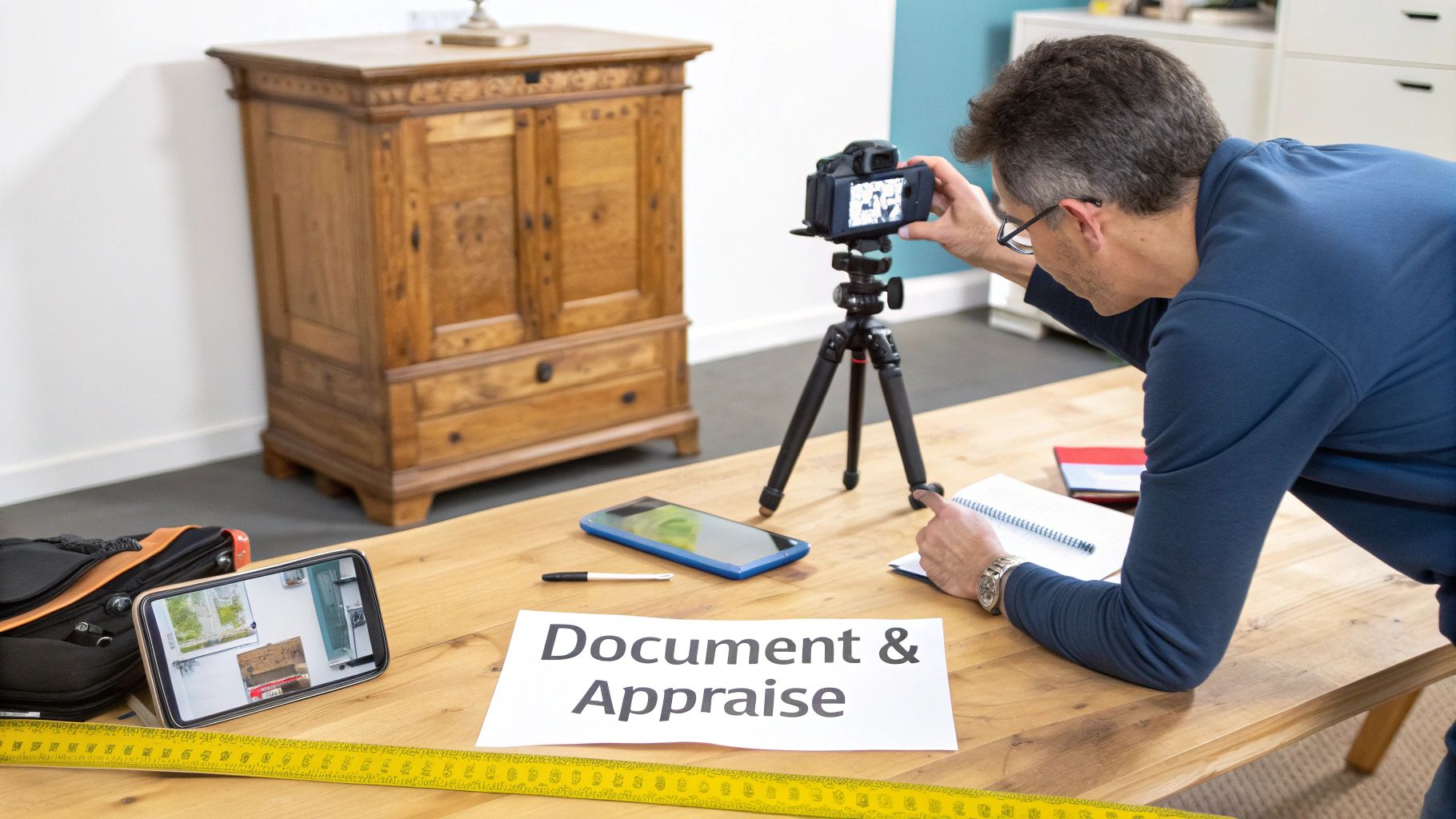
Knowing what makes antique furniture valuable is one thing. Actually putting that knowledge to work is the next crucial step. This is where you move from theory to practice by documenting your piece and figuring out how to get it appraised.
Think of yourself as a detective building a case for your furniture's worth. You wouldn't just show up to court with a vague idea; you'd have photos, evidence, and a clear story. The same goes for your antiques. Solid documentation is the bedrock of any credible valuation.
Capturing the Essential Details
Before you can get a real sense of value, you need to gather the facts. This isn't about taking a quick picture with your phone; it's about creating a detailed visual and written file on your piece.
Start by taking clear, well-lit photos from every possible angle—front, back, sides, top, and even underneath. Then, get in close to capture the details that tell the real story.
- Maker's Marks: Look for any signatures, labels, or stamps. Check inside drawers, on the back panels, or under the main surfaces.
- Construction Details: Get shots of the joinery, especially things like hand-cut dovetails. Don't forget the original hardware, like drawer pulls and hinges.
- Condition: Be honest and thorough. Photograph any wear, patina, scratches, or repairs. These details are critical to an accurate valuation.
- Overall Form: Take a few great shots of the entire piece that show its true shape and scale without any weird angles or distortion.
While you're taking photos, start a notes file. Write down the exact dimensions—height, width, and depth. Jot down anything you know about its history, like who owned it before you or how your family acquired it. This "dossier" is exactly what you'll need when you seek an appraisal.
Navigating Appraisal Options
With your documentation ready, you have a few ways to go about getting a valuation. The right path really depends on what you need the number for. Are you just curious, or do you need a certified value for an insurance policy?
An appraisal isn't just a number; it's an informed opinion backed by market data and expertise. The method you choose will determine the level of detail and formality you receive.
For a quick ballpark figure, online forums can sometimes offer a starting point, but take that advice with a grain of salt. If you need something official for insurance, estate planning, or a potential sale, you absolutely need a professional. You can find accredited appraisers through organizations like the Appraisers Association of America.
Once you have a clear value, protecting your investment is the next logical step. It's wise to learn about the nuances of insuring valuable collections to ensure your piece is covered properly.
Leveraging Modern Tools for Instant Insights
Thankfully, technology has given us a fantastic shortcut. Identification apps like Curio have made getting initial information easier than ever.
These tools use image recognition to analyze a photo of your furniture. They can identify the style, guess the period, and suggest a possible origin by comparing your photo to massive databases of auction results and past sales. Within minutes, you can get a surprisingly solid estimate of its market value, often with helpful context and examples of similar pieces.
For anyone who wants to quickly understand what they have without committing to the time and cost of a formal appraisal, this is an amazing first step. To learn more about the different ways to get a valuation, check out our guide to antique appraisal services.
Real-World Examples of Furniture Valuation
Theory is one thing, but seeing how these valuation principles play out in the real world is where it all clicks. The seven pillars we've discussed—from who made it to who wants it—are the exact tools appraisers use to connect a piece's story to its price tag.
Let's walk through a few distinct scenarios. Each story highlights how one or two key factors can completely change the conversation about what an old piece of furniture is truly worth.
Case Study 1: The Undervalued Federal Bookcase
A family inherited a tall, stately bookcase. They figured it was a nice 1920s reproduction of an older style, well-made and useful, but nothing special. They pegged its value at around $800, mostly as a decorative piece.
But something wasn't quite right for a 20th-century copy. An appraiser took a closer look and spotted the tell-tale signs: the slightly uneven, hand-cut dovetail joints in the drawers and the faint, straight saw marks on the backboards. These weren't the marks of a machine; they were the fingerprints of a pre-industrial craftsman.
- Pillars at Play: This was all about Materials & Construction and Age & Period. The hand-craftsmanship was the dead giveaway that this was the real deal—an authentic American Federal period piece from around 1810.
- The Outcome: The valuation skyrocketed. What was once an $800 decorative item was now a genuine antique. It ended up selling at auction for $7,500, nearly ten times what the family thought it was worth. It’s a perfect example of how the real story is often hidden in the joinery.
Case Study 2: The Damaged Qing Dynasty Armchair
Next up, a beautiful rosewood armchair from China's Qing Dynasty, dating to about 1880. This piece had a great backstory, with papers tracing it to the home of a high-ranking official. But it had problems: a nasty crack in one arm and a clumsy, modern repair on one leg.
The owners were stuck. Should they spend a fortune on a professional restoration or just sell it as is? The whole decision came down to Condition & Restoration. Damaged, it might bring $5,000. A top-tier restoration, however, could cost $4,000.
The question becomes whether the restoration adds enough value to justify the expense. A poor repair could make things worse, while a masterful one could unlock its full potential.
A quick look at the global antiques market provided the answer. Interest in pieces like this is booming, especially in Asia, where similar chairs can fetch anywhere from $10,000 to $100,000, depending on their history and condition. This shows just how much regional demand can influence price.
- Pillars at Play: The Provenance, Rarity, and Market Demand were all there, pointing to a high potential value. But its poor Condition was holding it back.
- The Outcome: Seeing the strong market, the family went for the professional restoration. Once it was structurally sound and its historical character preserved, the chair received a formal appraisal of $22,000. The investment paid off, and then some.
Case Study 3: The Tale of Two Credenzas
Finally, let's look at two Mid-Century Modern credenzas that were, for all intents and purposes, identical. Both were made from teak in the 1960s, both had those classic clean lines, and both were in great shape. But there was one tiny difference: one was unmarked, and the other had the faint maker's mark of a famous Danish designer.
The unmarked credenza was still a beautiful, functional piece of vintage furniture. It sold for a perfectly respectable $1,200 to someone who just loved the look.
The second one, however, was a whole different ballgame.
- Pillars at Play: The Maker’s Mark was the only thing that set them apart. That one small detail elevated the piece from just a stylish cabinet to a collector's item.
- The Outcome: The designer-attributed credenza drew in serious collectors. It sold for $6,800—more than five times the price of its unsigned twin. This is the ultimate lesson in how a name can act as a guarantee of design history and quality, creating a massive gap in the value of antique furniture.
Common Mistakes to Avoid When Valuing Furniture
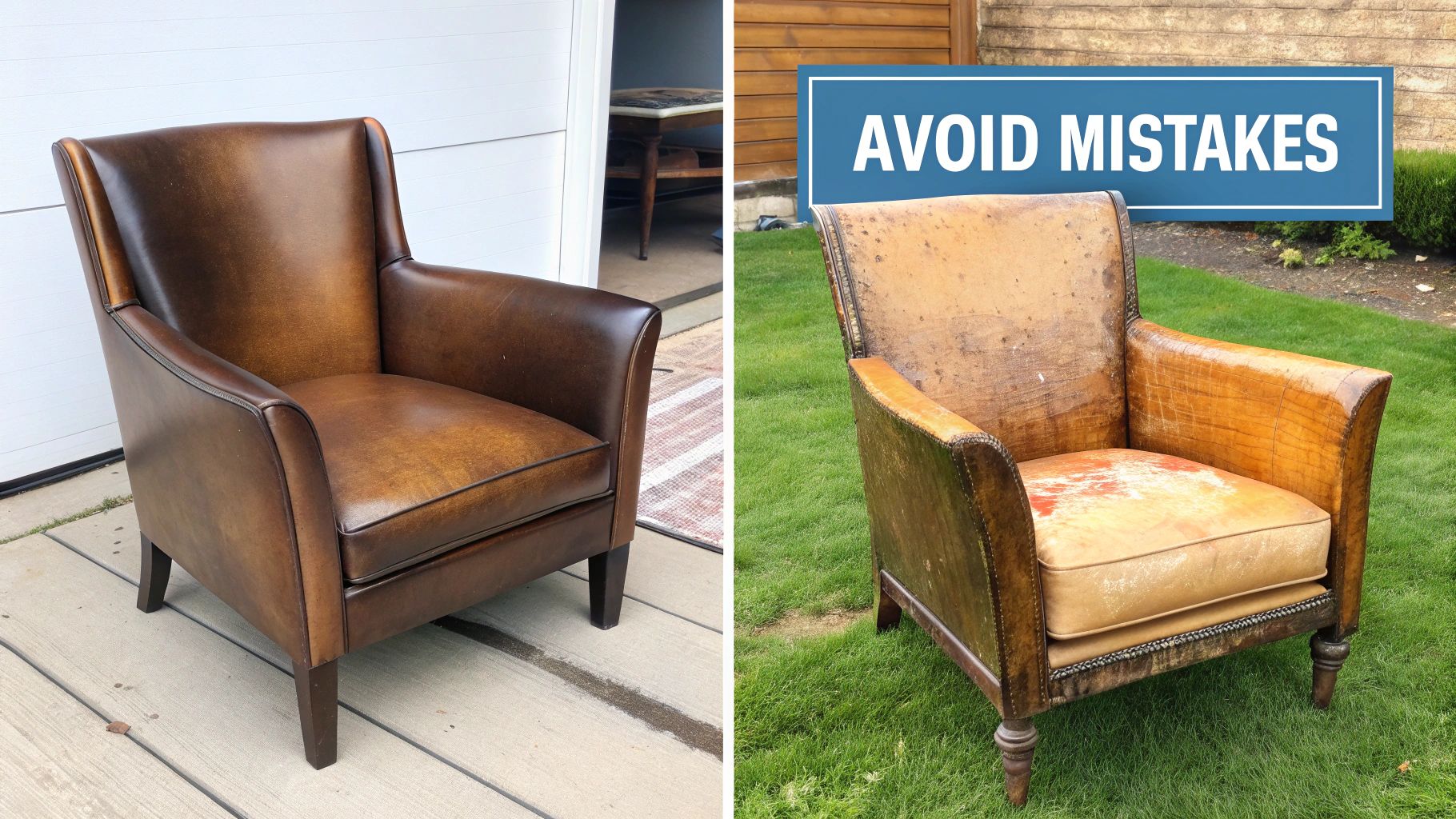
Figuring out what an antique is worth isn't just about what you do right; it's about what you don't do wrong. A simple misstep can cost you dearly, turning a potential windfall into a story of what could have been. Learning to spot these common traps is key to becoming a confident evaluator.
One of the biggest blunders is mistaking a very good reproduction for an original period piece. It’s an easy mistake to make. Many modern copies are excellent mimics, but they don't have the history, the hand-tooling, or the lived-in soul that gives a genuine antique its value.
Another trap is thinking that older always means better. Age is a huge part of the equation, but it doesn’t work alone. A run-of-the-mill Victorian side table might be over 100 years old, but it will probably be worth a fraction of a rare, well-documented designer piece from the 1960s. Rarity and demand often trump age.
The Restoration Trap
Here’s where things can go terribly wrong: an overzealous “restoration.” So many people think that making a piece look brand new will boost its value. In the world of serious antiques, the exact opposite is often true.
Stripping off an antique's original finish—its patina—is the cardinal sin. That surface is the piece's autobiography, telling a story of its journey through time. Once you remove it, that history is gone forever. A serious collector will almost always pay more for a piece in honest, original condition than for one that’s been stripped and refinished to look new.
Of course, small repairs to make a chair stable or a drawer functional are fine. But a heavy-handed refinish can slice a piece’s value in half, sometimes more. You’re not restoring it; you’re erasing it.
Other Valuation Pitfalls to Sidestep
Beyond bad restoration jobs, a few other common missteps can throw your valuation way off track.
- Ignoring Physical Damage: You have to be honest about the flaws. Overlooking chips, cracks, or wobbly legs leads to a fantasy price tag. And be careful not to create new problems—there are plenty of common mistakes when moving furniture that can instantly devalue a piece.
- Relying on a Single Source: Never hang your hat on one online listing or a single opinion. Retail sites like 1stDibs often show "aspirational" prices, which are a world away from what a private seller can realistically get.
- Misinterpreting Market Prices: This one is crucial. Look for what pieces have actually sold for at auction, not what people are asking. A desk listed for $5,000 for six months hasn't proven its value. A similar one that sold last week for $2,500 has.
By sidestepping these mistakes, you’ll be making decisions based on reality, not wishful thinking. You'll protect both the history and the real-world value of your furniture.
Your Antique Furniture Questions, Answered
Getting to the bottom of your antique furniture's value can feel like solving a puzzle. Let's tackle some of the most common questions that come up.
How Do I Know if My Furniture Is Valuable or Just Old?
It's a great question, and the answer is usually in the details. Look for tell-tale signs of hand-craftsmanship—things like dovetail joints that aren't perfectly uniform, faint saw marks, or the use of solid wood even on the back panels. A true antique is generally over 100 years old and will usually fit into a recognizable design period, like Georgian or Victorian.
If you're unsure where to start, an identification app can be a handy first step. A quick photo can often help you pin down the style, period, and maybe even a potential maker, giving you a solid launchpad for further research.
Should I Restore an Antique Before Selling It?
Hold on before you break out the sandpaper! For truly rare and valuable pieces, collectors often prize the original finish and patina—that gentle wear and tear that tells a story. A bad restoration, especially one that strips away the original surface, can tank the value.
Minor, reversible repairs are usually fine, but for anything major, get an appraisal first. You need to know exactly how a "fix" might affect the final price.
It's a classic mistake to think a shiny, "like-new" piece is always better. In the antiques world, authenticity often beats perfection. That untouched surface carries history, and that's something collectors will pay a premium for.
What’s the Single Most Important Factor in Determining Value?
If I had to pick just one, it would be desirability. This isn't a single thing but more of a perfect storm created by rarity, condition, maker, and what the market is hungry for right now. A rare piece in fantastic shape from a known maker will always be valuable.
But if that particular style suddenly becomes the hottest thing in interior design, its value can absolutely soar as buyers scramble to get their hands on one.
Can My Furniture Be Valuable if It Doesn’t Have a Famous Maker’s Mark?
Absolutely. While a famous name like Chippendale or Stickley certainly adds a premium, countless unsigned pieces are incredibly valuable. It all comes down to the quality.
An exceptionally well-made piece that perfectly captures its time period, uses rare woods, or has a unique design can command a high price on its own merits. This is especially true if it comes with a documented history or solid provenance.
Feeling a bit lost in an attic full of heirlooms or just curious about that thrift store find? Curio is like having an antique expert in your pocket. Just snap a photo to get instant identification, historical context, and an estimated value, turning your questions into confident answers.
Download Curio today and start uncovering the stories hidden in your furniture.