Figuring out the value of an antique pocket watch comes down to a few key things: the brand, its condition, how rare it is, and the complexity of its inner workings. A pristine watch from a famous maker will always be worth more than a common one that's seen better days. Let's walk through the practical steps to uncover what your timepiece is truly worth.
What Is Your Antique Pocket Watch Really Worth?
Holding an old pocket watch is like holding a piece of history. But what’s that history worth in today's market? This guide will break down the valuation process, giving you a clear path to understanding whether you have a priceless heirloom or a valuable collector's item on your hands.
We'll skip the dense jargon and focus on what really matters. Think of this as your personal roadmap to uncovering the hidden value in your watch, whether it's been passed down through generations or is a recent find from an antique shop.
The Four Pillars of Pocket Watch Value
Valuing a pocket watch isn't guesswork; it's a detective story where the clues are in the details. You'll need to investigate four main areas:
- The Maker: Who actually manufactured the watch?
- The Condition: What is its physical and functional state? Is it working?
- The Rarity: How many of this specific model were ever produced?
- The Materials: Is the case made of solid gold, silver, or a less valuable base metal?
These pillars are the bedrock of any accurate appraisal. The difference in value can be staggering. Legendary names like Patek Philippe are in a class of their own, with some rare models selling for millions. The Patek Philippe Henry Graves Supercomplication, for instance, famously sold for $24 million because of its incredible complexity and rarity.
A watch's story is told through its details. The maker's name on the movement, the faint scratches on the case, and the gleam of its metal are all chapters that contribute to its final value.
To get a better sense of how these factors work together, you can even look at a good old coin valuation guide. The principles are surprisingly similar, with rarity, provenance, and condition being just as critical.
To put it all in perspective, here's a quick rundown of what to look for when you start your appraisal.
Key Factors That Determine Pocket Watch Value
| Factor | What to Look For | Impact on Value |
|---|---|---|
| Maker/Brand | Famous names like Patek Philippe, Vacheron Constantin, Waltham, Elgin, or Hamilton. | High Impact: A prestigious brand can increase value exponentially. |
| Case Material | Markings for 14k or 18k gold, sterling silver, or platinum. | High Impact: Solid precious metals are far more valuable than gold-filled or base metals. |
| Condition | Clean dial, no cracks/chips, original hands, smooth case, working movement. | High Impact: Mint or near-mint condition commands top dollar. Damage significantly lowers value. |
| Rarity | Low serial numbers, limited production runs, special commemorative editions. | High Impact: The fewer that exist, the more a collector is willing to pay. |
| Movement | High jewel counts (e.g., 17-23 jewels), intricate complications like chronographs or repeaters. | Medium to High Impact: A more complex, higher-quality movement adds significant value. |
| Provenance | Engravings, original box and papers, documented history of ownership. | Medium Impact: A documented story or famous owner can add a premium. |
Understanding these elements is the first and most crucial step in the valuation process. From here, you can dive deeper into each one to build a complete picture of your watch's worth.
Decoding the Markings Inside Your Watch
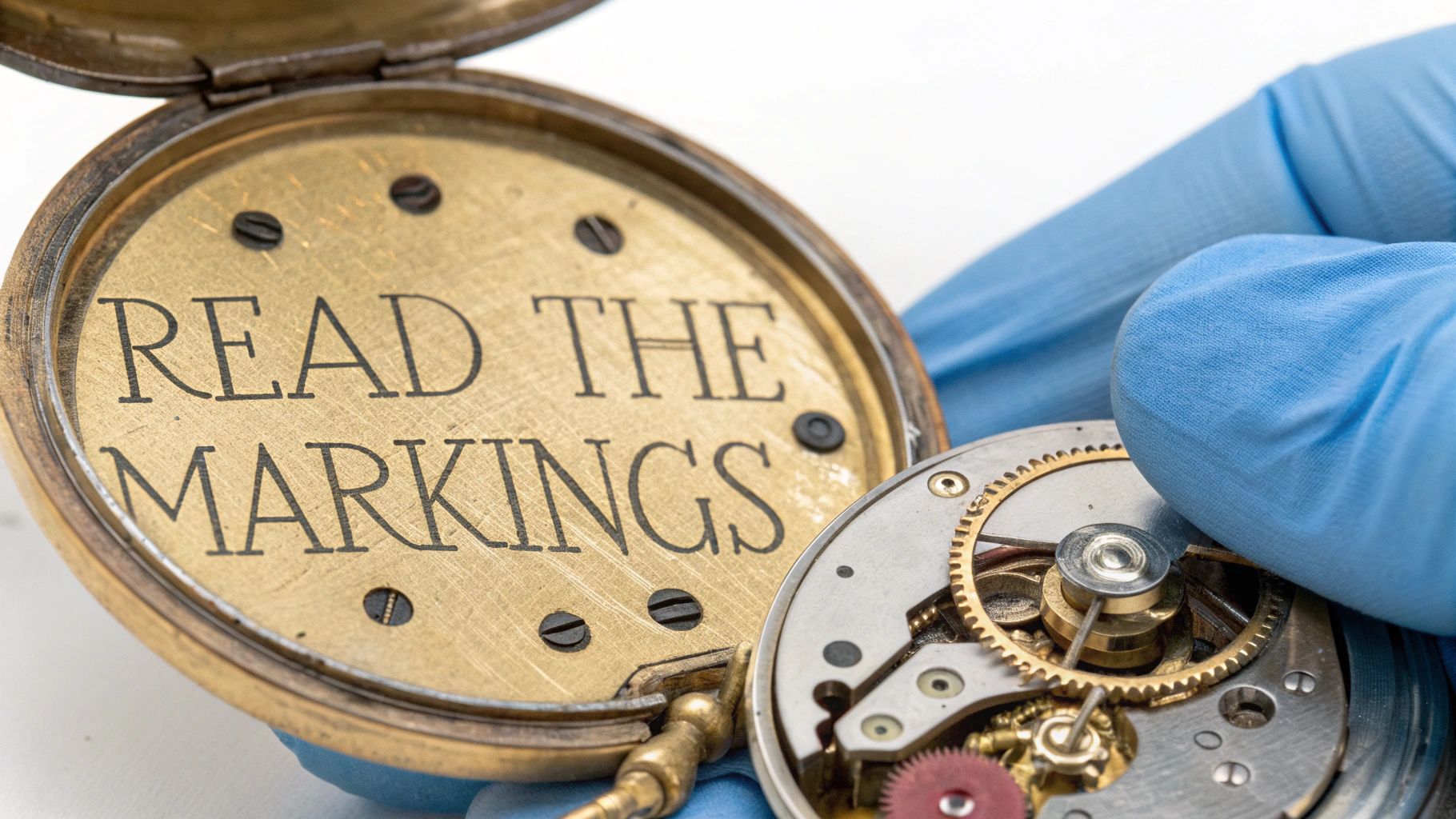
To get to the heart of what your pocket watch is worth, you've got to look past the dial and get inside the case. The movement—the intricate engine that makes it tick—is where the real story is told, and it's where most of the value is hidden.
Getting inside requires a gentle touch. Most antique pocket watches have either a screw-off or a hinged back. If yours screws off, try a soft, grippy cloth or a special watch case ball for traction. The goal is to get a firm grip without scratching the metal. For hinged cases, find the tiny lip along the seam and use a fingernail or a dull case knife to carefully pry it open.
Once you’re in, you’ll likely find another metal cover called a cuvette, or dust cover. This also usually opens on a hinge. Behind that, you’ll see the beautiful, complex movement. This is where your detective work begins.
Identifying the Key Inscriptions
Manufacturers etched all the important details right onto the movement. As you examine it, you’re looking for a few crucial clues that are essential to determining the value of an antique pocket watch.
- Maker's Name: The manufacturer's name should be engraved somewhere prominent. Look for names like Elgin, Waltham, Hamilton, or Illinois.
- Serial Number: This is the single most important number on the watch. It’s your key to unlocking its history and will be clearly stamped on the movement.
- Jewel Count: You’ll often see text like "17 Jewels" or "21 Jewels." Generally, a higher jewel count points to a higher-quality, more accurate, and more durable movement.
The serial number is your starting point. Think of it like a car's VIN—it tells you exactly when the watch was made and what specific model, or "grade," it is.
What the Movement Tells You
The quality of the movement has a massive impact on the watch's value. A high-grade movement from a respected brand will always be more desirable than a basic one. For example, a 21-jewel Waltham Vanguard or a 19-jewel Elgin B.W. Raymond was built for railroad-grade precision, a standard that makes them highly sought after by collectors today.
On the other hand, a simple 7-jewel movement from a more obscure maker was the budget option of its time. Even if it's housed in a beautiful case, the movement itself will keep the overall value much lower.
Pro Tip: It's easy to mix up the serial numbers. The number on the movement is what you need to research the watch's history and grade. Any number you find inside the case just identifies the case itself, which was often made by a different company.
While you're inside, don't forget to inspect the case for hallmarks. If the case is made of a precious metal, you'll find stamps indicating its purity, like "14K" for gold or "Sterling" for silver. Knowing these markings is a big piece of the puzzle, and you can learn how to interpret these important symbols by reading our guide on what hallmarks are on silver. This gives you a baseline value for the metal, entirely separate from the horological value of the movement ticking away inside.
Getting a Real Sense of Your Watch's Condition
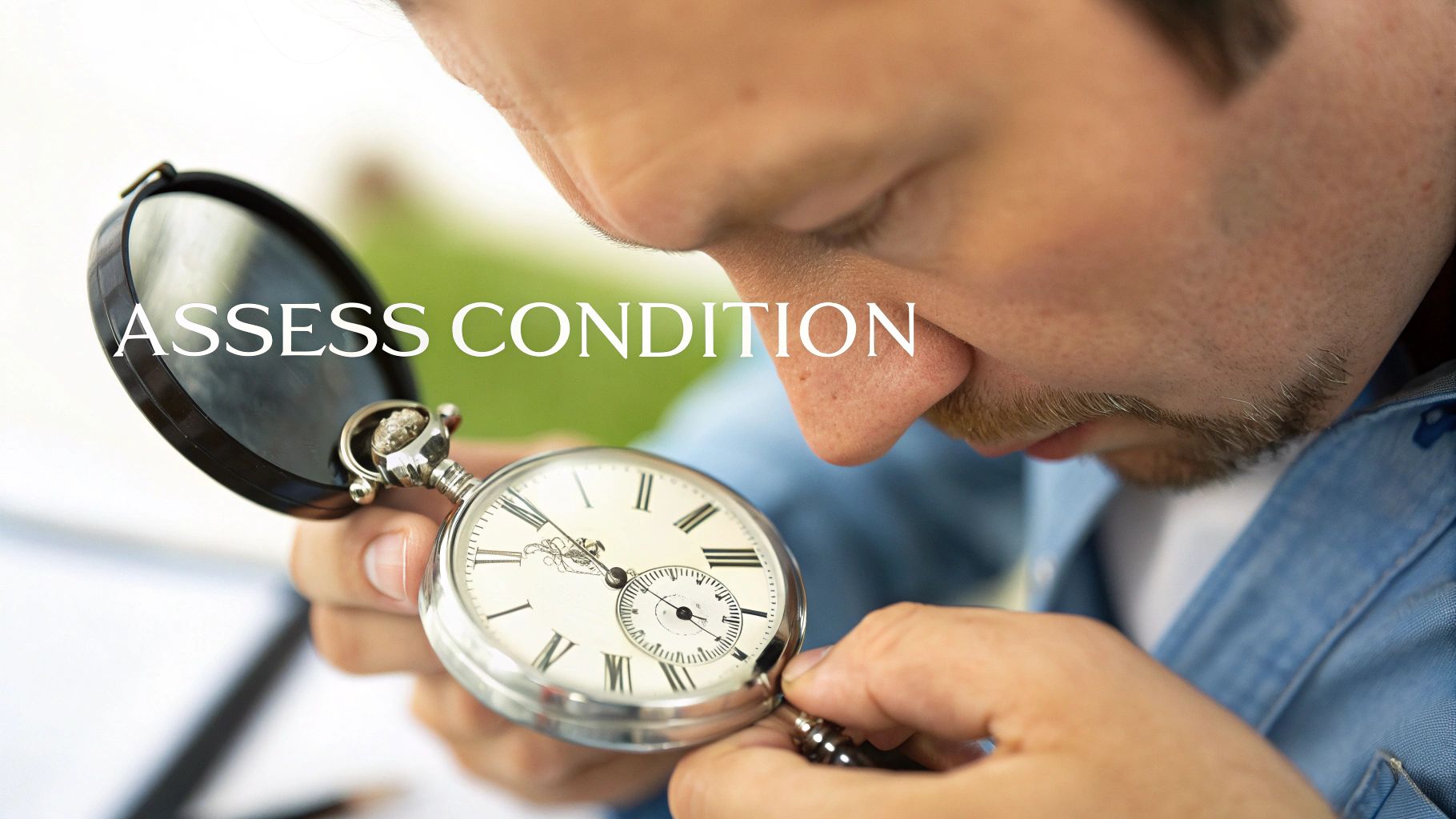
In the world of antique collecting, there's an old saying: condition is king. And with pocket watches, this couldn't be more true. A watch that looks great from a few feet away might reveal a whole different story under close inspection, and those hidden details are what separate a true treasure from a simple trinket.
To really value antique pocket watches, you have to train your eye to see them like a seasoned appraiser. It's about more than just checking if it ticks; it's about spotting any damage, repairs, or non-original parts. Believe me, even tiny flaws can take a surprising bite out of the final value.
Start With the Dial: The Face of the Watch
The dial is the very first thing a potential buyer will scrutinize, so it’s the best place to begin your assessment. Grab a jeweler's loupe or a good magnifying glass and find a well-lit spot. You're looking for anything that isn't original and perfect.
Many older watches feature beautiful porcelain or enamel dials, which are unfortunately quite fragile. The most common issues you'll find are hairline cracks—they often look like tiny, faint spiderwebs spreading across the surface. Also, be sure to check for chips. These usually pop up around the edges where the dial tucks into the case, or near the winding hole on older key-wind models.
A completely flawless dial is the holy grail for collectors and can add a huge premium. Any damage you find will, without a doubt, bring the value down.
Move to the Case and Crystal
Next, let's look at the case. Think of it as the watch's life story, told through its dings and scratches. A little honest wear is expected and can even add character, but significant damage is a major problem.
Here's what to look for:
- Dents and Scratches: Are there any deep gouges? Do any dents throw off the case's symmetry?
- Hinges: Gently open and close the front and back covers. The hinges should feel solid and secure, not wobbly or loose.
- Over-polishing: Sometimes people get a little too aggressive with polishing. This can soften the sharp edges of the case and wear down delicate engravings—a big no-no for serious collectors. A case with crisp, sharp details is always worth more.
- Originality: Take a look at the bow (the loop where the chain attaches). Is it worn thin, or does it look brand new? Oddly enough, a worn-out but original bow is often better than a shiny new replacement.
The crystal (the glass cover) should ideally be original, too. Older crystals were typically mineral glass, which is a bit thicker and can have a slight yellow hue. It's common to see modern acrylic replacements, which is an acceptable repair, but finding an original crystal is a definite plus. The case material itself is a huge value driver; you can dive deeper into that topic in our guide to antique silver pocket watches.
A Quick Note on Grading: Experts grade a watch's condition on a scale from 'Mint' (looks like it just left the factory) down to 'Poor'. Most watches you’ll encounter will probably fall into the 'Fine' or 'Good' range, meaning they show normal, honest wear for their age.
Don't Forget the Hands and Movement
Finally, it's time to examine the little details that purists obsess over. Do the hands look original? Their style should match the numerals on the dial, and they should show a similar patina. Mismatched or replaced hands can be a deal-breaker for some collectors.
While you have the back open, take another look at the movement, but this time focus on its condition. You’re looking for any signs of rust, corrosion, or water damage. A clean, bright, and shiny movement is a fantastic indicator that the watch has been well cared for throughout its long life.
Uncovering Your Watch's Rarity and Story
So, you’ve figured out the basics—the maker, the metal, and what kind of shape it’s in. Now for the fun part: digging into your watch's past to see if you're holding a common timepiece or a rare treasure. This is where you separate the everyday finds from the truly collectible ones.
The key to unlocking this story is almost always the serial number engraved on the movement itself. Forget the number on the case for now; the movement's number is your direct link to the factory's production records. It’s what turns a beautiful old object into a documented piece of history.
The Power of Online Databases
Just a couple of decades ago, this kind of detective work meant sifting through dusty reference books or hoping to find an expert. Today, you can do it from your couch. For American pocket watches, your first and best stop should be the Pocket Watch Database.
Simply plug in the manufacturer's name and the movement's serial number, and you'll get a snapshot of your watch's life. It's like a birth certificate, showing you things like:
- The exact year it was manufactured.
- How many other watches were made in that same production run.
- The official model or grade, like a Waltham "Vanguard" or an Elgin "B.W. Raymond."
- Technical specs like its size, jewel count, and other details.
This information is gold. Discovering your watch was one of only 1,000 made is a game-changer. That's a world away from finding out it was part of a massive run of 50,000.
For instance, imagine you find out your plain-looking Elgin watch was part of a special, low-production run of 21-jewel movements made in 1905 for railroad men. That single detail instantly tells you it’s a high-grade, historically important piece, and its value just shot up.
Looking for Historical Significance
The production numbers are just one piece of the puzzle. Rarity is also about the watch's original purpose. Certain watches were built for tough, specific jobs, and that history makes them far more interesting to collectors.
Was it a railroad-grade watch? These weren't just fashionable accessories. They were mission-critical tools, built to incredibly high standards of accuracy to keep the nation's trains running on time and, more importantly, safely. Their connection to this vital chapter of industrial history gives them a special appeal.
Or maybe you have a presentation watch. Keep an eye out for detailed engravings on the case lids. A watch given to a retiring company president in 1910, with his name and a date inscribed, has a unique, personal story that a standard model lacks. This kind of provenance—a documented history—can make an otherwise common watch a one-of-a-kind find.
To help you on your research journey, a few websites are absolutely essential. I've bookmarked these myself and turn to them constantly.
Essential Online Resources for Pocket Watch Research
Here’s a quick list of some of the most valuable websites out there for identifying and researching your watch. They're a great starting point for anyone serious about this hobby.
| Resource Name | What It's Used For | Website Link |
|---|---|---|
| Pocket Watch Database | Identifying American pocket watches by serial number. Provides production dates, grades, and run totals. | pocketwatchdatabase.com |
| NAWCC Forums | The National Association of Watch and Clock Collectors forums are a place to ask questions and learn from experts. | nawcc.org/index.php/forums |
| Renaissance Watch Repair | Offers detailed articles and identification guides for both American and Swiss watch brands. | renaissancewatchrepair.com |
When you start combining the hard data from these resources with the physical clues you've already gathered from the watch itself, a complete picture begins to form. You’re not just holding an old timepiece anymore; you’re holding a tangible artifact with a story to tell. And that story is a huge part of its value.
Finding the Current Market Value
So, you've decoded all the markings and given your watch an honest assessment of its condition. Now for the million-dollar question: what is it actually worth? The history and craftsmanship are fascinating, but at the end of the day, a watch's market value is simply what someone is willing to pay for it right now.
This is where you put on your detective hat. You need to dig into what similar watches have actually sold for recently. Forget about what sellers are asking for; the real story is in completed sales. Price guides can offer a starting point, but the market moves fast, and the most reliable data comes straight from real-world transactions.
Tap into Real-World Auction Data
Your best friend in this process will be the "sold" or "completed listings" filter on auction websites. This is the single most important step to get a realistic valuation. It's the difference between what someone hopes to get and what people are truly paying.
I always start my search on these platforms:
- eBay: The advanced search function here is a goldmine. You can filter for sold items, giving you a massive dataset, especially for the more common American and Swiss pocket watches.
- Heritage Auctions: If you suspect you have a higher-end piece, this is the place to look. Their archives of past auction results are invaluable for premium brands.
- LiveAuctioneers: This site is an aggregator, pulling in results from hundreds of auction houses. It gives you an incredibly broad picture of the market.
As you browse, be brutally honest with yourself. Look for direct comparisons—same maker, model, jewel count, and, critically, the same condition. It's so easy to see a pristine example that sold for a high price and get your hopes up, but that won't help you value your watch.
The biggest mistake I see people make is cherry-picking the one amazing sale price they find. A much better approach is to find several comparable sales and figure out the average. That gives you a realistic, defensible number.
Keep an Eye on Market Trends
The world of antique watches isn't static. It has its own trends, with certain models suddenly becoming popular. You'd be surprised how some of the more common American pocket watches have shot up in value lately.
For instance, the 2024 Pocket Watch Database market report highlighted some interesting shifts. The Elgin 102 (an 18-Size, Model 3, 11-Jewel watch) saw a massive 47.9% jump in value, now averaging around $173. Another one, the Waltham "Appleton, Tracy & Co." (an 18-Size, Model 1877), climbed 22.6% to about $195.
These numbers prove that you don't need an ultra-rare piece to have something of value. By pairing your research on your specific watch with an awareness of these broader market movements, you can confidently determine where your timepiece fits in today's collecting world. This is how you turn all that historical detail into a solid, real-world valuation.
When It's Time to Call in a Pro
Following this guide will get you a very solid idea of what your pocket watch is worth. But sometimes, a well-informed estimate isn't enough. There are moments when you absolutely need the certified, documented valuation that only a professional appraiser can provide.
Knowing when to make that call is key. If you suspect you're holding a top-tier name like Patek Philippe or Vacheron Constantin, or if the case is solid gold or platinum, an expert is your next step. The same goes for watches with rare complications, unique features, or a verifiable connection to a historical figure.
Finding the Right Expert
Don't just go to any jeweler. You're looking for a specialist—a certified appraiser or a seasoned horologist, ideally someone connected with a respected organization like the National Association of Watch and Clock Collectors (NAWCC). These folks live and breathe this stuff; they've spent decades studying the tiny details that can make or break a watch's value.
A formal appraisal is more than just a number on a piece of paper. It's a comprehensive report that serves as legal documentation for several important situations:
- Insurance: This is the proof you'll need to properly insure your watch against loss, theft, or damage.
- Estate Planning: It ensures a valuable family heirloom is handled fairly when being passed down.
- Big-Ticket Sales: For a high-value piece, a certified appraisal gives a serious buyer the confidence they need to commit.
An appraisal gives you something priceless: peace of mind. It takes you from a well-educated guess to a certified fact, giving you the power to properly insure, sell, or treasure your timepiece.
Understanding the appraisal process itself is a big help. For a deeper dive, our guide on getting an appraisal for antiques walks you through exactly what to expect.
The pocket watch market can be surprisingly volatile. For example, looking at long-term trends in pocket watch values, some C.H. Meylan models bounced between $435 and $1,700 in the years from 2007 to 2019. An expert appraiser navigates these fluctuations for you, ensuring your valuation is grounded in today's market, not yesterday's prices.
Answering Your Pocket Watch Questions
Even with a step-by-step guide, you're bound to have some specific questions pop up. Let's tackle a few of the most common ones I hear from people who are just starting to figure out what their old pocket watch is worth.
What If It's Not Working? Is It Worthless?
Not necessarily. This is a classic "it depends" situation.
If you have a truly rare watch from a prestigious maker like Patek Philippe or Vacheron Constantin, it can still be incredibly valuable even if it's not ticking. A serious collector knows a master watchmaker can often bring it back to life, and they'll just factor that repair cost into what they're willing to pay.
On the other hand, for a more common watch—say, a standard-grade Elgin or Waltham—being non-functional is a major hit to its value. In those cases, the cost of a proper repair can sometimes be more than the watch is even worth.
A watch’s value is a combination of its mechanical soul and its physical body. Sometimes, even if the heart isn't ticking, the history and rarity of its form are valuable enough on their own.
How Much Does the Case Actually Matter?
It matters a lot. The case is one of the biggest drivers of value, right after the maker and the movement itself.
Think of it this way: a solid 14k or 18k gold case is valuable just for its raw materials, before you even consider the watch inside. Cases made of platinum or those with intricate, multi-colored enamel scenes can send the price soaring.
Conversely, a watch in a "gold-filled" case (a thin layer of gold bonded to a base metal) or a simple silver or nickel case will be worth significantly less, all other things being equal.
Ready to uncover the story and value of your antiques? With Curio, you can get instant identification, historical context, and an expert appraisal right from your phone. Download the app and let your antiques tell their story. Learn more about Curio.