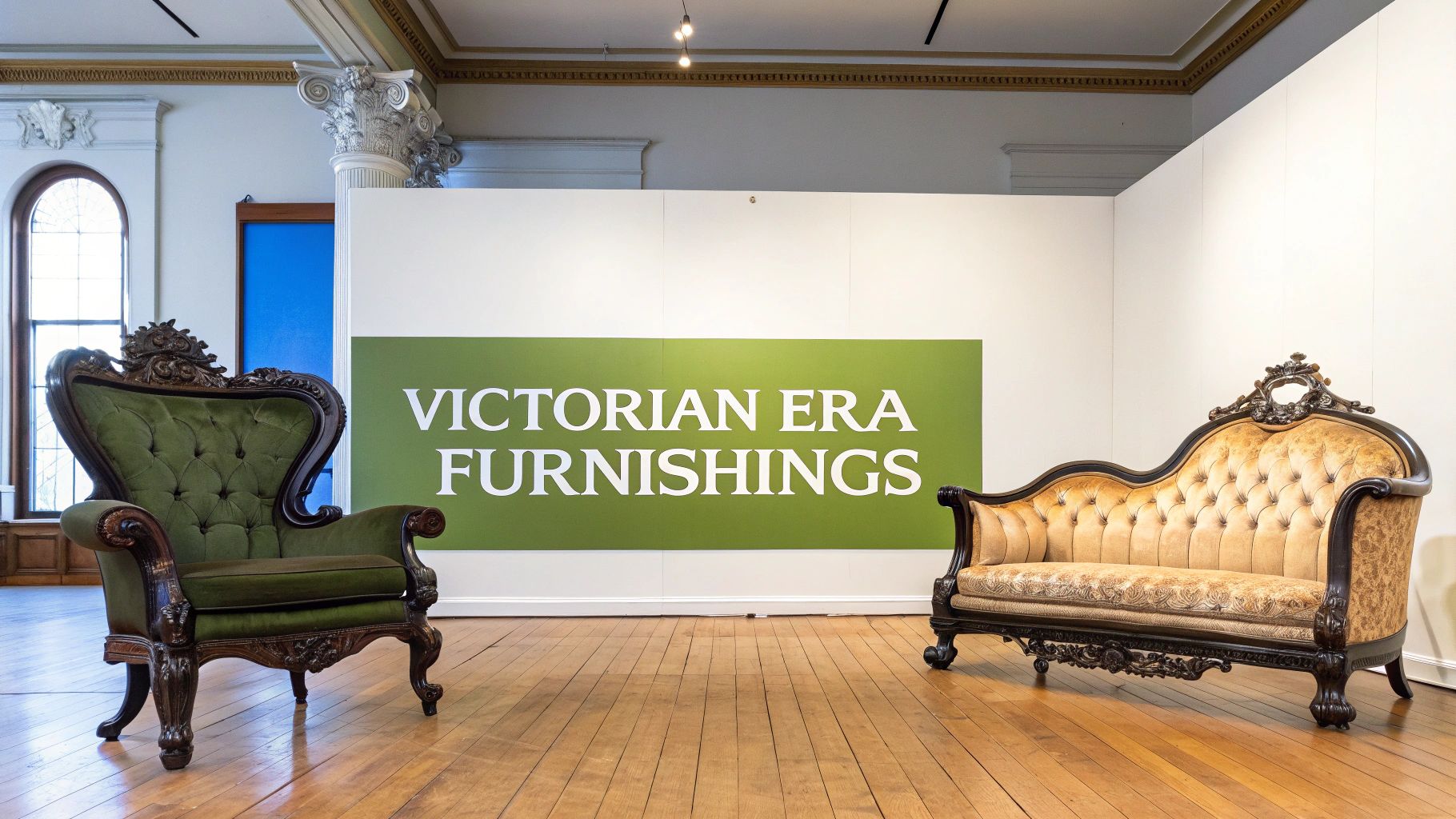
When you think of Victorian furniture, what comes to mind? Probably ornate, heavy, and highly decorative pieces carved from dark woods like mahogany and walnut. That's a great starting point, but it's just scratching the surface. These pieces weren't just furniture; they were powerful symbols of a family's wealth and social standing during a time of incredible change.
A Beginner’s Guide to Victorian Furniture
Walking into a room filled with Victorian furniture can feel like stepping back in time. This was an era where artistry collided head-on with the new power of the Industrial Revolution, and the results were spectacular. From 1837 to 1901, furniture became more than just functional. Every piece was a statement of taste, status, and aspiration, designed to tell a story about its owner's place in a rapidly evolving world.
For the first time ever, elaborate furniture wasn't just for the ultra-rich. The growing middle class could finally afford it, and this created an explosion of creativity and an incredible diversity of styles. We're going to unpack how the big shift from small artisan workshops to bustling factory floors shaped what people put in their homes.
The Rise of Mass Production
The Industrial Revolution changed everything, especially how furniture was made. Think of it as the first real era of mass production for home goods. By the mid-19th century, Britain was nicknamed the 'workshop of the world,' and London alone was home to over 2,000 furniture-making businesses.
These weren't just single-person shops. They were hubs with workshops for 24 different trades—from carpenters and carvers to gilders and upholsterers—all working together. This new factory system meant that styles once reserved for the aristocracy could be produced on a larger scale and sold to a much wider audience. You can get a deeper look into the Victorian furniture trade on this historical resource from the Furniture History Society.
The Victorian home became a stage, and the furniture was the main cast. Each piece, from a heavily carved sideboard to a tufted settee, played a role in telling a story of comfort, morality, and social standing.
What We'll Cover
This guide will walk you through everything a new collector or curious enthusiast needs to know. We’ll cover the essentials to get you started:
- Major Styles: We'll break down the key differences between Gothic Revival, Rococo Revival, the Aesthetic Movement, and other popular styles so you can tell them apart.
- Identification Tips: You'll learn how to spot authentic pieces by looking at the details—the joinery, the materials, and the maker's marks that tell the real story.
- Practical Guidance: We’ll also get into the nitty-gritty of collecting, preserving, and valuing these incredible antiques.
Understanding the Defining Victorian Furniture Styles
The story of Victorian furniture isn't just one story—it's a collection of several distinct, and often competing, design movements. Designers from this period loved looking to the past for inspiration, pulling historical aesthetics into a new industrial age. This created a fascinating and diverse mix of "revival" styles, each with its own personality. Learning to spot the differences is the first step to truly appreciating the creativity of the 19th-century home.
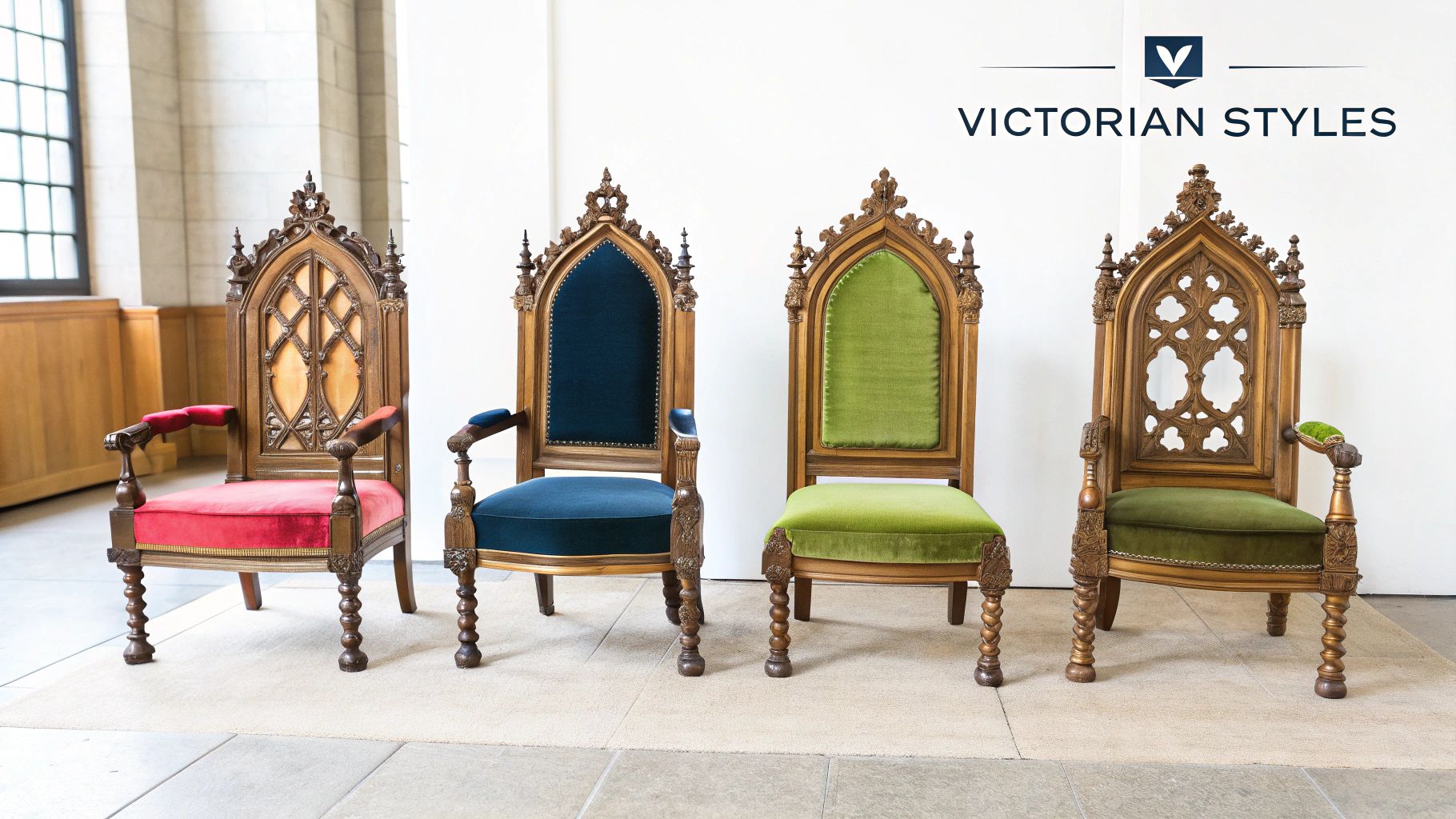
Gothic Revival: The Drama of the Middle Ages
Early in the Victorian era, there was a huge fascination with the romance and grandeur of the Middle Ages. The Gothic Revival style took its cues directly from the soaring cathedrals of Europe, essentially bringing the architectural weight of a church right into the parlor. It was a bold, serious statement against the lighter styles that came before it.
You'll know it when you see it.
- Pointed Arches: This is the dead giveaway. You’ll find these arches on the backs of chairs, carved into cabinet doors, and towering on massive headboards.
- Intricate Tracery: Look for delicate, almost lace-like carvings that copy the elaborate stonework you'd see in a cathedral window.
- Heavy, Solid Woods: Oak was the wood of choice, loved for its sturdiness and its historical link to medieval craftsmanship. These pieces were built to feel substantial, permanent, and even a little bit pious.
Rococo Revival: The Romance of the Curve
By the mid-19th century, tastes began to shift toward something softer and more fluid. The Rococo Revival looked back to 18th-century France, celebrating lush curves and flowing, natural forms. It exploded in popularity, quickly becoming one of the most recognizable styles of the entire Victorian era.
This style is all about motion and grace. C-scrolls and S-scrolls are absolutely everywhere, giving pieces a sense of elegant movement. Carvings of fruit, flowers, and vines are piled on, making sofas and chairs feel almost alive with decoration. The American master of this style, John Henry Belter, was famous for his laminated rosewood furniture, a technique that allowed for incredibly deep and complex carvings that were impossible before.
Rococo Revival pieces were the heart of the formal Victorian parlor. Their joyful, romantic lines and elaborate ornamentation perfectly captured the era's focus on showcasing wealth and sophisticated taste through beautiful, expressive furnishings.
Eastlake Style: A Reaction to Excess
As the century wore on, a counter-movement started brewing against the over-the-top revival styles. Led by designer Charles Eastlake, this new approach called for simpler, more honest construction. It wasn't plain, but its decoration was more controlled and geometric—a direct rebellion against the lavish curves of Rococo Revival.
Eastlake furniture is easy to spot by its squarer, more rectangular forms and its shallow, incised carvings. Instead of deep, realistic flowers, you'll find stylized geometric patterns, simple grooves, and turned spindles, all efficiently made with new machinery. This style celebrated "honest" construction, where the beauty came from the piece's structure and the quality of the wood itself, not from hiding it under layers of ornamentation.
Aesthetic Movement: Art for Art's Sake
The late Victorian period gave rise to the Aesthetic Movement, which ran on the motto "art for art's sake." This philosophy put beauty and artistic expression above everything else, drawing heavy inspiration from Japanese design. The result was furniture that felt both elegant and surprisingly modern for its time.
Key features of the Aesthetic Movement include:
- Ebonized Wood: Pieces were often painted or stained black to create a dramatic, lacquer-like finish that made the perfect canvas.
- Gilded Details: Delicate, gold-painted carvings and incised lines created a stunning contrast against the dark wood.
- Japanese Motifs: Keep an eye out for stylized images of cranes, fans, bamboo, and asymmetrical floral patterns.
Major Victorian Furniture Styles at a Glance
To make sense of these overlapping styles, it helps to see them side-by-side. This table breaks down the key features of each major movement.
| Style | Key Characteristics | Peak Popularity | Common Examples |
|---|---|---|---|
| Gothic Revival | Pointed arches, tracery, heavy proportions, dark woods like oak and walnut. | 1840–1860 | Hall stands, bookcases, side chairs, large dining tables. |
| Rococo Revival | Ornate C & S-scrolls, cabriole legs, deep carvings of fruits & flowers, laminated rosewood. | 1845–1870 | Parlor sets (sofas, chairs), étagères, marble-topped tables. |
| Eastlake | Rectilinear forms, incised geometric lines, turned spindles, "honest" construction. | 1870–1890 | Bedroom suites, side tables, hall trees, dining chairs. |
| Aesthetic Movement | Ebonized wood, gilded details, Japanese motifs (cranes, fans), asymmetrical designs. | 1880–1900 | Cabinets, screens, side chairs, small decorative tables. |
Each of these movements shows just how much Victorian furniture was constantly evolving. To get a better feel for their unique qualities, it's helpful to see a comparison of contemporary vs. traditional design styles to understand how these historical forms stand apart.
And for an even deeper dive into this topic, you can explore our detailed guide on https://www.curio.app/blog/identifying-antique-furniture-styles.
The Materials and Craftsmanship of the Era
The grand, over-the-top styles we associate with Victorian furniture didn't just appear out of nowhere. They were the product of a perfect storm: a flood of new materials from around the globe and incredible new technologies that made elaborate designs affordable for the first time. The very soul of Victorian furniture is rooted in the deep, rich timbers and factory innovations that defined the age.
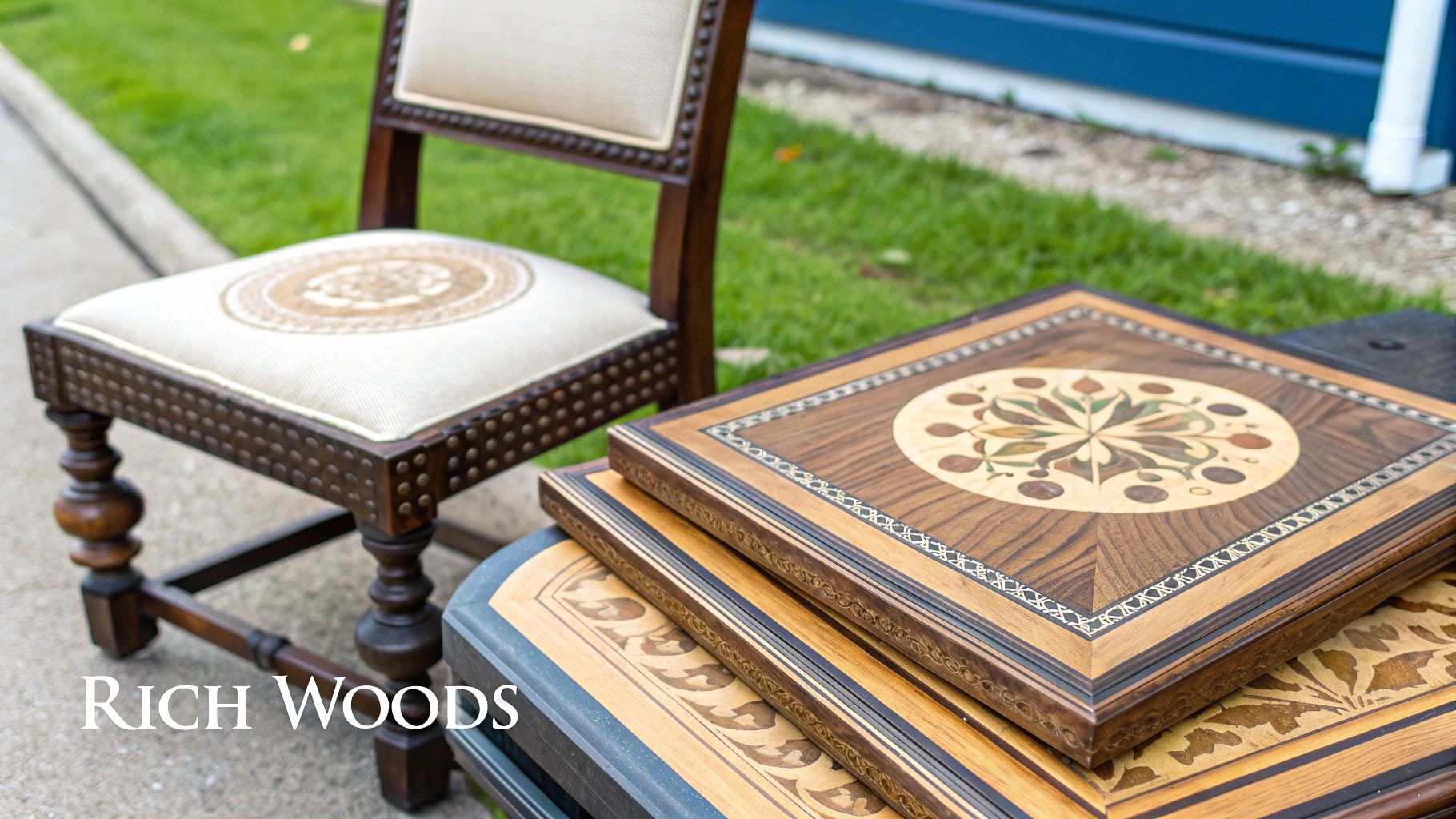
Think of the materials as an artist's palette and the new technology as a revolutionary set of brushes. The era’s palette was dominated by dark, dramatic woods, often imported from across the British Empire. These weren't just chosen for strength; they were selected for sheer visual impact and their ability to hold the intricate carvings that became the period's hallmark.
The Signature Woods of Victorian Design
Walk into a room of authentic Victorian furniture, and you immediately feel the weight and presence of the wood. A few key types defined the look, each with its own personality that helped create the formal, substantial atmosphere homeowners craved.
- Mahogany: The undisputed king. Its deep reddish-brown color, straight grain, and fantastic durability made it the go-to choice for dining tables, hefty sideboards, and bedroom sets built to last generations.
- Walnut: A very close second in popularity. Prized for its rich, dark tones and beautiful grain—especially the swirling patterns found in its burls—walnut was a favorite for fancy parlor chairs and decorative tables.
- Rosewood: The luxury option. This exotic wood was even darker and more dramatic, often reserved for the absolute finest pieces, particularly during the Rococo Revival craze.
While these dark timbers set the dominant tone, you will also see lighter woods like oak and ash, especially in Gothic Revival furniture and the later Arts and Crafts pieces that reacted against industrial production.
The Factory Revolution in Furniture Making
The materials provided the potential, but it was technology that truly unlocked it. The Industrial Revolution completely flipped the script on woodworking. Tasks that once took days of painstaking hand labor could now be done with speed and precision by steam-powered machines.
New band saws and circular saws, for instance, made it possible to slice wood into paper-thin sheets called veneers. This clever technique allowed a cabinetmaker to cover an inexpensive base wood with a beautiful layer of exotic rosewood or burled walnut, creating a luxurious look for a fraction of the cost. At the same time, steam-bending technology made it possible to create the swooping curves of a Rococo Revival chair without having to carve it from a giant, solid block of wood.
This marriage of machine power and raw wood is what allowed decorative furniture to finally become a mass-market product, transforming the Victorian home from top to bottom.
The Industrial Revolution didn't just make furniture faster; it democratized style. Suddenly, ornate details and exotic woods were no longer the exclusive property of the aristocracy, allowing the middle class to express their aspirations through their home decor.
An Innovation That Redefined Comfort
Believe it or not, the most important technological advance for Victorian furnishings had nothing to do with wood at all. The invention and mass production of the coiled spring was an absolute game-changer for comfort. Before this, chairs and sofas were just stuffed with materials like horsehair, which would pack down and become hard over time.
This new spring technology is a key reason why Victorian furniture is so heavily upholstered. Mahogany was prized for its carving potential, but the comfort offered by springs made the fabric just as important as the frame. Heavy textiles like velvet and damask became essential, covering pieces made possible by the coiled spring, which was first patented during the Victorian era. You can learn more about these transformative materials and styles in the Victorian period.
The widespread use of coiled springs led directly to the deep, comfortable seating we now associate with the era. It’s why you see so much deep button-tufting and plush, overstuffed silhouettes in armchairs and sofas. The iconic Chesterfield sofa, born in this era, is a direct result of this innovation and remains a classic to this day.
How to Identify Authentic Victorian Pieces
Trying to tell a true antique from a modern copy can feel like you're on a treasure hunt. When it comes to Victorian furniture, authenticity isn't something you spot in a single "aha!" moment. It’s more like being a detective, slowly piecing together a story from small clues where the wood, joints, and hardware are your key witnesses.
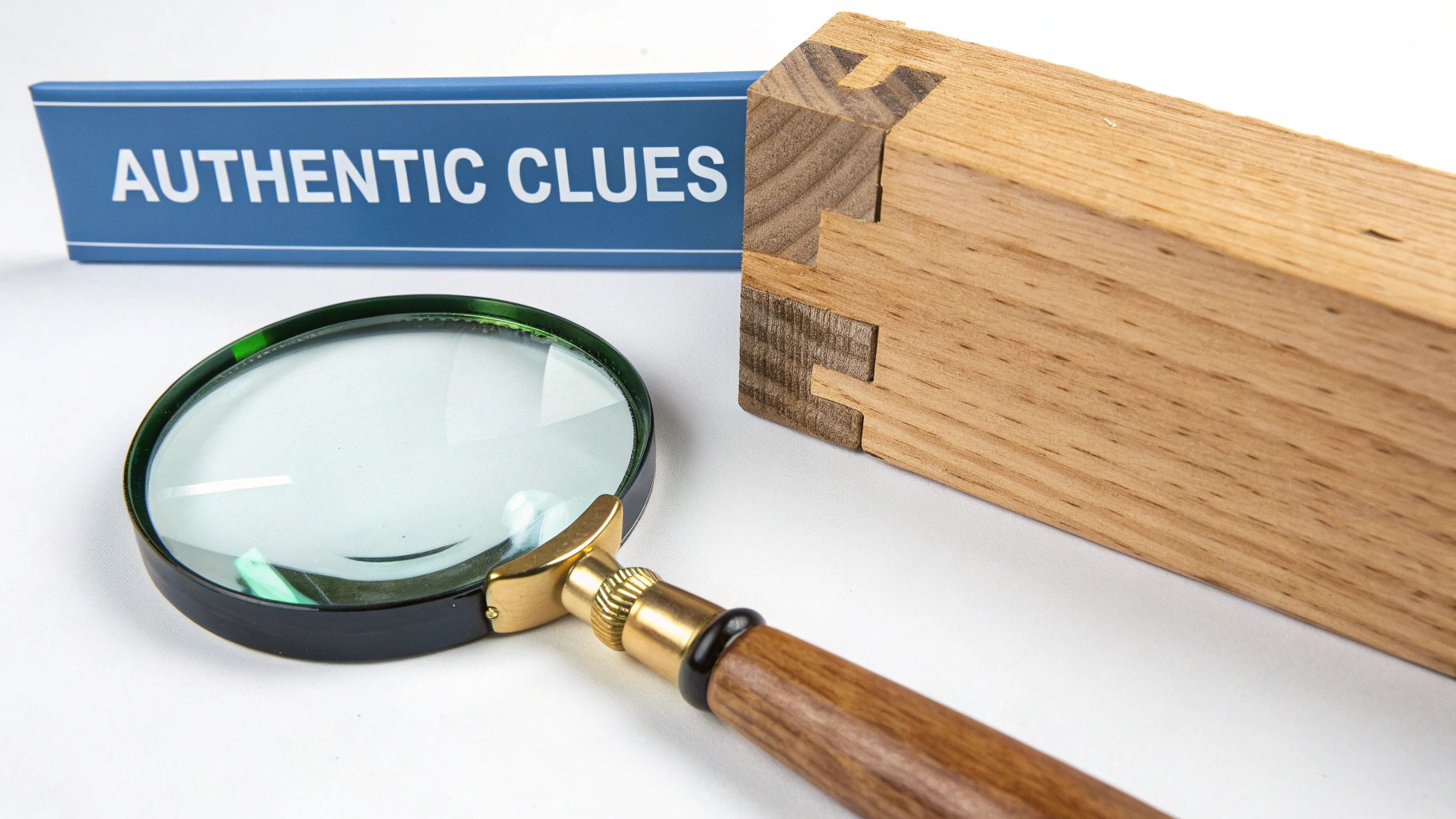
Once you learn what to look for, you'll start to recognize the tell-tale signs of 19th-century craftsmanship. A genuine piece shows its age gracefully, with a deep glow and minor imperfections that prove it’s lived a long life. Let’s walk through the essential things to inspect to make you a more confident antique hunter.
Start with the Wood and Finish
The most obvious clue is the wood itself. The Victorians loved using dark, heavy timbers like mahogany, walnut, and rosewood for their formal, show-off pieces. While they used lighter woods like ash or maple for bedrooms, the overall impression was always dramatic and rich.
An original finish is another dead giveaway. After more than a century, shellac and varnish darken and develop a deep, warm glow called patina. It’s a unique luster that’s almost impossible to fake. You should also look for honest signs of aging:
- Faint water rings: Marks from glasses left on a surface over decades.
- Minor scratches and dents: Everyday wear-and-tear that tells the piece’s story.
- Slight color variations: Areas that got more sun may be a bit lighter.
These so-called "flaws" are actually the marks of authenticity that collectors love. A piece that looks too perfect is often a red flag—it might be a reproduction or has been so heavily refinished that its value has dropped.
Examine the Construction and Joinery
How a piece was built tells you a ton about its age. The Victorian era was a time of transition, moving from entirely handmade construction to machine-assisted methods. The joints are a perfect record of that evolution. Dovetail joints, which lock drawer corners together, are a fantastic place to start your investigation.
- Early Victorian (c. 1840–1860): These pieces almost always have large, slightly irregular, hand-cut dovetails. You’ll notice that the "pins" and "tails" of the joint aren't perfectly identical.
- Late Victorian (c. 1860–1901): As machinery took over, dovetails became much more precise. Look for small, clean, and perfectly uniform machine-cut joints.
It’s just as important to check the back of a piece as it is to admire the front. Turn a chest of drawers around and look at the backboards. Real Victorian furniture often has straight, up-and-down saw marks left by the large circular saws used in 19th-century mills.
A genuine Victorian piece should feel solid and substantial. The Victorians used solid wood, making their furniture incredibly heavy. If a big, imposing sideboard feels strangely light, it could be a modern reproduction made with cheaper materials.
Check the Hardware and Upholstery
The final clues are in the details—the drawer pulls, keyholes, and even the stuffing you can't see. Finding original hardware is a real score and adds significant value. Look for brass pulls that show their age with a soft patina, not a bright, artificial shine. Keyholes, often made of brass, bone, or ivory, should have tiny scratches from years of keys turning in them.
Don't forget to check the screws! Original Victorian pieces used screws with a simple single slot in the head. The sight of modern Phillips-head screws is a clear sign that the hardware has been replaced or the entire piece is a reproduction.
If the piece is upholstered, try to get a peek at what's inside.
- Original Stuffing: Authentic Victorian upholstery used materials like horsehair, hay, or cotton. If you find uniform foam inside, the piece has been reupholstered or is a modern creation.
- Webbing: Look underneath a chair or sofa. Original webbing is often stretched out and might show signs of old tack holes, which is a great indicator of age.
When you add them all up, these small details can build a compelling case for a piece’s age and authenticity. For an even faster way to get answers, tools like the Curio app can help you identify items with a quick photo, turning your smartphone into a pocket antique expert.
Caring For Your Antique Furniture Collection
Owning a piece of Victorian history is a genuine privilege, but it also means you've become a caretaker. The goal isn't to make these pieces look brand new; it's about preserving their integrity and the stories they hold for the next generation. A little know-how goes a long way in keeping these treasures stable and beautiful.
This is about more than a quick polish. True care requires understanding the unique needs of aged wood, original shellac finishes, and delicate, century-old fabrics. A gentle, consistent routine will always beat an aggressive, infrequent cleaning.
Gentle Cleaning for Aged Surfaces
When it comes to cleaning antique wood, the golden rule is "do no harm." Modern polishes loaded with silicone and harsh chemical cleaners can eat away at the original finish, destroying the very patina that gives the piece its character and value.
Start simple. Regular dusting with a soft, dry microfiber cloth is often all you need. If a piece is grimy, you can use a cloth that's just barely damp with water on a sealed wood surface, but be sure to wipe it completely dry immediately afterward. The enemy here is moisture—it can make wood swell and cause delicate veneers to bubble and lift. For a deeper dive, our guide on how to clean antique wood details safe methods for various finishes. For upholstery, a gentle vacuuming with a low-suction brush attachment is your best friend.
The warm, glowing patina on a piece of Victorian furniture is its history made visible. Aggressive cleaning or stripping this finish can erase its story and significantly diminish its value to collectors.
Creating a Stable Environment
The climate inside your home has a massive impact on your furniture's health. Wood is a living material; it breathes, expanding and contracting with every shift in temperature and humidity. These fluctuations are the single biggest threat to your victorian era furnishings.
Consistency is key to minimizing stress on the wood, glue, and joints.
- Control Humidity: Try to keep the relative humidity in your home between 45% and 55%. A dehumidifier in the humid months and a humidifier in the dry winter can stop wood from cracking or warping.
- Avoid Direct Sunlight: UV rays are relentless. They fade finishes and dry out wood over time. Keep your most precious pieces out of direct sunlight or protect them with UV-filtering curtains.
- Maintain Stable Temperatures: Don't place antiques next to radiators, fireplaces, or heating vents. The constant cycle of hot and cold can weaken glue joints and cause serious damage.
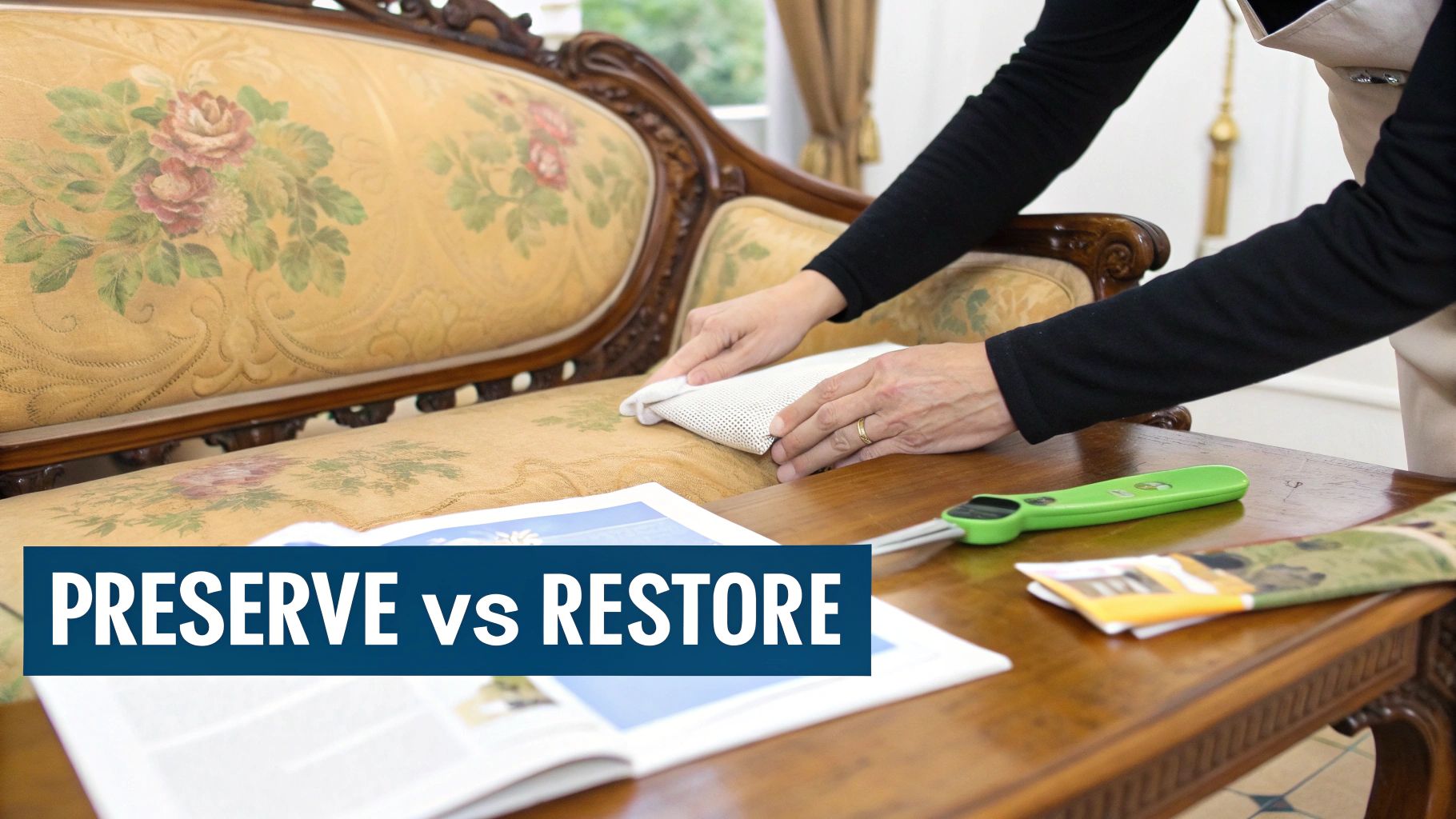
The Dilemma: Preserve vs. Restore
Every collector eventually faces the big question: should you preserve a piece as-is, or should you restore it? Preservation is all about maintaining the furniture in its current state, accepting the honest signs of age like small nicks and a darkened patina. For collectors, this is almost always the best path for maintaining value.
Restoration, on the other hand, involves more significant work to make a piece fully functional or look "perfect" again. This route should only be taken for major structural problems, like a wobbly leg or large sections of missing veneer. If you do choose restoration, find a professional conservator who specializes in historical techniques. For more insight, this practical guide on restoring antique furniture is a great resource. Making the right call here is what separates a caretaker from a mere owner.
Valuing and Investing in Victorian Antiques
Figuring out the value of Victorian furniture is about more than just admiring its beauty. For any serious collector, it means learning to see a piece as an asset, moving past the aesthetics to understand what really drives its monetary worth and investment potential.
Think of it like appraising a historic home. You wouldn't just look at the fresh coat of paint; you’d get in the crawlspace to check the foundation, inspect the originality of the fixtures, and dig into its history. It’s the same with Victorian furniture. A proper valuation requires a methodical eye that considers everything from the physical condition to the documented past.
Core Factors That Drive Value
Four key elements really form the bedrock of any antique furniture appraisal. Get a handle on these, and you'll have a solid framework for making smart purchases and spotting that true investment piece hiding in a cluttered antique shop.
These factors all work in concert to build the full story of an item's worth:
- Condition: This is everything. A piece with its original finish, untouched hardware, and minimal damage will always be worth more than something that’s been heavily restored. Collectors will pay a serious premium for authenticity.
- Rarity: Was this a factory-line piece churned out by the thousands, or a special commission? A one-of-a-kind creation by a celebrated maker like John Henry Belter will obviously fetch a much higher price than a common washstand.
- Provenance: This is the paper trail—the documented history of who owned it. A piece that can be traced back to a notable family or a historic event carries a story that adds incredible value.
- Maker Marks: A signature or label is like a certified autograph on a baseball card. Marks from well-known workshops in London, New York, or Grand Rapids can boost an item's value dramatically.
A classic mistake is thinking that "old" automatically equals "valuable." The truth is, a beautifully preserved, high-quality piece from the late Victorian period can easily be worth far more than a beat-up or mass-produced item from an earlier decade.
Distinguishing Quality Craftsmanship
Let's be clear: not all Victorian furniture was created equal. The era produced both breathtaking, handcrafted masterpieces and a flood of lower-quality, mass-produced goods. The trick is spotting the signs of superior work.
Look for carvings that are sharp and detailed, not soft and muddy-looking. Check for solid wood construction instead of thick, clumsy veneers slapped onto a cheaper base wood.
An original, untouched finish is the holy grail, even if it has a few dings and scratches. That "patina" of age tells the piece's history and is nearly impossible to fake. A stripped and refinished item might look cleaner, but it has often lost a huge chunk of its historical and financial value in the process. For a deeper dive, our comprehensive guide on how to approach valuing antique furniture can shed more light on these details.
By learning to research auction results and follow market trends, you can start to recognize true value when you see it. This knowledge turns you from a casual buyer into a savvy collector who knows that the best victorian era furnishings aren't just pretty objects, but tangible pieces of history with real investment potential.
Common Questions About Victorian Furniture
Stepping into the world of Victorian antiques always sparks a few questions. Whether you're just starting your collection or are simply curious, here are some straightforward answers to what people often ask.
Wasn't All Victorian Furniture Dark and Heavy?
That’s the classic image, isn't it? But it's not the whole story. Dark, imposing woods like mahogany and walnut were definitely popular, especially in formal rooms where you wanted to project a sense of wealth and status. Think grand dining rooms and serious libraries.
But step into more private spaces, like bedrooms, and you’d often find lighter woods like ash and maple. And by the end of the era, the Arts and Crafts movement was a direct reaction against all that heavy ornamentation, championing simpler, more honest designs, often in oak.
How Do I Actually Mix Victorian Pieces with Modern Decor?
The trick is to aim for contrast, not perfect harmony. You're not trying to build a museum exhibit; you're adding a piece with a soul and a story to your modern home.
Think of a single, ornate Victorian piece as functional art. Its rich history and intricate details can serve as the perfect focal point, keeping a contemporary room from feeling cold or generic.
Here are a few ways to make it work:
- The Statement Sideboard: An elaborately carved Victorian sideboard can look absolutely stunning in an otherwise minimalist dining area.
- The Ornate Mirror: A large, gilded Rococo Revival mirror adds instant drama and character to a clean, modern entryway.
- The Cozy Reading Nook: A single, plush Victorian armchair paired with a sleek, modern floor lamp creates a perfect blend of comfort and style.
What's an Easy Way to Tell Styles Apart?
Let's take two popular but wildly different styles: Rococo Revival and Renaissance Revival. The simplest way to remember the difference is to think curves versus lines.
- Rococo Revival: This style is pure romance. It’s all about graceful, flowing S- and C-scrolls, delicate carved flowers, and a sense of lightness.
- Renaissance Revival: This one is much more formal and architectural. It features strong, straight lines, bold geometric shapes, and classical elements like columns and carved busts.
Inspired to figure out the story behind a piece you own? With Curio, you can identify antiques, get a sense of their value, and learn their history, all from a simple photo. Stop guessing and start knowing.
Download Curio today and put an antiques expert in your pocket: https://www.curio.app