So, you've got a piece of vintage jewelry and you're wondering if it's a hidden treasure or just a pretty trinket. It’s a common question, and the answer isn't always straightforward. The real value of vintage jewelry goes far beyond just the sparkle of its stones or the gleam of its metal; it's wrapped up in its history, craftsmanship, and rarity.
To figure out what a piece is truly worth, we need to look at the four key elements that every seasoned collector and appraiser focuses on.
What Really Determines Vintage Jewelry Value
Before you get lost in the finer details, it helps to understand the big picture. Think of it like putting together a puzzle—each element adds another layer to its story and, ultimately, its value. From the materials it’s made of to the tiny signature stamped on the back, every detail matters.
This goes deeper than just spotting precious metals. A crucial first step is understanding the material composition. For instance, knowing the difference between gold types is absolutely fundamental. A great starting point for any new collector is understanding the differences between solid gold, gold-filled, and gold-plated jewelry, because this knowledge directly affects a piece’s base value.
Quick Guide to Jewelry Valuation Factors
At its core, assessing any vintage piece comes down to looking at four main areas. A piece that scores high in all four categories could be a serious find. On the other hand, a major flaw in even one area can significantly impact its worth. This table breaks down what to look for.
| Factor | What to Look For | How It Affects Value |
|---|---|---|
| Materials | Precious metals (gold, platinum, silver) and quality gemstones (diamonds, rubies, sapphires, emeralds). | The higher the quality and rarity of the materials, the higher the intrinsic value. |
| Maker's Mark | A signature, hallmark, or stamp from a known designer like Cartier, Tiffany & Co., or Van Cleef & Arpels. | A signature from a famous house can increase value exponentially compared to an unsigned piece. |
| Era & Style | Distinctive designs from sought-after periods like Art Deco, Art Nouveau, or Victorian. | Pieces that perfectly capture the aesthetic of a popular historical era are highly collectible and in demand. |
| Condition | Originality, completeness (no missing stones), structural integrity, and quality of any repairs. | A piece in pristine, original condition will always be worth more than one that's damaged or poorly restored. |
A piece's unique design and historical significance are huge drivers in the market right now. People are increasingly drawn to the intricate styles of the past that simply aren't made today. This trend is so strong that the global vintage ring market is expected to grow at a CAGR of 2.90% through 2030.
For many collectors, the true allure lies beyond the materials. A piece's history, the story it tells, and its connection to a bygone era are often the most priceless qualities.
Trying to evaluate a piece on your own can feel a bit overwhelming, especially when you're just starting out. Using a tool like the Curio app can give you a great head start. It helps you do a quick initial check, letting you sort potential gems from more common costume jewelry without getting bogged down in the complex details right away.
Reading the Clues in Marks and Styles
Think of every piece of vintage jewelry as a tiny time capsule. It has a story to tell, and the real secrets are often hidden in plain sight. Learning to read these clues—the small stamps, the design details—is like becoming a detective. This is where you start to really understand your jewelry's history and value.
The detective work begins with identifying the piece's style. Each era had its own distinct personality, from the flowing, nature-inspired motifs of Art Nouveau to the sharp, symmetrical lines of Art Deco. Simply recognizing which period your piece belongs to gives you immediate context for its age and potential rarity.
Decoding Purity and Maker's Marks
Now, let’s get up close. The most important clues are the tiny stamps known as hallmarks, purity marks, and maker's marks. You’ll usually find them tucked away on the inside of a ring, the back of a pendant, or near the clasp. A good jeweler's loupe is your best friend here, but your phone's camera zoom can work wonders in a pinch.
Purity marks tell you exactly what the piece is made of. For instance, gold is often marked by its karat value ("14K," "18K") or a three-digit number representing its purity:
- 750: This means the piece is 18-karat gold, which is 75% pure gold.
- 585: This stamp signifies 14-karat gold, or 58.5% pure gold.
- 925: The classic mark for sterling silver, indicating 92.5% pure silver.
- PLAT or 950: Look for these marks to identify a piece made of platinum.
Maker's marks are the signatures of the jewelry world. A well-known stamp from a legendary house like Cartier, Tiffany & Co., or Van Cleef & Arpels can send a piece's value soaring. But even marks from lesser-known, respected artisans can add significant provenance and desirability.
Identifying Design Eras
Placing your jewelry in the correct historical period is crucial for its valuation. An Art Deco brooch with its bold, geometric precision is valued very differently than a whimsical, asymmetrical Art Nouveau locket. Even the hardware can give the game away; you can learn a lot by exploring the different https://www.curio.app/blog/types-of-necklace-clasps-vintage and the eras they belong to.
One of the biggest mistakes I see people make is dismissing small, hard-to-read stamps. That tiny, almost invisible mark could be the signature of a famous designer, instantly turning a pretty accessory into a serious collector's piece.
To broaden your knowledge, it's worth checking out general guides on how to identify valuable antiques, as the core principles of authentication often apply across different categories. By piecing together style, materials, and maker's marks, you start to build a true picture of your jewelry’s story and its real worth.
How Condition Impacts the Final Worth
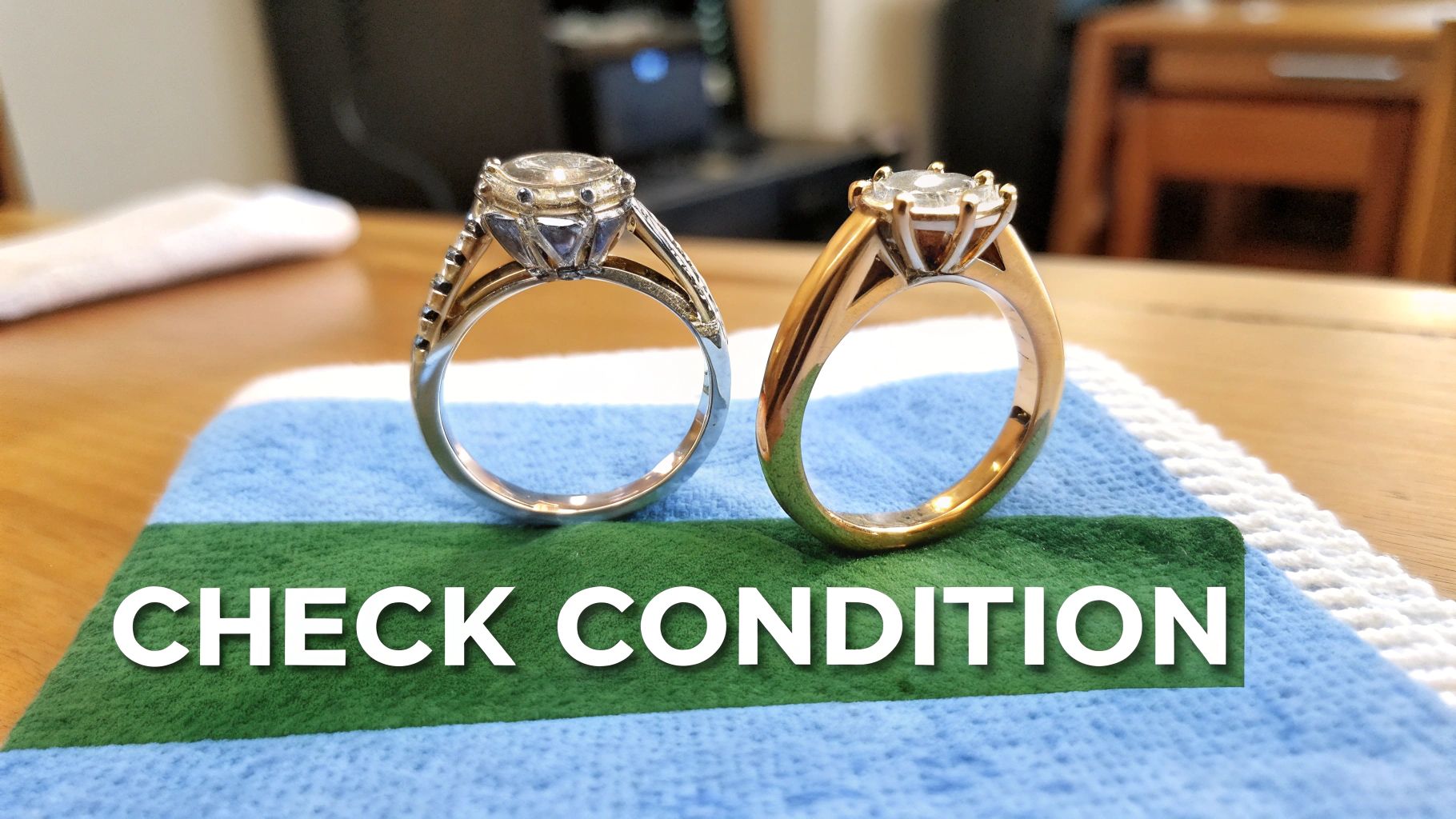
You could have a stunning Art Deco ring from a legendary designer, but if it's in rough shape, the value can completely tank. When it comes to vintage jewelry, condition is king. It often matters more than the era or even the materials themselves.
This means you need to look past the initial sparkle and inspect every piece with a critical eye. Think of yourself as a detective. A professional jeweler's loupe is your best friend here, but honestly, the zoom on a modern smartphone can work wonders for a preliminary check.
What to Look for During Inspection
When you get a piece in your hands, you’re looking for anything that compromises its beauty or, just as importantly, its structural integrity. Some flaws are obvious, but the devil is always in the details.
- Loose or Missing Stones: Give the piece a gentle tap or carefully run a fingernail over the settings. Hear any rattling? That’s a red flag. Even one tiny missing seed pearl can bring the value down.
- Worn Prongs: Look closely at the little metal claws holding the gemstones. If they look thin, flat, or worn, the stones are at risk of falling out. That’s not just a flaw; it's a future repair bill waiting to happen.
- Chipped Enamel: Enamel is basically colored glass fused onto metal. It's beautiful but delicate. Check for any cracks, flakes, or chips—repairing it to perfectly match the original color and style is incredibly difficult and expensive.
- Hidden Repairs or Alterations: Are there spots of mismatched solder color? This usually means a break was fixed. If the back of a ring band (the shank) is paper-thin, it's likely been resized multiple times, which seriously weakens it.
A key mistake I see people make is overlooking a "clunky" repair. A poorly executed fix can actually devalue a piece more than if it were left in its original, slightly damaged state. Collectors prize authenticity and original craftsmanship above all else.
The Patina Predicament
One of the most misunderstood aspects of vintage jewelry condition is patina. This is the soft, often dark, finish that develops on metals like silver and gold over many decades. It's a natural part of the aging process, and for serious collectors, it's a badge of honor—proof of the piece's history and authenticity.
Whatever you do, don't polish it away! You might think you're making a piece look "new," but you're actually erasing decades of character that collectors actively seek out. Aggressive polishing can also soften the crisp edges of detailed engravings and filigree work.
There's a right way to care for aged metals. Our guide on how to clean antique silver walks you through preserving integrity while gently cleaning. When in doubt, do less. You can never get that beautiful, time-worn patina back once it's gone.
Finding Your Jewelry's Market Price
Alright, you've done the detective work. You know the era, the maker, and the condition of your piece. Now comes the big question: what is it actually worth to someone else? This is where we get down to brass tacks and figure out a realistic market price.
It's also where I see people make the most common—and costly—mistake. They confuse what a seller is asking for with what a buyer has actually paid.
An "asking price" on a retail site or in a fancy antique shop is pure optimism. It's the seller's ideal scenario. A "sold price," which you can find in completed listings on places like eBay, is reality. It’s what a real person was willing to hand over. That second number is the only one that truly reflects market demand and gives you a solid footing for valuation.
Thinking otherwise is like valuing your house based on your neighbor's ambitious Zillow "Zestimate" instead of the final closing price of the house down the street.
Mastering Your Search for Comparables
To get to those reliable "sold" prices, you have to be a bit of a search ninja. Vague searches like "old gold necklace" will dump a mountain of useless results on you. You need to use every single detail you’ve gathered so far.
For instance, instead of a generic search, try something like: "Victorian 14k gold locket with seed pearls." See the difference? That level of specificity cuts through the noise and shows you what truly comparable pieces are fetching. The more details you include, the better.
Here’s how I recommend refining your search:
- Lead with the Era: Always start with terms like "Art Deco," "Edwardian," or "Mid-Century."
- Call out the Materials: Be specific. "Sterling silver," "18k gold," "platinum," and any notable stones like "sapphire" or "old mine cut diamond."
- Name the Maker: If you identified a maker's mark like "Trifari" or "Napier," that’s your golden ticket. It's often one of the most significant factors in an item's value.
This focused approach keeps you from falling into the outlier trap. You might see one piece listed for a wild price, but if ten others sold for a tiny fraction of that, you know which number to trust.
Leveraging Visual Search and Market Trends
What if you don't have the right keywords? Sometimes a picture is all you have to go on. This is where visual search tools are a game-changer. Apps like Curio let you snap a photo of your jewelry and will scour the web for visually similar items. It can be an amazing shortcut to finding the right terminology or even landing on an identical listing.
It also pays to know what's happening in the broader market. Vintage and antique jewelry is hot right now, with a projected 15% annual growth heading into 2025 and 2026. This isn't just seasoned collectors; younger buyers are increasingly drawn to the unique craftsmanship and history.
The whole high-end, pre-owned luxury world is booming, expected to more than double from $44.7 billion in 2023 to $98.3 billion by 2031. People are starting to see these pieces not just as beautiful accessories, but as tangible assets that hold their value against inflation. If you want to dive deeper, you can discover more insights about this growing market.
By focusing on sold prices for highly specific, comparable items, you move from guessing to making an evidence-based assessment of your vintage jewelry's value. This is the single most important step in setting realistic expectations for selling or insurance.
When to Get a Professional Appraisal
Doing your own homework on a piece of vintage jewelry is incredibly satisfying. More often than not, a bit of research can give you a really solid ballpark idea of its worth.
But sometimes, a DIY assessment just won’t cut it. There are specific moments when you absolutely need the official, documented eye of a certified professional. Knowing when to make that call is the final, crucial step in understanding what you truly have.
Key Scenarios Demanding a Certified Appraiser
Think of a professional appraisal as the official birth certificate for your jewelry. You’ll need one for any high-stakes situation where an informal opinion simply won't hold up.
For Insurance Coverage: This one is non-negotiable. To properly insure a valuable piece against loss, theft, or damage, your insurance company will require a formal appraisal. This document gives them the all-important retail replacement value they need to write your policy.
Settling an Estate: When dividing assets, emotions can run high. A formal appraisal provides a clear, unbiased fair market value for legal and tax purposes. It ensures everything is distributed fairly among heirs and keeps the process transparent.
Verifying a Major Designer Piece: Got a piece signed by a major house like Cartier, Tiffany & Co., or Van Cleef & Arpels? An appraisal from a qualified expert is essential. It authenticates the piece and creates the official provenance record that proves it's the real deal, which is absolutely critical to its market value.
An appraisal isn't just a price tag; it's a detailed report that serves as a legal document. It protects your investment by creating an official record of your jewelry's identity, quality, and worth at a specific point in time.
Understanding the Appraisal Process
Getting an appraisal is so much more than just hearing a number. A qualified appraiser performs a meticulous examination, documenting everything—materials, gemstone measurements, maker's marks, and overall condition. The final report is a comprehensive document, complete with detailed descriptions and clear photographs.
It’s also crucial to know that "value" isn't a single number. The retail replacement value used for insurance is typically the highest figure, reflecting the cost to buy a comparable new item today. On the other hand, the fair market value used for estate settlements is what a willing buyer would likely pay a willing seller in the current market.
If you're ready to take that step, exploring different antique appraisal services is a great place to start. Finding the right expert who understands these nuances will ensure you get the exact documentation you need for your specific situation.
Got Questions About Your Vintage Jewelry? I've Got Answers.
When you're diving into the world of vintage jewelry, a few questions always seem to pop up. I hear them all the time from new collectors and people who've just inherited a box of family heirlooms. Let's clear up some of the most common points of confusion right now.
Think of this as the FAQ you'd get if you were sitting down with an appraiser. My goal is to give you the confidence to know what you're looking at.
What's the Difference Between Antique, Vintage, and Estate?
This is easily the biggest mix-up I see. People throw these terms around, but for an expert, they have very specific meanings that directly affect a piece's value.
- Antique Jewelry: This is the big one. To be officially antique, a piece must be 100 years old or older. That beautiful Art Deco diamond ring from 1925? It's now an antique.
- Vintage Jewelry: This is a broader category. Generally, it refers to jewelry that's at least 20 to 50 years old, but not yet a century old. Your mom's cool 1970s turquoise bracelet falls right in here.
- Estate Jewelry: This term simply means the jewelry has been owned before. That's it. An estate piece could be a Georgian-era antique brooch, a vintage ring from the 80s, or even a designer necklace bought just last year.
Getting this terminology right is your first step. Calling something "antique" when it's really "vintage" can set the wrong expectations for value right from the start.
How Much Do the Gemstones Really Matter?
The short answer? A whole lot. The quality of the main stones—what we call the "Four Cs" for diamonds (carat, cut, clarity, and color)—is a huge factor in the final valuation.
Naturally, precious stones like diamonds, sapphires, rubies, and emeralds usually drive the price up. But here's where real expertise comes in: context is everything. With certain Art Nouveau pieces, for instance, a stunning moonstone or a perfectly polished turquoise cabochon was considered far more artistically important than a diamond. The value isn't just in the raw material, but in how that stone serves the design and captures the spirit of its time.
How Can I Spot a Fake?
Spotting fakes and reproductions often feels like being a detective. You're looking for clues that just don't fit the story. A piece stamped with a famous Victorian maker's mark shouldn't have perfectly symmetrical, laser-cut diamonds—that technology didn't exist yet.
Look for the little things. Is the construction flimsy? Do you see a modern lobster-claw clasp on a necklace that's supposedly 80 years old? Are the hallmarks crisp and shiny on a piece that otherwise looks heavily worn? Those are the red flags that make me pause and look a lot closer.
My best advice for spotting fakes is to get your eyes on the real deal. Use visual identification tools and look at authenticated examples from the same period. Once you know what's right, the fakes and reproductions start to stick out like a sore thumb.
If you’ve just inherited a big collection and feel totally overwhelmed, start simple. Just sort it. Make piles for rings, brooches, necklaces, and so on. Then, grab a loupe or magnifying glass and start looking for any kind of stamp or mark. Breaking it down like this makes the whole process feel manageable and helps you zero in on the pieces that need a second look.
Ready to uncover the story and value of your own pieces? Curio puts an antique expert in your pocket. Snap a photo to instantly identify, learn about, and get an estimated value for your jewelry and other treasures. Stop guessing and start knowing. Download the app and begin your discovery at https://www.curio.app.