That old pocket watch tucked away in a drawer isn't just a charming relic; it's a piece of history. And it has a real monetary value, which can be anywhere from under $100 to well over $100,000. Where it lands on that spectrum all comes down to its maker, condition, materials, and unique story.
Figuring out what you've got is the first step to unlocking that value.
Is Your Old Pocket Watch a Hidden Treasure?
It’s not uncommon to find one of these beautiful timepieces and have no idea you're holding something significant. The approach is a lot like valuing old collections for hidden treasures—you need to know what clues to look for. This guide will walk you through the key factors that separate a simple keepsake from a serious collectible.
The market for these watches is surprisingly strong. In 2022, it was valued at $1.5 billion and is expected to hit $2.0 billion by 2030. A lot of this interest comes from younger buyers who see these timepieces as unique, retro status symbols.
Why Your Watch Might Be Valuable
So, what's the difference between a common hand-me-down and a collector's dream? It boils down to a few core elements. Think of it as detective work where you piece together clues from the watch's history, craftsmanship, and current market demand.
To help you get started, here's a quick rundown of the main factors that drive a pocket watch's value. These are the details you’ll want to investigate first.
Quick Guide to Key Value Factors
| Factor | What to Look For | Impact on Value |
|---|---|---|
| Maker | Famous names like Patek Philippe or Vacheron Constantin. | High: Elite Swiss brands are always in demand. |
| Movement | Number of jewels, complexity (complications), and condition. | High: More jewels and features like chronographs add significant value. |
| Case Material | Solid gold, silver, or platinum hallmarks. | Medium to High: Precious metals are inherently valuable, but gold-filled is less so. |
| Condition | Original parts, no cracks in the dial, running smoothly. | High: Originality and pristine condition are huge selling points. |
| Provenance | Documented connection to a famous person or historical event. | Very High: A great story can make a watch's value skyrocket. |
| Rarity | Limited production runs or unusual designs. | Medium to High: Fewer made often means higher demand from collectors. |
Understanding these points is essential. Each one provides a piece of the puzzle, helping you build a complete picture of your watch's history and potential worth.
The process of identification is foundational to valuation. Without knowing the maker, model, and age, you're just guessing. This is where modern tools can dramatically simplify your research.
It's a lot to take in, but you don't have to do it all manually. Apps like Curio can help you identify your watch in a snap, putting you on the right path to uncovering its story and market value. It's a smart first step, similar to other expert strategies to https://www.curio.app/blog/how-to-identify-valuable-antiques that might be hiding in your home.
Uncovering the Secrets Inside Your Watch
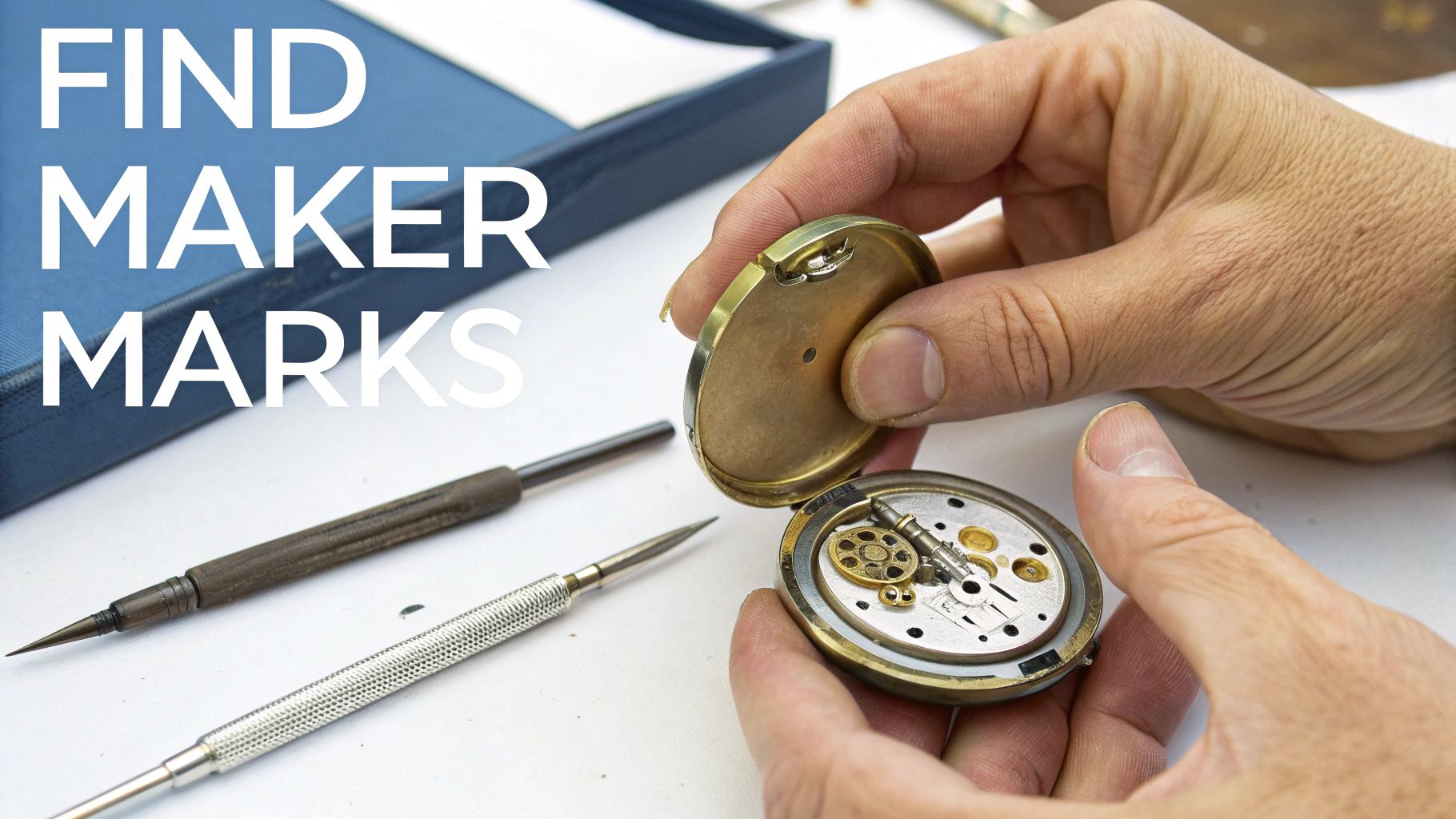
The real story of a pocket watch is sealed inside its case. To get a true sense of its value, you have to look past the dial and get to the intricate movement and hidden markings within. This is where you’ll find the critical details about its maker, age, and quality.
First things first, you need to open the case back. Most pocket watches have a screw-off or a snap-off back. If you see a small lip or indentation around the edge, you can often use a dull, thin tool like a case knife to gently pry it open. Take your time and use steady pressure to avoid scratching the metal.
Decoding the Movement and Serial Numbers
Once it’s open, you're looking at the watch's mechanical heart: the movement. This is where the most important information lives. Look carefully across the metal plates for an engraved name, which will identify the manufacturer—think "Elgin," "Waltham," or "Hamilton."
Somewhere on that movement, you’ll also find a serial number. This number is your key to dating the watch. Don't confuse it with any numbers you might find on the case; the case number is usually irrelevant for identifying the watch's history.
Expert Tip: The movement serial number is the single most important piece of information you can find. It’s what helps you pinpoint the production year and the specific grade or model of the watch.
This is where online databases become your best friend. For example, you can take a serial number from an old Waltham watch, plug it into a specialized lookup tool, and instantly get a wealth of information. These databases cross-reference your number against millions of factory records, providing details on the production date, jewel count, and model specifics.
Reading the Case Hallmarks
Now, turn your attention to the inside of the case back you removed. Here, you'll find a different set of markings called hallmarks. These small, stamped symbols tell you all about the case's material and purity, which is essential for valuation.
Here's a quick guide to what you might find:
- Gold Cases: Look for stamps like "14K," "18K," or the European equivalent ".585" (for 14K). If you see a mark that says "Guaranteed 20 Years," that means the case is gold-filled, not solid gold, which dramatically changes its value.
- Silver Cases: Sterling silver is typically marked with ".925" or, if it's British, a small lion symbol.
- Other Materials: Less valuable cases might be made of nickel or other base metals and often have fewer official markings, if any.
Understanding these tiny stamps is a skill in itself. For a deeper look into this fascinating world, check out this guide on what hallmarks on silver mean and how to interpret them. By combining the movement's identity with the case's material value, you start to build a complete profile of your watch.
How to Assess Condition Like an Expert
When you're trying to figure out what a vintage pocket watch is worth, nothing—and I mean nothing—matters more than its condition. I've personally seen common, run-of-the-mill models in pristine shape outsell rare, historically important pieces that have been knocked around a bit. In this game, condition is king.
This isn't just an anecdotal observation. It’s a hard fact across the entire $103 billion watch market. An excellent example of a vintage pocket watch can command two to three times the price of an average one from the same model line. Knowing how to spot quality is what turns a decent find into a genuine investment, a point driven home in this market analysis on how pocket watches are valued.
Examining the Exterior Case and Crystal
The first thing you should do is give the case a thorough once-over. This is the watch's armor. Get it under a bright light and turn it over in your hands. You're looking for imperfections. Light, honest surface wear from being in a pocket for decades is totally normal. What you need to watch out for are the big things: deep gouges, noticeable dents, or evidence of a clumsy repair, like sloppy solder marks.
Check the hinges and the bow (the little loop where the chain connects). Do they feel solid, or are they wobbly and loose? A worn-out bow is often a red flag for a watch that's seen heavy, constant use, which could hint at wear and tear on the inside, too. The crystal—the glass cover—should also be clear. Deep scratches or chips that make it hard to read the dial are a definite minus.
Assessing the Dial and Hands
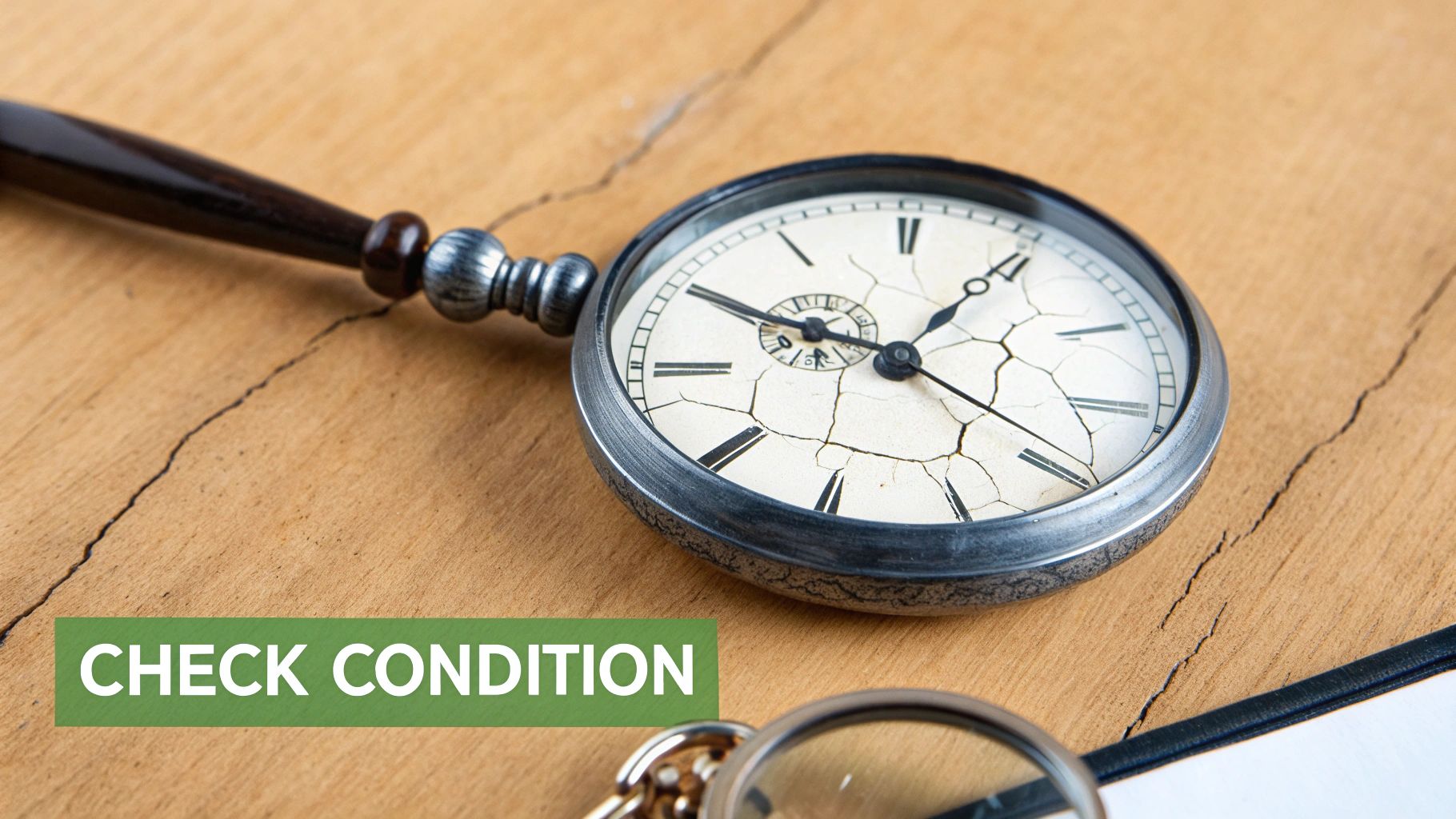
The dial is the heart and soul of the watch, so its condition is a huge deal. The most common killer for porcelain or enamel dials are hairline cracks. These tiny fractures can spiderweb out from the winding hole or the edges, and they can absolutely tank a watch's value.
Next, get a good look at the hands and numerals. Are they sharp and original to the watch? Look for rust, discoloration, or hands that just don't seem to match. A collector will always prefer a watch with its original hands, even if they show a little age, over one with a shiny but incorrect replacement set.
A Quick Originality Checklist:
- Hands: Do they fit the style of the watch's maker and time period?
- Crown: Is the winding crown the factory original, or a generic stand-in?
- Dial: Does the signature on the dial look authentic, not like a cheap repaint?
- Case: Any personal engravings? While they tell a great story, non-historic engravings can often lower the market value.
Another thing to consider is polishing. A light, careful clean can be great, but an overzealous polish that rounds off the sharp, crisp edges of the case can seriously hurt its value. If you're dealing with a silver case, it pays to know what you're doing. We have a whole guide on how to properly clean antique silver that can help.
Checking the Watch's Functionality
At the end of the day, a watch is a machine built to tell time. So, does it actually work? Give the crown a gentle wind. You should hear a nice, steady ticking sound. If it does run, see if it keeps reasonably good time over a 24-hour period. A watch that doesn't run isn't worthless, but its value takes a significant hit. Any potential buyer will have to subtract the cost of a professional service—which can easily run into hundreds of dollars—from their offer.
Recognizing High-Value Makers and Materials
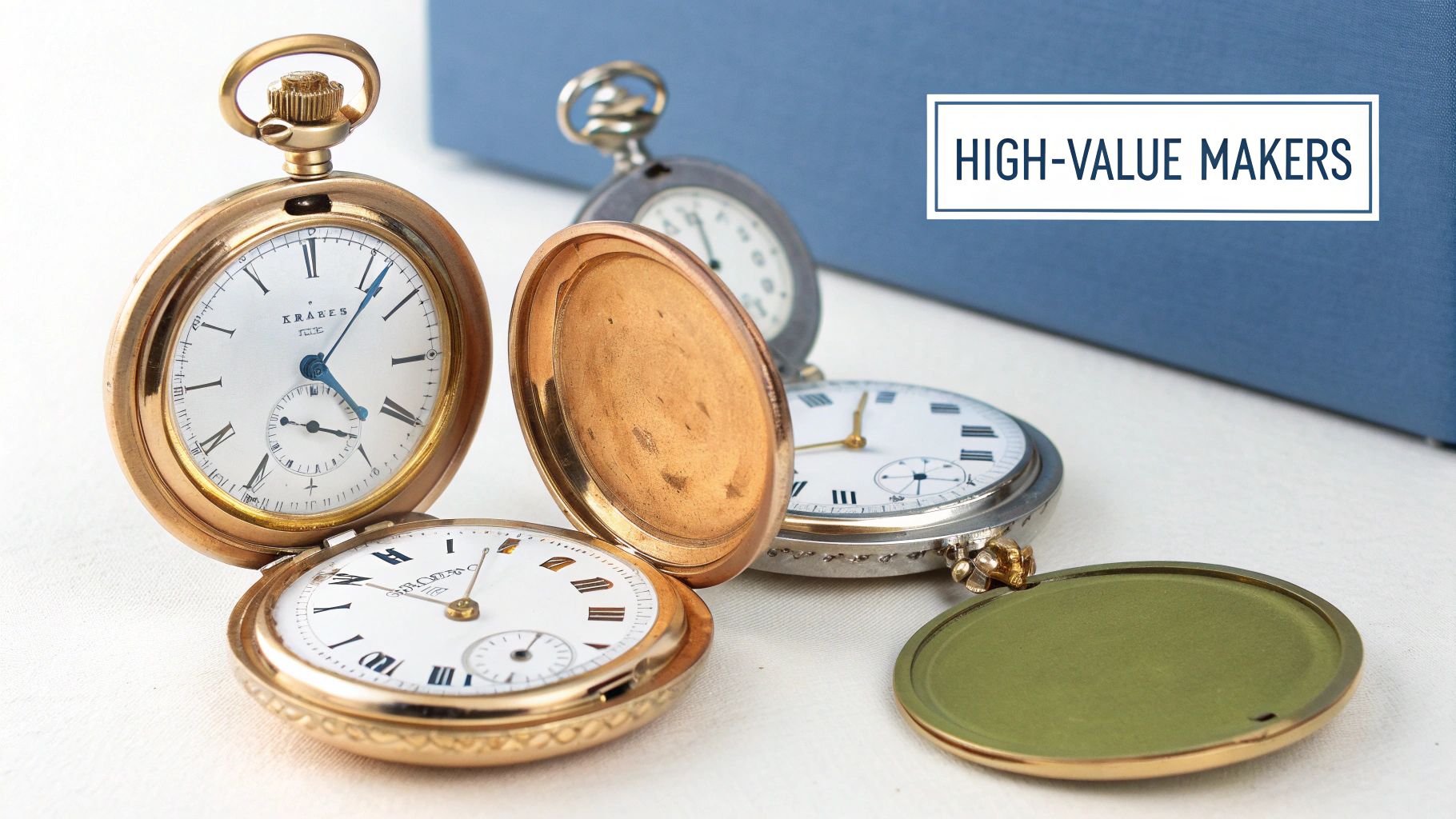
When you first hold a vintage pocket watch, two things immediately give you clues about its potential value: the name on the dial and the metal of the case. Certain brands just scream quality and command respect in the collecting world, creating a pretty clear pecking order.
At the very top, you have the legendary Swiss powerhouses like Patek Philippe and Vacheron Constantin. These aren't just watches; they're masterpieces of engineering with a long history of prestige. Finding one of these is like hitting the jackpot.
But don't overlook the American workhorses. Names like Hamilton, Elgin, and Waltham were giants of their time, producing millions of reliable, well-made watches. Their high-end, railroad-grade models are especially sought after by collectors who appreciate their incredible precision and their role in building America.
The Great American Brands
For many collectors, the classic American brands are the heart of the hobby. While they might not fetch the sky-high prices of the elite Swiss makers, their value is solid and has been climbing steadily. We're seeing a real surge in interest for specific models.
Take some of the classic American 18-size watches, for instance. According to the latest market data, an Elgin 102 (Model 3, 11 Jewels) saw its average value leap by a massive 47.9%, now sitting around $173. The Waltham W.W.Co. (Model 1857, 11 Jewels) is up 12.5% to $225, and even a top-tier Waltham Vanguard (Model 1892, 21 Jewels) climbed 5.6% to $320. If you want to dive deeper into these trends, the 2024 Pocket Watch Database market report is a fantastic resource.
Here’s a quick look at some of the big names you'll encounter and where they generally stand in the market.
Common American Pocket Watch Brands and Value Tiers
| Brand | Era | Key Features | Typical Value Range (Working Condition) |
|---|---|---|---|
| Patek Philippe | 1839-Present | Swiss luxury, complex movements, exceptional finishing, high jewel counts. | $5,000 - $100,000+ |
| Waltham | 1850-1957 | American pioneer, railroad-grade models (Vanguard, Crescent St.), high production. | $150 - $1,500+ |
| Elgin | 1864-1968 | Major American producer, railroad models (B.W. Raymond), huge variety. | $100 - $1,200+ |
| Hamilton | 1892-1969 | "The Watch of Railroad Accuracy," known for 992B and 950B models. | $200 - $2,000+ |
| Illinois | 1870-1927 | High-quality movements, coveted railroad models like the Bunn Special. | $250 - $2,500+ |
This table gives you a general idea, but remember that condition, rarity, and special features can push a watch well beyond these typical ranges.
Material Matters: Solid Gold vs. Gold-Filled
After the brand, the next big thing to check is the case material. The difference between a solid gold case and a gold-filled one can mean a difference of thousands of dollars.
- Solid Gold: Pop open the back cover and look for hallmarks like "14K," "18K," or the European equivalents ".585" and ".750." These stamps are your proof that the entire case is made from a precious metal alloy, giving it significant melt value alone.
- Gold-Filled: If you see markings like "Guaranteed 20 Years" or "Warranted," you're looking at a gold-filled case. This means a thin layer of gold was mechanically bonded to a cheaper base metal. They look great, but their actual gold content is minimal.
Learning to spot the difference is crucial. A solid gold case isn't just about the bullion value; it often means the manufacturer put a better, higher-quality movement inside, boosting the watch's overall worth as a timepiece.
Complications and Extra Features
Finally, keep an eye out for complications—that’s the watchmaker’s term for any function that goes beyond telling the hours, minutes, and seconds. These nifty features required serious skill to create and can dramatically increase a watch's value.
Here are a few high-value complications to look for:
- Chronograph: Basically a stopwatch function, often identified by extra pushers on the side of the case.
- Moon Phase: A beautiful little display that tracks the lunar cycle.
- Minute Repeater: The holy grail for many. This is a complex mechanism that chimes the exact time when you activate it.
Finding any of these complications instantly signals that you're holding something special. It's often what separates a nice five-hundred-dollar watch from a five-thousand-dollar treasure.
Digging into Market Value and Recent Sales
Alright, you've figured out your watch's maker, its approximate age, and you've given it an honest condition assessment. Now for the exciting part: finding out what it's actually worth. This is where the rubber meets the road, because a true valuation is based on what people are really paying, not just wishful thinking.
One of the biggest mistakes I see people make is looking at active "for sale" listings. Asking prices can be all over the map and often don't reflect what a watch will ultimately sell for.
Your mission is to hunt down sold prices. This is the concrete proof of what a buyer was willing to shell out for a watch like yours. You're searching for a pattern—a series of recent sales for timepieces that match yours as closely as possible in brand, model, condition, and material.
Where to Find the Real Numbers
To get a realistic view, you need to go where the collectors and buyers are. The key is to use the "sold" or "completed" listings filters on the big online marketplaces. It's the only way to see the final hammer price.
Here are my go-to spots for this kind of detective work:
- eBay: Don't just browse. Use the "Advanced Search" and make sure to tick the "Sold listings" box. For common to mid-tier watches, this is an absolute goldmine of data.
- LiveAuctioneers & Heritage Auctions: These platforms are fantastic for higher-end and rarer pieces. Their archives are a treasure trove of results from countless auction houses, giving you a solid history of what a specific model has sold for over time.
Get specific with your search terms. Don't just type in "gold pocket watch." Instead, try something like "Waltham Model 1892 21 jewel solid 14k gold." The more details you include, the better your results will be. For a more in-depth look at how luxury watches are valued, this expert watch valuation guide is a great resource.
A Modern Shortcut for Faster Research
Let's be honest, manually scrolling through hundreds or thousands of old listings can be a real grind. This is where a bit of modern tech comes in handy. I've started using an app called Curio, which uses visual search to find comparable sales in a fraction of the time.
You just snap a picture of your watch, and its image recognition technology scours the web for visual matches from sales and auction sites. It essentially automates the most time-consuming part of the whole process, giving you a solid price range in seconds.
Key Takeaway: You're looking for a realistic price range, not a single magic number. One sale might be an outlier on the high end, and another might be a low-ball auction. The true value lies somewhere in the average of multiple data points.
When to Call in a Professional Appraiser
While your own research will get you a solid valuation for most watches, some situations really do call for an expert. If you suspect your watch is incredibly rare, has a fascinating history (provenance), or was crafted by a legendary maker like Patek Philippe, a professional appraisal is a wise move.
A certified appraiser can provide official documentation, which is crucial for insurance and can give you a major advantage if you decide to sell. For most pocket watches worth under a few thousand dollars, your own legwork will be enough. But if you think you might have a masterpiece on your hands, getting it professionally verified is the only way to go.
A Few Final Questions About Your Pocket Watch
As you get closer to understanding what your pocket watch is worth, a few practical questions always pop up. Thinking through these last details can make a real difference in how you handle the watch, particularly when it comes to selling it or getting it fixed.
Let's walk through some of the most common things people ask. Getting these right will help you make smart decisions that protect and hopefully increase the value of your timepiece.
Should I Get My Watch Repaired Before Selling It?
This is a classic dilemma, and honestly, the answer is "it depends."
If you're dealing with a common, mid-grade watch from a maker like Elgin or Waltham and it isn't running, a basic service can be a good move. Spending $150 to $300 on a standard cleaning and overhaul often adds more than that to the final sale price simply by making the watch functional. A running watch is just easier to sell.
But for very rare or high-end pieces, the opposite is often true. Serious collectors frequently want these watches in their original, untouched condition—even if that means they aren't working. A clumsy repair or an incorrect part can permanently damage its historical integrity and absolutely tank its value.
My Two Cents: If you even suspect a watch is worth over $1,000, talk to a professional appraiser before you let anyone touch it. The risk of a bad restoration devaluing a rare timepiece just isn't worth it.
What's the Big Deal with "Railroad Grade" Watches?
You'll hear the term "railroad grade" thrown around a lot. This wasn't just some marketing slogan; it was a life-or-death standard of quality. To prevent train collisions in the late 19th and early 20th centuries, watches used by railroaders had to meet incredibly strict accuracy requirements.
These timepieces are valuable for a few key reasons:
- Top-Tier Engineering: They had to have at least 17 jewels, be open-faced for easy reading, and be adjusted to keep accurate time in multiple positions and extreme temperatures.
- A Piece of History: These watches were essential tools that helped build modern America. They are genuine historical artifacts from the golden age of rail.
- Built Like a Tank: Designed for the rough environment of the railroad, they are famous for their durability and incredible craftsmanship.
Brands like Hamilton, Illinois, and Waltham are legendary for their railroad models. That blend of history and quality is exactly why collectors hunt them down.
Do Engravings Help or Hurt the Value?
In most cases, a personal engraving from someone we don't know hurts the value. Collectors generally want a "clean" case they can appreciate for its original design. An inscription like "To John, Love Mary, 1922" is sentimental, but for a buyer, it can be a drawback.
The huge exception here is provenance. If that engraving connects the watch to a famous person, an important event, or a major company—and you have the documents to back it up—the value can skyrocket. A watch owned by a known historical figure is a whole different ballgame.
Without that verifiable story, though, an engraving usually means a lower price.
Feeling like this is a lot to piece together? The fastest way to get a clear picture of your watch's history and value is with Curio. Just take a picture, and the app does the heavy lifting—identifying the model, giving you its history, and providing a reliable value based on real-world sales data. Stop guessing and get answers. Download Curio today at https://www.curio.app.