A Weller pottery mark is the signature, stamp, or incised mark the Weller Pottery company used to identify its work between 1872 and 1948. For anyone interested in American art pottery, these marks are the key to unlocking a piece's story—telling you when it was made, what production line it belongs to, and ultimately, what it's worth.
Why Weller Pottery Marks Are Essential for Collectors

Getting to know Weller's marks is a fundamental skill for any collector. Think of them as a direct line back to the pottery's vibrant history. Each variation in the mark tells a story, mapping the company's journey from a humble one-man operation to an industry powerhouse.
Samuel Augustus Weller started small in 1872, making simple stoneware in Fultonham, Ohio. The big shift came when he moved to Zanesville in 1882, a move that set the stage for massive growth. By 1915, Weller Pottery wasn't just big; it was the largest art pottery company in the world. The marks evolved right along with the company, reflecting its changing ambitions and production methods.
The Role of Marks in Identification
Nailing down the correct Weller pottery mark is always your first step. It's the starting point for any real appraisal. Different marks point to specific time periods, individual artists, and distinct pottery lines, and each one carries a different weight in the collector's market.
For instance, a hand-incised mark from the early 1900s almost always signals a more valuable, artist-driven piece. Compare that to an in-mold script mark from the 1940s, which usually points to a mass-produced item from the company's later years.
Here's why paying close attention to these marks is so important:
- Authentication: First and foremost, a mark helps you confirm you're holding a genuine piece of Weller and not a clever fake or reproduction.
- Dating: The marks are easily the most reliable way to place a vase or bowl within a specific time frame, often narrowing it down to a single decade.
- Valuation: The specific mark, combined with the piece's condition and the rarity of its line, is what ultimately determines its value on the market.
To make things easier, I've created this quick reference table to help you connect different marks to their respective eras.
Weller Pottery Mark Eras at a Glance
This table gives you a quick-and-dirty guide to the major periods of Weller pottery production, showing you which marks to look for and what they mean. It's a great starting point for dating any piece you come across.
| Era | Date Range | Common Mark Types | Key Characteristics |
|---|---|---|---|
| Early Period | 1872-1894 | Unmarked or handwritten | Small-scale production; often simple stoneware or early art lines like Lonhuda. |
| Middle Period | 1895-1925 | Die-stamped, incised script | The "Golden Age" of art pottery; includes famous lines like Louwelsa, Sicard, and Hudson. Marks are generally clear. |
| Late Period | 1925-1948 | In-mold script, ink stamps | Mass production era; marks become less consistent. Many pieces feature the "Weller" script in the mold itself. |
Learning to read these symbols is a skill that pays off. This guide is built for rapid identification, but if you want to expand your knowledge, our more comprehensive pottery marks identification guide covers a wide range of other manufacturers and can provide even more context.
The Complete Visual Guide to Weller Marks
Getting the mark right is the first, and most critical, step to understanding any piece of Weller pottery. This guide is laid out just like Weller's history—chronologically—to help you match the mark on your piece to the right era. It covers the big changes over the company's seventy-six-year history.
Every mark tells a part of Weller's story. You can see the company's journey from early, hand-scribed signatures on one-of-a-kind art pieces to the later in-mold scripts designed for factory efficiency. Let's walk through each period and the marks that define it.
Early Hand-Incised Marks: 1872 to 1896
One of the trickiest parts of collecting early Weller is that many pieces from this time have no mark at all. When Samuel Weller started out, he was making practical stoneware, and branding wasn't the priority it is today. It was only when he started dabbling in art pottery, with famous lines like Lonhuda, that hand-incised marks started showing up.
Just as the name suggests, these marks were scratched into the wet clay by hand before the piece was fired. This gives them a wonderfully personal feel, and it also means no two are ever perfectly identical.
Key Features of Early Marks:
- Variability: You'll see handwritten script, sometimes just "Weller" or the name of a specific line, like "Lonhuda."
- Placement: These marks can be anywhere on the base. They can be tricky to spot, sometimes faint or partially hidden by the glaze.
- Rarity: An authentic, clearly marked piece from this period is a fantastic find and highly valued by collectors.
Spotting an incised mark is a great sign you're holding an early, handcrafted piece, made before the company moved toward more standardized production. These pots truly represent the artistic soul of Weller's beginnings.
The Golden Age Seals and Stamps: 1896 to 1925
This period was Weller's heyday, when it was a real powerhouse in the art pottery world. To keep up with demand and create a recognizable brand, the company brought in die-stamped marks. These were pressed into the clay, leaving a much cleaner and more uniform Weller pottery mark.
Diving into Weller's marks from this time is like uncovering a secret history. The Louwelsa line (1896-1924) is a perfect example: it started with hand-incised 'Weller' signatures, but by the late 1890s, the company adopted a distinct half-circle seal that they used into the early 1900s. It’s a similar story with the Aurelian line (1898-1910), where collectors still debate whether hand-incised marks came before 1900, with circular stamps appearing after. This makes any pre-1900 find a real treasure.
To speed things up, Weller started adding the "Weller" name right into the molds by the 1890s, which cut down on production time. You can learn more about how these marks evolved over at Curio.app.
Expert Tip: Pay attention to how deep and crisp the stamped seal looks. The earliest stamps from around the turn of the century are often much sharper than those from the 1920s. After decades of use, the dies simply started to wear down.
This era produced some of the most iconic Weller marks, many tied to specific, famous pottery lines.
- The Half-Circle Seal: Used mostly on the Louwelsa line, this mark has "WELLER" in an arc above the line's name. It’s one of the most recognizable early stamps.
- The Full-Circle Seal: You'll find this on lines like Aurelian and Eocean. It's a circular stamp that clearly says "WELLER," often with the line name inside.
- The "Weller" Block Letter Stamp: A straightforward, impressed stamp with the company name in all caps became common in the 1910s and 20s for lines like Hudson and LaSa.
Later In-Mold Script Marks: 1925 to 1948
After Samuel Weller died in 1925, the company's focus shifted. Production became more commercial and geared toward the mass market. This change is easy to see in the marks themselves, which were no longer applied by hand but became part of the mold itself.
This "in-mold" mark is usually the word "Weller" in either a flowing script or simple block letters. Because it was part of the mold, the mark is raised from the clay's surface instead of pressed into it. This was a huge time-saver and a clear sign of faster, more streamlined production.
Common Later Marks Include:
- The Cursive "Weller" Mark: This flowing script signature is probably the most common mark you'll find on pieces from the 1930s and 40s.
- Block Letter "WELLER" Mark: A simple, in-mold mark with the name in capital letters is often seen on Weller's kitchenware and other everyday items.
- Paper Labels: Some later pieces, particularly those with smooth, flat bases, had foil or paper labels. Unfortunately, these often wore away or were washed off over the years.
How to Identify Artist Signatures and Ciphers
Beyond the usual factory stamps, finding an artist's signature or cipher is where things get really exciting for a Weller collector. These personal marks are what can elevate a nice piece of pottery into a true work of art, boosting its value significantly.
For collectors, learning to spot these signatures is a vital skill. A Weller pottery mark with an artist's initials or name tells you the piece was hand-decorated by one of the pottery's premier talents, not just an anonymous factory worker. It's the key to separating a common piece from a rare and desirable one.
Key Artists and Their Marks
A handful of artists truly defined Weller's finest work, and their signatures are what collectors hunt for today. Each had their own unique style and often worked on the company's most prestigious lines. Getting to know their marks is one of the best things you can do as an enthusiast.
Here’s a quick rundown of some of the most important artists who signed their work at Weller.
- Frederick Hurten Rhead (1903-1904): A legendary name in ceramics, Rhead’s tenure at Weller was short but powerful. His work on the Jap Birdimal and Faience lines is highly coveted. Keep an eye out for his "FHR" monogram, which is usually incised or painted on the base.
- Jacques Sicard (1902-1907): The creator of the famous Sicard line, his iridescent, metallic glazes are instantly recognizable. These pieces are almost always marked with both "Sicard" and "Weller" in a flowing script. Even though the signature quality varies, its presence is a guarantee of high value.
- Dorothy England Laughead (1920s-1930s): Laughead was a talented decorator best known for her contributions to the Hudson and LaSa lines. Her signature is typically a simple "DL" cipher. Her beautifully painted floral and landscape scenes are especially sought after.
Valuation Insight: An artist-signed piece of Weller can easily be worth 2 to 10 times more than a similar unsigned piece from the same line. The final value really depends on the artist's reputation, the quality of the decoration, and the overall condition of the pottery.
Practical Tips for Signature Identification
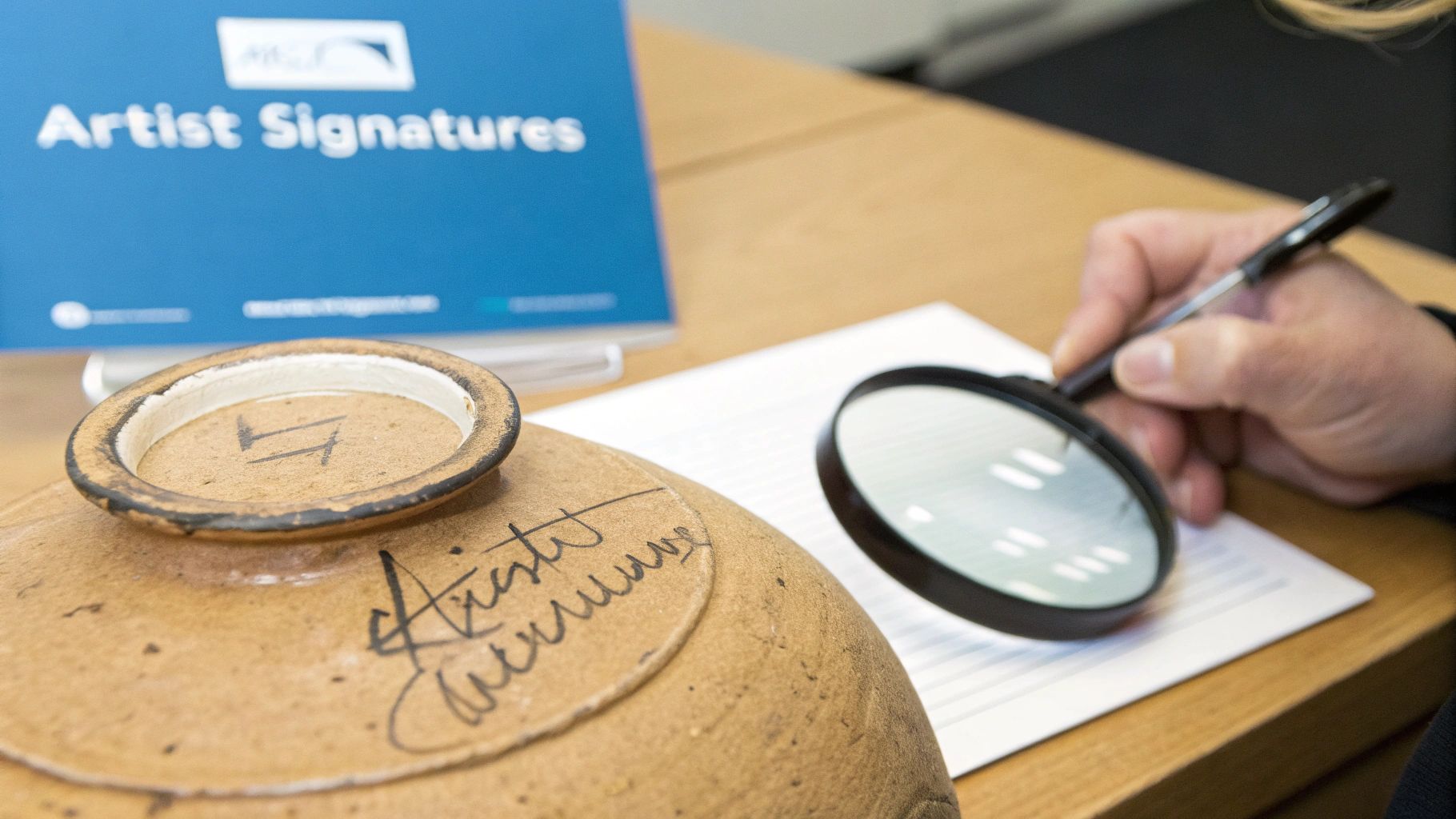
Spotting an artist’s mark takes a bit of patience and a good eye. Signatures can be faint, highly stylized, or even partially hidden under the glaze. You'll usually find them on the bottom of a piece near the main Weller factory mark, but it's worth checking the side near the base, too.
For instance, a standard Hudson vase might just have the "Weller" block letter stamp. But finding a small, painted "DL" nearby turns it into something special. Likewise, a Sicard vase is far less valuable without Jacques Sicard’s actual signature.
Always grab a magnifying glass and use bright, direct light to inspect the base. That extra bit of effort can be the difference between finding a common pot and uncovering a real treasure.
Understanding Marks from the Later Years
After Samuel Weller's death in 1925, the company's entire philosophy changed. The focus shifted from artistic expression to pure commercial survival, a story told clearly through the pottery marks of the time. The Great Depression and evolving public tastes forced Weller to embrace efficiency and mass production, a period collectors call the "Late Period," which lasted until the factory doors shut for good in 1948.
When you're looking at a piece from this era, you're really looking for signs of a streamlined process. The beautiful, hand-incised signatures and detailed die-stamps of the earlier years were almost entirely abandoned. In their place, you’ll find marks that were integrated right into the pottery molds, a simple change that saved a massive amount of time on the production line.
The Shift to In-Mold and Ink Marks
By far, the most common marks you'll encounter from the 1930s and 1940s are the in-mold script or block letter logos. Because they were part of the mold itself, these marks appear raised from the surface of the clay, not impressed into it.
- In-Mold Script "Weller": This is the one you’ll see most often. It’s a simple, flowing, cursive "Weller" and shows up on many popular lines like Coppertone, Roma, and Woodcraft.
- In-Mold Block "WELLER POTTERY": You'll see this one less frequently, but it’s still common. It uses plain, capital letters and was often reserved for more utilitarian pieces like planters and kitchenware.
- Ink Stamps: As the company neared its final years, it also turned to simple ink stamps. These are usually found on pieces with very smooth bases where an in-mold mark wasn't practical. Look for blue or black ink, but be prepared for it to be faded or smudged from years of use.
This move toward practical, everyday wares was a direct response to the harsh economic realities of the time. After Samuel Weller died on January 17, 1925, the company’s creative energy faded. By the mid-1930s, two of the factories had closed, and the last one limped along until 1948. The marks from this period, like the simple 'Weller Pottery since 1872' text, reflect this decline. These days, these later pieces are easy to find and typically trade in the $50 to $200 range. For a deeper dive into this period, the history at Just Art Pottery is a great resource.
What Later Marks Mean for Value
As a general rule, pottery with these later in-mold or ink-stamped marks is more common and, therefore, less valuable than pieces from Weller's earlier "Golden Age." The lack of hand-decoration and individual artist involvement means they tend to appeal more to decorators and casual fans than to serious art pottery collectors.
Collector's Note: While later Weller is more affordable, condition is everything. These were everyday items, so finding a piece from a line like the 1930s Oak Leaf pattern without chips, cracks, or heavy crazing can be a real hunt. An example in mint condition will always fetch a premium.
How to Spot Fake and Forged Weller Marks
It’s an unfortunate reality in the collecting world: where there's value, there are fakes. As the market for Weller pottery has heated up, so have the efforts of forgers looking to cash in. Protecting your collection means learning to tell a genuine Weller pottery mark from a clever fake.
The best way to train your eye is to study known, authentic marks and compare them directly against anything that seems questionable. Forgeries almost always give themselves away with small, but critical, mistakes. These can be anything from a clumsy signature to a complete misunderstanding of which mark was used during a specific period.
Telltale Signs of a Forgery
Spotting a fake often comes down to the little things. Authentic marks were made with specific tools and a practiced hand, details that forgers find surprisingly difficult to get right. You need to look for the details that just don't add up.
Keep an eye out for these common red flags:
- Incorrect Fonts and Proportions: Forgers often slip up on the lettering. Compare the mark to a verified example—is the font too thin? Too clunky? Is the spacing between the letters off? These are telltale signs.
- Blurry or Messy Impressions: A real die-stamped or in-mold mark is usually pretty crisp and clear. Fakes, on the other hand, can look smudged, shallow, or ill-defined. This often happens when the forgery is made from a poor cast of an original mark.
- Modern Tool Marks: When you're looking at a hand-incised mark, think about how it was made. A signature etched with a modern Dremel tool looks very different from one hand-carved into wet clay over a century ago. The groove will often look too perfect and uniform.
- Mark on the Wrong Pottery Style: This is a dead giveaway. A forger might put an early Louwelsa mark on a Coppertone vase from the 1930s. Knowing your timelines is your best defense against this kind of blatant error.
One of the sneakiest tricks is when a forger takes an unmarked piece from another Zanesville-area maker (like Roseville or Owens) and adds a fake Weller mark. The pot itself is authentic to the period, which makes the piece much harder to dismiss at first glance.
Building Confidence in Authentication
At the end of the day, there's no substitute for hands-on experience. The best thing you can do is handle as much authenticated Weller as possible. Get a feel for the weight, the glaze, and of course, the look and feel of the marks.
Developing this skill is a huge part of being a successful collector. Our guide on how to spot fake antiques has some great general advice that applies here, too. With a bit of practice, you’ll start to get a gut feeling for what looks right—and what is definitely wrong.
How Weller Pottery Marks Affect Value
The mark on the bottom of a Weller piece is far more than just a company logo—it's one of the biggest clues to its story and, ultimately, its value. For any collector, knowing how to read these marks is the first step in separating a common find from a truly rare treasure.
A mark tells you when a piece was made, and that's critical. An early, hand-incised mark from Weller’s "Golden Age" (roughly 1896-1925) points to a period of incredible creativity and artistry. These pieces were often hand-decorated, which means they'll almost always be worth more than a later piece from the 1940s bearing an in-mold script mark, which signals mass production.
Connecting Marks to Market Prices
While the mark is your starting point, it works together with other factors to determine the final price. The specific pottery line, the piece's condition, and whether an artist signed it all matter immensely. Think of it this way: a perfect Louwelsa vase with a clear, half-circle seal and an artist's initial is in a completely different league than a chipped Coppertone planter with a generic in-mold mark.
When you're looking at a piece, keep these key things in mind:
- Production Era: Early marks from the pre-1935 period consistently bring higher prices.
- Artist Signatures: A verifiable artist's signature or cipher can increase a piece's value exponentially.
- Line Rarity: Marks tied to short-lived or experimental lines are a huge draw for serious collectors.
- Mark Clarity: A crisp, easy-to-read mark is always better than a faint, smeared, or partially glazed-over one.
To get a better sense of how Weller fits into the bigger picture, it helps to look at other manufacturers from the same time. This guide to vintage pottery marks provides a great foundation for comparing and identifying different pottery styles.
For a real-world example, a common piece from the 1930s Oak Leaf pattern might sell for $40 to $50. In contrast, a premier piece of Sicard ware, with its famous iridescent glaze and distinct signature, can easily fetch thousands at auction.
Weller Pottery Value Reference by Mark and Line
To help you make quick assessments, the table below connects some of the most popular Weller lines to their common marks and typical value ranges. This is a great starting point for estimating what a piece might be worth.
This table cross-references popular Weller lines with their typical marks to provide estimated value ranges, helping collectors assess their pieces. Just remember, these are estimates for pieces in good condition—market demand, rarity, and condition can cause prices to vary.
| Weller Line | Typical Mark Type | Associated Era | Estimated Value Range (Good Condition) |
|---|---|---|---|
| Louwelsa | Half-Circle or Full-Circle Seal | 1896-1924 | $150 - $800+ |
| Sicard | Hand-Incised "Sicard" Signature | 1902-1907 | $500 - $5,000+ |
| Hudson | Die-Stamped Block Letters | 1910s-1920s | $200 - $1,200+ |
| Coppertone | In-Mold Script "Weller" | 1920s-1930s | $75 - $300 |
| Woodcraft | In-Mold Script or Block Letters | 1920s-1933 | $100 - $400 |
| Roma | In-Mold Script "Weller" | Late 1920s | $50 - $200 |
As you can see, the specific line and its associated mark create a massive difference in valuation. Always start with the mark, and you'll be well on your way to understanding your Weller pottery.
Common Questions About Weller Marks
Every collector, from the beginner just starting out to the seasoned pro, runs into the same questions when trying to identify Weller pottery. Think of this section as your go-to cheat sheet for tackling those common head-scratchers and sharpening your identification skills.
What Does an Unmarked Piece of Weller Mean?
It's a classic collector's dilemma: you find a piece that just screams "Weller," but when you flip it over... nothing. Don't dismiss it just yet! Finding an unmarked piece is actually quite common and doesn't automatically mean it's a fake.
Many early pieces, especially from experimental lines, were never marked. Sometimes, the only mark was a simple paper label that washed away decades ago. When there's no mark, you have to play detective and rely on the physical evidence. Look closely at the shape, the specific glaze, and the clay body, and compare them to confirmed examples. For instance, the unmistakable rich, brown high-gloss glaze on a piece of Louwelsa is often a better clue than any stamp could be.
Is an Artist-Signed Weller Piece Always More Valuable?
Yes, almost without exception. A genuine signature from a known Weller artist like Jacques Sicard or Frederick Hurten Rhead can elevate a piece from a simple factory product to a unique work of art. That signature is a direct link to the artist's hand, instantly adding a layer of rarity and history.
But—and this is a big but—the signature isn't the only thing that matters. The final value is a mix of factors. The condition of the piece, its size, the complexity of the decoration, and the fame of the artist all come into play. A tiny, damaged vase by a lesser-known decorator won't fetch the same price as a large, flawless piece by one of the masters.
Key Takeaway: An artist's signature is a huge value-add, but the overall quality and condition of the piece are still king. A signed piece in poor shape might be worth less than an unsigned one in mint condition.
Differentiating Impressed and In-Mold Marks
This one comes down to how the mark was made. You can usually tell the difference just by looking and feeling.
An impressed mark was physically stamped into the wet clay after the pot was formed but before it was fired. This method leaves a sharp, clean indentation—you can feel the crisp edges.
On the other hand, an in-mold mark was built right into the mold itself. The "Weller" name was carved into the plaster, so when the clay was pressed in, the lettering came out raised on the finished pot. These marks tend to look a bit softer and less defined and were the go-to for later, mass-produced lines where speed was key.
Feeling uncertain about an unmarked piece or a tricky signature? The Curio app puts an antiques expert in your pocket. Just snap a photo and get instant identification, historical context, and an estimated value to help you understand your treasures. Download Curio today at https://www.curio.app.