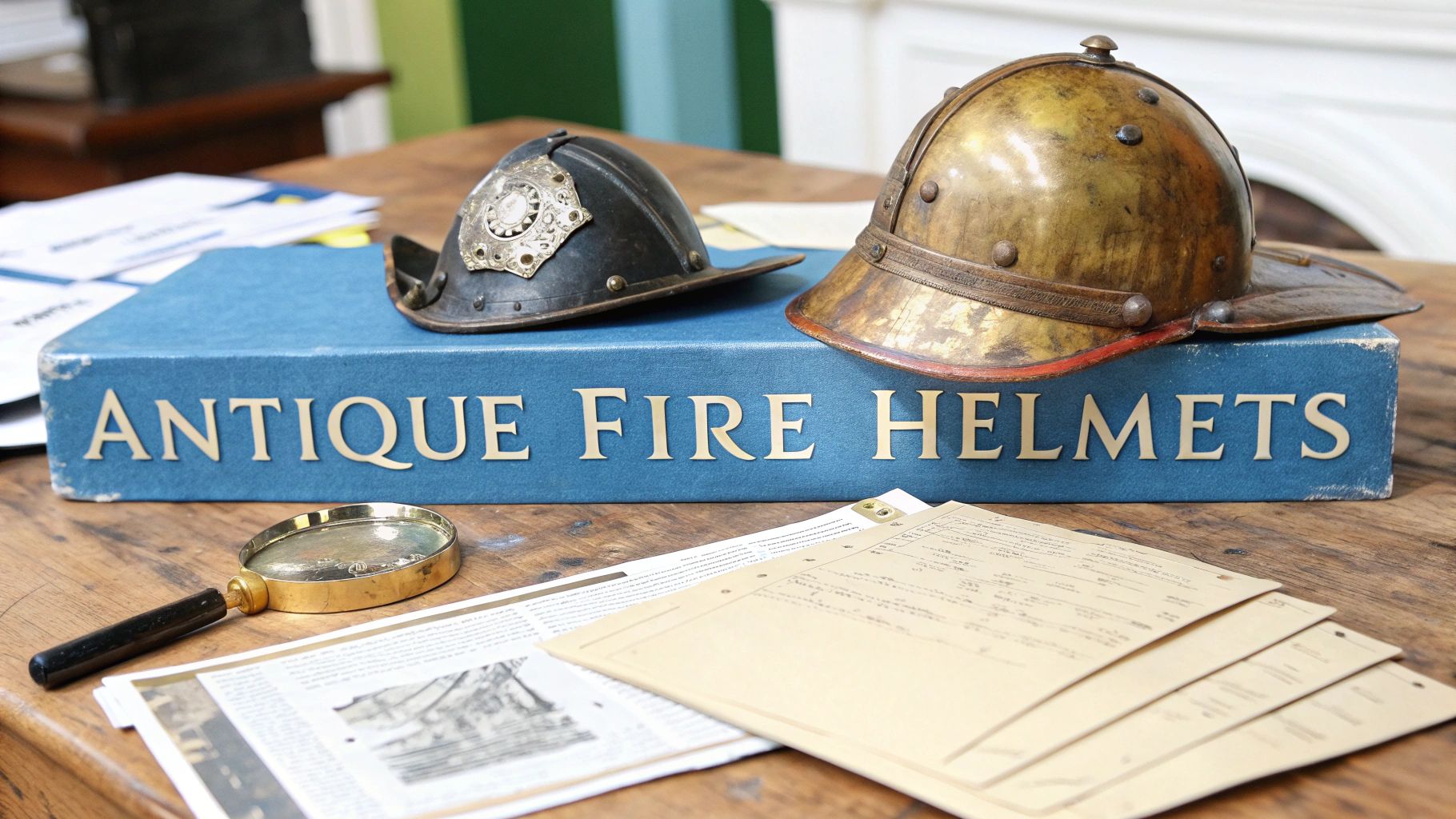
An antique fireman's helmet is so much more than a piece of old headgear. It's a direct, physical connection to a heroic past, carrying the real scuffs and scars of history and bravery. Collectors prize everything from the iconic American leather designs to ornate European brass styles, not just for their craftsmanship, but for the powerful stories they tell.
From Artifact to Heirloom: The Story in Every Helmet
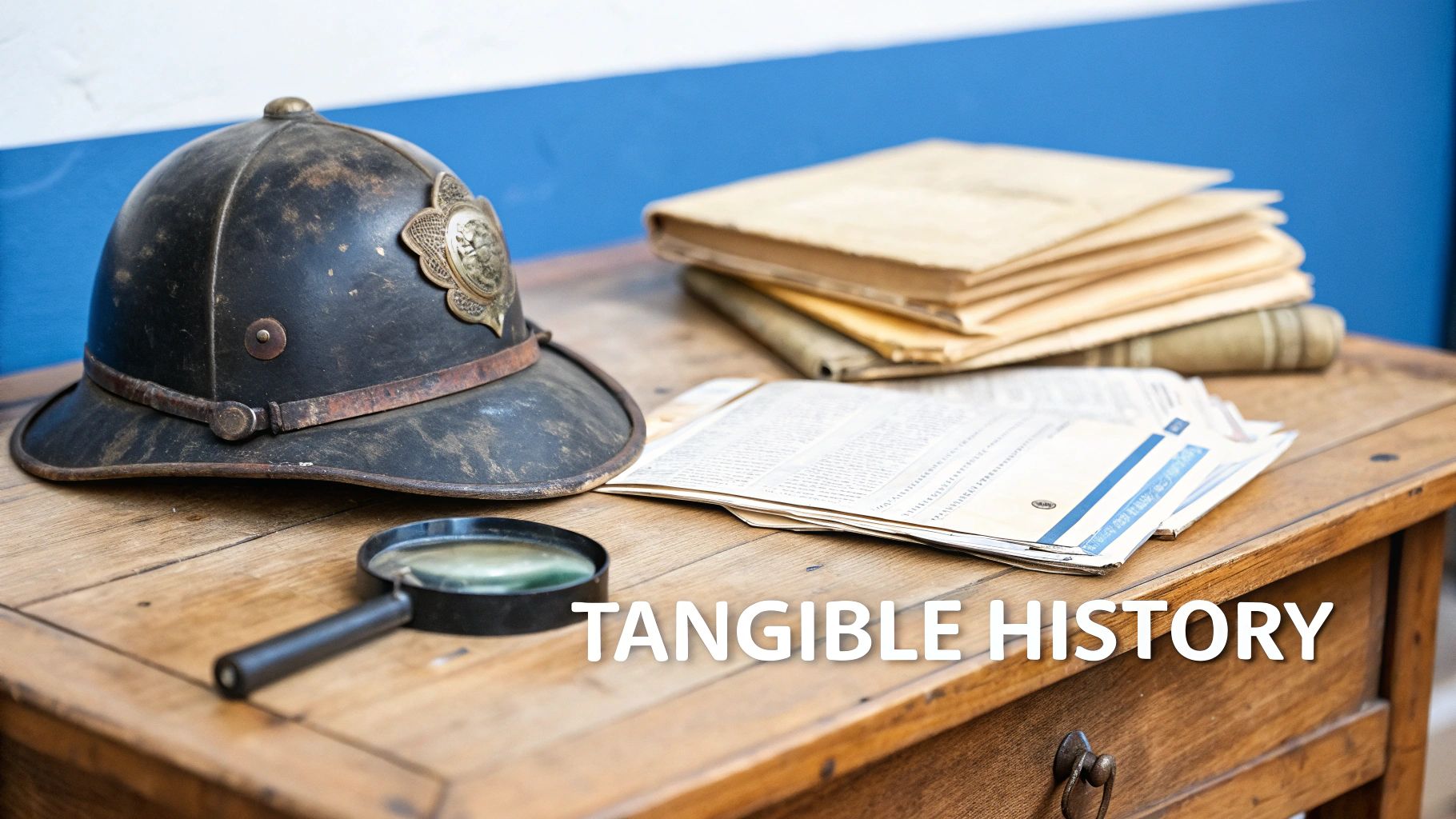
Picture it: the clang of a fire bell slicing through the night in a 19th-century city. Horses thunder over cobblestones, pulling a heavy steam pumper. Against the glow of a distant blaze, firefighters hold on tight, their most critical piece of gear firmly on their heads. That helmet was their shield against falling embers, torrents of water, and collapsing buildings. Every single dent, scratch, and layer of soot on an old helmet tells a piece of that story.
This guide is for the treasure hunter and family historian in all of us. It’s for anyone who's stumbled upon a dusty leather helmet in the attic or felt a spark of curiosity seeing a polished brass one at a flea market. We'll show you how to peel back the layers and uncover the rich history that can turn that simple object into a cherished heirloom.
The Evolution of a Lifesaving Icon
Early on, firefighter headwear was pretty basic. It was often more about identification than actual protection. Think of the simple leather caps used back in the 1740s—their main job was to help tell the fire companies apart from the chaotic crowds. But as firefighting became more organized and the dangers grew, the helmet had to evolve into a serious piece of specialized equipment.
Eventually, two major styles took center stage, each born from a different philosophy of protection and design.
- The American 'Leatherhead': This is the rugged, iconic design you probably picture first. Patented by Henry T. Gratacap in 1836, it became the gold standard in the United States. Its long rear brim, often called a "duckbill," was a brilliant feature designed to funnel water away from a firefighter's neck and coat.
- The European Brass Helmet: Often linked to the French Sapeurs-Pompiers and later adopted by departments like London's Metropolitan Fire Brigade, these helmets were basically armor for the head. Their high, rigid crests were engineered to deflect heavy, falling debris.
Why These Helmets Capture Our Imagination
At its core, an antique fireman's helmet is a direct link to the very person who risked their life wearing it. It's an artifact that was there, witnessing history firsthand. For collectors, interior designers, and museums, these helmets aren't just memorabilia; they're powerful symbols of courage and service to the community.
A vintage fire helmet is a one-of-a-kind find. No two are the same, as they age and wear differently based on use, making them amazing conversation starters.
Whether you're looking to preserve a piece of your family's legacy or just starting a new collection, understanding what makes these helmets special is the first step. With a bit of knowledge, you can start to read the stories etched into the leather and brass, connecting with the past in a way that feels uniquely personal.
A Tale of Two Helmets: American Leather vs. European Brass
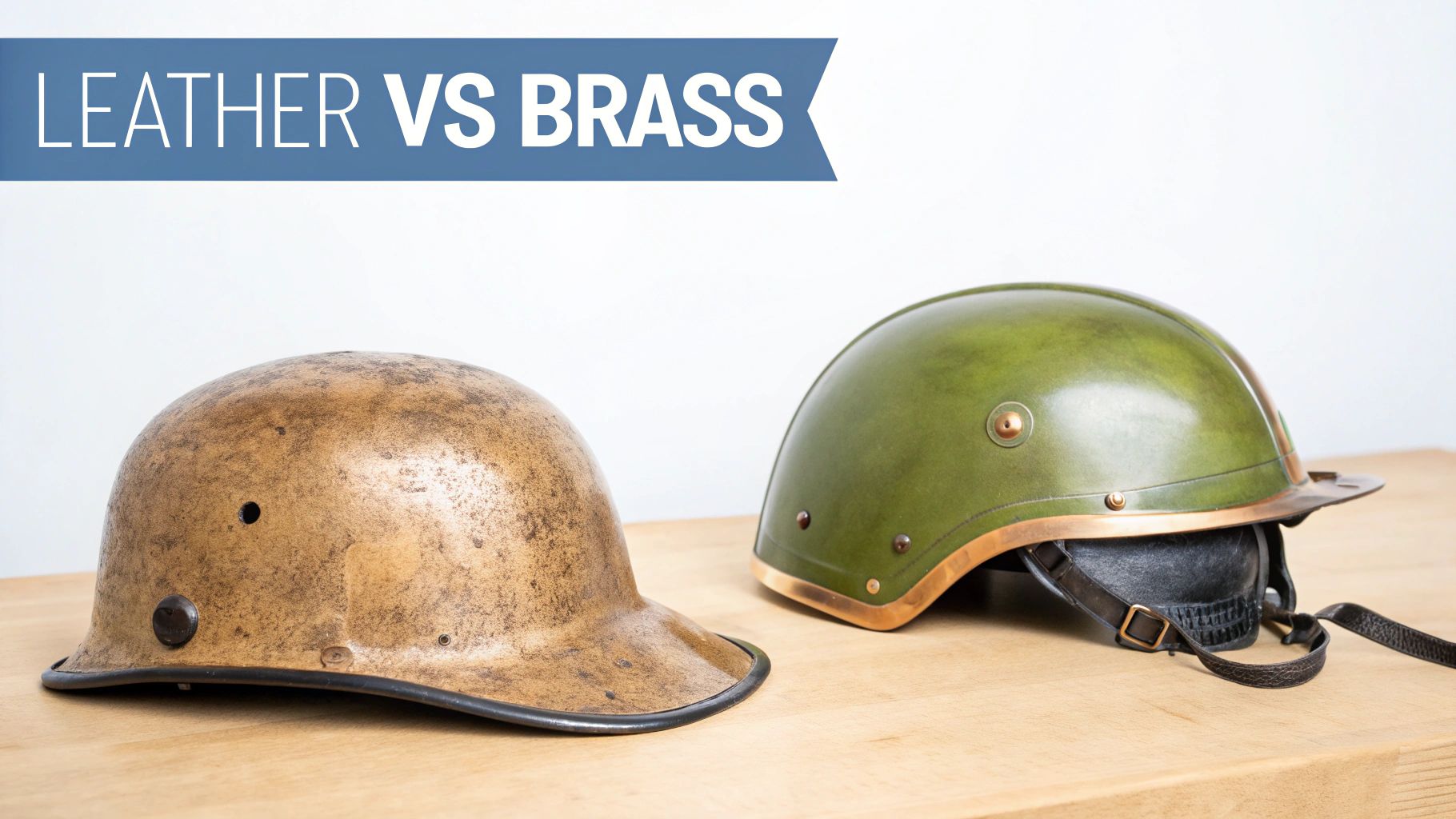
When you first dip your toes into the world of antique fire helmets, you'll quickly find two legendary styles that stand apart, born on opposite sides of the Atlantic. Each was shaped by different materials and firefighting philosophies, but both were crafted to protect those who ran toward the flames.
Getting to know these two archetypes—the American "Leatherhead" and the European brass helmet—is the perfect starting point for appreciating the rich history of this field.
Think of the American leather helmet as a cowboy’s saddle—it's rugged, purely functional, and perfectly suited to its environment. It was built to handle the brutal reality of firefighting in America’s booming cities, where tinderbox-like wooden buildings fueled intense and unpredictable blazes.
The European brass helmet, on the other hand, is more like a knight’s shining armor. It’s ornate, regal, and engineered to deflect crushing blows from the heavy masonry of Old World architecture. One is a tool of raw utility; the other is a powerful blend of protection and ceremonial pride.
The American Icon: The Leatherhead
The story of the American helmet really begins with one man: Henry T. Gratacap. A volunteer firefighter in New York City, he knew firsthand that they needed better head protection. Before him, firefighters in the 1740s wore simple leather caps, mostly just to stand out in a crowd.
Gratacap’s game-changing design, the "New Yorker," was born in 1836. Crafted from thick, flame-treated leather, it had a segmented comb crest for incredible strength, a long rear "duckbill" to keep scalding water off the neck, and a bold front piece for company badges. These elements are still iconic today.
The design was a massive hit. Within decades, over 90% of U.S. urban fire departments were using "leatherheads," and makers like Cairns were cranking out thousands a year.
What made this helmet such a masterpiece of practical design?
- Segmented Comb Construction: That high crest wasn't just for looks. It was built from eight stitched-together sections, or "combs," creating a structure that could absorb and distribute the force from a falling beam.
- Long Rear Duckbill: This distinctive feature was a brilliant piece of engineering. It channeled hot water, embers, and debris away from a firefighter’s neck and down their coat, keeping them far safer and drier.
- The Front Piece: A defining characteristic was the leather shield, or frontispiece, which proudly displayed the firefighter’s company number and city. Often topped with a metal eagle, it became a powerful symbol of identity and pride.
The American leather helmet was less an accessory and more a purpose-built tool. Every curve and seam served a vital function, putting the firefighter's safety and effectiveness above all else. Its legacy is so strong that you can still see its influence in many modern helmets used today.
The European Tradition: The Brass Helmet
Hop across the Atlantic, and you’ll find a completely different philosophy in helmet design. European cities, built largely of stone and brick, posed a different kind of threat: the crushing force of collapsing masonry. This led to helmets designed not to absorb impact, but to deflect it entirely.
The most famous style was inspired by the Sapeurs-Pompiers of Paris and later perfected by manufacturers like Merryweather & Sons in London. These helmets were usually made of polished brass, a metal prized for its incredible strength and resistance to corrosion.
This style has its own key characteristics:
- Prominent Central Crest: Unlike the American comb, the European crest was a high, solid ridge running down the middle. Its curved shape was designed to make falling bricks and debris glance right off, protecting the skull from a direct hit.
- Visor and Neck Guard: Many designs included a small front visor and a flared rear neck guard, offering 360-degree protection from falling embers and water.
- Ornate Details: European brass helmets often had a more formal, militaristic look. They were frequently decorated with intricate badges, dragon-shaped comb holders, and other flourishes that reflected immense civic pride.
Keeping the shine and integrity of these historical pieces is a huge part of owning one. If you have one of these beautiful artifacts, you might find our guide on the delicate process of cleaning antique brass helpful. Following the right steps ensures you preserve its history without causing damage.
Ultimately, these polished helmets were symbols of a city’s strength and the professionalism of its fire brigade, masterfully blending impeccable function with formidable style.
How to Identify and Date Your Antique Fire Helmet

When you hold an antique fire helmet, you’re holding a tangible piece of history. But the real excitement kicks in when you start to uncover its unique story. You have to become a bit of a detective. By looking closely at a few key features, you can move beyond a simple guess and start to pin down the helmet's maker, its age, and where it saw service.
Your first move? Look for the maker's mark. Think of it as the artist's signature. Carefully turn the helmet over and check the inside of the shell for any stamps, embossed text, or old paper labels.
Well-known American makers like Cairns & Brother or MSA (Mine Safety Appliances) almost always left a clear mark. Across the pond in Europe, you might find a name like Merryweather & Sons of London. Spotting one of these is a huge win, as it immediately gives your helmet a pedigree.
Reading the Clues in the Materials
The very materials a helmet is made from tell a story about the technology and traditions of the time. They’re a timeline you can touch.
If you have a helmet made of pressed felt, you're likely looking at a very early piece, probably from the first part of the 19th century before stronger materials became the norm.
Later on, American firefighters famously adopted leather, earning the nickname "leatherheads," while their European counterparts generally preferred helmets made of brass or other metals. This transatlantic split is often one of the first and most obvious clues to a helmet's origin.
- Leather: A heavy, stitched leather shell almost certainly means it’s an American helmet, likely from the mid-1800s to the early 20th century.
- Brass or Nickel: A gleaming, polished metal helmet is a hallmark of European design, with a history stretching from the mid-19th century forward.
- Aluminum: Lighter aluminum helmets started popping up in the 1930s. Their arrival signaled a major shift toward more modern, functional materials.
- Composite/Fiberglass: If it feels like an early, heavy plastic, you’ve probably got a mid-20th-century helmet that marks the end of the traditional metal and leather era.
Pinpointing the Decade with Design Details
Once you've got a handle on the material, the finer design details can help you zero in on a specific decade. These are the unique fingerprints of each era.
For instance, the tall, ornate comb on an 1880s American leather helmet is a world away from the lower, more streamlined profile of a helmet from the 1940s. European brass helmets also evolved, with the shape of their crests and visors changing as designs were refined for better protection and style.
To help you get started, here’s a quick-reference table that breaks down the common features you’ll see from different periods.
Key Identification Features by Helmet Era
| Era | Common Materials | Key Design Features | Notable Makers |
|---|---|---|---|
| Early 19th Century (1820s-1850s) | Pressed Felt, Leather | Very tall, stovepipe-like shapes. Basic painted front shields. | Early independent craftsmen. |
| Mid-to-Late 19th Century (1860s-1890s) | Leather (US), Brass/Nickel (Europe) | High, ornate combs (US). Elaborate metal crests (Europe). Simple leather or oilcloth liners. | Cairns & Brother, Henry T. Gratacap. |
| Early 20th Century (1900s-1930s) | Leather, Aluminum, Stamped Metal | Lower profile combs. More standardized shapes. Adjustable liners begin to appear. | MSA, Cairns & Brother, Merryweather. |
| Mid-20th Century (1940s-1960s) | Aluminum, Early Composites/Fiberglass | Streamlined, functional designs. Complex suspension liners for better fit and safety. | MSA, Cairns (N5A "New Yorker" model). |
This table is a great starting point, but always remember to cross-reference multiple features to build a complete picture of your helmet's age and origin.
A helmet's liner can be a surprisingly accurate clue. Early helmets often had simple, rudimentary liners made of oilcloth or basic fabric, while later examples feature more complex suspension systems designed for better comfort and safety. An intact original liner significantly adds to a helmet's historical value.
Don't forget the frontispiece—that's the shield on the front. These are often the most personal and revealing part of a helmet. The artwork, lettering style, and symbols can tell you about the specific fire company and even the rank of the firefighter who wore it.
If you're looking to get even better at this, our broader guide on how to identify antiques shares more detective techniques that work for all kinds of historical items. By piecing together all these clues—maker, material, and design—you can confidently tell the unique story behind your antique fire helmet.
What's My Fire Helmet Really Worth?
So, you’ve figured out who made your helmet and roughly when it was made. The next question is always the big one: "What's it worth?" When it comes to antique fire helmets, finding the value isn't as simple as looking up a price in a book. It’s more like putting together a puzzle, where several key pieces have to fit just right.
Think about it this way. You could have two helmets sitting side-by-side. They might be from the same maker, from the same decade, and look almost identical. Yet, one could be worth $200, while the other is a $2,000 showpiece. The huge difference in value comes down to a mix of originality, condition, rarity, and the story the helmet tells. Understanding these factors is what separates a casual collector from a serious one.
Originality Is Everything
In the world of antiques, originality is king. There's just no substitute for it. A helmet that has managed to survive for over a century with all its original parts is always going to be more sought-after than one that’s been restored or pieced together. Serious collectors want a helmet that looks the way it did when it was retired from service.
Here's what to look for when checking for originality:
- The Original Liner: Is that leather or fabric suspension system inside the helmet the one it left the factory with? Liners took a lot of abuse and were often replaced. Finding a helmet with its original, intact liner is a huge plus.
- The Original Front Piece: That leather or metal shield on the front is the helmet's soul. It tells you the company and the firefighter's rank. A helmet with its period-correct, original frontispiece is far more valuable than one with a replacement or a "married" piece that didn't start its life there.
- Untouched Paint and Patina: It can be tempting to polish an old brass helmet until it gleams, but don't do it! That aged patina is a badge of honor, a part of its history. The same goes for paint—even if it's worn and chipped, original paint tells a story that collectors value far more than a shiny new repaint.
A restored helmet might look pretty, but the process often strips away its history and, consequently, a lot of its monetary value. An honest, untouched helmet will almost always be worth more than one that's been cosmetically "perfected."
Condition and Rarity: The Value Multipliers
Condition obviously plays a huge part in what any antique is worth, and fire helmets are no different. Experts usually use a simple scale, from "poor" to "mint." A mint condition helmet looks like it just came off the shelf, with almost no signs of use. On the other end, a poor condition helmet might be badly cracked, missing key parts, or have significant damage. Most helmets you'll find land somewhere in the middle, showing the honest dings and scrapes of a life spent on duty.
Rarity, on the other hand, is a bit more complicated. A helmet can be rare for a few different reasons. It might have belonged to a tiny volunteer fire company that only existed for a few years, meaning very few of their helmets are still around. Or, it could be an ornate presentation helmet. These were beautifully decorated pieces, often with silver plating and elaborate engraving, given as awards or for ceremonies. They were never meant to see a fire, making them true works of art. These one-of-a-kind helmets often command the highest prices.
The real sweet spot for value is where incredible original condition meets proven rarity. A helmet doesn't become valuable just by being old; it has to be a scarce and well-preserved piece of firefighting history.
The Power of a Good Story: Provenance
Finally, we get to what can be the biggest value-driver of all: provenance. Provenance is simply the helmet's documented history—its story. A fairly average helmet's value can absolutely skyrocket if you can prove it was connected to a specific, well-known firefighter or a major historical event.
For example, take a gleaming brass fireman's helmet from the 1860s, with its iconic high crest down the center. These helmets were serious pieces of engineering. Back in 1866, Captain Massey Shaw of London's Metropolitan Fire Brigade was inspired by French designs to create the gold standard of his time. Made from 28 individual parts, its high comb deflected falling debris while its curved brim channeled water away from the firefighter. A nice, well-preserved Massey Shaw-era brass helmet with no specific story might bring $2,000-$5,000. But one with documents proving it was worn during a famous London fire? Its value could climb dramatically. You can explore more about the evolution of these designs and how they were crafted for safety.
If a helmet comes with an old photo of the firefighter wearing it, his service medals, or a newspaper clipping about a heroic rescue he was part of, it's no longer just an object. It becomes a tangible piece of history. That documented story is what connects us to the past, and it’s what can turn a simple antique into a priceless artifact.
A Practical Guide to Buying and Selling Helmets
Diving into the market for an antique fireman's helmet, whether you're buying your first or selling a family heirloom, requires a good bit of street smarts. This isn't just about a simple transaction; it's about making sure a piece of history finds the right home. For buyers, the excitement of the chase is always tinged with the risk of running into a fake. For sellers, the big challenge is getting a fair price that reflects the artifact's true worth.
But don't let that intimidate you. With the right game plan, you can navigate the market like a pro. This guide is all about giving you clear, no-nonsense advice to find the real deal, sidestep common traps, and present a helmet in a way that truly honors its story.
Tips for Buying Your First Antique Helmet
There's nothing quite like the feeling of finding a genuine antique fire helmet. The secret is simply knowing where to hunt and what to look for.
Sometimes the best finds are hiding in plain sight. Sure, the big auction houses like Morphy Auctions or Cowan's are fantastic for high-end, documented pieces, but don't sleep on your local options. Estate sales, antique malls, and even the occasional flea market can turn up some incredible treasures.
Of course, online marketplaces have blown the doors wide open, giving you access to sellers around the world. That convenience comes with a catch, though—you have to be extra careful. To get started, try using a few smart search terms to cut through the noise:
- "19th century fire helmet"
- "Vintage leather fire helmet"
- "Antique Cairns fire helmet"
- "Merryweather brass helmet"
- "Civil War era fire helmet"
A good rule of thumb for online buying: always vet the seller. Look at their reviews and check their return policy. A trustworthy seller will provide a ton of high-quality photos and a detailed, honest description. If you're unsure about something, never hesitate to ask for more pictures or information before you pull the trigger.
Spotting Fakes and Red Flags
Just like with any other valuable collectible, the fire helmet market has its share of fakes. Reproductions can be deceptively good, but they almost always have little details that give them away. Your best defense is learning to spot these tell-tale signs.
Buyer's Checklist for Authenticity
- Check the hardware: Look closely at the screws and rivets. Authentic antique helmets used simple, flat-head screws. If you see Phillips-head screws, that's a modern invention and a dead giveaway that the helmet is either a fake or has had significant later repairs.
- Examine the weight and materials: A real leather or brass helmet from the 19th or early 20th century feels substantial in your hands. It has heft. Fakes are often made from cheaper, lighter materials and can feel flimsy or look unnaturally flawless.
- Look for genuine aging: A helmet that saw action has the scars to prove it—honest dents, soot stains, scratches, and a natural patina that develops over decades. Reproductions often have artificial aging that looks too uniform, almost like it was painted on.
- Inspect the liner: This is a big one. Finding a plastic or modern fabric liner inside a helmet that's supposed to be from the 1880s is a massive red flag.
Selling Your Fire Helmet for the Best Price
When it's time to sell, your job is to be a storyteller. How you present the helmet can make a huge difference in the final price.
Start by taking a lot of clear, well-lit photos from every possible angle. Make sure you capture the overall shape, a close-up of the front piece, the maker's mark, the inside liner, and any unique details or damage. Good photos build trust and let potential buyers see exactly what they're getting.
Next, write a description that brings the helmet to life. Don't just list the specs. Weave a narrative. Mention the maker, the estimated era, the materials used, and any history or provenance you know. And always, always be honest. Be upfront about any repairs, damage, or missing parts. Buyers appreciate transparency. Finally, do a little homework on sites like eBay to see what similar helmets have recently sold for. This will help you set a price that's both realistic and competitive.
How to Preserve Your Piece of Firefighting History
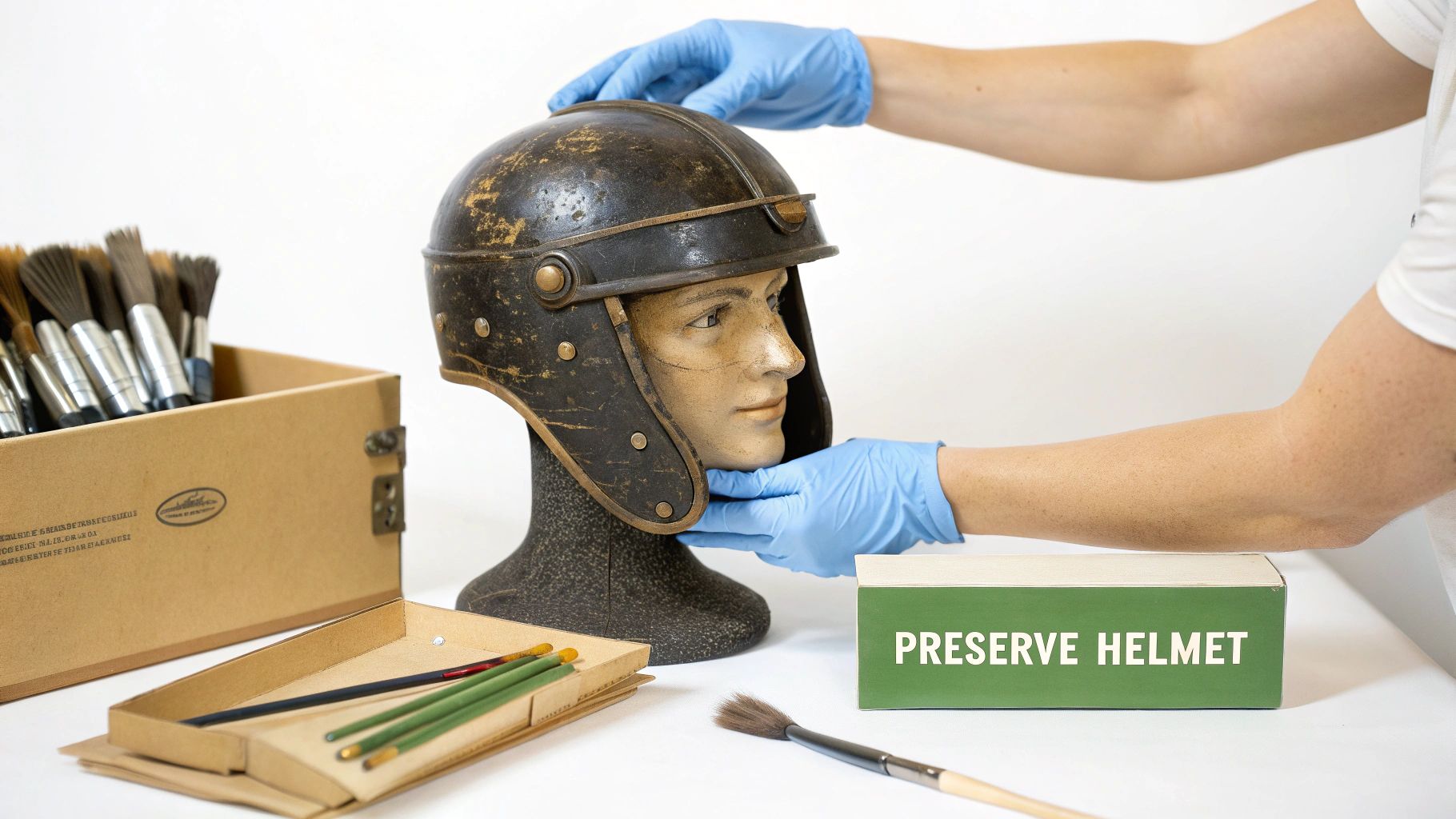
When you own an antique fireman's helmet, you become the custodian of its story. Proper care is about more than just protecting a financial investment—it's about honoring the history and bravery baked into the very metal and leather of the piece. Think of it less like an old object and more like a fragile historical document that needs a gentle hand to survive.
These helmets are far more delicate than they look. Years of fighting fires, being exposed to smoke, heat, and water have left their materials incredibly sensitive. A harsh cleaning or the wrong storage environment can cause irreversible damage, essentially erasing the very history that makes the helmet so compelling. The first and most important rule is simple: do no harm.
Caring for Different Helmet Materials
The material of your helmet determines exactly how you should care for it. What works for a brass helmet could completely destroy a leather one, so you have to know what you’re working with. A gentle, patient approach is always the right one.
For Antique Leather Helmets:
- Conditioning is Key: Over the decades, leather gets dry, brittle, and prone to cracking. Use a conservation-grade leather conditioner made for archival items. Apply just a tiny amount with a soft, clean cloth, working it in very gently to bring back a bit of flexibility.
- Avoid Water: Never, ever soak old leather or try to clean it with water. This will cause it to warp, shrink, and harden into a permanently damaged state. Stick to dusting it carefully with a soft-bristled brush.
For Brass and Nickel Helmets:
- Embrace the Patina: That dark, aged look on the surface isn't just tarnish; it's called patina. It’s a historical fingerprint that has developed over a century or more. Polishing a helmet to a mirror shine strips away its character and can seriously tank its value.
- Gentle Cleaning Only: If you absolutely must clean it, a dry microfiber cloth to remove dust is your best bet. For a bit of grime, you can use a slightly dampened cloth, but you have to dry the surface immediately and completely. The principles are similar to other metals, and learning how to clean bronze can give you a good sense of how to preserve that valuable patina.
Remember, the goal of conservation is stabilization, not restoration. You're trying to stop any further decay and preserve the helmet exactly as it is for future generations to admire.
Proper Display and Long-Term Storage
Where you put your helmet is just as critical as how you clean it. Direct sunlight is public enemy number one. Its UV rays will fade paint and make leather brittle in just a few months. Find a spot in your home with a stable, moderate temperature and humidity level.
To keep the helmet’s shape, don't just set it on a flat shelf. The constant pressure on one point can cause the shell to warp over time. The best solution is a custom archival-quality head form or an acid-free padded mount that spreads the weight out evenly. This one simple step goes a long way in preserving its original form.
If you have a particularly valuable or fragile piece, it might be worth looking into professional storage options. For example, some collectors use climate-controlled storage solutions to protect their items from any environmental changes. By taking these steps, you ensure your piece of firefighting history will remain a powerful artifact for years to come.
A Few Common Questions About Antique Fire Helmets
Diving into the world of antique fire helmets can feel a bit overwhelming at first. Whether you're a seasoned pro or just found your first piece in an attic, you probably have a few questions. Let's tackle some of the most common ones.
What Makes an Old Fire Helmet Valuable?
You might be wondering if every old fire helmet is a hidden treasure. The short answer is no. While many are collectible, what really drives the price up comes down to a few key things: rarity, who made it, its condition, and any historical story it carries.
A fairly common helmet from the 1950s in rough shape might not be worth much at all. On the other hand, a well-preserved antique fireman's helmet from a legendary 19th-century maker can easily be worth thousands of dollars.
How Can I Spot a Reproduction?
This is a big one. Nobody wants to get stuck with a fake. Reproductions often have little details that give them away if you know what to look for.
Keep an eye out for modern materials like plastic liners where you'd expect to see aged leather. Check the hardware—are there modern Phillips-head screws instead of period-correct flat-head ones? Fakes often feel too light or look unnaturally pristine.
An authentic antique fireman's helmet just feels right. It has a certain heft and shows the real, honest wear from its history. The patina and maker's marks are your best friends here, as those are the details that are hardest to convincingly fake.
What Are the Most Sought-After Helmets?
While tastes vary, a few types consistently get collectors excited. If you're looking for the heavy hitters, two categories really stand out:
- 19th-Century American Leather Helmets: Think of the classic leather helmets with those incredible, ornate fronts. Pieces from makers like Cairns & Brother, especially those with a carved eagle, are true collector's items.
- High-Crested European Brass Helmets: The polished brass helmets from European makers like Merryweather & Sons are iconic. That high, protective crest is instantly recognizable and always in demand.
Beyond those, the absolute holy grail for many are presentation helmets. These were never meant for fighting fires. They were often lavishly decorated, sometimes with silver plating, and given as ceremonial gifts or awards. Finding one of those is like finding a masterpiece.
Feeling inspired to uncover the story behind your own find? Let Curio be your guide. Snap a photo, and our app will provide instant identification, historical context, and an estimated value, turning your curiosity into expertise. Download Curio today and see what treasures are waiting to be discovered. https://www.curio.app