So, you're wondering if that old chair collecting dust in the attic is a hidden gem. Good news: you don't have to hire a pricey appraiser just to get a solid idea of its value. Finding a quality antique price guide free of charge is easier than ever before, but the secret lies in knowing where to look and how to read the information you find.
Finding Antique Values Without Spending a Dime
This guide gets right to it, showing you the practical, modern ways to find what your antiques are worth—for free. We'll walk you through how to use the same online databases and marketplaces the pros use to see what buyers are actually paying.
Think of this as your personal treasure map. It’ll help you uncover the real-world value of your items and turn what seems like a daunting task into an exciting investigation. You'll learn the core strategies that give you the confidence to price things accurately.
The internet completely changed the game for collectors. Free online antique price guides and marketplaces have made establishing value more transparent than ever. In fact, by 2023, the wider collectibles market was estimated to be a massive $300–$450 billion industry globally, a boom driven largely by accessible digital price data. If you want to dive deeper, you can read more about this new era of growth and opportunity for the antiques market.
Where to Begin Your Search
Before you dive in, it helps to know which platforms offer the most reliable information. Each resource has its own strengths and plays a different role in your valuation journey.
To get you started, here's a quick rundown of the best free resources and what they're good for.
Top Free Resources for Quick Antique Valuations
| Resource Type | Best For | Information Provided |
|---|---|---|
| Online Marketplaces | Finding real-world sold prices for common to mid-range items. | Historical sales data, current asking prices, and market trends. |
| Auction House Archives | Researching high-end, rare, or authenticated pieces. | Official hammer prices, detailed descriptions, and provenance. |
| Specialized Forums | Getting identification help and community feedback. | Expert opinions, identification clues, and informal value estimates. |
| Image Search Tools | Identifying unknown objects and finding comparable listings. | Visually similar items across various sales platforms and websites. |
This table gives you a great starting point for figuring out where to direct your energy based on what you have. For most people, online marketplaces are the perfect first stop.
Let's break down how to use these effectively.
- Online Marketplaces: Sites like eBay are pure gold for seeing what similar items actually sold for. This is the most important part—asking prices can be all over the place, but sold prices tell you what someone was willing to pay.
- Auction House Archives: Major auction houses like Heritage Auctions or Christie's often publish their past results online, giving you a peek into high-end sales and professionally vetted items.
- Specialized Forums: Online communities, like Reddit's r/Antiques, connect you with incredibly knowledgeable collectors and dealers who can often help you identify a mystery piece.
For example, a quick search on eBay for "antique chair" and then filtering by "Sold Items" gives you immediate, real-world sales data. It’s that simple.
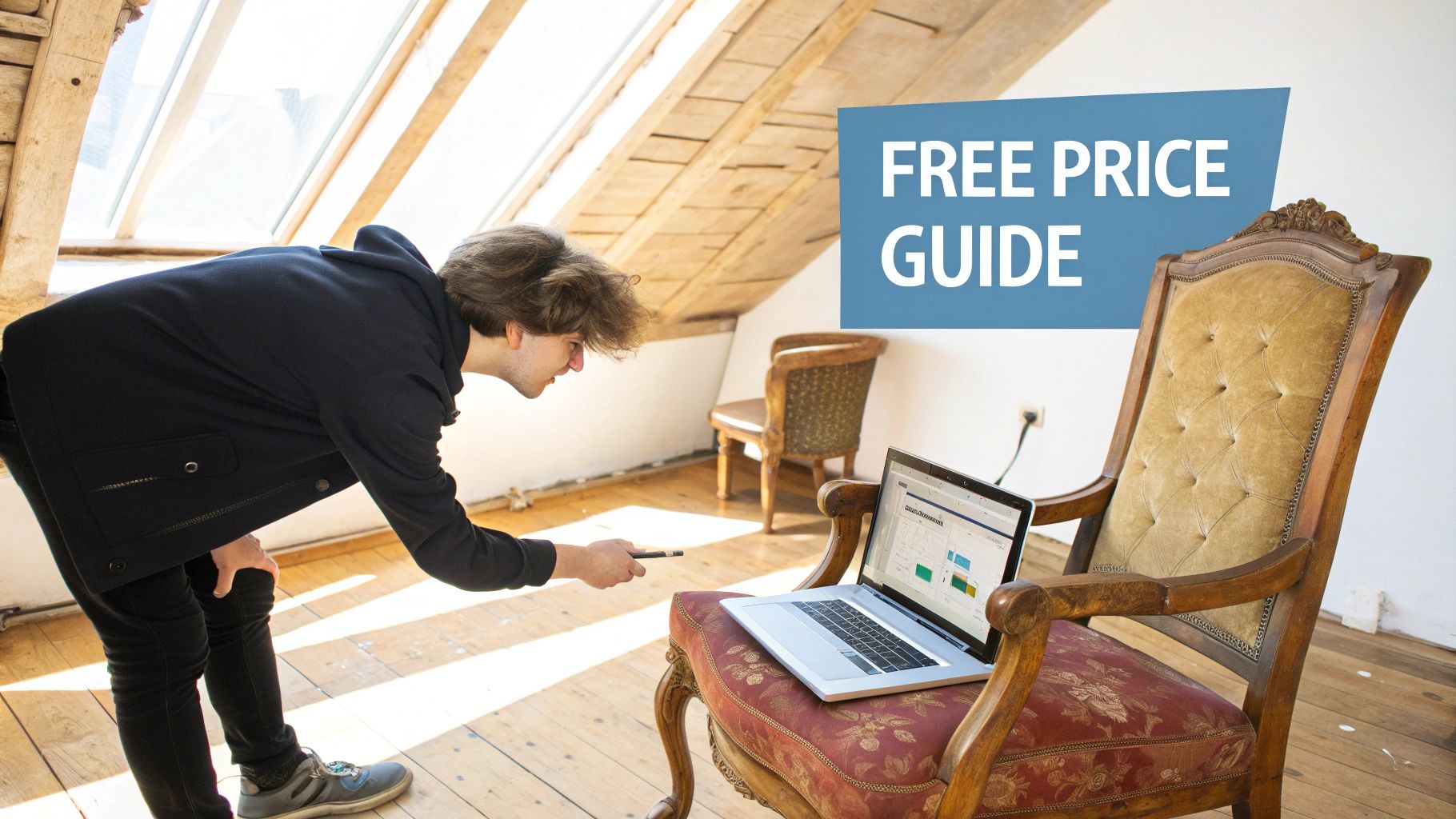
As you can see, prices can swing wildly from under $50 to over $1,000, depending on the style, condition, and rarity. This first step is all about finding a realistic ballpark for your item. For more in-depth advice, check out our complete guide on how to appraise antiques online for free.
Using Online Auctions to Uncover Real Prices
Let’s get one thing straight: an asking price is just a hope. A sold price? That’s a fact. This is where you dig in and find out what your item is actually worth to a real buyer. Think of major online auction platforms like eBay, LiveAuctioneers, and Heritage Auctions as your personal, free-to-access antique price guides.
The single most important trick here is learning to filter for "Sold" or "Completed" listings. This simple click cuts through all the noise—the inflated prices, the wishful thinking—and shows you exactly what a real person paid for a similar item. It’s the difference between guessing and knowing.
This easy access to sales data has completely reshaped the antiques market. With everyone able to get free antique price guidance, the game has changed for both buyers and sellers. Today, roughly 20% of antique and collectible sales happen online, largely because these tools help sellers set fair prices and buyers make smart offers. You can read more about these modern market trends and what to invest in for 2025.
A Real-World Walkthrough
Let's say you've stumbled upon what looks like a "Depression-era glass vase." If you just type that into an auction site's search bar, you’ll be flooded with active listings. That’s not what you’re looking for. You need to get into the archives.
Pro Tip: On eBay, you'll want to scroll down the filter options on the left-hand side and check the "Sold Items" box. For sites like LiveAuctioneers, you’re looking for a tab or button labeled "Archived" or "Past Results." This is the treasure map.
Once you’re looking at sold items, your real work begins. It's tempting to see a high price and get excited, but you have to be a detective. Compare your item to the ones that sold and pay close attention to the details:
- Subtle Differences: Is your vase a slightly different shade of green? Is the pattern more intricate? In glass, for instance, rare colors can be worth dramatically more.
- Condition: Scour the descriptions for any mention of chips, cracks, or repairs. Even a tiny flaw can slash an item's value.
- Seller Quality: An item from a reputable dealer with professional photos and a well-researched description will almost always sell for more than the same item from a seller with blurry pictures.
Interpreting What You See
Auction sites give you more than just a final number. For example, a quick search for an antique lamp on a major auction aggregator will pull up a huge range of prices.

As you can see, prices can swing wildly from under $100 to several thousand dollars. This really hammers home why you need to find the closest possible matches to your own item.
One little detail that often trips people up is the buyer's premium. This is an extra fee—usually 15-25%—that the winning bidder pays on top of the final "hammer price." Some sites show the price with the premium included, while others don't. Always check the fine print to understand the true final cost.
By consistently checking the number of bids, the final prices, and the sale dates, you’ll start to get a feel for the market. You'll begin to notice when certain styles are heating up or if a particular maker is suddenly in demand. This is how you go from being a novice to an informed collector, and it won't cost you a dime.
Identifying Your Antique with Pictures and People
You can't look up a price if you don't know what you're looking at. This is the first, most critical step in using any free antique price guide, and thankfully, you have some incredibly powerful tools right in your pocket.
A good picture is your single most important asset. Modern apps like Google Lens are fantastic starting points, but their accuracy completely depends on the quality of the images you feed them. Think of your phone's camera less as a simple camera and more as a high-powered scanner for clues.
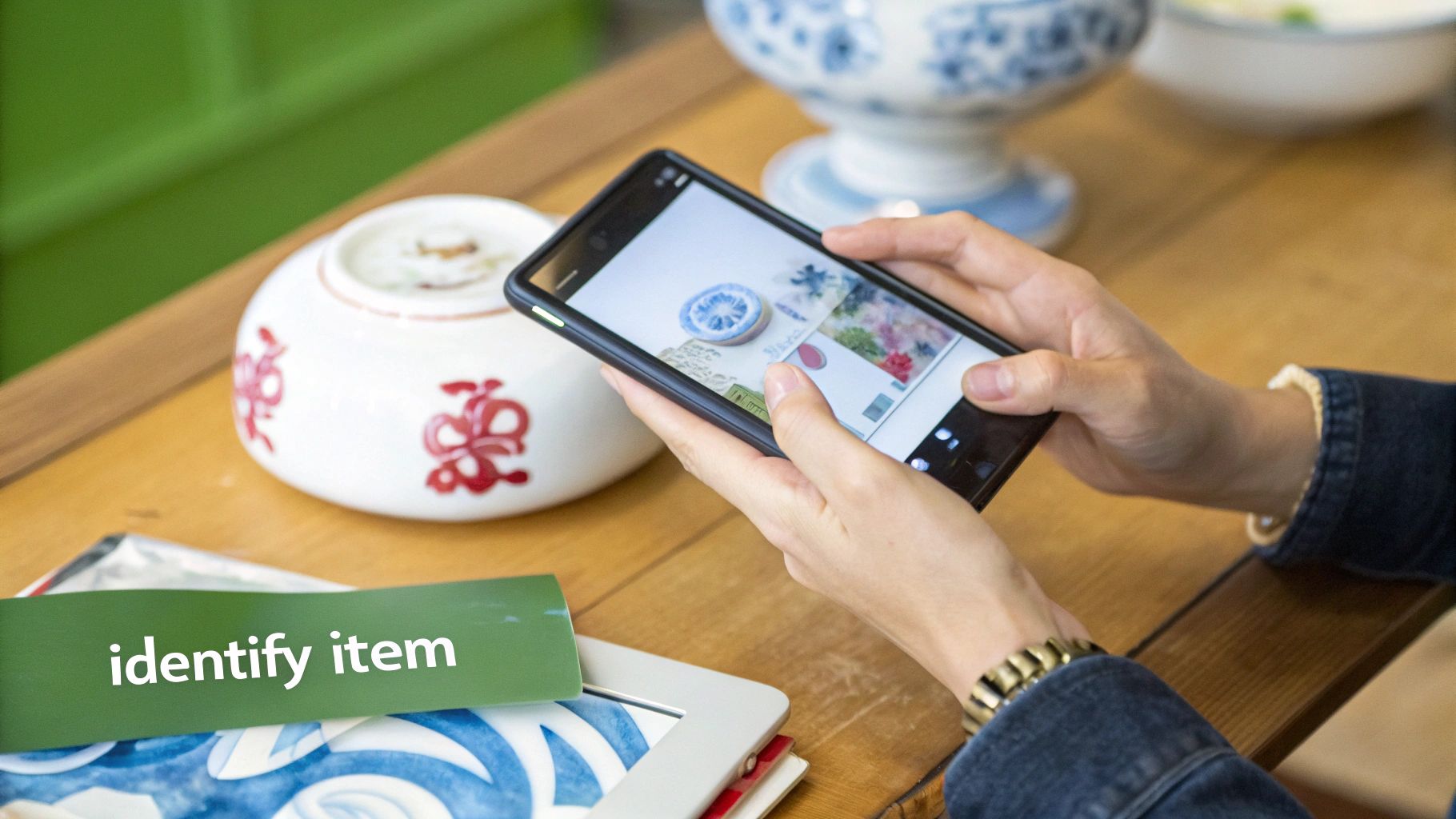
Before you do anything else, take a set of clear, well-lit photos. We have a whole guide on photographing antiques that walks you through getting professional-quality shots, but the basics are simple. Capture the piece from every possible angle—front, back, top, and bottom. Then, get in close on the details that really tell its story.
What to Photograph for a Better ID
Your goal here is to document the item's unique fingerprint. Focusing your lens on these key areas will give both AI tools and human experts the best clues to work with.
- Maker’s Marks or Signatures: This is your golden ticket. Look for any stamped logos, handwritten signatures, or imprinted names—they're the most direct clue to an item's origin.
- Construction Details: Check out how it was made. Can you see dovetail joints on a drawer? Hand-thrown rings on pottery? These little details are dead giveaways for how and when something was crafted.
- Unique Features: Snap clear shots of any unusual carvings, hand-painted decorations, or quirky design elements that make your piece stand out from the crowd.
- Wear and Tear: Don't hide the signs of age! A natural patina on metal or fine crazing in a ceramic glaze can actually help confirm an item’s authenticity.
Once you have your photos and maybe a preliminary idea from Google Lens, it’s time to bring in the human element.
Tapping into Online Communities
Never underestimate the power of a passionate community. Online forums are an incredible resource, and places like Reddit's r/Antiques are packed with thousands of collectors, seasoned dealers, and specialists who genuinely love a good mystery.
To get the best help, you need to provide the best information. A blurry photo with the title "What is this?" will likely be ignored. A post with clear pictures and detailed context invites experts to engage.
When you write your post, give them more than just the photos. The more context you provide, the better the community sleuths can help you. This approach is not just for identification; it also starts to build the story behind your item’s value. If you're dealing with jewelry, for instance, understanding what makes a piece special is key, which is why resources explaining What is estate jewelry can be so helpful.
Make sure your post includes:
- Measurements: Height, width, and depth give a sense of scale.
- Materials: What do you think it's made of? Wood, ceramic, brass, silver? Take your best guess.
- Known History: Where did it come from? Was it a family heirloom? Any piece of the story helps.
- Location: Simply mentioning your country or region can help experts pinpoint local manufacturers or styles.
By blending powerful visual search with the collective wisdom of online communities, you lay a solid foundation for finding an accurate price for your antique.
How Condition and Story Affect an Antique's Value
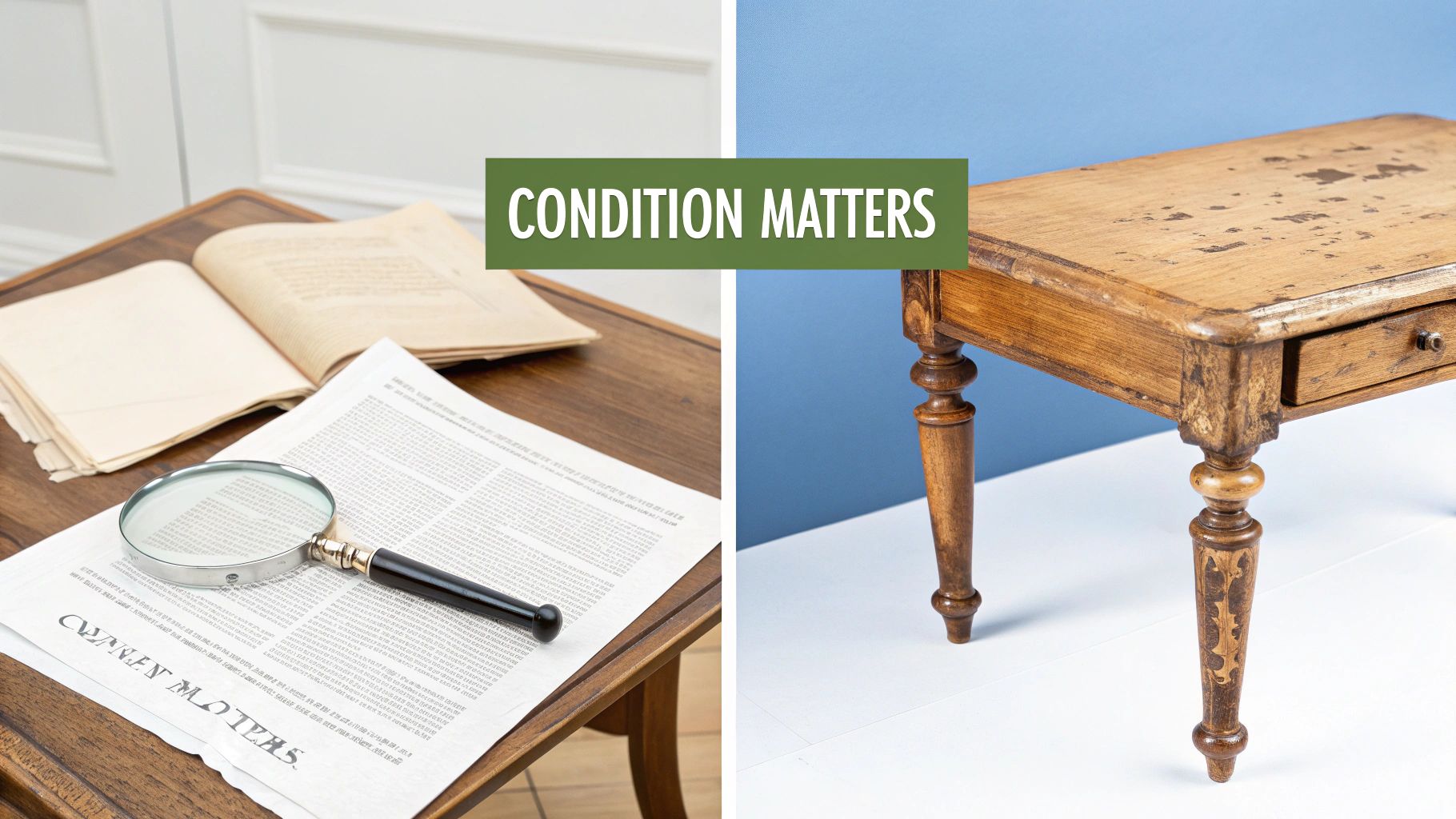
Ever wonder why one old table is worth $50 while another that looks almost identical could fetch $5,000? The secret is almost always in two key areas that a free online price guide can't fully tell you: the item's physical condition and its unique story.
Learning to spot the difference is how you start thinking like a real appraiser. It's one thing to find a similar item in an auction database, but the real value is always hiding in the details. A piece in pristine, untouched condition will always be worth more than one that's been sloppily repaired, repainted, or damaged. Collectors aren't just buying an object; they're buying a tangible piece of history. The more authentic that history is, the more they're willing to pay.
Putting an Item's Physical Condition Under the Microscope
Before you even think about numbers, you need to become a detective. Your first step is to give the item a thorough, hands-on inspection. Get it into bright, natural light if you can and start looking for clues.
This isn't just about spotting flaws; it's about building a complete picture of the item's life. Think of it like a checklist to identify anything that might hurt its value.
- Is the finish original? Look closely at the paint or wood finish. A piece that's been stripped and refinished can lose up to 70% of its value compared to one with its original, even if worn, surface. Patina is priceless.
- Any signs of repair? Hunt for traces of modern glue, new-looking screws, or mismatched wood patches. A skillful, period-appropriate repair might be acceptable, but a clumsy modern fix is a huge red flag.
- Is it complete? Check if all the original parts are still there. A clock without its pendulum or a writing desk missing its original key is incomplete, and its value will take a hit.
- What about damage? Make a note of everything you see, no matter how small. Look for chips on ceramics, hairline cracks in wood, or tears in upholstery.
These are the very details that separate a common thrift store find from a true collector's gem.
The Power of a Good Story (Provenance)
Beyond its physical state, an antique's history—what experts call its provenance—can make its value skyrocket. Provenance is simply the documented story of an item's life: who has owned it, where it has been, and how it got here. It’s the paper trail that authenticates its journey.
A simple chair is just a chair. But that same chair with a dusty receipt proving it once belonged to a famous artist? Suddenly, it’s a historic artifact. The story adds a layer of fascination that collectors will pay a serious premium for.
I once saw a guest on Antiques Roadshow who brought in a French copy of Le Petit Prince she’d picked up for $1.25 at a garage sale. It turned out to be a signed, numbered first edition. That documented rarity gave it an auction estimate of $8,000 to $12,000. The story transformed it from a forgotten book into a treasure.
To help you put this all together, think about how condition levels directly translate to value.
Impact of Condition on Antique Value
| Condition Level | Description | Potential Value Impact |
|---|---|---|
| Pristine | No repairs, original finish, no damage. Often called "mint" condition. | This is the holy grail. It can increase the price by 100% or more compared to a lesser example. |
| Good | Minor wear consistent with age, small and professional repairs. | This is the standard market value and often the baseline for price comparisons. |
| Fair | Obvious damage, clumsy repairs, or missing non-essential parts. | Expect a big drop. This could be 50-75% less than an item in "Good" condition. |
| Poor | Major damage, structural problems, or significant parts missing. | The value is drastically reduced. These items are often sold only for parts or as a restoration project. |
As you can see, two items that look the same at first glance can have wildly different values based on these subtle factors.
So, how would you describe your item to a potential buyer? Do you have old family photos that show the piece in the background? Any letters or receipts that mention it? Every little piece of its story helps build its character and, ultimately, its worth.
Knowing When to Call in a Professional Appraiser
The free online resources we've talked about are fantastic for getting your bearings. They give you a solid ballpark figure and help you understand what you've got. But they have their limits.
Think of it this way: online guides are great for satisfying your curiosity or pricing a common flea market find. But when the stakes get higher, relying on them alone can be a costly mistake. For the really important stuff, you need to bring in a pro.
When a Formal Appraisal is Non-Negotiable
So, when is it time to graduate from DIY research? In my experience, it's any time you need a value that’s legally defensible and officially documented.
Here are the most common situations where you absolutely need a certified appraisal:
- Insurance Coverage: To properly insure a valuable antique, your insurance company will require a formal appraisal to set the replacement value. Without it, you risk being seriously underinsured if something happens.
- Estate Settlements: When settling an estate, a certified appraisal is essential for dividing assets fairly among heirs and meeting legal and tax obligations. It removes all guesswork and potential for conflict.
- Donations and Taxes: Planning to donate an antique to a museum and claim a tax deduction? The IRS requires a qualified appraisal for items valued over a certain threshold.
- Divorce Proceedings: Just like with estates, dividing property during a divorce requires a neutral, professional valuation to ensure a fair split of assets.
- Extremely Rare or Unique Items: If you suspect you have something truly one-of-a-kind, online price guides will be useless—there are no comparable sales! Only a specialist appraiser can accurately determine its market value.
Finding the Right Expert for the Job
Not just any appraiser will do. You need an expert who not only knows their stuff but also follows strict ethical guidelines.
My best advice is to look for professionals certified by respected organizations like the Appraisers Association of America (AAA) or the International Society of Appraisers (ISA).
A certified appraiser works under a code of ethics known as USPAP (Uniform Standards of Professional Appraisal Practice). This is the gold standard, ensuring their valuation is unbiased, thoroughly researched, and professionally documented.
When you're ready to make that call, it helps to be prepared. Gathering any paperwork, receipts, or family stories related to the item can make the whole process smoother. To learn more about what to expect, check out our complete guide to professional antique appraisal services.
Ultimately, think of a professional appraisal not as a cost, but as an investment. It’s the only way to protect the true value of your items when it really counts.
Your Top Questions Answered
Even with the best online resources, pricing an antique is rarely a straight line from A to B. You're going to have questions. Here are a few of the most common ones I hear, along with some practical advice from my own experience.
What If I Can't Find an Exact Match for My Item?
This happens all the time, so don't panic. In fact, it's probably the number one question people have. It’s actually pretty rare to find an identical twin for your item in past sales records, especially if you have something truly old or unique.
The trick is to think like an appraiser and look for the closest comparable items, or "comps." You’re looking for pieces that tick the same boxes: same maker, same time period, similar style, and similar materials. Even if the pattern on a teacup or the subject of a painting is different, getting a good set of comps will give you a solid, defensible value range.
I once had to value an unsigned landscape painting from the 1920s. Of course, I couldn't find that exact painting anywhere online. My solution? I researched the sold prices for dozens of other American landscape paintings from that decade that were of a similar size, quality, and artistic style. That's how I built a credible value for my client.
How Much Does a Small Chip or Crack Really Matter?
The short answer? A lot. Condition is king in the antiques world, and any kind of damage will almost always drag the value down. It's a hard truth, but an important one.
A tiny, hard-to-see chip on a common piece of Depression glass might knock the value down by 20-30%. But if you have that same small chip on a rare piece of 18th-century porcelain, you could be looking at a value drop of 50% or more. Be brutally honest with yourself about condition—and remember that a bad repair can sometimes be even more damaging to the value than the original break.
Why Do Prices for the Same Item Fluctuate So Much?
It can be maddening to see the same item sell for $50 one day and $250 the next. This isn't a sign that the market is broken; it just shows that a lot of different factors are at play.
- Venue Matters: The final price in an auction format is entirely dependent on who shows up to bid that day. A "Buy It Now" price on a site like eBay or Etsy is just what one seller hopes to get.
- Seller Reputation: A trusted dealer with a great reputation, professional photos, and a detailed description can often get a higher price. Buyers pay for confidence.
- Location, Location, Location: An item that's common in New England might be considered a rare find in California, and the price will reflect that. Regional demand is a real thing.
This is exactly why you should never base your price on a single sale. Always look at the average price across multiple sold listings to get a realistic picture of what your item is actually worth on the open market.
Still feeling a bit lost? The Curio app can help clear things up. It’s designed to cut through the noise—just take a photo of your item, and you'll get instant insights, history, and a reliable price estimate right on your phone. Download Curio and let your antiques tell their story.