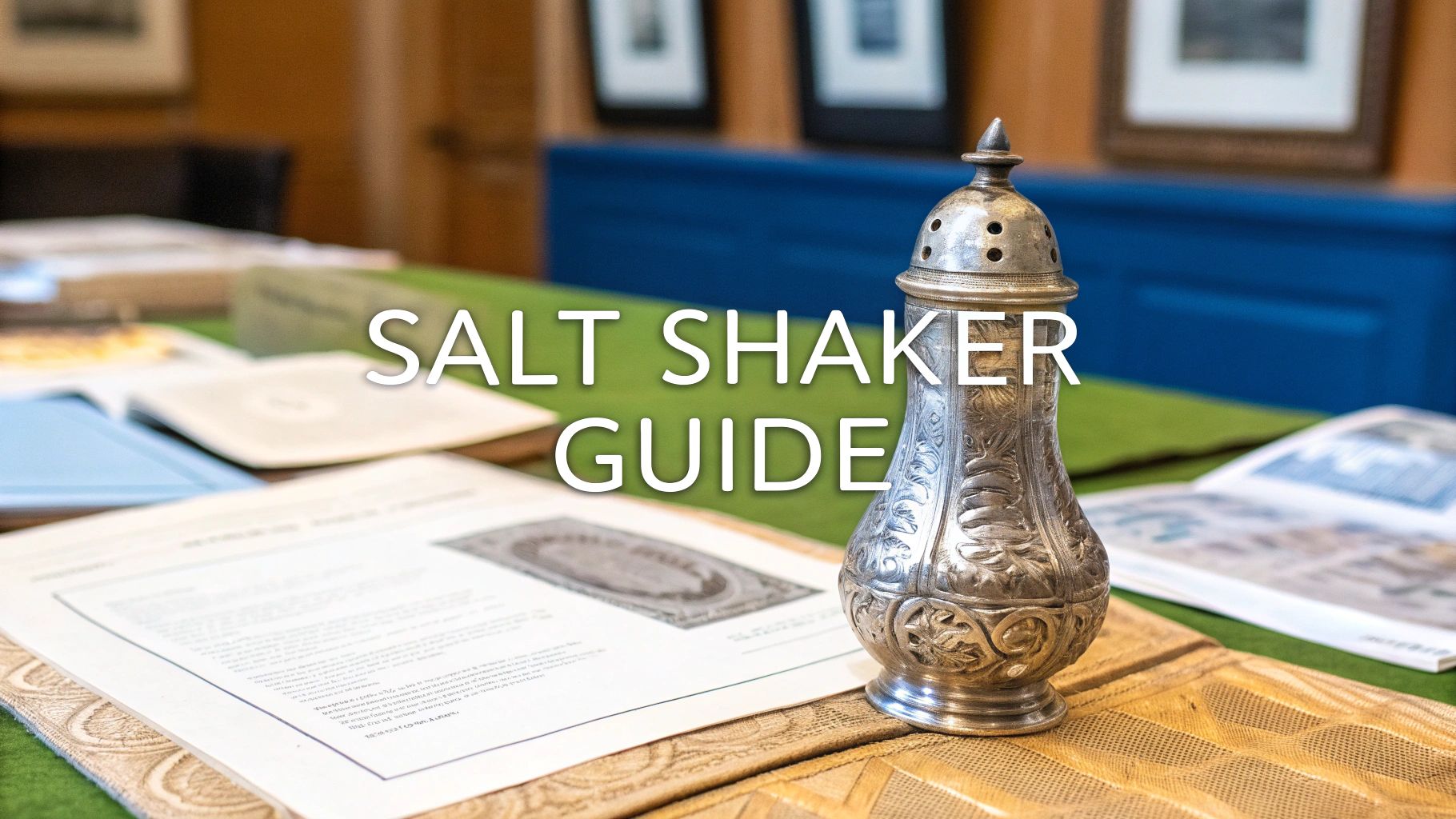
An antique silver salt shaker is so much more than a simple dining accessory. Think of it as a miniature sculpture, a little piece of history that tells a story of craftsmanship, changing social customs, and forgotten artistic trends.
These elegant pieces capture a major shift in how people dined. They mark the moment we moved from open salt cellars to the convenient shakers we still use today—a change that only became possible in the late 19th century.
The Hidden Stories in Antique Silver Salt Shakers
Before shakers, salt was a precious commodity served in open dishes called salt cellars. Placed right in the middle of the table, these were often elaborate vessels meant to show off the host's wealth and status. Guests would take a pinch with tiny, delicate spoons, a formal ritual that highlighted just how valuable salt was.
Everything changed during the Victorian era. The invention of anti-caking agents meant salt could finally flow freely, which paved the way for the perforated top we now take for granted. This simple innovation completely transformed dining etiquette, turning seasoning into a personal, effortless act.
From Utility to Artistry
The very first shakers were all about function, but it didn't take long for artisans to see them as a new canvas. They started turning these everyday objects into intricate works of art, with each era leaving its unique stamp on their design. Understanding this evolution is the first step to truly appreciating what makes each antique silver salt shaker special.
Here’s a quick look at how different periods shaped their style:
- Victorian Era (1837-1901): Think ornate and over-the-top. These shakers are often covered in floral engravings, detailed repoussé (a method of hammering metal from the reverse side), and even figural shapes like animals or people.
- Art Nouveau (1890-1910): This style was all about flowing, organic lines inspired by nature. You’ll see lots of swirling patterns and graceful, asymmetrical forms.
- Art Deco (1920-1939): A complete departure, this era embraced bold geometric shapes and clean lines. Shakers became streamlined, sleek, and symmetrical, reflecting a new, modern elegance.
These tiny artifacts are more than just tableware; they are tangible links to the past. Each shaker captures a moment in time, reflecting the tastes and technologies of the people who used them daily.
When you start exploring these miniature treasures, you're not just looking at old objects. You're uncovering the stories of generations past, one beautifully crafted antique silver salt shaker at a time. This guide is here to help you decode their secrets.
How to Read Silver Hallmarks and Uncover Their Secrets
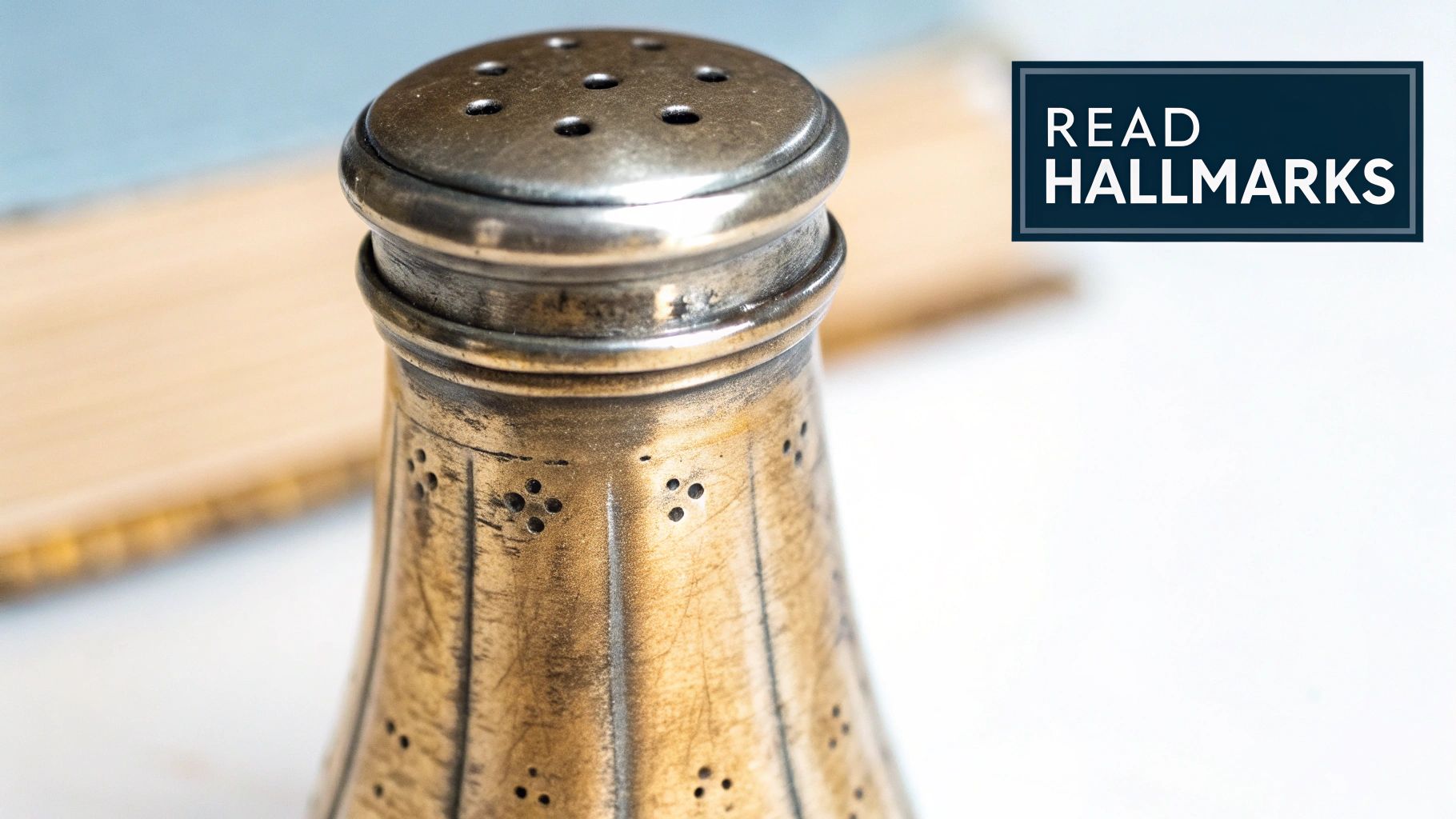
Think of silver hallmarks as a secret language stamped right onto your shaker. Every tiny symbol is a clue that, when pieced together, tells a story about where it came from, who made it, and, most importantly, what it's truly made of. For any collector, learning to read these marks is the single most valuable skill you can develop—it’s what separates a priceless find from a pretty trinket.
These marks were essentially an early form of consumer protection, a guarantee of silver quality. To start deciphering them, you’ll absolutely need a jeweler's loupe or a good magnifying glass. Time and countless polishings have a way of making these stamps incredibly small and faint.
Decoding the Four Key Hallmarks
If you have a piece of British silver, you're in luck, as they set the gold standard for hallmarking. Most pieces will have a series of four or five distinct stamps. Each one answers a critical question about your shaker's journey through time.
Here's a breakdown of what you're looking for:
- The Purity Mark (Standard Mark): This is the big one for value. It confirms the silver content. For British sterling, the classic symbol is the Lion Passant—a walking lion guaranteeing the piece is 92.5% pure silver.
- The Assay Office Mark: This tells you the city where the silver was tested and stamped. A leopard's head means it was London, while an anchor points to Birmingham. Every major city had its own unique symbol.
- The Date Letter: This is simply a letter of the alphabet that corresponds to a specific year. The font, the case (upper or lower), and the shape of the punch around it all change from one cycle to the next, which is how experts can date a piece so precisely.
- The Maker's Mark: These are usually the initials of the silversmith or the workshop that made the shaker. Researching this mark can connect your piece to a famous artisan, like the legendary Paul Storr or Hester Bateman.
A complete, clear set of hallmarks is a game-changer for value. It erases any doubt about the piece's age, origin, and quality, making it infinitely more desirable to serious collectors.
To get more comfortable with these fascinating symbols, you can explore our detailed guide on what hallmarks on silver truly mean. This knowledge is your best tool for navigating the often-confusing world of antiques.
Sterling Silver Versus Silver Plate
One of the first hard lessons for new collectors is learning the difference between solid sterling silver and silver plate. A plated item only has a whisper-thin coating of silver over a base metal like copper, which makes it far less valuable. And once again, the hallmarks tell the real story.
The value of an antique salt shaker really comes down to its material, age, and how rare it is. Sterling silver pieces are king, especially in the US and UK markets, where they make up 60% of premium sales. Being able to spot sterling versus plate is the first step to understanding what your shaker might be worth.
The table below is a quick cheat sheet to help you see the difference right away.
Sterling Silver vs Silver Plate Hallmarks at a Glance
This quick guide will help you distinguish valuable solid sterling marks from the more common silver-plated ones you'll find on antique shakers.
| Hallmark Type | Common Sterling Marks (Examples) | Common Silver Plate Marks (Examples) | What It Means for Value |
|---|---|---|---|
| Purity Guarantee | "Sterling," "925," Lion Passant (UK), Minerva Head (France) | "EPNS" (Electro-Plated Nickel Silver), "EP," "A1," "Quadruple Plate" | Sterling marks confirm high intrinsic and collectible value. Plated marks indicate minimal silver content and lower value. |
| Maker's Marks | Initials within a shield or shape (e.g., "G.A." for George Adams) | Full company names (e.g., "Rogers Bros.," "Reed & Barton") often accompany plating marks. | While some plated pieces from top makers have value, they rarely match their sterling counterparts. |
| Overall Appearance | Marks are typically crisp, clear, and well-organized in a line. | Marks can be less uniform and may include trademarks or patent numbers instead of traditional hallmarks. | Inconsistent or commercial-looking marks are a strong indicator of silver plating rather than solid sterling silver. |
Ultimately, sterling marks feel official and systematic, while plated marks often feel more like a company's brand name. Training your eye to spot this difference is a skill that will pay for itself many times over.
Iconic Makers and Timeless Designs
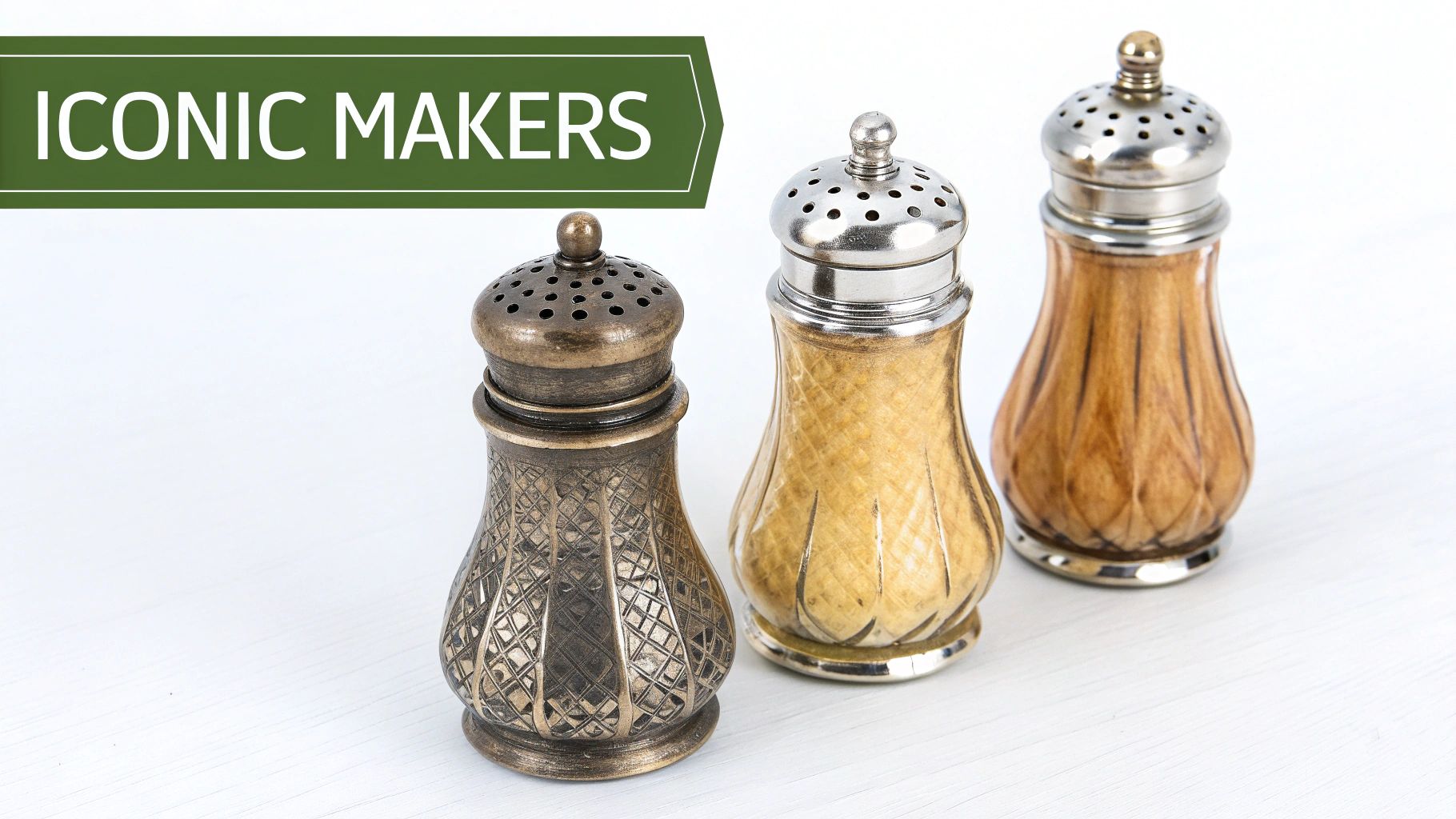
While hallmarks tell you the basics—what it is, where it’s from, and when it was made—the maker’s mark tells you the who. And that's where things get interesting. This is the moment an ordinary object can transform into a signed piece of art from one of history’s most celebrated silversmiths.
Knowing the names behind the craftsmanship is like knowing the difference between a local painter and a Rembrandt. It completely changes the story and, of course, the value of the piece you’re holding.
Some makers are simply legendary in the world of silver. Their work is hunted down by collectors across the globe because they didn’t just make tableware; they defined entire artistic movements. They set the bar for quality and design that everyone else tried to reach. Learning to spot their unique styles is one of the most rewarding parts of becoming a serious collector.
The American Titans of Silver
Here in the United States, a couple of names really dominated the silver scene through the 19th and 20th centuries. When you think of American luxury and craftsmanship from that era, you’re thinking of them.
Gorham Manufacturing Company (Providence, Rhode Island)
Founded way back in 1831, Gorham became an absolute powerhouse in silver, especially during the Victorian era. Their style is anything but subtle.
- Signature Style: Think over-the-top, elaborate designs. We're talking intricate floral patterns (repoussé), detailed little figures, and surfaces covered in decoration. Gorham's shakers are often bold and heavy, a perfect reflection of Gilded Age extravagance.
- Collectible Designs: Keep an eye out for their legendary "Chantilly" pattern. It was one of the best-selling flatware patterns ever, and they often made hollowware like shakers to match. Their figural shakers shaped like animals or people are also huge gets for collectors.
Tiffany & Co. (New York, New York)
It’s a name that means luxury, and for good reason. Tiffany & Co. has been a leader in silver since it was founded in 1837. Their whole vibe tends to be more about timeless elegance than flashy ornamentation.
- Signature Style: They're known for exceptionally high quality, clean lines, and classic shapes. While they could certainly do ornate when they wanted to, Tiffany is really celebrated for a sophisticated, understated look that still feels modern today.
- Collectible Designs: Shakers with Japanese-inspired motifs from the Aesthetic Movement are highly sought after. Simple, elegant sterling patterns are also a big deal. Honestly, any piece with that Tiffany & Co. stamp is instantly more valuable.
European Masters and Their Distinctive Aesthetics
Of course, incredible work was happening across the Atlantic, too. European silversmiths were crafting masterpieces that reflected their own unique cultures and artistic heritage. From Scandinavian cool to British whimsy, these makers bring a totally different flavor to the table.
Georg Jensen (Copenhagen, Denmark)
As a master of both the Art Nouveau and Art Deco movements, Georg Jensen’s work is a love letter to nature and simplicity. His silversmithy, founded in 1904, practically defined the "Scandinavian Design" aesthetic.
- Signature Style: His pieces are organic, often with hammered surfaces and motifs pulled straight from the garden—grapes, blossoms, leaves. Jensen's designs feel like little sculptures, and they have a wonderful weight and feel in your hand.
- Collectible Designs: The "Grape" (Acathe) and "Blossom" (Magnolia) patterns are absolutely iconic. Finding an antique silver salt shaker from Georg Jensen is a true score for any collector who values artistry.
The maker's mark does more than just identify a company; it represents a legacy of design philosophy and a commitment to quality. A Gorham piece tells a story of Victorian grandeur, while a Georg Jensen piece speaks to the quiet elegance of Scandinavian modernism.
Sometimes, the most charming designs come from where you least expect them. A great example is the rare pig-shaped Edwardian set made by Robert Pringle & Sons between the early 1900s and 1940s. These sterling silver pieces are just so whimsical and fun, with detailed engravings that really capture the spirit of Edwardian-era dining. It was a time when British silver craftsmanship was at its peak, and high society tables were nothing short of opulent. You can learn more about these fascinating vintage salt and pepper shakers.
Ultimately, connecting an item to its maker is what lets you appreciate it not just as an antique, but as a small piece of design history.
How to Determine the Value of Your Silver Shaker
Figuring out what an antique silver salt shaker is worth is a bit like playing detective. Every piece holds clues to its past, and learning to read them can tell you if you've got a common tabletop item or a real treasure. Five key factors work together to determine a shaker's market value: material, condition, maker, rarity, and provenance.
It's best to think of these as interconnected gears. A famous maker's mark is a fantastic start, but a big dent or a missing top can send the price tumbling. On the other hand, a rare design from a totally unknown silversmith might fetch a surprisingly high price. It's the combination of all five elements that paints the full picture.
Material and Condition
First things first: what is it actually made of? As we’ve covered, solid sterling silver will always be in a different league than silver plate. That distinction is the absolute bedrock of any valuation.
After that, you have to get critical about its physical condition. You need to inspect your shaker like a hawk, looking for any flaw that could drag down its value. Even tiny imperfections can be a dealbreaker for a serious collector who is often hunting for a perfect specimen.
Here are the main things to look out for:
- Dents and Dings: Gently run your fingers over the entire surface. Small dents from being dropped are pretty common, but deep creases or anything that compromises the shaker's shape are serious red flags.
- Pitting: Salt is incredibly corrosive to silver. Check inside the shaker for tiny, permanent pits in the metal. This is a sign of heavy use and can significantly lower the value.
- Repairs: Look closely for tell-tale signs of old repairs, like messy solder marks or parts that just don't seem to match. A professional repair is better than a clumsy one, but nothing beats an original, undamaged piece.
- Engravings: A beautiful, period-appropriate monogram can sometimes add a bit of charm and history. But a sloppy, modern engraving or evidence of an old one being removed will almost always hurt its value.
Maker and Rarity
The maker's mark is your next major clue. A piece clearly stamped "Tiffany & Co." or "Georg Jensen" immediately gets a promotion to a higher tier of collectibility. Famous makers are sought after not just for the name, but for the legacy of quality and design they represent.
But sometimes, rarity can trump even a famous name. A shaker might be valuable simply because it's a bizarre shape, a limited-production design, or one of the few surviving examples from a small, long-forgotten silversmith. In the antiques world, "rare" is a magic word that makes prices climb.
Appraising an antique is about balancing the tangible with the intangible. The weight of the silver provides a base melt value, but the shaker's history, artistry, and rarity create its true collector value.
Provenance and Market Trends
Finally, provenance—the documented history of ownership—can add a tremendous amount of value. Did your shaker once belong to a famous family or come from a historic estate sale? If you have letters, receipts, or old photos to back it up, you have something incredibly special that can elevate its worth exponentially.
Market demand also plays a huge role. In major markets like London and New York, these shakers have appreciated 15-20% annually over the past decade, driven by demand from museums and high-end decorators. Experts recommend the magnet test—no attraction confirms sterling purity—and a coin-tap yielding a high-pitched ring for authentication. To put this in perspective, a Reed and Barton 20th-century sterling set from a similar era might command $2,000-$2,500, highlighting how a unique shape and a prestigious maker can dramatically boost value. You can find more insights about these fascinating vintage salt and pepper shakers.
Estimated Value Ranges for Antique Silver Salt Shakers
To give you a starting point, I've put together a quick reference table. Remember, these are just estimates for pieces in pristine condition, and a specific item's value can easily fall outside these ranges based on the factors we've discussed.
This table provides estimated market values for antique silver salt shakers based on material, maker, and historical period, offering a quick reference for collectors.
| Era / Style | Common Makers | Material | Estimated Value Range (Pristine Condition) |
|---|---|---|---|
| Georgian (1714-1830) | Hester Bateman, Paul Storr | Sterling Silver | $400 - $1,500+ (per pair) |
| Victorian (1837-1901) | Gorham, Kirk & Son | Sterling Silver | $150 - $600 (per pair) |
| Art Nouveau (1890-1910) | Unger Bros., Whiting Mfg. | Sterling Silver | $200 - $800 (per pair) |
| Art Deco (1920-1939) | Georg Jensen, Buccellati | Sterling Silver | $300 - $1,200+ (per pair) |
| Silver Plated (Various Eras) | Reed & Barton, Rogers Bros. | Silver Plate (EPNS) | $20 - $75 (per pair) |
Think of this chart as a compass, not a map. It will point you in the right direction, but the real journey of discovery lies in analyzing the unique details of your specific piece.
Caring For Your Antique Silver Collection
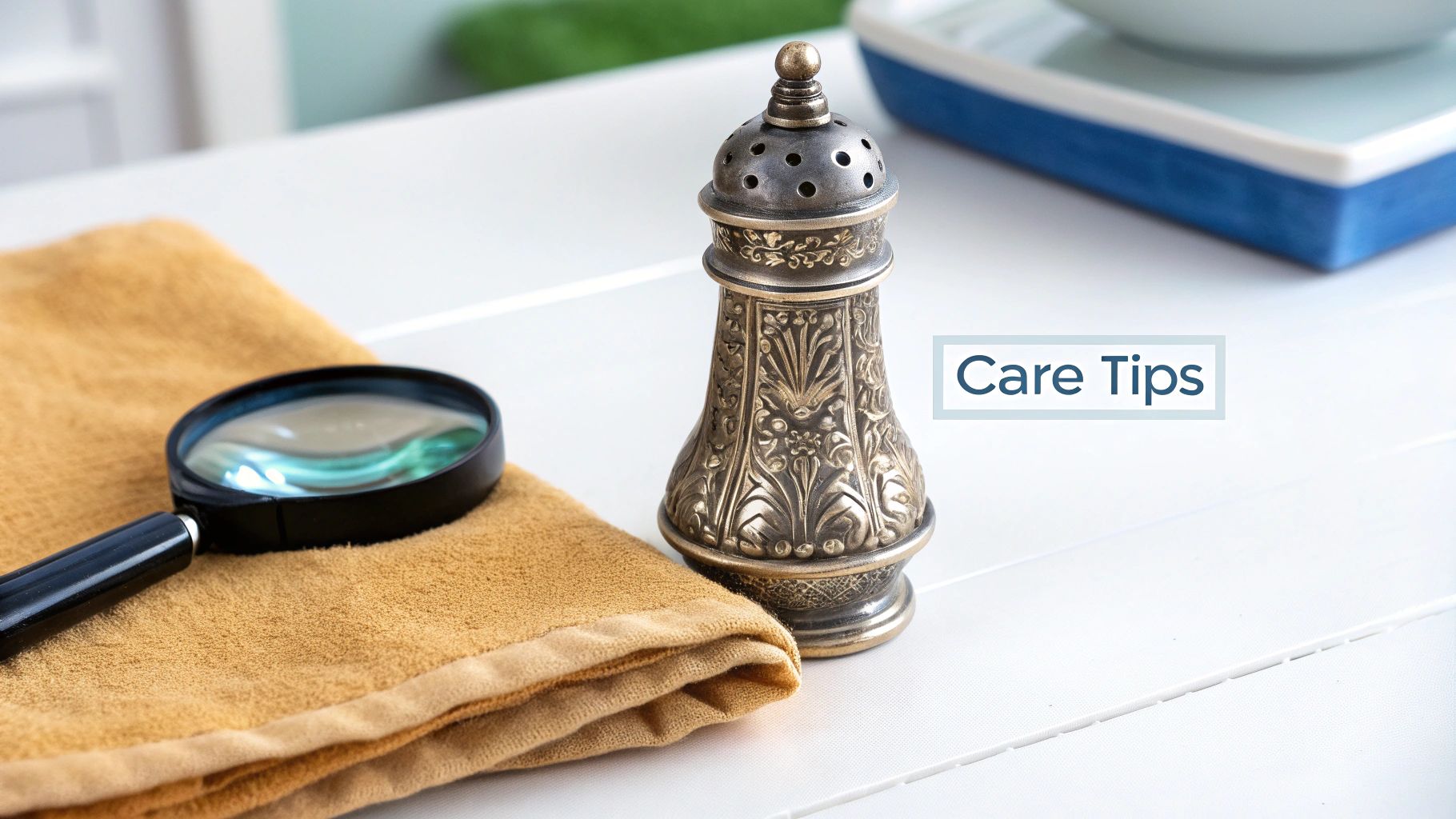
When you own an antique silver salt shaker, you're not just a collector—you're the current custodian of a little piece of history. Proper care isn’t about making it look brand new. It's about preserving its integrity and story for the next generation. The good news is, it's a lot easier than you might think and doesn't involve any harsh chemicals or aggressive scrubbing.
The golden rule is simply to be gentle. I always tell people to think of the silver's surface like delicate skin. You wouldn't scrub it with something abrasive, and the same goes for your antiques. Rubbing too hard, especially with the wrong cleaner, can permanently erase fine, hand-chased details or even wear through the silver on plated pieces.
The Do's of Silver Care
Good maintenance comes down to a soft touch and the right supplies. The whole point is to clean the piece without harming the metal or its unique, aged character. Follow this approach, and your collection will stay beautiful and hold its value.
Here are the essential things you should always do:
- Do Wash Before Polishing: Always give your shakers a gentle bath in warm water with a mild, phosphate-free soap first. This gets rid of any surface dust or grime that could act like sandpaper during polishing.
- Do Use a Quality Silver Polish: It's worth investing in a reputable, non-abrasive silver polish made for fine antiques. These formulas are designed to lift tarnish without etching the metal underneath.
- Do Use Soft Cloths: A clean, soft cotton cloth or sponge is your best friend for applying polish. To finish, grab another fresh, soft cloth to gently buff the shaker to a warm luster.
That soft, lovely glow that old silver gets over time? That's called patina. It settles into the little nooks and crannies of the design, and serious collectors absolutely cherish it as a sign of authenticity and age. If you polish too aggressively, you'll strip it right off, which can seriously diminish an item's character and value.
The Don'ts of Silver Care
Knowing what not to do is every bit as important as knowing what to do. So many of those household cleaning "hacks" you see online are a complete disaster for antique silver and can cause damage you can't undo.
Steer clear of these methods to protect your treasures:
- Don't Use Toothpaste or Baking Soda: I can't stress this enough. They are far too abrasive and will cover the surface in tiny scratches, permanently dulling the finish.
- Don't Put Silver in the Dishwasher: The combination of harsh detergents and high heat is brutal on a silver finish. It will come out looking pitted and lackluster, especially a delicate antique salt shaker.
- Don't Use "Silver Dips": These chemical baths are incredibly harsh. Yes, they work fast, but they strip away everything—the good patina right along with the bad tarnish—and can even eat into the silver itself.
For a deeper dive, check out our complete guide on how to clean antique silver the safe and effective way. The principles are the same whether you're caring for a shaker or another fine piece. For example, the same considerations for material and condition apply when valuing something like a mixed-metal sterling silver and gold pendant.
By following these simple rules, you can confidently maintain the beauty and history of your collection for years to come.
Where to Sell or Insure Your Silver Shakers
So, you’ve uncovered the story and value behind your antique silver salt shaker. Now what? You're at a crossroads: do you sell it, or do you keep it safe as a cherished part of your collection? There's no single right answer—it really comes down to your personal goals.
Whether you're looking to cash in or protect your investment for the long haul, a little strategy goes a long way. Let's walk through the options to help you make the best decision for your unique piece.
Choosing the Right Place to Sell
Deciding where to sell is just as important as deciding to sell. You wouldn't take a rare painting to a garage sale, and the same logic applies here. The right venue can make all the difference in the final price and how much work you have to put in.
Here are the most common paths collectors and resellers take:
- Online Marketplaces (Etsy, eBay, Ruby Lane): These platforms put you in front of a massive global audience. You’re in the driver's seat—you handle the photos, the description, and the shipping. It’s more hands-on, but you also keep a bigger slice of the final sale price. This is a great route for common-to-mid-range shakers with clear, easy-to-identify hallmarks.
- Specialized Auction Houses: If you have something truly special—a rare maker, an unusual design, or a piece with a documented history—an auction house is probably your best bet. Their experts take care of everything, from research and marketing to finding serious collectors who are ready to compete for top-tier items.
- Local Antique Dealers: Selling to a dealer is often the quickest, most straightforward way to get cash in hand. Of course, they have to buy low enough to make a profit when they resell, but it saves you the time and effort of listing, packing, and shipping.
Key Takeaway: Think about your shaker's value and how much time you want to invest. For the heavy hitters, an auction house's expertise is worth it. For more everyday treasures, online marketplaces give you incredible reach.
Getting Ready to Sell or Insure
No matter where you choose to sell, a great listing is everything. Your photos need to be sharp, clear, and well-lit. Don't just take one picture; capture the shaker from all angles, get a close-up of the hallmarks, and show off any beautiful details or notable flaws. Your description should bring the piece to life. Talk about the maker, the period it’s from, and any interesting history you know.
Antique silver salt shakers are a surprisingly hot market. Did you know that sterling silver pieces make up over 70% of the high-end sets sold on major platforms? You can get a feel for the market for sterling silver shakers to see what's currently popular.
On the other hand, if you've decided these shakers are keepers, you need to protect them. Don't just assume your standard homeowner's policy has you covered—it almost certainly doesn't for the full antique value. You’ll need a special rider or a dedicated collectibles policy.
To get that coverage, you'll need a formal written appraisal from a certified professional. This document is the proof of value your insurance company needs to protect your collection against theft, damage, or loss. It's the only way to ensure your little pieces of history are truly safe. For more tips on getting the best value, check out our guide on where to sell antiques for the best price.
Got Questions About Your Antique Silver Salt Shakers?
Diving into the world of antique silver always brings up a few questions. It’s totally normal! Getting good answers is the quickest way to feel more confident, whether you're buying, selling, or just admiring a family heirloom.
Let's tackle some of the most common things people wonder about.
How Can I Tell if My Shaker Is Sterling Silver or Silver Plated?
This is the big one, but thankfully, there's a simple way to know for sure: check for hallmarks. A real sterling silver piece will proudly wear its mark.
- Sterling Marks: Keep an eye out for the word "Sterling" or the number "925." In British silver, you'll see a lion walking sideways (the lion passant). These marks guarantee the piece is made of 92.5% pure silver.
- Plated Marks: If you see stamps like "EPNS" (which stands for Electro-Plated Nickel Silver), "A1," or just "Silver Plate," you're looking at a piece with a thin layer of silver over a different base metal.
Quick Tip: Grab a small magnet. Sterling silver isn’t magnetic, so if the magnet snaps right onto your shaker, it’s a dead giveaway that it's silver-plated.
Should I Actually Use My Antique Silver Salt Shakers?
You can, but you really have to be careful. Salt is the arch-nemesis of silver. It's incredibly corrosive and, over time, will eat away at the metal, causing permanent damage called pitting. This can seriously hurt the shaker's value.
If you can't resist using them for a special dinner, make sure to empty and clean them the moment the meal is over. Honestly, most collectors keep them purely for display or hunt down little glass liners to pop inside. The glass acts as a barrier, protecting the silver from the corrosive salt.
What Is the Difference Between a Salt Shaker and a Salt Cellar?
It all comes down to the design and when it was made. For centuries, the standard was the salt cellar—a small, open bowl of salt that sat on the table. You'd use a tiny, delicate spoon to serve yourself.
The antique silver salt shaker we know today, with its little holes on top, is a much newer invention, really only appearing in the late 19th century. They only became practical once anti-caking agents were mixed into salt, which finally allowed it to flow freely instead of clumping. It's a small change that completely reshaped the dinner table!
Ready to uncover the stories hidden in your own heirlooms? The experts at Curio have created an app that makes identifying antiques as easy as snapping a photo. Get instant identification, historical context, and value estimates right from your pocket. Download Curio today and let your antiques tell their story. Learn more about Curio.