That vase you picked up at a flea market or inherited from your grandmother is more than just a pretty object—it's a little piece of history. Officially, a ceramic antique vase is one that's at least 100 years old, but really, it's a tangible link to the artists and cultures of a bygone era. Learning to read its story is like a fascinating detective game where every little detail is a clue.
What Story Is Your Ceramic Antique Vase Hiding?
Think of this guide as your first toolkit for uncovering the secrets locked inside your pottery. You're the detective, and the vase is the mystery. The clay it's made from, the elegance of its shape, and the tiny marks on its base are all critical clues waiting for you to find them. Figuring out where a vase came from is the only way to truly understand its story and its worth.
We'll walk you through the key concepts you need to piece together your vase's past. The whole process might seem a bit intimidating at first, but it’s actually more straightforward than you might think. You don't need an art history degree—just a keen eye and a bit of patience.
Your First Steps in Identification
Before you go down the rabbit hole of research, a quick once-over can point you in the right direction. This is all about gathering your initial evidence, not making a final call.
So, where do you start? Just start looking. A simple way to begin is with a quick checklist to get your bearings.
Quick Identification Checklist for Your Vase
Here are the first things you should examine to start your investigation. Think of this as your initial "sweep of the crime scene" to gather the most obvious clues.
| Key Feature | What to Look For |
|---|---|
| Material and Weight | Does it feel heavy and solid like stoneware, or light and delicate like porcelain? Hold it up to a light—can you see a faint glow through it? |
| Maker's Mark | Flip it over carefully. Look for any stamps, signatures, symbols, or numbers on the bottom. This is the maker's "fingerprint." |
| Overall Style and Shape | Is the design busy and ornate, hinting at the Victorian era? Or is it clean and geometric, screaming Art Deco? The shape tells you a lot about its time. |
This isn't about becoming an expert overnight. It's about learning what to look for. For example, a heavy, unmarked, earthy-toned vase tells a completely different story than a delicate, brightly painted porcelain piece with a clear factory stamp.
A vase isn't just a container for flowers; it's a time capsule. Every element, from the type of clay to the style of the glaze, tells you something about the world it came from and the person who made it.
Once you start recognizing these basic traits, you'll be well on your way from simple curiosity to the thrill of real discovery.
The Three Main Families of Antique Ceramics
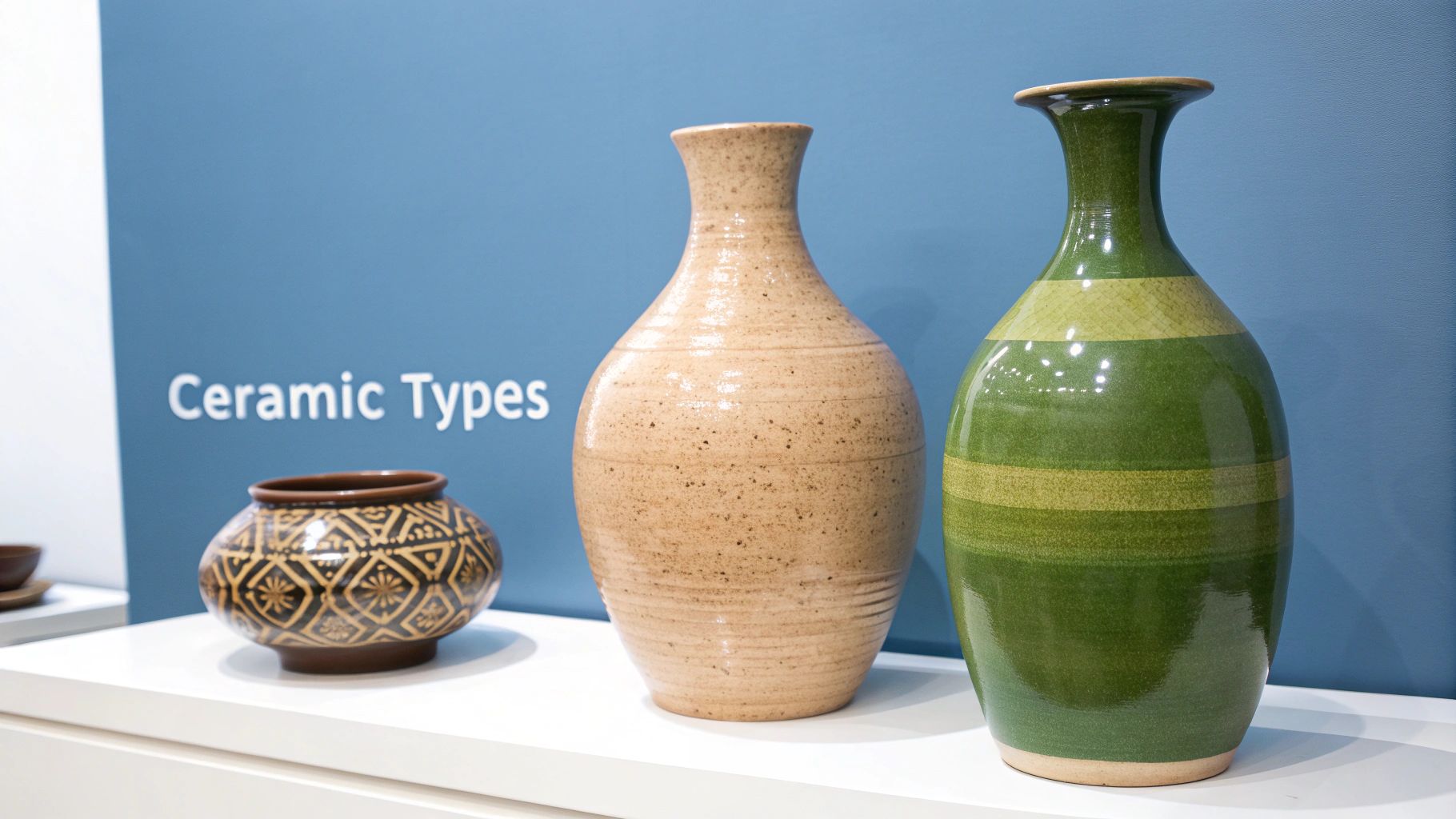
When you first pick up an antique ceramic vase, pay attention to how it feels. Its weight, texture, and even the sound it makes when you gently tap it are the first big clues to its identity. Not all ceramics are the same, and learning to spot the differences is one of the most important skills you can develop. Think of the material as the vase’s DNA—it tells a story about its age, where it came from, and what it was made for.
Most antique ceramics fit into one of three main groups: earthenware, stoneware, and porcelain. Each one has its own unique character, defined by the type of clay used and, most importantly, the intense heat of the kiln.
Earthenware: The Oldest and Most Porous
Earthenware is the original pottery, the kind people have been making for thousands of years. It’s fired at relatively low temperatures, typically between 1,000–1,200°C. This process doesn't fully vitrify the clay, meaning the particles don't completely melt into a glassy state. The result? It stays porous.
Think of a classic terracotta flowerpot. It’s a bit soft, you can scratch it fairly easily, and it will definitely soak up water unless it's glazed. Antique earthenware often has a rustic, earthy charm and tends to be thicker and heavier to make up for its inherent fragility. If you give an unglazed spot a light tap, you’ll hear a low, dull thud.
Stoneware: The Sturdy Workhorse
Stoneware is the tough middle sibling of the ceramic world. Fired at higher temperatures of around 1,200–1,300°C, the clay particles fuse together, making it hard, dense, and non-porous. This means it’s naturally waterproof, even without a glaze.
Picture your favorite heavy coffee mug or an old-fashioned pickle crock. That’s stoneware. It’s built to last, which made it the go-to material for everyday items that needed to be durable. Tapping a piece of stoneware gives you a much clearer, higher-pitched "clink" than earthenware. Understanding The Difference between Ceramic and Stoneware is a great next step, as it really breaks down these core properties.
Key Takeaway: It all comes down to the firing temperature. Low heat gives you porous earthenware, medium-high heat creates dense stoneware, and scorching-hot kilns produce translucent, glass-like porcelain.
Porcelain: The Pinnacle of Elegance
Porcelain is the most refined and difficult ceramic to master. It’s made from a special white clay called kaolin, which is fired at blistering temperatures up to 1,450°C. This extreme heat transforms the clay into a fully vitrified material that is incredibly hard, brilliantly white, and often translucent.
Imagine the delicate teacups you’d handle with extra care. That’s porcelain. It’s famous for its smooth, glassy surface and its ability to be shaped into incredibly thin, graceful forms. A classic test for identifying a ceramic antique vase as porcelain is to hold it up to a light source; you can often see the shadow of your fingers right through the wall of the piece. For a closer look, our guide on porcelain vs china explores the subtle but important differences.
How to Decode Maker's Marks and Signatures
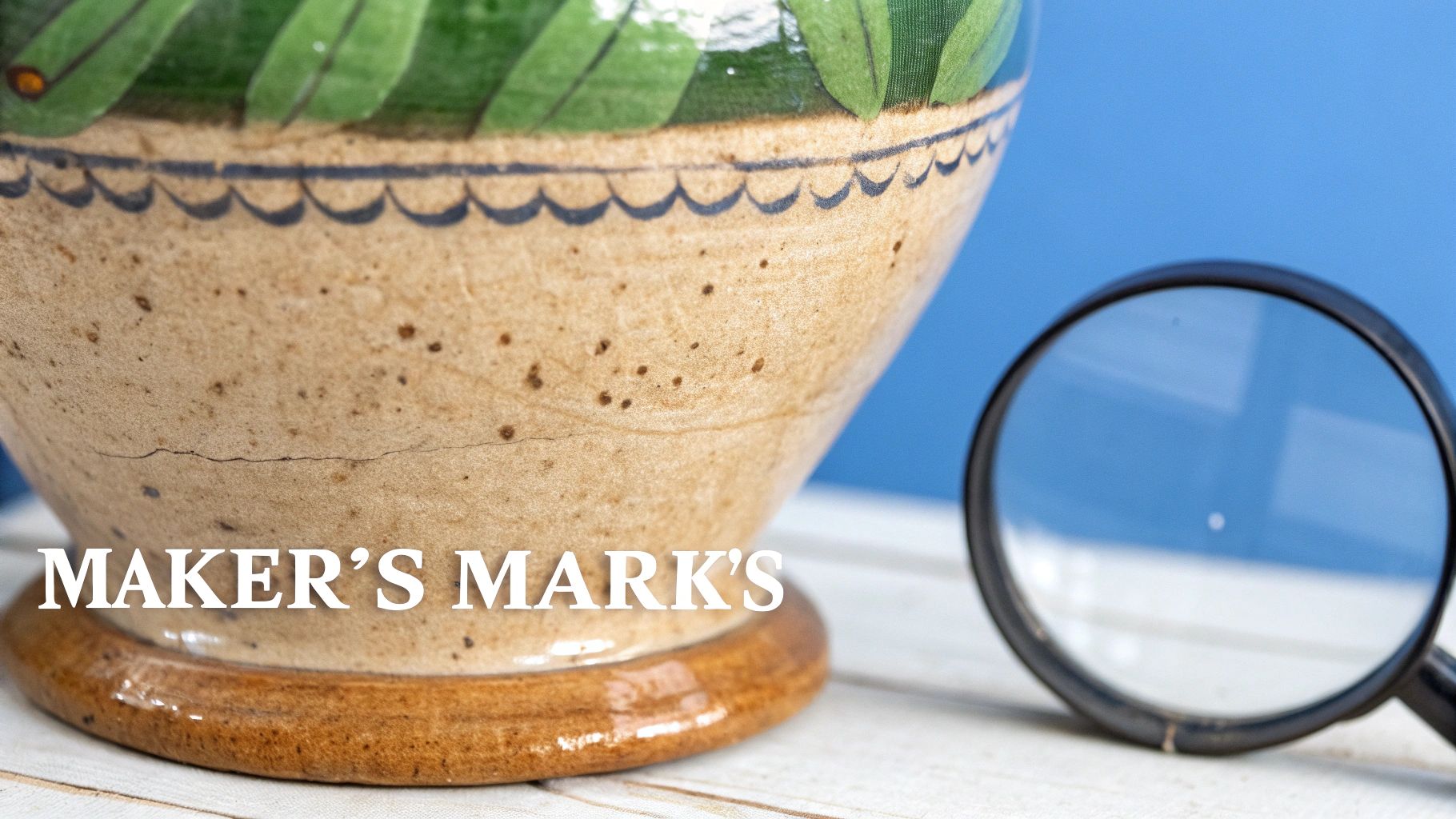
For any collector, the most exciting part of examining a piece is flipping it over to look at the bottom. That little symbol, scrawled signature, or string of numbers is the maker’s mark—it's the artist or factory’s fingerprint, and it’s the key to the vase's entire story.
You'll find these marks come in all shapes and sizes. They can be anything from an elaborate factory logo, like the famous crossed swords of Meissen, to the simple, hand-painted initials of a studio potter. Learning to decipher these symbols is one of the most essential skills you can develop.
This mark isn't just a name. It’s a clue that helps unlock a vase's age, its history of ownership (provenance), and ultimately, its value. The maker's mark is often the very first thing an appraiser looks for when authenticating a potentially valuable piece.
Inspecting and Capturing the Mark
To figure out what a maker's mark on a ceramic antique vase means, you first need to get a really good look at it. Even a faint, worn-down impression can be the clue you need, so don't rush this step.
First things first, find a soft, stable surface—a folded towel works perfectly. Grab a magnifying glass and a bright, but not harsh, light to closely inspect the base for any stamps, painted marks, or etched signatures. It's not uncommon for marks to be faded or partially hidden under the glaze.
Once you find it, your next job is to take a high-quality picture. This photo becomes your most important tool for research.
- Clean Gently: A soft, dry brush is all you need to clear away any surface dust. Steer clear of water or cleaners, which can easily damage old, unglazed marks.
- Use Good Lighting: Nothing beats natural daylight. If that's not an option, place a lamp off to the side. This creates soft shadows that can make an impressed mark pop. A direct camera flash will just cause glare and hide the details.
- Get a Sharp, Focused Photo: Keep your phone steady and tap the screen right on the mark to make sure it's in perfect focus. Snap a few pictures from slightly different angles—you never know which one will capture the crucial detail.
A crystal-clear photo is exactly what an identification tool like the Curio app needs. When you upload the image, the app searches its massive database to find a match, which can save you from spending hours scrolling through websites.
Expert Tip: Don't get discouraged by a partial or hard-to-read mark. Even just a piece of a symbol can be enough for an expert or a good identification app to recognize the pattern and lead you to the right maker.
From Symbol to Story
With a clear photo in hand, the real detective work can start. You can manually compare your mark to online databases and reference books, but for a head start, you can check out our guide to common markings on pottery to see what symbols from famous makers look like.
Pinpointing the maker is a game-changer. It opens the door to researching the factory's history, its well-known styles, and exactly how your ceramic antique vase fits into the timeline. That tiny mark on the bottom instantly transforms a beautiful object into a tangible piece of history.
Placing Your Vase in a Historical Timeline
Every single curve, color, and pattern on an old ceramic vase tells a story. Think of its style like a fashion statement—just like bell bottoms scream 1970s, the design of a vase can pinpoint the era it came from. Learning to recognize these styles is how you start to place your piece in history, giving it a real time and place in the world.
This isn't about memorizing a bunch of boring dates. It's about developing an eye for the personality of an era. For instance, if you see a vase dripping with gilded details and overflowing with romantic, complex shapes, you can bet it's from the over-the-top Victorian period. On the flip side, a vase with clean, simple lines and a no-fuss attitude practically shouts Mid-Century Modern.
Spotting these visual cues is one of the most satisfying parts of the whole process. It's what turns a simple vase into a tangible piece of history, connecting you directly to the art and culture of its time.
From Victorian Frills to Art Deco Flair
Let's walk through some of the major design movements you’ll likely run into. Each one had its own distinct philosophy, and it shows up loud and clear in their pottery.
- Victorian (c. 1837–1901): Think elaborate, sentimental, and just a little bit cluttered. Victorian vases are known for heavy ornamentation, deep colors like burgundy and forest green, and lots of floral, bird, and human figure motifs. Symmetry and formality were everything.
- Art Nouveau (c. 1890–1910): This style was a direct rebellion against the stiff formality of the Victorians. Art Nouveau is all about organic, flowing lines pulled straight from nature—imagine twisting vines, delicate insect wings, and graceful, asymmetrical forms. Glazes often have a soft, dreamy iridescence.
Here’s a simple trick to tell them apart: Ask yourself, does it look like it belongs in a formal, crowded parlor (Victorian), or a whimsical, enchanted forest (Art Nouveau)? That one question can get you surprisingly close.
Art Deco and Mid-Century Modern Styles
As we roll into the 20th century, design took a sharp turn, reflecting a new world fascinated with technology, speed, and changing social rules.
Art Deco (c. 1920–1940)
Art Deco is pure Jazz Age—it’s bold, glamorous, and obsessed with the future. The style celebrated the machine age with sharp geometric patterns, strict symmetry, and powerful, streamlined shapes. Keep an eye out for zigzags, sunbursts, and high-contrast colors. A true Art Deco ceramic vase feels confident, almost architectural.
Mid-Century Modern (c. 1945–1965)
After the second World War, the mood shifted toward simplicity and function. Mid-Century Modern vases are all about minimalist shapes, earthy tones (think avocado green and burnt orange), and abstract patterns. The driving idea was "form follows function," so these pieces have an honest, uncluttered, and effortlessly cool vibe.
Once you start recognizing these key design signatures, you can build a timeline for your vase even if you can’t find a maker’s mark. Each style tells a unique story, and learning to read them is the first real step to becoming your own antique detective.
How to Assess the Condition and Value of Your Vase
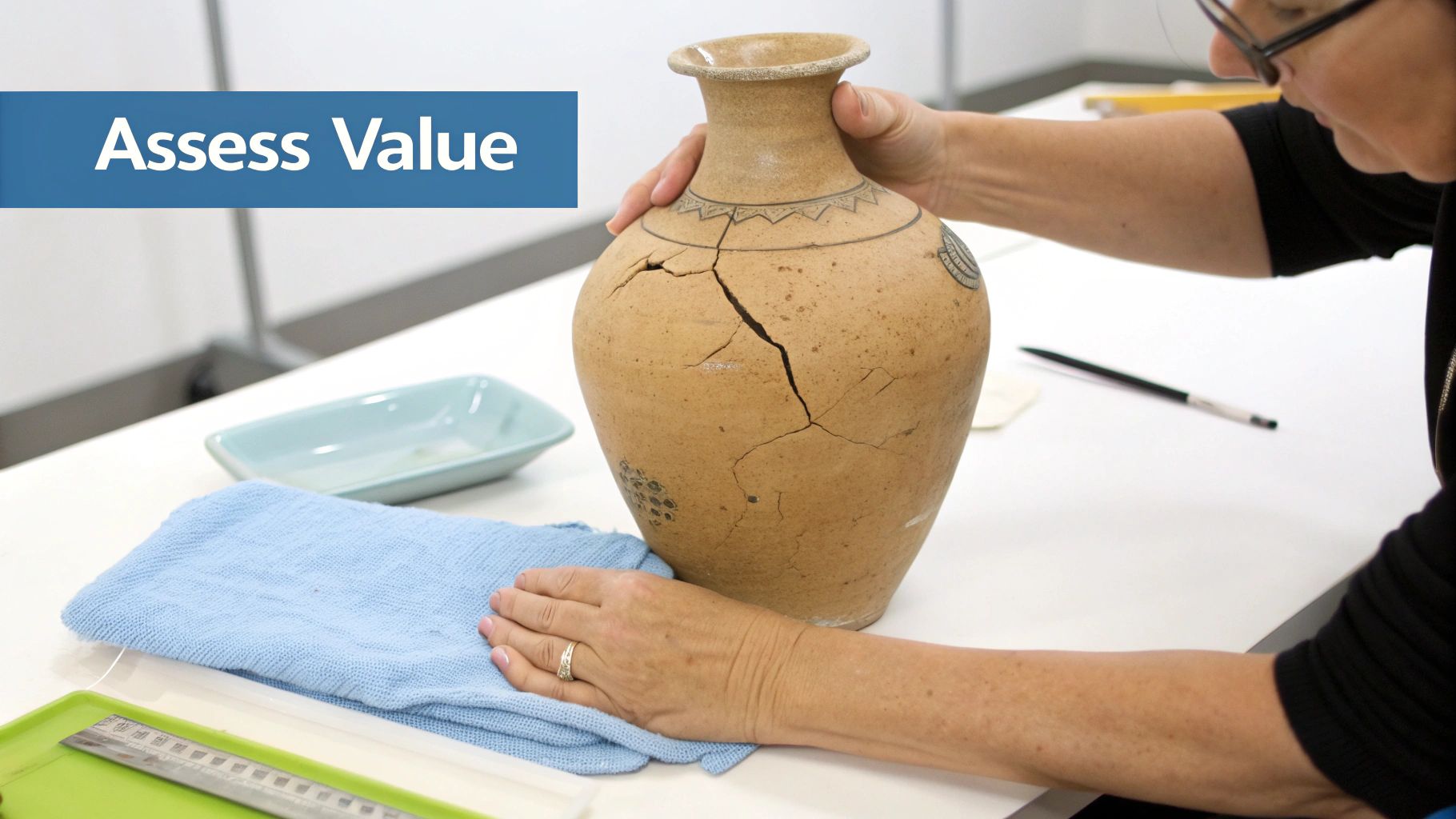
So, you've got a vase and you're wondering if it's a priceless treasure or just a pretty piece for the mantle. The pros look at four key things to figure that out: its rarity, provenance (the story of who owned it), its condition, and the sheer artistry of the piece. Getting a handle on these factors is the first step toward knowing what you really have.
A vase's rarity is often its biggest trump card. If a factory only made a dozen of a certain design, you can bet collectors will take notice. The same goes for provenance. A simple ceramic vase that once belonged to someone famous is suddenly a whole lot more interesting—and valuable—than an identical one with an unknown past.
Reading the Signs of Wear and Tear
Condition is the easiest part for you to check yourself, and it directly affects the price tag. It's time to play detective and look for clues that tell the story of the vase’s journey through time. Even tiny flaws can knock the value down, especially on more common pieces.
Start by carefully running your fingertips along the rim and base. You're feeling for any little chips or nicks that your eyes might miss. Then, get it under a good, bright light and tilt it back and forth to see how the glaze catches the light—this will reveal any subtle imperfections.
Keep an eye out for these common issues:
- Hairline Cracks: These are very fine fractures in the actual body of the vase. They can be tough to spot but are a serious flaw.
- Chips and Flakes: Check for any missing bits of ceramic, paying close attention to the rim, handles, and base, as these are the usual suspects for damage.
- Crazing: This looks like a delicate web of cracks, but it's only in the surface glaze, not the vase itself. Sometimes it was done on purpose for effect, but heavy, age-related crazing can lower the value.
- Repairs: Old repairs are a huge red flag for collectors, especially if they’re clumsy or used glue that has yellowed over time.
But remember, context is everything. A tiny, stable hairline crack on a super-rare 18th-century porcelain vase might be perfectly acceptable. That same crack on a mass-produced piece from the 1920s could make it virtually worthless.
Market Demand and Artistic Quality
Finally, step back and look at the vase as a work of art. Is the painting exceptionally skillful? Does it represent a famous artist or factory at the top of their game? What’s popular right now also matters. The global ceramic vase market is set to hit an estimated USD 6.2 billion by 2035, largely because people are hungry for unique, handcrafted items for their homes.
This demand means a beautiful ceramic antique vase is more than just a historical object; it’s a sought-after piece of decor. If you want to dive deeper into what makes some old vases worth money, we have a guide that breaks it all down.
Caring for Your Ceramic Antique Vase
Owning an antique ceramic vase is like being the custodian of a small piece of history. It’s a wonderful responsibility, but these old pieces need a different kind of care than modern pottery. Think of it less like cleaning and more like careful conservation.
The golden rule? Never use harsh chemicals or abrasive scrubbers. These will absolutely wreck an antique's finish, scratching the glaze, fading hand-painted details, and damaging porous earthenware in ways you might not see until it's too late. Most of the time, a gentle dusting with a soft, dry microfiber cloth is all it needs.
Gentle Cleaning and Safe Display
If you're dealing with more than just dust, you can use a cloth dampened with water and maybe a single drop of pH-neutral soap. Always test this on a hidden spot first, like the very bottom of the base, to see how the ceramic reacts. Once you're done, pat it completely dry with a clean cloth to avoid water spots.
Where you put your vase matters just as much as how you clean it. Keep these simple things in mind to protect your treasure:
- Keep It Out of Direct Sunlight: UV rays are a killer for old pigments. Over time, they will bleach the colors, erasing the vase's vibrancy and a good chunk of its value.
- Find a Stable Spot: Don't place it in a busy hallway or anywhere it could get bumped by kids, pets, or an accidental elbow. A quiet corner or a sturdy shelf is best.
- A Dab of Museum Putty: This stuff is a game-changer. A small, removable ball of museum putty under the base will keep it steady and secure from minor vibrations or jostles.
And if you ever need to move your vase, packing it correctly is non-negotiable. It's worth looking up some essential tips for packing fragile items to prevent a tragedy.
A significant portion of a ceramic antique vase's story is told through its subtle signs of age. While professional restoration can fix major damage, sometimes it's best to preserve the authentic, time-worn character that makes it unique.
The interest in antique ceramics isn't just a niche hobby; it's a booming global market. In fact, North America accounted for 35.54% of market revenue and has seen nearly 80% growth since 2021. With Europe and Asia Pacific also seeing huge gains, it’s clear that protecting your piece isn't just about preserving history—it's a smart investment.
Got Questions? We’ve Got Answers
As you get deeper into the world of antique ceramics, a few questions always seem to surface. It's totally normal. Getting a handle on these common puzzles will give you the confidence to keep digging.
Think of this as your quick-start guide for those "what if" moments that can trip up even seasoned collectors.
What If My Vase Has No Maker's Mark?
So you've turned your vase over and... nothing. No stamp, no signature, no mark of any kind. Don't worry, this isn’t a dead end—it's actually quite common. This just means your detective work will focus on other clues.
Many early pieces, especially anything made before the 19th century, were simply never marked. The same goes for many studio potters who let the work speak for itself. Instead of getting hung up on the missing mark, turn your attention to the object itself:
- Feel and Form: What's it made of? Is it heavy, earthy stoneware or fine, almost translucent porcelain? Look at its shape—are the lines sharp and geometric like an Art Deco piece, or do they curve and flow like something from the Art Nouveau period?
- Glaze and Style: The color, texture, and even how the glaze was applied are huge giveaways. These details can be as distinctive as a signature.
- An Unmarked Clue: Sometimes, the lack of a mark is the clue. For certain makers or eras, leaving a piece unmarked was standard practice. In these cases, the absence of a stamp can tell you as much as its presence.
Can I Actually Put Flowers in My Antique Vase?
It's tempting, I get it. You have a beautiful old vase, and you want to see it filled with fresh flowers. But my strong advice is: don't. The risk of water damage is just too high, and it can permanently ruin the vase and tank its value.
Water is the enemy of porous ceramics like earthenware. It can seep into the clay, causing it to sweat or "weep" on the outside. Worse, minerals in the water can leave behind a crusty, permanent stain on the inside glaze that’s impossible to clean without damaging the piece.
If you absolutely must use it for a bouquet, there’s a safe way to do it. Just find a smaller, watertight container—a simple glass jar or plastic cup works great—and place it inside the antique vase. Fill that inner container with water, and you can enjoy your flowers without putting your treasured ceramic at risk.
Feeling stuck with an unmarked vase or just need a quick valuation? The Curio app is like having an antiques expert in your pocket. Snap a photo to find out your vase's story and get a value in seconds. You can download Curio and start exploring at https://www.curio.app.