Japanese silver hallmarks are the tiny stamps you'll find on silver pieces that tell you about their purity, who made them, and where they came from. The key identifiers to look for are often character-based marks, like 'jungin' (純銀) on older items, or numerical stamps such as '950' on more modern export-quality silver. Being able to read these marks is crucial for dating and valuing antique and vintage silver from Japan.
Your Guide to Identifying Japanese Silver Marks
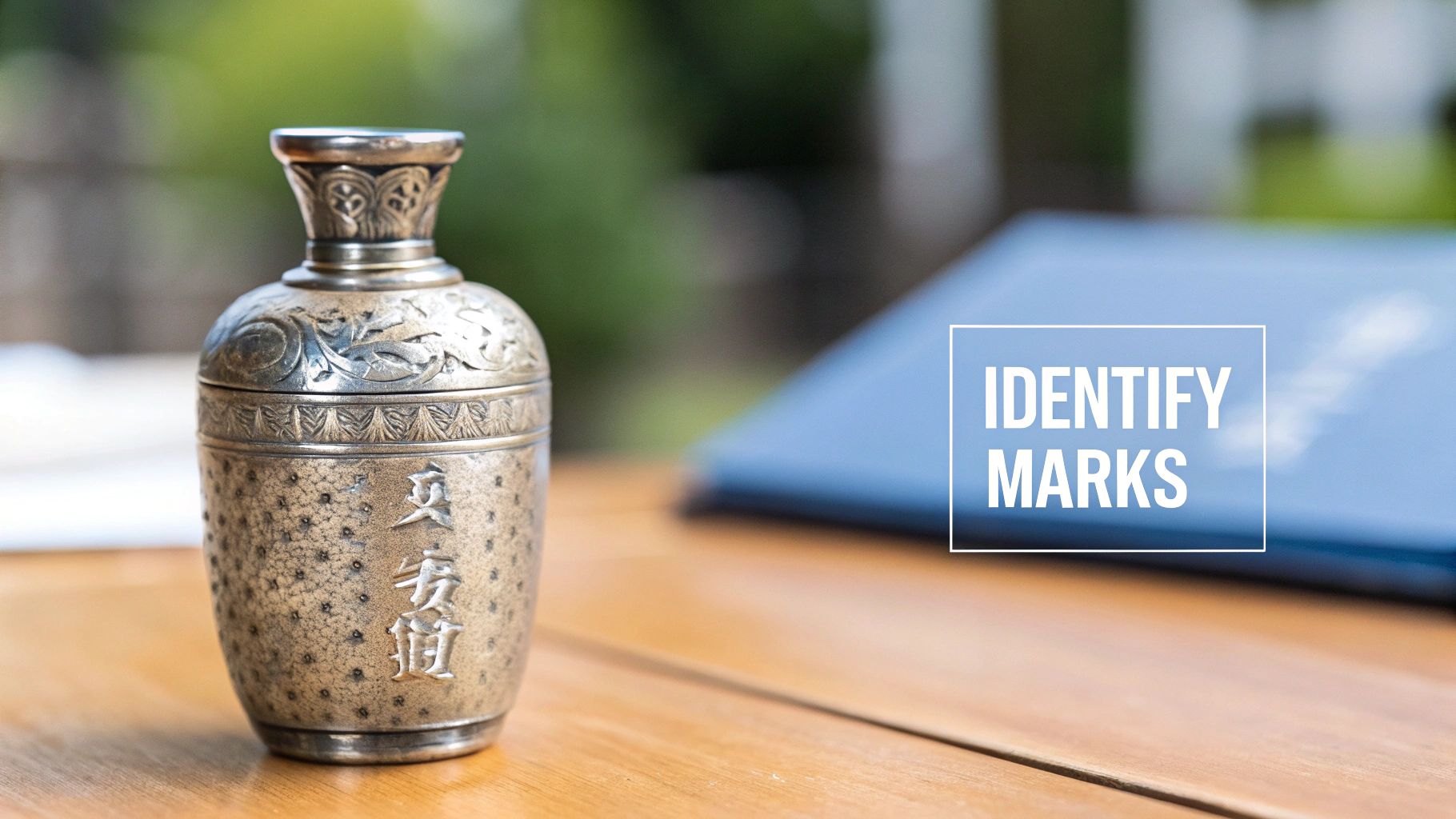
Trying to figure out the small, detailed marks on a piece of Japanese silver can feel like you're trying to crack a code. But every single one of those symbols tells a part of the item's story, whether it was crafted during the artistic explosion of the Meiji era or produced for the global market in the 20th century. Getting a handle on these hallmarks is the only way to accurately identify and value your pieces.
Think of this guide as your go-to reference, built for collectors, appraisers, and anyone fascinated by Japanese silver. We'll walk through the whole range of japan silver hallmarks, giving you the practical tools you need to tell one historical period or maker from another. If you're just starting out, getting a feel for what hallmarks on silver are in general is a great first step.
What You Will Learn in This Guide
I've structured this reference so you can jump straight to the information you need. Whether you're looking at a family heirloom or a recent find, this guide will help you:
- Trace Historical Evolution: See how the marks changed over time, from traditional characters like 'jungin' (純銀) during the Meiji period to the standardized numeric system and the official Japan Mint flag mark that came along in 1928.
- Identify Key Makers: Learn to recognize the signatures of famous workshops and artists. A known maker can elevate an item's value far beyond just its silver content.
- Authenticate and Value with Confidence: I'll show you how to spot common red flags and apply your knowledge of hallmarks to date and appraise your silver with much more certainty.
By the time you're done here, you'll be able to read the story stamped onto your silver, turning what might seem like just another object into a tangible piece of history.
A Brief History of Japanese Silver Marks
To really get a handle on japan silver hallmarks, you have to understand the history behind them. The marks themselves tell a story about Japan's journey from an isolated nation to a global exporter. For centuries, before the late 1800s, Japan didn't have a formal, government-run hallmarking system like you’d find in Europe. Quality wasn't guaranteed by an official stamp, but by the reputation of the artisan or the workshop—a tradition that, in many ways, continues today.
The Meiji period (1868–1912) changed everything. As Japan opened its doors to the West, its craftsmen began creating stunning silver pieces specifically for international buyers and world fairs. This was the golden age of Japanese silver. The most respected mark from this time was ‘jungin’ (純銀), two characters that literally mean "pure silver." This wasn't a government standard; it was a maker's personal guarantee of exceptional quality, often indicating a fineness close to 100%—far purer than the sterling standard used in the West.
The Move Toward a Standard System
After the Meiji era, during the Taishō (1912–1926) and early Shōwa (1926–1989) periods, Western influence on trade became much stronger. Japanese silversmiths started using numeric purity marks, like "950," so their pieces would be easily understood by international customers. It was a practical shift, driven by the need to compete in a global market where buyers expected to see standardized marks.
This gradual change led to a major milestone for Japanese silver. The government realized that an official, unified system was needed to guarantee quality and make exporting easier. Relying on a maker's reputation alone just wasn't enough anymore. This decision paved the way for the modern hallmarking system we see today.
The Official Japan Mint Hallmarking System
Compared to Europe, Japan was a late arrival to the world of formal hallmarking. The modern system was officially established by a Ministerial Decree on June 29, 1928, and the standards were updated again in 1954. By the mid-20th century, Japanese law recognized several levels of silver purity: 1000, 950, 925, 900, and 800 parts per thousand, which brought them in line with international standards.
Starting in 1929, the Japan Mint took over the job of assaying commercial silver. Pieces that passed the test were stamped with a mark featuring the Japanese national flag, confirming they had been officially certified. For a collector, spotting a piece with both a number like "950" and this flag mark is a dead giveaway that it was made for export after 1929. If you're interested, you can dive deeper into the history and meaning of various silver hallmarks from around the world to see how Japan's system compares.
This official system was a game-changer. The Japan Mint's flag is a clear sign you're looking at a 20th-century piece that has been officially tested, giving you a reliable guarantee of its silver content. For anyone trying to identify japan silver hallmarks, knowing the difference between the early character-based marks and these later government stamps is the first, most important step in dating and valuing any piece.
Decoding Pre-Modern Japanese Silver Marks
Before Japan adopted the numeric purity standards common in the West, identifying a piece's origin and quality meant learning a different language of marks. The hallmarks used before the official 1928 system weren't government stamps; they were guarantees of quality made by the artisans themselves. For collectors, these early marks, especially from the Meiji period, are the real treasures.
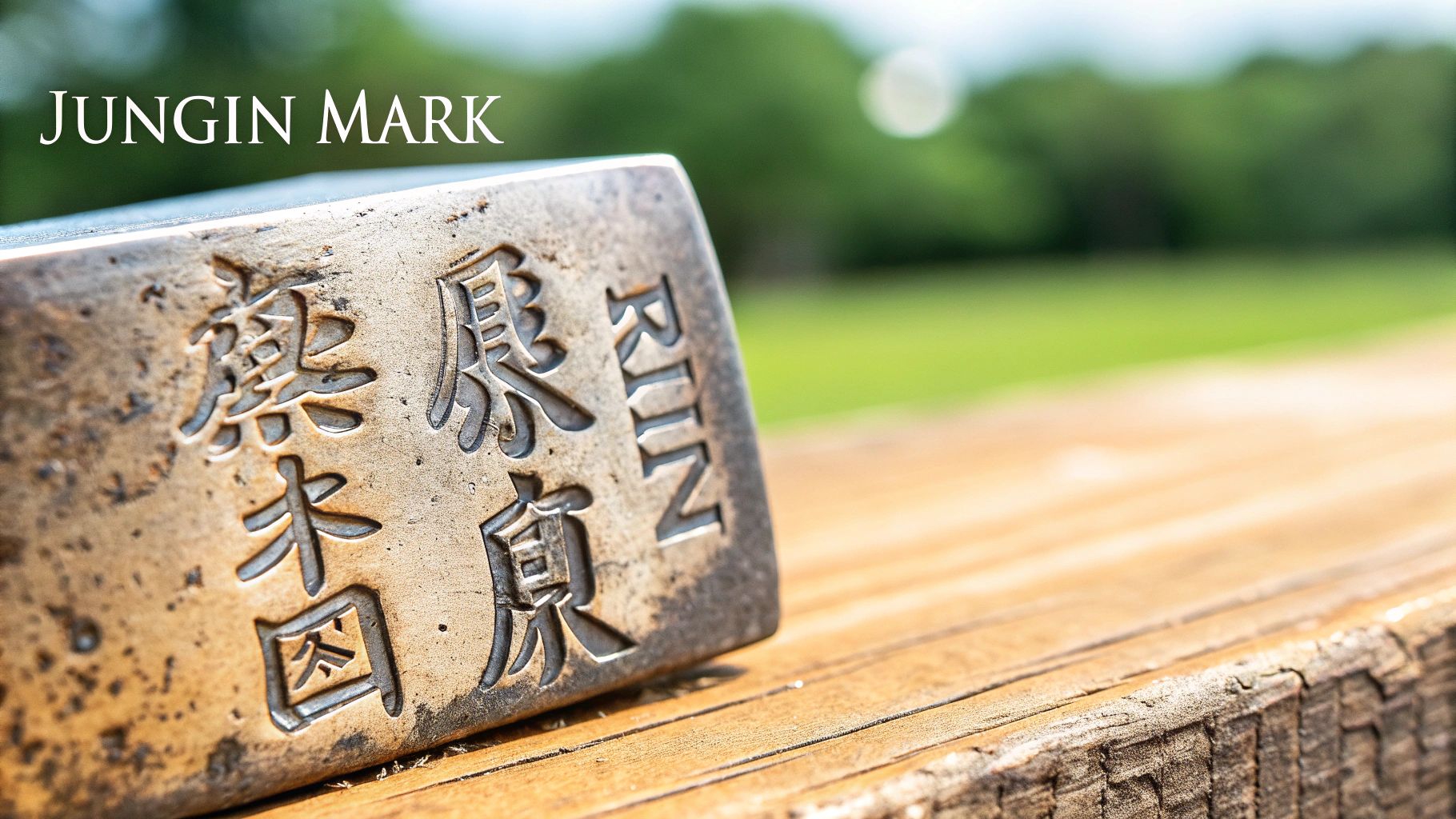
Think of this section as your visual dictionary for these important early japan silver hallmarks. Knowing what you're looking at is the key to telling a valuable Meiji-era artifact apart from a later, more common export piece.
The Jungin Mark: A Symbol of Meiji Excellence
By far, the most important hallmark from this era is 'jungin' (純銀). It simply translates to "pure silver." This two-character mark became a byword for the incredible craftsmanship that defined the Meiji period (1868–1912). Unlike the familiar '925' or 'Sterling' stamps we see elsewhere, 'jungin' was a maker's personal promise of exceptionally high silver content, often hitting a fineness near 1000/1000.
Working with silver this pure—at almost 99.9%—is a real challenge. It's incredibly soft compared to standard sterling (92.5%), which can make it difficult to shape and easy to damage. To overcome this, Meiji silversmiths, many of whom came from samurai families looking for new trades, pioneered advanced techniques. They used methods like double-skinned construction and deep relief chasing to give their intricate creations the strength they needed to last.
For a collector today, finding the 'jungin' mark is a moment of pure excitement. It signals a piece of incredible quality from a golden age of Japanese metalwork and almost always commands a price far beyond its simple silver weight. You can learn more about how these specialized techniques played out on the world stage by reading up on the history of high-purity Japanese silver and its enthusiastic reception abroad.
Kako and Maker's Marks: The Artist's Signature
Beyond the purity mark, pre-modern silver often carries the unique signatures of the artists and workshops behind the work. These marks are far more personal than a standardized hallmark, giving us a direct connection to the person who made the piece.
You'll generally find two types of artistic signatures:
- Maker's Signatures: These are typically the artisan's name, elegantly inscribed in kanji. A piece signed by a known master like Konoike or Miyamoto Shoko can be significantly more valuable.
- Artistic Workshop Seals (Kako): These are stylized seals or symbols that act as a brand logo for a specific workshop or studio. A kako represents the collective reputation and distinct style of a group of craftsmen working together.
Identifying these individual marks is what transforms an anonymous object into a signed work of art. It allows you to attribute a piece to a specific, often highly sought-after artisan, adding layers of provenance and historical context that are simply priceless.
Recognizing the subtle differences between the 'jungin' mark, a maker's signature, and a workshop seal is a fundamental skill. It's what separates a casual buyer from an informed collector, allowing you to accurately date, attribute, and value these stunning pieces of Japanese history.
Decoding Modern Japanese Purity and Export Marks
After 1928, the world of Japanese silver hallmarks went through a major overhaul. The old, artful signatures like 'jungin' gave way to a standardized, government-controlled system. This change was a game-changer for collectors, as it made identifying 20th-century silver much more straightforward. The new marks give you clear, verifiable facts about a piece's purity and official approval. If you're looking to accurately date and value anything made after the Meiji period, getting to know these modern marks is non-negotiable.
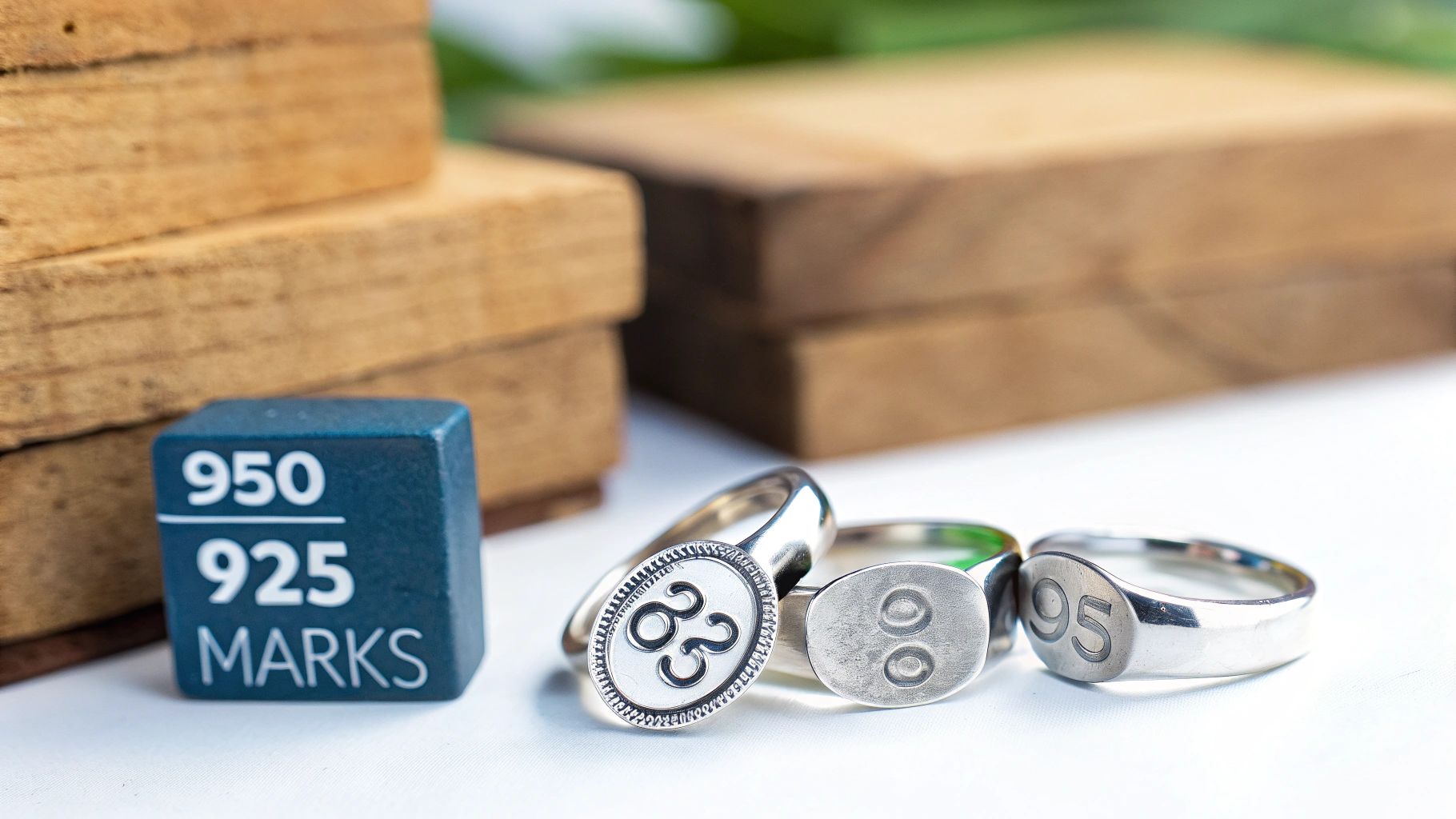
This new system wasn't just for internal record-keeping; it was designed to bring Japanese silver in line with international trade standards. For Western buyers, this meant they could finally understand the quality of what they were buying without needing to be an expert in Japanese characters. The key things to look for from this era are the numeric purity stamps and the official assay mark from the Japan Mint.
The Japan Mint Flag Assay Mark
The single most important hallmark you can find on modern Japanese silver is the Japan Mint assay mark. First introduced in 1929, this official stamp is a small, stylized version of the Japanese national flag—a circle inside a rectangle. Its presence is a rock-solid guarantee from the government that the silver has been tested and meets the purity level stamped elsewhere on the item.
Spotting this flag mark is a dead giveaway that your piece was made after 1928. It’s almost always stamped right next to a numeric purity mark, giving you two layers of confirmation. It's important to understand the difference between an official assay mark and other symbols. To learn more, check out our guide on how to distinguish between silver and EPNS marks.
Common Numeric Purity Marks
Right alongside the Mint's flag, you’ll find numeric stamps that tell you the silver's fineness in parts per thousand. These marks spell out the exact silver content, which clears up all the ambiguity of the older, character-based hallmarks.
Here are the key numbers to keep an eye out for:
- 1000: This means pure silver (99.9%). Because it's so soft, you'll usually only find it on ceremonial objects or special decorative pieces.
- 950: A very common standard you'll see on high-quality Japanese export silver. It's slightly higher than sterling and gives a beautiful bright finish while still being strong enough for things like tea sets and flatware.
- 925: This is the sterling silver standard recognized around the world, meaning the item is 92.5% pure silver. Understanding marks like 'S925' is key, and you can find a detailed guide on S925 silver purity that explains what it signifies.
- 900: Often called "coin silver," this standard was also pretty common, especially for pieces made for the domestic market or certain export regions.
- 800: A lower grade of silver with 80.0% purity. While more common in some parts of Europe, it was still a recognized standard in Japan.
When you find these modern marks—often together with a maker's mark from a firm like K. Uyeda or Miyamoto Shoko—they tell a clear and reliable story. By spotting the Japan Mint flag and its matching numeric purity, you can confidently place a piece in the 20th century and know exactly what it's made of.
Recognizing Major Makers and Workshops
While purity and period marks tell you what an item is and when it was made, the maker’s mark is the one that tells you who made it. This is the signature that can transform a simple silver object into a valuable piece of art with a story. For any collector of Japanese silver hallmarks, identifying the mark of a famous workshop is where the real thrill begins.
Many of the most celebrated silversmiths and firms came into their own during the Meiji and Shōwa periods. They were producing for a sophisticated domestic audience as well as a booming international market, and their marks reflect that—ranging from straightforward kanji characters to intricate, artistic logos.
Learning to spot these signatures is crucial. It’s how you grasp the true artistic and historical weight of a piece. An object from a master artisan isn’t just valued for its silver content; it's valued for the history, the rarity, and the incredible skill poured into its creation.
Key Meiji and Taishō Period Makers
The Meiji (1868–1912) and Taishō (1912–1926) eras were really the golden age for Japanese silver. Craftsmen masterfully combined traditional Japanese design with Western forms, producing stunning works for world fairs and wealthy clients.
- Konoike (Yokohama): Active in the late 19th and early 20th centuries, the Konoike workshop was renowned for its incredible high-relief decorative pieces. You'll often see classic Japanese imagery—dragons, chrysanthemums, detailed landscapes—all rendered with unbelievable precision. Their mark is usually the name "Konoike" written in kanji (鴻池).
- Arthur & Bond (Yokohama): This company was a major retailer of top-tier Japanese decorative arts, and they commissioned silver from only the best local workshops. If you see a piece stamped "Arthur & Bond Yokohama," you know it was made well. It's a clear signal of export-quality silver meant for a discerning Western buyer.
- Samurai Shokai (Yokohama): This firm, run by a former samurai named Nomura Yozo, was another key player in Yokohama. They catered largely to foreign tourists and diplomats, so their silver is consistently top-notch. The mark "Samurai Shokai" or "Y. Nomura" signifies a piece of exceptional quality.
Finding a mark from one of these premier Meiji workshops is a big deal. It often means you're holding an investment-quality piece. These weren't just objects; they were artistic statements, using silver as a medium for sculpture.
Prominent Shōwa Period Firms
During the Shōwa period (1926–1989), the style began to shift towards more modern, sometimes standardized designs, but the leading firms never compromised on quality. In fact, many are still in business today.
Miyamoto Shoko (Tokyo)
Founded back in 1880, Miyamoto Shoko rose to become one of Japan's most respected silversmiths. They were even appointed as a purveyor to the Imperial Household Agency in 1899—a massive honor. Their work spans everything from elaborate presentation pieces to sleek, modern flatware.
- Hallmark: Their mark is typically the name "Miyamoto Shoko" (宮本商行) or just "Miyamoto" (宮本). Sometimes it's paired with the character "ginsei" (銀製), which simply means "made of silver."
- Significance: As an imperial supplier, any item bearing the Miyamoto mark is a guarantee of the absolute highest quality, both in silver purity and in craftsmanship.
Hattori (Tokyo)
Most people know Kintarō Hattori as the founder of the Seiko watch company, but his firm was also a producer and retailer of fantastic silver. Their luxury goods store, Wako, is still an icon in Tokyo's Ginza district. Spotting a "Hattori" mark (服部) on silver tells you it came from a company with a legendary reputation for precision and quality.
For collectors, digging into the backstory of a workshop like Hattori can be just as fascinating as spotting the marks themselves. Taking a deeper look into the history of a silversmith’s mark like the CW Silver Mark can provide invaluable context for your collection.
How to Spot Fakes and Identify Red Flags
Knowing how to recognize authentic Japanese silver marks is only half the battle; you also need a sharp eye for spotting fakes. Forgeries and clever misrepresentations can trip up even experienced collectors, so learning the common red flags is crucial to avoid a costly mistake.
Start by looking closely at the hallmark itself. Authentic japan silver hallmarks are almost always struck with a high-quality die. This leaves a mark with crisp, clean edges and a consistent depth. Fakes, on the other hand, often look blurry, shallow, or uneven—tell-tale signs of being cast from a mold or stamped with a cheap, poorly made tool.
Next, think about wear and tear. On a genuine antique, the hallmark should show a level of wear that makes sense with the rest of the piece. If an object is covered in scratches and shows its age, but the hallmark looks brand new, something is wrong. The reverse is also true: a heavily worn mark on an item that looks pristine should make you suspicious.
Checklist for Preliminary Authentication
When you're looking at a piece, it helps to run through a quick mental checklist. A systematic approach like this keeps you from overlooking the small details that matter most.
- Mark Clarity: Is the mark sharp and distinct? Or are the edges soft and muddled? Fakes rarely have the precision of a genuine strike.
- Consistent Wear: Does the wear on the hallmark match the wear on the silver around it? If they don't match, that's a major red flag.
- Correct Period Marks: Does the hallmark’s style actually fit the supposed age of the piece? Seeing a modern Japan Mint flag mark on an object clearly styled after the Meiji period just doesn't add up.
- Purity vs. Plating: Is it possible the item is silver-plated instead of solid? Learning to tell the difference is key, and resources like a practical guide to silver plating jewelry can be a huge help. Plated items won't carry the same kind of hallmarks as solid silver.
A common trick forgers use is to stamp a fake "jungin" mark onto a piece of low-grade silver or even a silver-plated item. This instantly inflates its perceived value, so always be extra careful when you see high-purity marks.
By staying vigilant and methodically checking for these signs, you can build your collection with much more confidence. An authentic hallmark is a guarantee of history and quality, and taking a few extra moments to verify it is always worth the effort.
A Practical Guide to Evaluating Silver Marks
When you're looking at a piece of Japanese silver, figuring out its story can seem daunting. But with a bit of practice and a methodical eye, it's actually quite straightforward. The key is to know what you're looking for and what those little stamps are telling you.
First, focus on the main purity mark. Is it written in Japanese characters—like the kanji for ‘jungin’ (純銀)? Or do you see a number, like ‘950’ or ‘STERLING’? This single detail is your biggest clue for dating. As a general rule, character-based marks suggest an older piece, usually from before 1928, while numeric stamps point to a more modern, 20th-century origin.
Putting the Clues Together
Once you've identified the main mark, start looking for other symbols to build a more complete picture. The presence of an official assay mark, like the Japan Mint flag, is a dead giveaway. It confirms the silver purity was government-assessed and places the item firmly in the post-1928 period.
On the other hand, if you have a piece marked ‘jungin’ without the flag, that’s exactly what you'd expect to see on an authentic item from the Meiji era. Finally, hunt for a maker's mark or workshop seal. A name like Miyamoto Shoko or Hattori Kintaro can elevate an item's value far beyond its weight in silver. By looking at all three—purity, official marks, and the maker—you can confidently determine the age, quality, and potential worth.
Let's break this down into a simple checklist you can use on the fly.
Quick Identification Checklist
This step-by-step table helps you quickly assess Japanese silver hallmarks and figure out an item's likely origin and period. Just work your way down the list.
| Check | What to Look For | Potential Meaning |
|---|---|---|
| 1. Primary Purity Mark | 純銀 (Jungin) | High-purity silver, often 950-1000. Common in the Meiji period (1868-1912). |
| 銀製 (Ginsei) | "Silver made." A general term, often indicating purity of 925 or higher. | |
| ‘STERLING’ or ‘925’ | Western sterling standard. Common on export items from the early 20th century onward. | |
| ‘950’ or ‘1000’ | Higher purity standards. Often seen on post-WWII export silver. | |
| 2. Official Assay Marks | Japan Mint Flag (旗) | Government-assessed purity. Places the item after 1928. |
| No Official Marks | Typical for pre-1928 pieces, especially those marked jungin. | |
| 3. Maker's Marks | Workshop or Artist Name | Signed pieces by known makers like Miyamoto Shoko, Konoike, or Hattori have significant collector value. |
| Retailer or Store Mark | Often indicates a piece made for a specific high-end store or brand. | |
| No Maker's Mark | Common on smaller or mass-produced items, but doesn't necessarily mean low quality. |
By cross-referencing these points, you can build a solid profile for almost any piece of Japanese silver you come across.
Why Correct Identification Matters
For anyone buying or selling, knowing how these marks influence value is everything. Pieces from the Meiji period (1868–1912), especially those stamped jungin and signed by a famous artisan, are at the pinnacle of the market. They represent incredible craftsmanship and often have a silver purity approaching 1000/1000. You can explore examples of this artistry on the BADA.org site for high-quality Japanese silver.
In contrast, 20th-century export silver usually has numeric purity marks and the Japan Mint flag, aligning it more closely in style and value with Western sterling.
It's a simple fact of the market: a small, signed Meiji ‘jungin’ box can be worth many times more than a much larger mid-century export tray of the same weight. Reading the hallmarks correctly can mean the difference between pricing something near scrap value and identifying a serious collector's piece.
Following this process helps you see beyond the object itself and understand the history and value locked within its japan silver hallmarks. It’s how a simple silver item becomes a tangible piece of history.
Common Questions About Japanese Silver
Diving into Japanese silver hallmarks often brings up a few key questions, especially when trying to sort out different periods and purity standards. Let's tackle some of the most common ones that collectors and curious owners run into.
What’s the Difference Between "Jungin" and "950 Silver"?
The main distinction between a 'jungin' (純銀) mark and a '950' stamp is really about time and trust. 'Jungin,' which translates to "pure silver," was the mark of choice during the Meiji period (1868–1912). Think of it less as a formal standard and more as a craftsman's personal guarantee of exceptional quality, often pushing 99.9% purity.
On the other hand, the '950' mark tells a different story. It means the item is precisely 95.0% pure silver. This became the standard after 1928, when Japan adopted a more Western-style, regulated hallmarking system. So, while 'jungin' is a historical promise of artistic integrity, '950' is a modern, objective measurement of silver content, often seen alongside the official Japan Mint flag mark.
How Can I Spot a Fake Japanese Silver Mark?
Telling a real mark from a fake one comes down to looking closely at the quality and context. Authentic hallmarks were struck with well-made steel dies, so they should look sharp, crisp, and evenly pressed into the metal. If a mark looks blurry, shallow, or has soft edges, be skeptical—those are classic signs of a cast forgery or a poorly made stamp.
Context is everything, too. The wear and tear on the hallmark should match the wear on the rest of the piece. A brand-new looking mark on a heavily worn teapot? That's a major red flag. The reverse is also true: a worn-down mark on a piece that looks like it just left the workshop is just as suspicious. Always ask yourself if the mark makes sense for the item's style and supposed age. A modern Japan Mint mark just doesn't belong on a classic Meiji-era design.
Are Unmarked Japanese Silver Pieces Worth Anything?
Absolutely. An unmarked piece of Japanese silver can still be incredibly valuable. Remember, before the standardized system kicked in around 1928, it was common for high-quality silver to have only a maker's signature or no mark at all. For these pieces, value is all about the craftsmanship, artistry, age, and history.
For example, a beautifully detailed Meiji vase could be worth a small fortune without a single purity mark, simply based on its artistic merit and historical significance. When you don't have a hallmark to go by, authentication relies on an expert eye to judge the piece's construction, style, and materials. A mark is a helpful shortcut, but its absence certainly doesn't mean an older, artist-signed piece is worthless.
What Does the Little Japanese Flag Mark Mean?
That small, stylized Japanese flag emblem is the official assay mark from the Japan Mint. It was introduced in 1929, and when you see it, you can be confident the piece has been officially tested and meets the purity level stamped next to it (like '950' or '925').
Seeing this flag mark is one of the surest ways to date a piece to the post-1928 era. It signals that the item was made under modern, government-regulated standards for both local and export markets. You won't find it on older 'jungin' pieces, but when it appears with a numeric purity mark, it adds a strong layer of authenticity to 20th-century silver.
Feeling overwhelmed by the hallmarks on your family heirlooms or thrift store finds? Curio can help. Snap a photo, and our app provides instant identification, historical context, and an estimated value, turning your mysterious treasures into understood history. Download Curio today and uncover the stories hidden in your collection at https://www.curio.app.