When you see the word “Nippon” on the bottom of a piece of antique porcelain, you’re looking at a specific timestamp in history. These marks identify items made in Japan specifically for export between the years 1891 and 1921. “Nippon” is simply the Japanese word for Japan, and its use during this precise 30-year window is what makes it a key for collectors.
Decoding the History of Nippon Marks
The story of the Nippon mark isn't just about art; it's a fascinating look at how international trade law shaped a collectible category. Before 1891, goods brought into the United States didn’t need to be marked with their country of origin. That all changed with a single piece of American legislation.
The McKinley Tariff Act of 1890 was a game-changer. It required that all imported goods be clearly labeled in English with their home country. In response, Japanese porcelain makers began stamping their export wares with “Nippon”—their own name for their country.
This practice, however, had a firm end date. In 1921, U.S. Customs decided that "Nippon" wasn't an acceptable English word for the country of origin. From that moment on, all imports from Japan had to be marked with the English word “Japan” or the phrase “Made in Japan.” This legal ruling created a closed, 30-year period for authentic Nippon-marked porcelain, instantly defining it as a distinct and desirable field for collectors. For a deeper dive into this historical turning point, the antique resource site RealOrRepro.com offers great insights.
The Significance of the Nippon Era
The years between 1891 and 1921 represent a unique chapter in Japanese decorative arts, and understanding this context is essential for any serious collector.
- A Defined Timeline: The strict legal start and end dates mean any piece with a genuine "Nippon" mark can be dated with confidence.
- Artistic Evolution: This period captures a beautiful transition in style, moving from elaborate Victorian designs toward the cleaner aesthetics of Art Nouveau and, later, Art Deco.
- Quality Craftsmanship: Many Nippon-era pieces showcase incredible artistry, including detailed hand-painting, moriage (a type of raised enamel work), and high-quality porcelain bodies. To learn more about the material itself, it's helpful to understand the differences between porcelain and ceramic.
This historical framework is the bedrock for identifying and valuing these beautiful antiques.
Quick Reference Timeline of Japanese Export Marks
The table below offers a simple breakdown of the major marking periods for Japanese export porcelain. It’s a handy tool for quickly placing a piece within its historical context based on its backstamp.
| Time Period | Required Mark | Primary Market | Key Historical Context |
|---|---|---|---|
| Pre-1891 | None Required | Global | Japan's Meiji period; focus on exports begins. |
| 1891–1921 | "Nippon" | United States | The McKinley Tariff Act is in full effect. |
| Post-1921 | "Japan" / "Made in Japan" | United States | A U.S. Customs ruling changes the marking rules. |
As you can see, a simple word on the bottom of a vase or plate tells a much bigger story about trade, law, and art.
How to Identify Authentic Nippon Marks
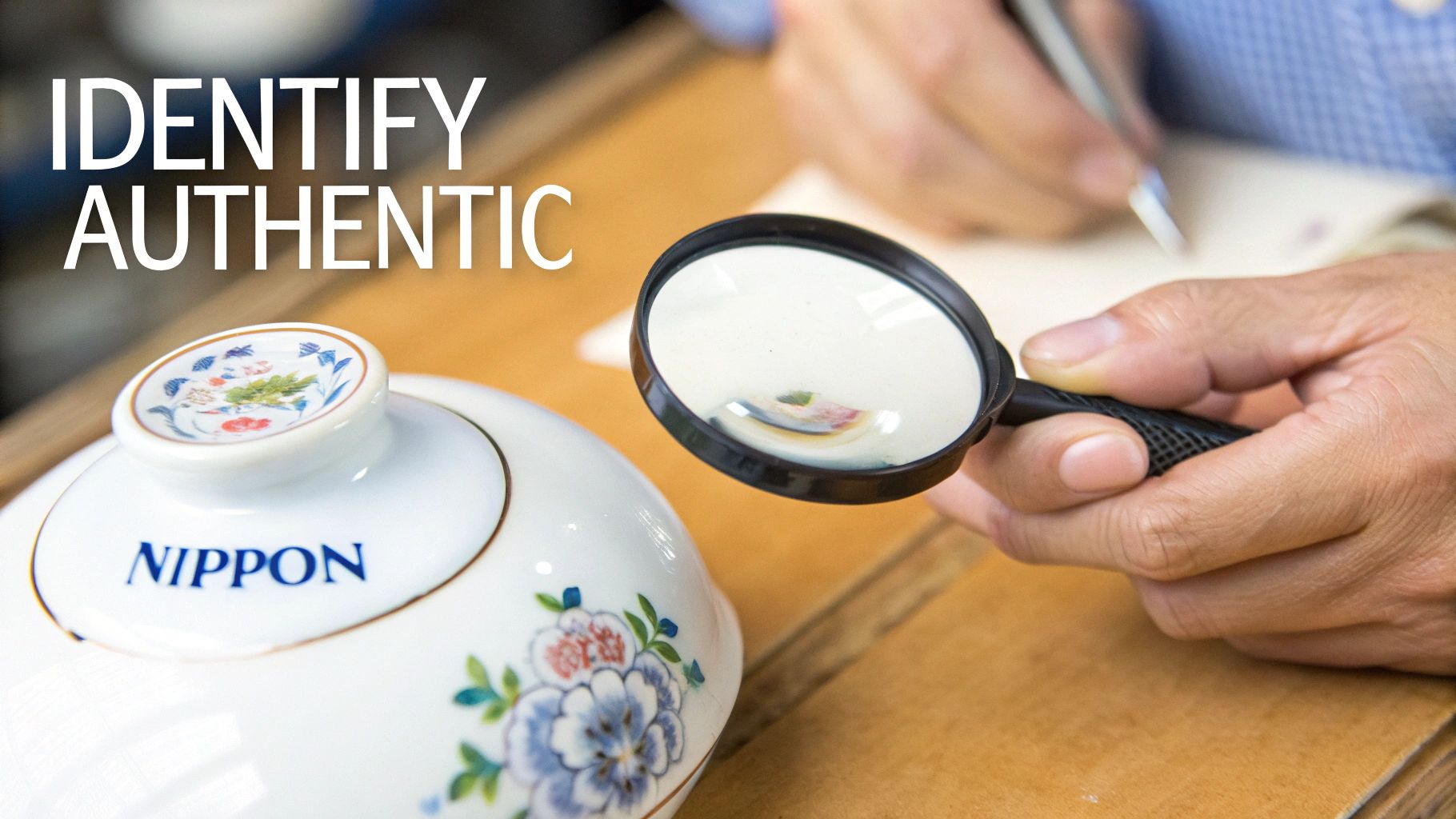
Telling a genuine antique from a later reproduction takes a bit of practice and a good eye for detail. When it comes to Japanese Nippon marks from the 1891-1921 period, there are several tell-tale signs that separate the real deal from the fakes. Learning these subtle cues is your best defense against costly mistakes.
The backstamp itself is always your starting point. Genuine marks from this era were almost always applied under the glaze, which means they were stamped on the porcelain before the final firing. This process fused the mark into the piece, so it should look crisp and clean, never blurry or smudged.
Most original marks were printed in a handful of specific colors. The most common you'll see are a rich cobalt blue or a distinctive green, often called "M-green" after the Morimura Brothers (who later became Noritake). You might occasionally find red or brown marks, but they’re far less common.
Examining the Mark Itself
When you're looking at a piece, get up close and personal with the backstamp. A magnifying glass is your best friend here. Here’s a quick checklist to help you spot a real mark from a reproduction:
- Clarity and Precision: An authentic mark should have sharp, well-defined lines. Fakes often look a little fuzzy, with bleeding edges or uneven ink.
- Glaze Interaction: This one is a dead giveaway. Run your finger over the mark. It should feel completely smooth, like it’s embedded within the porcelain. If you can feel a raised edge, the mark was applied over the glaze—a sure sign of a modern fake.
- Spelling and Font: Counterfeiters aren't always careful. Keep an eye out for misspellings or fonts that just look too modern or don't match known historical examples.
Authentic Nippon marks are more than just a word; they're a stamp of a specific manufacturing process. The underglaze application is a critical detail because it was standard for the era, a step modern forgers often skip to save time and money.
Looking Beyond the Backstamp
While the mark is crucial, don't forget to evaluate the piece as a whole. The physical characteristics of the porcelain offer vital supporting clues. An authentic piece from the Nippon era often has a certain lightness and feels delicate in your hands, which is quite different from the heavier, sometimes clumsy feel of reproductions.
Pay close attention to the artistry and the quality of the glaze. Genuine Nippon porcelain is known for its high-quality, often intricate hand-painting and a smooth, consistent glaze. Be suspicious of pieces with overly bright, garish colors or a glaze that looks thick and uneven. Getting familiar with pottery markings in general can give you a better framework for your assessment. You can learn more in our detailed guide on the common types of markings on pottery.
Beyond the specifics of Nippon, understanding the broader principles of identifying reproductions will sharpen your skills even further. By combining a detailed analysis of the mark with a hands-on physical inspection, you can build a much more confident case for authenticity.
A Visual Guide to Common Nippon Marks and Makers
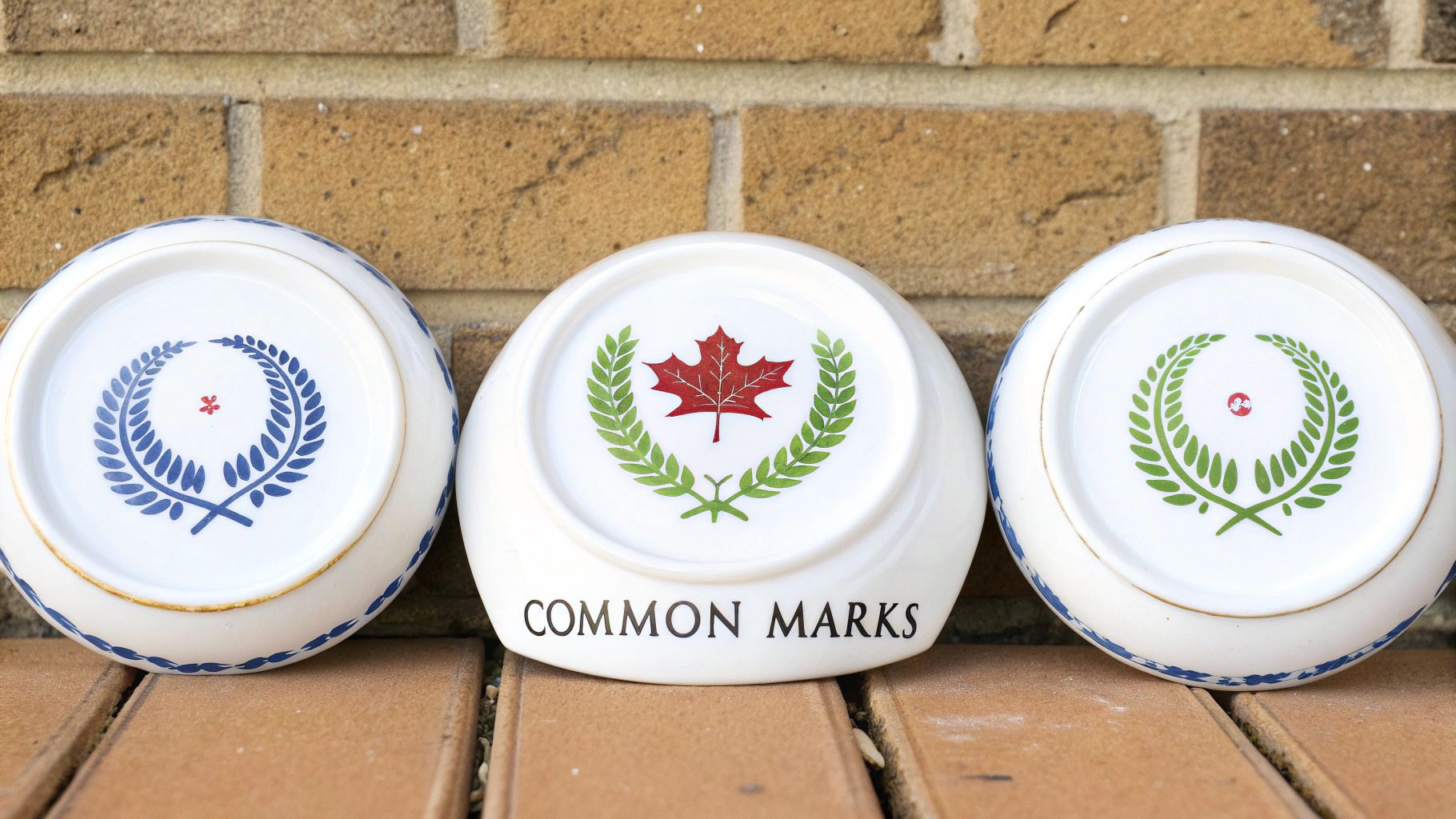
The first step in identifying a piece of Nippon-era porcelain is flipping it over and examining the mark. These backstamps are the signatures of the artists and factories that created them, and they’re packed with clues about a piece's origin, maker, and age.
While you’ll find thousands of variations out there, most fall into a few recognizable categories based on their design. Learning to spot these common Japanese Nippon marks is like learning a secret code. The most common designs often use symbols like wreaths and maple leaves as a kind of shorthand for specific manufacturers. This guide will walk you through some of the marks you're most likely to see.
The Iconic Wreath Marks
If there's one mark that screams "Nippon," it's the wreath. These elegant, circular designs are almost always associated with high-quality porcelain and are a huge favorite among collectors. The specific details inside the wreath are what tell you the real story.
The "M in Wreath" Mark: This is the quintessential mark of Noritake. The "M" stands for Morimura, the Morimura Brothers trading company that founded the Noritake factory. You'll see this mark on pieces made for the American market from about 1911 to 1921, and it’s a solid sign of quality. The green version is the one you'll encounter most often.
The "RC in Wreath" Mark: The letters "RC" stand for Royal Crockery. Noritake used this mark for a short time on items intended for markets outside the U.S., especially in Asia. It's not as common as the "M in Wreath," but the quality is just as good.
It's worth noting that because these wreath marks are so famous, they are a prime target for reproductions. Always check that the mark is applied under the glaze and that the printing is crisp and clear.
Pictorial and Symbolic Marks
Beyond the classic wreath, Japanese decorators got creative with a whole host of other symbols. These marks can sometimes be a bit trickier to pin on a single maker, but they are just as valuable for dating and identification.
The Maple Leaf mark is another one you’ll see frequently. It usually appears in green, red, or blue and was used by several different companies. However, it's most often connected to wares made by the Morimura Brothers before they standardized the famous "M in Wreath" mark. If you find a piece with a maple leaf, it likely dates to the earlier part of the Nippon period, roughly 1891 to 1911.
A key takeaway for collectors: A specific mark like the "M in Wreath" points straight to one company, but broader symbols like the Maple Leaf were used by many. This means you have to look at the overall quality and artistic style of the piece itself to get the full picture.
You might also come across other pictorial marks, including rising suns, pagodas, birds, and fans. Many of these were the signatures of smaller, independent decorating studios. These businesses would buy blank porcelain pieces from the big kilns and then hand-paint them for export. This makes identifying the exact studio a real challenge, but if you see "Hand Painted Nippon" next to the symbol, you can be confident in its origin and time period.
Below is a quick-reference table to help you visually identify some of the most common marks you'll encounter.
Common Nippon Mark Identification Guide
| Mark Symbol/Image | Associated Maker | Typical Date Range | Identifying Characteristics |
|---|---|---|---|
| "M" inside a wreath | Noritake (Morimura Bros.) | 1911 - 1921 | The letter "M" is centered within a green laurel wreath. Primarily for the US market. |
| Maple Leaf | Various (often Morimura Bros.) | 1891 - 1911 | A single maple leaf, typically in green, red, or blue. Pre-dates the "M in Wreath" mark for Morimura wares. |
| "RC" inside a wreath | Noritake (Royal Crockery) | c. 1911 | "RC" for Royal Crockery inside a wreath. Used for non-US export markets. |
| Rising Sun | Various smaller decorators | 1891 - 1921 | A stylized rising sun symbol, often accompanied by "Hand Painted Nippon." |
| Pagoda | Various independent studios | 1891 - 1921 | A depiction of a traditional Japanese pagoda. Often found on scenic or landscape pieces. |
This table covers the most prevalent marks, but remember that the world of Nippon porcelain is vast. Use these as a starting point for your identification journey.
Dating Your Nippon Porcelain with Confidence
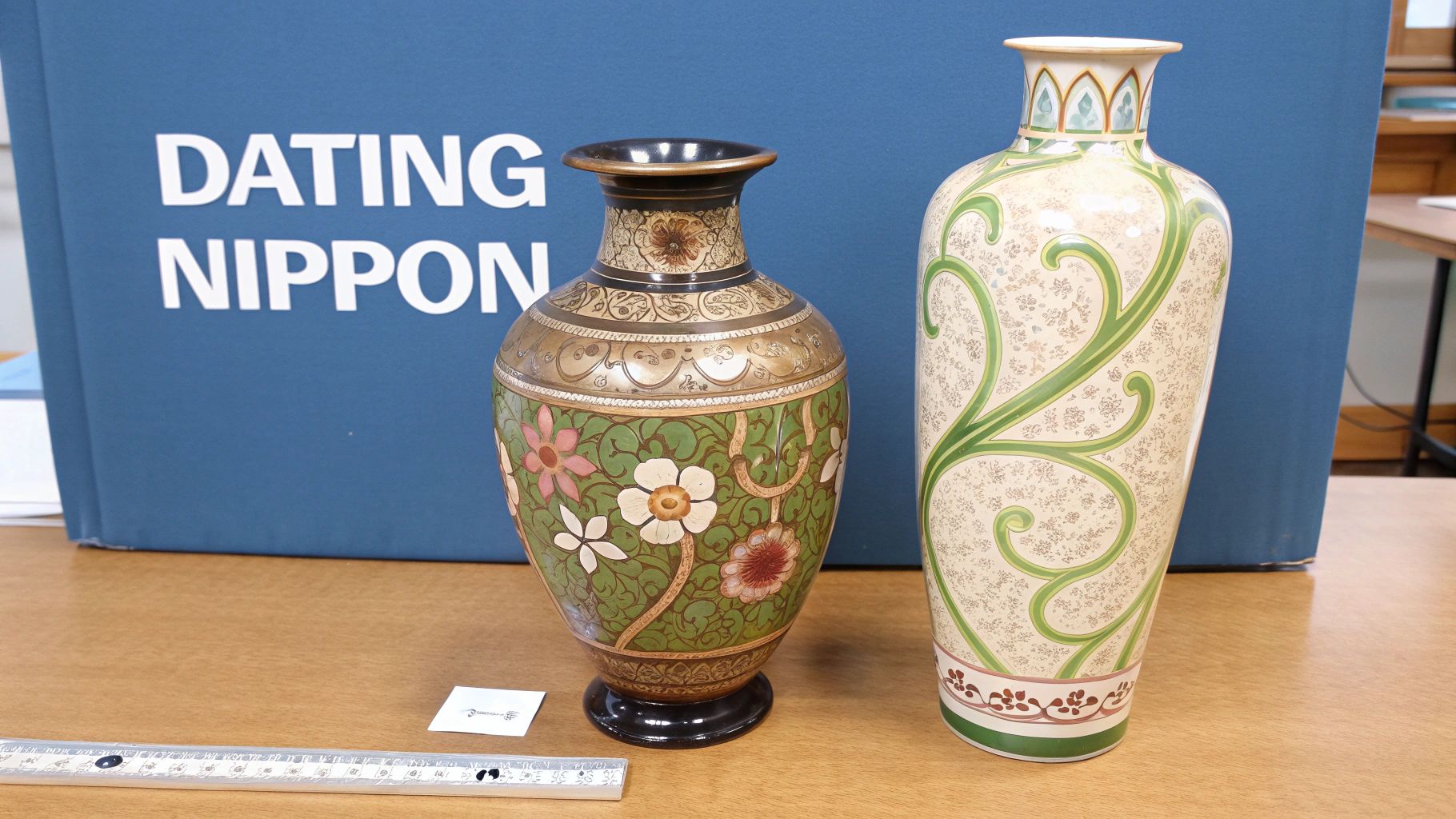
While any authentic Japanese Nippon mark reliably places a piece within the critical 1891 to 1921 window, you can often get much more specific. By learning to read the artistic styles and manufacturing details, you can move beyond that general 30-year span and build a more precise story for your collection. It’s a skill that requires looking at the entire object, not just the mark on the bottom.
The evolution of decorative styles offers some of the best clues. The Nippon era coincided with a huge shift in global artistic tastes, and Japanese porcelain producers were keenly aware of what Western markets wanted. Understanding this timeline helps you place a piece in the early, middle, or late part of the period.
Reading the Artistic Styles
The earliest Nippon wares, from the 1890s into the early 1900s, are drenched in Victorian aesthetics. These pieces often feature incredibly dense, ornate decoration that covers nearly every inch of the surface.
You'll know you're looking at an early-period piece if you see:
- Heavy Gilding: Think elaborate gold trim, intricate scrollwork, and raised gold paste designs that you can feel with your fingertips.
- Victorian Motifs: Look for complex floral patterns (roses and violets were huge), portraits of elegant women, cherubs, and romantic, idealized landscapes.
- Complex Patterns: The overall feel is often busy and highly detailed, reflecting the "more is more" philosophy of the late Victorian age.
As the world entered the 20th century, designs started to open up, embracing the flowing, nature-inspired lines of Art Nouveau. This middle period, spanning from about 1900 to the late 1910s, shows a clear break from Victorian clutter. You'll begin to notice more "negative space" in the designs, which really allows the artistry to stand out.
Finally, pieces from the very end of the Nippon era, around 1918 to 1921, often give a nod to the coming Art Deco movement. These later items feature simpler patterns, bolder color choices, and a more streamlined look, setting the stage for the styles that would define the 1920s.
Analyzing Manufacturing and Decorative Clues
Beyond the broad art movements, specific production techniques and decorative elements provide even more dating clues. The type of porcelain itself, for example, can be telling. Earlier pieces sometimes have a heavier, thicker porcelain body compared to the finer, more delicate wares used later on, especially by major players like Noritake.
Another fantastic indicator is the use of moriage—a technique where raised slip or enamel is applied to create a textured, three-dimensional effect. While moriage was used throughout the Nippon period, its style and complexity changed over time. Early examples are often incredibly intricate and finely detailed, while some later applications can be a bit less precise.
When you combine your analysis of the artistic style, the porcelain body, and specific techniques like moriage, you create a layered approach to dating. A heavily gilded, ornate vase with detailed moriage screams early Victorian influence. In contrast, a piece with stylized geometric patterns and a lighter feel almost certainly dates to the final years just before the 1921 marking change.
How to Determine the Value of Your Nippon Porcelain
Figuring out what a piece of Nippon porcelain is worth can be a real adventure. Prices swing wildly, from just a few dollars for a simple dish to thousands for a show-stopping, museum-quality vase. So, what makes one piece a treasure and another just a nice trinket?
While the Japanese Nippon marks are your guarantee that a piece is from that coveted 1891-1921 period, the mark itself is just the starting point. Several other factors come into play, and they all work together to create the final value.
Core Value Drivers for Nippon Porcelain
Four things really drive the price of any piece: how rare the mark is, the quality of the artwork, the shape or form of the item, and, most critically, its condition. A rare backstamp from a smaller, well-regarded studio will naturally catch a collector's eye more than a common, mass-produced mark. But don't count out the common marks—if one is found on an exceptionally beautiful or unusual piece, it can still be quite valuable.
Here’s a breakdown of what to look for:
- Artistry: This is the big one. Intricate, hand-painted scenes—think detailed landscapes, portraits, or complex floral arrangements—are always more valuable than simple transfer prints or basic patterns. Special techniques like heavy gold trim or detailed moriage (that wonderful raised enamel work) add a ton of value and visual appeal.
- Form: What is it? Large, impressive pieces like floor vases, humidors, or complete chocolate sets are generally more sought-after and pull in higher prices. They simply have more presence. Common items like small plates, basic teacups, or celery dishes are far more plentiful. A unique shape or an item with an unusual purpose will always spark more interest.
- Condition: This is non-negotiable. A piece in mint condition—no chips, no cracks, no hairline fractures, no repairs—will always fetch a premium. Even a tiny, barely-there chip can slash the value by 50% or more. Always inspect your porcelain carefully under a bright light.
Understanding Market Prices
The history of the Nippon era has a direct impact on today's prices. The 1890 McKinley Tariff Act is what mandated the "Nippon" mark in the first place. But in 1921, a new ruling required the country of origin to be marked in English, so the mark changed to "Japan." This instantly created a finite supply of pre-1921 pieces.
As a result, genuine Nippon vases can command prices 200-300% higher than similar pieces made just a few years later and marked "Japan." The truly exceptional, hand-painted examples can bring thousands at major auction houses. For a deeper dive into this, the folks at TrueLegacyHomes.com have a great write-up on the historical price impact.
For a ballpark idea of value, checking online auction sites for records of comparable sales is a great first step. If you want a more organized way to approach your research, an antique value estimator can help structure the process.
And if you discover you're sitting on a valuable collection, protecting it is key. For your best Nippon pieces, it might be wise to look into specialized insurance for valuable items once you have a good sense of their worth.

The Global Strategy Behind the Nippon Mark
When you see a Nippon mark on a piece of porcelain, you're looking at more than just a country of origin stamp. It's a key piece of one of the most successful national branding campaigns in history. To really get what your collection is about, you have to understand that "Nippon" was a strategic choice—a core part of Japan's push during the Meiji era (1868-1912) to transform its image from a secluded, feudal nation into a modern industrial powerhouse.
This was no accident. After centuries of isolation, Japan’s new leaders knew they needed a reputation for quality to compete on the world stage. The government threw its weight behind exports, pushing industries to adopt Western production methods while holding onto that unique Japanese aesthetic. "Nippon," the country's name in its own language, became the banner for these high-quality goods, which were then shipped off to a fascinated and receptive international market. Every one of those porcelain pieces was an ambassador for this new economic and cultural mission.
Branding a Nation's Exports, Not Just a Product
This branding effort wasn't limited to porcelain. The "Nippon" mark was stamped on all sorts of goods, creating a unified identity that broadcasted quality and modernity to Western buyers.
- Textiles: Silk was a huge part of Japan's export economy, and the "Nippon" brand helped establish it as a true luxury item.
- Lacquerware and Metalwork: Traditional Japanese crafts were skillfully adapted for Western homes and marked to highlight the country's artistic legacy.
- Toys and Novelties: Even everyday things like celluloid toys and decorative fans were caught up in this massive export wave.
This consistent branding built a powerful image in the minds of consumers in America and Europe. To own something marked "Nippon" was to own a piece of a sophisticated, modern Japan. It was an incredibly effective campaign, one that paved the way for the Japanese brands we all know today, from Noritake right up to Toyota.
You could say the "Nippon" mark was Japan's first global logo. It was a promise of quality and a bold announcement that the nation was now a serious player in international trade, turning everyday objects into ambassadors for a modernizing country.
The Unseen Power of Everyday Goods
While porcelain was certainly one of the more glamorous exports, the strategy's true genius is clear when you look at more ordinary products. Between 1868 and 1930, for instance, matches became a surprisingly dominant Japanese export, with thousands of different trademarks registered. This boom was so massive that from 1912 to 1923, Japan's match output was greater than the combined exports of the next twelve biggest producers.
This flood of Nippon-marked matchboxes swamped Asian markets, grabbing an 80% market share in major hubs like Hong Kong and Singapore by the 1920s. You can read more about this incredible industrial surge and its impact on global trade. It just goes to show how the "Nippon" branding strategy reached every level of production, turning even the most humble items into potent tools of economic influence.
Your Top Questions About Japanese Nippon Marks, Answered
As you get deeper into collecting, you'll find that some questions come up again and again. Here, I'll tackle some of the most common queries I hear about Japanese Nippon marks to help clear up any confusion and build on what we've already covered.
Is Every Piece of Nippon Porcelain Valuable?
Not always. It's a common misconception. While a "Nippon" mark confirms a piece is from the desirable 1891-1921 era, that's just the starting point. The real value is driven by artistry, rarity, and condition.
The most sought-after pieces are the ones that are truly works of art. We're talking about exquisite, detailed hand-painting—think intricate landscapes, delicate portraits, or lavish floral patterns. Unusual shapes, like a humidor or a massive vase, will always fetch more than common items. So while a simple floral plate is a genuine antique, its value might be modest because so many were made. An artist-signed vase in a stunning design, on the other hand, could be worth a small fortune.
What's the Difference Between "Nippon" and "Made in Japan"?
The difference is all about timing. The "Nippon" mark was used strictly from 1891 to 1921. This was a direct result of the McKinley Tariff Act in the U.S., which mandated that imported goods had to be stamped with their country of origin.
Everything changed in 1921. A U.S. customs ruling decided that "Nippon" wasn't an acceptable English word for the country of origin. From that day forward, Japanese factories had to mark their exports to the States with "Japan" or "Made in Japan." This is why a real "Nippon" mark is a surefire way to date a piece to the pre-1921 period, making it a distinct collecting category.
How Can I Spot a Fake Nippon Mark?
Authentic marks from this era were almost always applied under the glaze before the final firing. The result is a mark that's crisp, clear, and perfectly smooth to the touch. Run your finger over it—you shouldn't feel a thing.
A mark that looks blurry, smudged, or sits on top of the glaze is a major red flag. Those are tell-tale signs of a modern reproduction.
A huge wave of fakes hit the market back in the 1980s. A good tip-off for these is the feel of the unglazed porcelain on the base—it often feels a bit sticky or just too "new."
When in doubt, pull up examples from a trusted online database or a good reference book. Scrutinize the font, the letter spacing, and any symbols like wreaths or maple leaves. You'll want to see a perfect match to a known, authentic mark.
What Does the "M in a Wreath" Mark Mean?
Ah, the "M in a Wreath." That's one of the most famous and well-regarded Japanese Nippon marks out there. It's the signature mark of the legendary manufacturer, Noritake.
The "M" stands for Morimura, for the Morimura Brothers trading company that established the Noritake factory. This particular mark was used on their high-quality porcelain exported to the United States, primarily between 1911 and 1921. If you find a piece with a clear, genuine "M in a Wreath" mark, you can be confident you've got a top-tier item from one of the era's most important producers.
Have a piece you're curious about? With the Curio app, you can snap a photo and get instant identification, historical context, and a valuation estimate right from your pocket. Take the guesswork out of your collection and uncover the stories behind your treasures. Learn more at https://www.curio.app.