When you see a Karlsbad Austria porcelain mark, you're looking at a stamp of quality from a bygone era. These pieces hail from the Karlsbad region (now Karlovy Vary in the Czech Republic) and were made before 1918, during the time of the Austro-Hungarian Empire.
It's important to remember that "Karlsbad" isn't one single company. Instead, think of it as a geographical stamp of quality, a testament to the area's rich deposits of kaolin clay, the essential ingredient for fine porcelain. Learning to spot the key symbols and names on the bottom of your china is the first step in unlocking its history.
What Karlsbad Marks Mean for Your Collection
Flipping over a delicate plate or teacup and finding "Karlsbad" or "Austria" on the back is always a little thrill. It’s more than just a brand; it's a historical "Made In" label that ties your piece to a specific time and place renowned for its incredible porcelain craftsmanship. For any serious collector, understanding these marks is crucial because they connect directly back to the powerful Austro-Hungarian Empire.
This guide is designed to be your go-to reference for decoding these often intricate symbols. To really get a feel for Karlsbad porcelain, it helps to know what it's made of. For a bit of background, this explainer on the difference between bone china and porcelain gives some great context on why the porcelain from this region was so prized.
Key Information Encoded in the Marks
The stamp on the bottom of your porcelain can tell you a surprising amount with just a quick glance. Once you know what to look for, you can start to piece together the story of everything in your collection.
- Geographical Origin: The word "Karlsbad" (sometimes spelled Carlsbad) immediately places the item's creation in a major center of European ceramic excellence, famous for its top-notch natural resources.
- Historical Era: Seeing the word "Austria" is a fantastic dating clue. It confirms the piece was made before the empire was dissolved in 1918.
- Manufacturer Identity: Look closer for specific symbols like crowns, eagles, or a set of initials. These are the signatures of the factories themselves, pointing you toward makers like Moritz Zdekauer or Victoria Schmidt & Co.
Learning to read these elements is what turns a casual owner into a knowledgeable collector. Every mark is a small puzzle, and solving it reveals how an item traveled from a historic European factory right into your hands. If you want to dive deeper into this world, our article on the various types of markings on pottery is a great place to broaden your understanding.
The Golden Age of Karlsbad Porcelain 1880-1918
When collectors talk about the peak of Karlsbad porcelain, they’re almost always referring to the years between 1880 and 1918. This wasn't just a successful period; it was the absolute golden age. The region, then a vibrant part of the Austro-Hungarian Empire, became a global center for fine china, powered by rich local resources and a booming international appetite for luxury.
Factories honed their craft to an incredible degree, producing a brilliant, hard-paste porcelain that could stand shoulder-to-shoulder with Europe's best. It was a perfect storm of skilled artisans, ambitious factory owners, and favorable trade agreements that pushed Karlsbad porcelain onto the world stage.

Defining Characteristics of the Era
Pieces from this era have a distinct and recognizable look. They were designed to catch the eye and signal refinement, appealing directly to the tastes of the prosperous middle and upper classes across Europe and America. While styles varied, a few key features are classic tells of this period.
- Intricate Floral Patterns: You'll see a lot of delicate, hand-painted flowers. These weren't just simple daubs of color but often detailed, botanically accurate illustrations.
- Heavy Gold Gilding: Luxury was the name of the game, and nothing said luxury like gold. Rims, handles, and decorative flourishes were often lavishly gilded.
- Lustrous Glazes: The porcelain itself had a famously smooth, high-quality glaze, creating the perfect canvas for all that detailed artwork.
A Global Export Powerhouse
Karlsbad's reach went far beyond the Austro-Hungarian Empire. The "Austria" mark became a mandatory stamp for all exports, a sign of origin for huge markets like the United States and Great Britain. At its height, the region was responsible for a staggering 70% of all fine china exported from Austria. To learn more, see how these Carlsbad Austria china marks signify a porcelain powerhouse.
The elegant 'Carlsbad Austria' mark isn't just a stamp; it's a badge of quality tied to the region now known as Karlovy Vary in the Czech Republic, famous for its rich kaolin clay deposits.
For any serious collector, understanding this period is key. A piece marked "Carlsbad Austria" isn't just a pretty antique—it's a direct link to an empire at the pinnacle of its artistic and cultural power. The end of World War I in 1918, and the breakup of the empire that followed, brought this golden age to a sudden halt. This is what makes porcelain from this specific era so historically significant and sought-after today.
Visual Guide to Common Karlsbad Marks
If you're trying to identify Karlsbad porcelain, the marks on the bottom are your best friends. Think of this section as your quick-reference catalog, helping you connect the symbols you see to the factories that made them. Over the years, Karlsbad manufacturers used all sorts of distinctive emblems—crowns, eagles, shields—to make their work stand out.
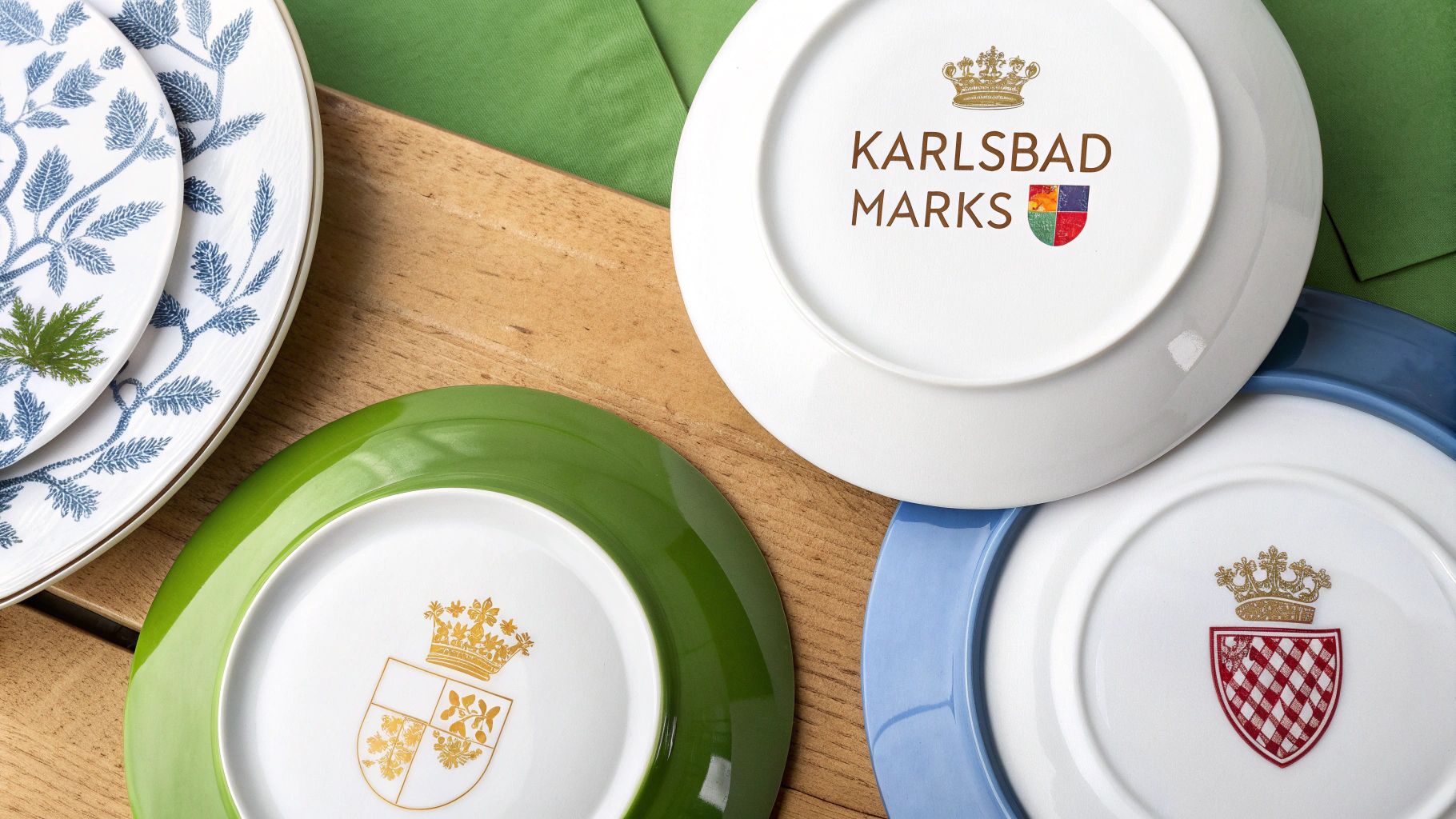
It’s like learning a visual language. When you see a double-headed eagle, for instance, it's often a nod to the Austro-Hungarian Empire's coat of arms—a clear signal of prestige and quality. Getting familiar with these key symbols is the first, and most important, step in figuring out what you have.
Visual Identification Guide to Karlsbad Porcelain Marks
I've put together this quick visual guide to help you get started. It's designed for fast lookups, matching some of the most common marks to the right manufacturer, date range, and key symbols. Just find the mark that looks like yours to get a solid lead.
| Mark Image | Manufacturer | Date Range | Key Symbols & Text |
|---|---|---|---|
|
Moritz Zdekauer | 1884–1918 | A prominent double-headed eagle above the text "MZ Austria" or "MZ Altrolau." |
|
O. & E.G. Royal Austria | 1899–1918 | Usually a green wreath with the initials "O. & E.G." and "Royal Austria" nearby. |
|
Victoria Schmidt & Co. | 1883–1945 | A very distinct crown sitting right on top of the word "Victoria," often with "Austria" below. |
|
L. Straus & Sons | c. 1890s–1920s | The initials "LS&S" are the key, frequently found inside a circle, shield, or fancy cartouche. |
Keep in mind that this is just a starting point, as variations are common. But having these core examples makes the process a whole lot easier.
One of the biggest clues you can find is the word "Austria." If you see it, you can be fairly confident the piece was made before the Austro-Hungarian Empire was dissolved in 1918. It’s a simple but incredibly reliable way to narrow down the age.
This kind of visual comparison is a lifesaver, whether you're going through an inherited collection or spotting something at an antique shop. It lets you make a quick assessment on the spot. By learning these core designs, you're not just identifying a piece; you're starting to uncover its story.
Profiles of Major Karlsbad Manufacturers
Seeing the words "Karlsbad Austria" on a piece of porcelain is a great first step, but the real story begins when you can trace it back to a specific factory. The Karlsbad region was a hotbed for porcelain production, with dozens of manufacturers operating, each with its own distinct history, style, and marks.
Learning to recognize these individual makers adds a fascinating layer of context. It transforms a simple antique into a tangible piece of industrial art history, letting you appreciate the specific heritage and artistry behind every item. This section will walk you through some of the most influential and commonly found porcelain producers from the Karlsbad area.
Victoria Schmidt and Co
Established in 1883 in Altrohlau, Bohemia, Victoria Schmidt & Co. grew to become one of the most familiar names in Karlsbad porcelain. Their marks are often some of the easiest for new collectors to spot, making them a perfect starting point for anyone diving into Karlsbad china.
The company produced a huge variety of items, from decorative vases to full dinner sets. Their style often leaned into vibrant floral transferware and generous gold gilding, which was incredibly popular with the growing middle class across Europe and America.
Common Marks to Look For:
- A very distinct crown is almost always perched right above the word "Victoria."
- You'll typically find "Austria" or "Carlsbad" printed below the main mark.
- This straightforward marking system was used consistently from their start until the factory was nationalized in 1945.
Oscar and Edgar Gutherz OEG Royal Austria
The tale of Oscar and Edgar Gutherz is a classic success story from the late Austro-Hungarian Empire. The brothers first opened a decorating studio in Altrohlau in 1889 and, by 1899, had expanded into full-scale porcelain production. Their work is highly sought after for its quality and artistic refinement.
Their "Royal Austria" line was their premium range, often decorated with delicate hand-painted details and complex patterns that made them stand out from the competition. An item with this mark usually indicates a higher level of craftsmanship. For a look at another key Bohemian producer from this era, check out our guide on identifying Robert Hanke porcelain marks.
The "O. & E.G." in the mark stands for Oscar & Edgar Gutherz. Adding "Royal Austria" was a smart marketing move to brand their best-quality porcelain, aimed squarely at the lucrative export market.
Pirkenhammer Fischer and Mieg
Pirkenhammer stands as one of the oldest and most esteemed porcelain factories in the region, with roots going all the way back to 1803. Founded by Friedrich Höcke, the factory became Fischer & Mieg in 1852, operating under that name through much of porcelain's golden age.
Pirkenhammer pieces are renowned for their incredible quality and artistry, frequently winning top awards at international exhibitions. While their marks changed quite a bit over their long history, a few core symbols are reliable identifiers.
Key Pirkenhammer Symbols:
- Crossed hammers: This is their most iconic symbol, a direct nod to the "hammer" in the Pirkenhammer name.
- Crowns and initials: Look for the letters "F&M" (for Fischer & Mieg) or "P" (for Pirkenhammer), often found under a crown.
- "Pirkenhammer" in script: Later marks frequently feature the full company name written out in an elegant, flowing script.
The Enduring Legacy of Thun Karlovarský Porcelán
While many Karlsbad factories have come and gone over the centuries, one name stands out as the region's enduring giant: Thun Karlovarský Porcelán. Founded way back in 1794, it's the oldest Czech porcelain maker still in operation today. With over 230 years of continuous production under its belt, a piece with a Thun mark is a direct connection to the very beginnings of Bohemian porcelain.
What makes Thun so special is its incredible resilience. Unlike factories that only existed during the Austro-Hungarian Empire's heyday, Thun has weathered it all—from its founding to world wars and into the modern era. This long and storied history is captured in the evolution of its karlsbad austria porcelain marks, which are a fascinating study for collectors.
Identifying Key Thun Marks
Thun marks are usually quite elegant and straightforward, making them relatively easy to spot once you know the key elements. Getting familiar with these symbols is the first step in attributing a piece to this historic manufacturer.
- The "TK" Monogram: This is probably the most common and recognizable feature—the intertwined initials "TK" stand for Thun Klášterec.
- Crown Motifs: Like many high-end European makers, Thun often used a crown in its backstamps. You'll frequently see it paired with the "TK" monogram or the full company name.
- "Thun" in Script: Many marks, particularly from later periods, simply feature the name "Thun" written in a graceful, flowing script.
A Powerhouse of the Golden Age
During the peak years of the Austro-Hungarian Empire, Thun was an absolute industrial force. At the time, the company was known as Thun'sche Porcellanfabrik, founded by Franz Joseph Graf von Thun und Hohenstein. They were churning out an astounding 800,000 items a year.
An incredible 65% of that massive output was for export. Their durable hard-paste porcelain was so well-made and competitively priced that it undercut French rivals by 15-20% in key markets like the United States and Great Britain. For a deeper dive into their history, you can explore more about Thun Karlovarský Porcelán and its market influence.
When you find a piece marked "Thun," you've found something from a true survivor. This is a factory that navigated the collapse of empires and the turmoil of the 20th century to become a symbol of Bohemian quality and resilience.
How to Date Your Karlsbad Porcelain
Figuring out the age of a piece of Karlsbad porcelain can feel like a bit of detective work. Luckily, the most important clue is usually stamped right on the bottom: the country of origin. This one word is often all you need to place your piece within a major historical period.
If your piece is marked "Austria," you know it was made before the end of World War I. Karlsbad was a key city in the Austro-Hungarian Empire, which was formally dissolved in 1918. After that, the region became part of a brand-new country.
This simple historical fact gives us an incredibly reliable rule of thumb for dating Karlsbad porcelain.
Key Takeaway: If the mark says "Austria," the piece was made before 1918. If it says "Czechoslovakia," it dates to after 1918. It's one of the most dependable clues you'll find.
Look Beyond the Country Name
The country name is a great starting point, but other details in the backstamp can help you get much more specific. Taking a closer look at the style of the mark and any other text can reveal the full story of your item's age.
- Mark Style: Is the mark impressed directly into the clay, or is it an ink stamp? Impressed marks generally point to an earlier production date, as stamped marks became the norm in the late 19th and early 20th centuries.
- Company Logo Evolution: Porcelain manufacturers tweaked their logos all the time. A subtle change in the design of a crown or the style of the lettering can often help you pinpoint a specific decade of production.
- Patent Numbers: If you spot patent numbers or the word "patented," you're in luck. These can sometimes be traced to the exact year a particular design or process was registered, giving you a very precise date.
By piecing these clues together, you can go from a broad timeframe to a much narrower window, which adds a ton of context—and often value—to your collection.
What's My Porcelain Worth? A Quick Guide to Valuation
Figuring out the story behind your Karlsbad Austria porcelain marks is the fun part, but what about the money? Knowing what a piece is worth comes down to a few practical, key factors that any appraiser will look for. Age alone doesn't guarantee value.
First and foremost, the reputation of the manufacturer matters a lot. A piece from a well-respected maker like Pirkenhammer or O. & E.G. Royal Austria is almost always going to fetch a higher price. Collectors know these names and actively seek them out for their quality and history.
What Appraisers Look For
Beyond the maker's mark, the two most important factors are condition and rarity. Even a piece from a famous factory will lose significant value if it's damaged.
Condition: Go over your items with a fine-toothed comb. Look for chips, cracks, and any of those tiny, spidery hairline fractures. Also check for crazing, which looks like a web of fine cracks in the glaze itself. Worn-off gold trim or faded painted designs will also bring the value down.
Rarity: Was this a common pattern made for decades, or a unique design that was only in production for a couple of years? A complete dinner service in a hard-to-find pattern is a collector's dream, worth far more than a single plate from a set you see everywhere.
Completeness: If you have a set, having all the original pieces is a huge deal. A full dinner service—complete with its serving platters, teacups, and saucers—is much more desirable and valuable than a mismatched or incomplete collection.
It's easy to assume older is always better, but that's not the case. A perfect, rare piece from 1910 can easily be worth more than a common, damaged item from 1880.
If you want to dive deeper, you can learn more about how experts determine the monetary value of antiques by exploring market trends and recent auction results. And if you ever need to move or ship your collection, these expert tips for packing fragile items are a lifesaver.
Frequently Asked Questions
When you're dealing with antique porcelain, a few common questions always seem to pop up. Let's get them answered so you can feel more confident in identifying and caring for your Karlsbad pieces.
Karlsbad or Carlsbad Spelling
You’ve probably seen both "Karlsbad" and "Carlsbad" on the bottom of pieces. It’s a common point of confusion, but the answer is simple: they’re the same place.
Karlsbad is the original German spelling. Carlsbad is the English version, often used on porcelain made specifically for export to places like Great Britain or the United States. Don't let the different spellings throw you off—both point to the same renowned porcelain hub in Bohemia.
How Should I Clean Antique Porcelain?
Keeping your porcelain looking its best requires a gentle touch. Aggressive cleaning can easily damage the glaze, paint, or gilding, so it's best to stick to a safe method.
Here’s a simple routine that works:
- Use lukewarm water only. Extreme temperature shifts from hot water can cause the glaze to develop fine cracks, a phenomenon known as crazing.
- Stick with a mild dish soap. Avoid anything with harsh chemicals, bleach, or abrasive particles. A little bit of gentle soap is all you need.
- Always wash by hand. Never, ever put antique porcelain in a dishwasher. The high heat and powerful detergents are a guaranteed way to ruin the decoration.
- Pat dry with a soft cloth. Gently dry each piece with something like a microfiber or lint-free cotton cloth to prevent scratches.
Identifying Reproductions and Fakes
Thankfully, outright fakes aren't a massive problem for most Karlsbad porcelain, but you still need to keep an eye out. Reproductions do exist, and they often give themselves away with a few tell-tale signs.
A sloppy backstamp is your biggest red flag. Authentic karlsbad austria porcelain marks were applied with care and are almost always crisp and clear. If a mark looks blurry, smudged, or has misspelled words, be suspicious.
Also, pay attention to the piece itself. A modern reproduction might look too perfect, with stark white porcelain or decorations that feel unnaturally bright. Genuine antiques from the Austro-Hungarian period have a certain character that new pieces lack. Another giveaway is a mark that looks like it was simply stamped on top of the final glaze, rather than being applied underneath it before the final firing.
Uncover the history and value of your heirlooms with Curio. Just snap a picture to instantly identify your antiques, get an estimated appraisal, and explore their fascinating stories. Download the app today.