Trying to make sense of Robert Hanke porcelain marks can feel like a history lesson in itself. The markings changed over time, directly reflecting the massive geopolitical shifts happening in Central Europe.
It all boils down to two key identifiers you need to spot first. Look for the word "Austria" on pieces made between 1882-1918, and "Czechoslovakia" for anything produced from 1918-1945. Getting that part right is your crucial first step in figuring out how old your piece really is.
Quick Reference Guide to Robert Hanke Marks
Think of this section as your fast-track identification tool. It’s designed to help you quickly figure out if you're holding a genuine Robert Hanke piece. By matching the symbols, text, and country names on your porcelain with the information here, you can get a solid preliminary idea.
Once you find a likely match, you can jump to the more detailed chronological guides later in this article to really nail down the specific era and confirm its authenticity.
Key Mark Elements at a Glance
Before you even look at the table, it helps to know what you’re looking for on the bottom of your item. Most authentic Robert Hanke marks will have some combination of these elements:
- Crown Symbol: A stylized crown is a true hallmark of the Hanke factory. You'll see it in different designs across the decades.
- Factory Name: The mark might spell out "Robert Hanke" or use the initials "RH" or "R.H."
- Geographical Indicator: This is the big one—the most important clue for dating. Your goal is to find either "Austria" or "Czechoslovakia."
To make things simpler, the table below organizes these key details in a way that's easy to scan. It connects the mark on your piece to a specific period. If you want to broaden your knowledge, our detailed guide on the common markings on pottery offers great background on the symbols and signs used by different makers.
Robert Hanke Mark Identification At a Glance
This quick lookup table pulls together the primary mark variations and their corresponding time periods. It's the fastest way to get your bearings.
| Era (Approximate) | Geographical Indicator | Common Text and Symbols | Key Significance |
|---|---|---|---|
| 1882 – 1918 | Austria | Crown, "Robert Hanke," "RH," "Made in Austria" | Denotes production within the Austro-Hungarian Empire before its dissolution. |
| 1918 – 1945 | Czechoslovakia | Crown, "RH," "Made in Czechoslovakia" | Indicates the factory was operating in the newly formed state of Czechoslovakia. |
Use this as your starting point. Once you've placed your mark within one of these two major eras, you can dig deeper into the subtle variations that tell the rest of the story.
A Quick History of the Robert Hanke Factory
To really get a feel for Robert Hanke porcelain marks, you first need to understand the factory's story. Think of each mark as a tiny snapshot in time, capturing the massive political and industrial shifts that rocked Central Europe from the late 19th century through World War II. The history of the porcelain is, in many ways, the history of the region itself.
It all started in 1882 when Robert Hanke set up his porcelain factory in Ledvice, Bohemia, which was then part of the Austro-Hungarian Empire. This wasn't a random location; the area was famous for its rich clay deposits and generations of skilled ceramicists. This prime spot gave the factory a head start, and it quickly became known for its beautiful decorative pieces.
In the beginning, the factory was all about luxury. We're talking ornate vases, elegant pitchers, and gorgeous earthenware, all made to an incredibly high artistic standard. The sheer quality of these early items helped the Robert Hanke name stand out in a very crowded market.
Expansion and A Change in Direction
As word of the factory's quality spread, so did its ambitions. By the early 1890s, Robert Hanke was shipping its wares across Europe and even over to the United States. This success didn't go unnoticed. In 1896, a major industrialist named Gustav Bihl bought the factory and renamed it Robert Hanke's Nachfolger, which simply means "Robert Hanke's Successor."
Under Bihl, things started to change. While the factory never completely abandoned its artistic roots, it began branching out into more industrial products to keep up with the times. A key part of this move was adding hard-porcelain to the lineup—a much tougher material than the delicate stuff used for decorative wares. You can learn more about what sets these materials apart in our guide on porcelain vs china.
This expansion broadened their catalog significantly:
- Electro-technical porcelain: Think insulators and components for the booming electrical industry.
- Durable kitchen earthenware: Practical, everyday items built to last.
- Colorful majolica: They kept making this popular decorative ware, which remained a bestseller.
It was a smart move. By catering to both artistic tastes and industrial needs, the factory didn't just survive; it thrived. This showed an impressive knack for adapting to the market without losing its reputation for quality.
Surviving Political Storms
You can’t talk about Robert Hanke porcelain without talking about the region’s chaotic politics. The most dramatic shift happened right after World War I, when the Austro-Hungarian Empire collapsed in 1918. Suddenly, Bohemia was part of a brand-new country: Czechoslovakia. This political earthquake was stamped directly onto the Robert Hanke porcelain marks.
This is hands-down the most critical clue for dating your pieces. If the mark says "Austria," it was made before 1918. If it says "Czechoslovakia," it's from the period between 1918 and 1945.
The factory weathered decades of economic turmoil, including serious material shortages that forced it to stop making earthenware entirely by 1939. Still, it pushed on, producing hard-porcelain until 1944, just one year before the factory shut its doors for good in 1945. Over its incredible 63-year run, the factory created a legacy in porcelain that tells the story of an empire’s fall and the birth of a new nation. You can get even more detail on the factory’s history and product evolution if you want to dig deeper.
Dating Marks from the Austrian and Czechoslovakian Eras
To accurately date a piece of Robert Hanke porcelain, you have to think like a historian. The factory's marks are a direct reflection of the seismic political shifts in Central Europe, and understanding that history is the key to unlocking the age of your porcelain. The whole process boils down to one simple question: was it made in the Austro-Hungarian Empire or the new nation of Czechoslovakia?
The name of the country stamped on the bottom is your single most important clue. If it says "Austria," you're holding a piece made before the end of World War I. If the mark reads "Czechoslovakia," it was produced after the empire fell. This one detail is the starting line for dating any Hanke piece.
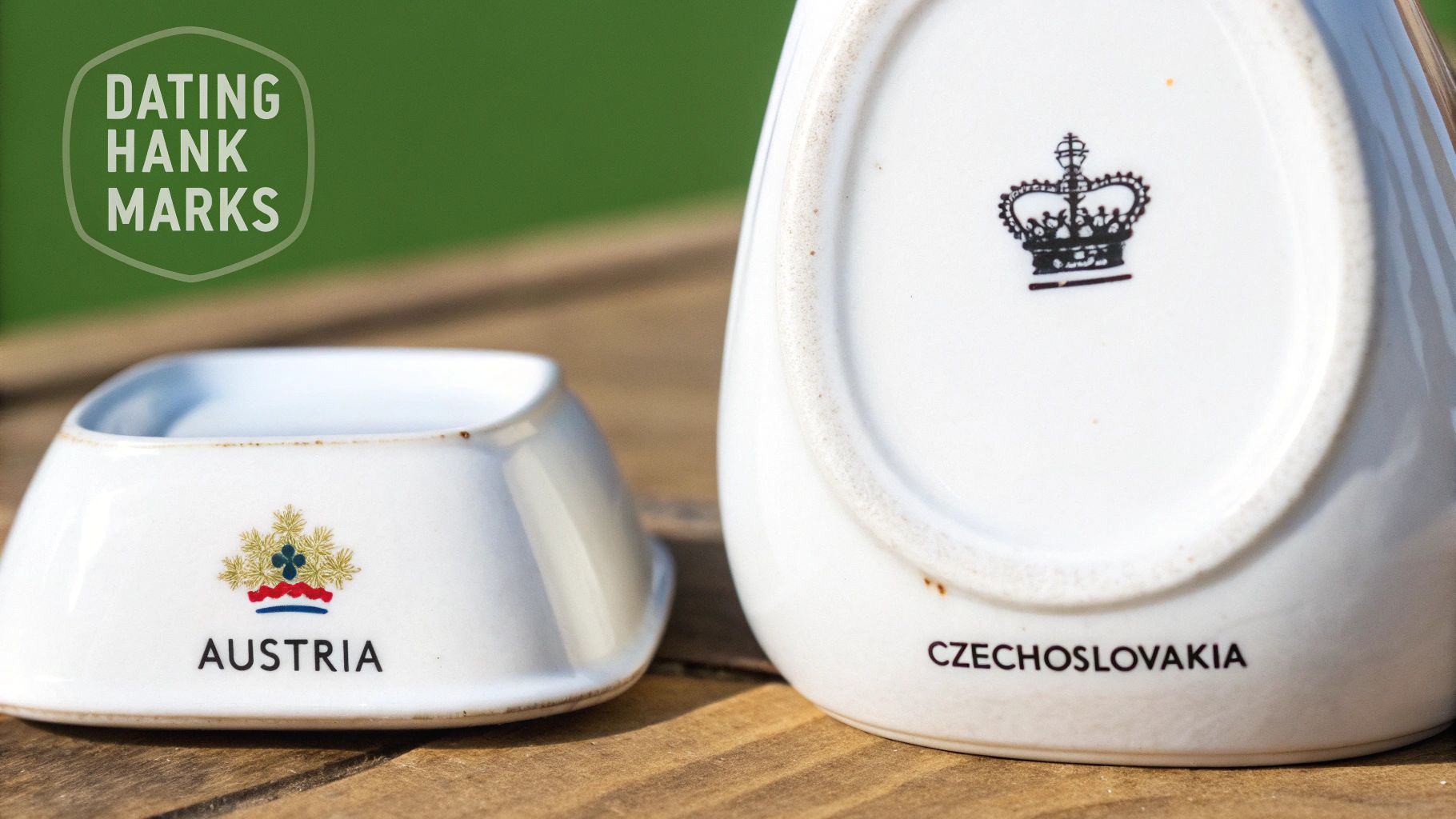
The Austrian Period Marks: 1882 to 1918
When Robert Hanke opened his factory in 1882, the area was known as Bohemia, a thriving industrial heartland of the Austro-Hungarian Empire. It's no surprise, then, that every piece of porcelain from this foundational era is marked with "Austria." For collectors, these early items are often the most desirable, representing the artistic peak of the empire.
On pieces from this period, look for a few key elements. The factory name, "Robert Hanke," or the stylized initials "R.H." are usually present. Almost without fail, you'll also see a crown, which served as the factory's signature emblem of quality.
These marks weren't always applied the same way. Some were printed on the surface in green, blue, or red ink. Others were impressed—pressed right into the clay before firing, leaving a slight indentation you can feel with your fingertip. This region's porcelain history is fascinating; for a deeper dive, our guide to identifying Carlsbad Austria china marks explores similar heritage from the same area.
Expert Insight: An "Austria" mark is a definitive sign that a Robert Hanke piece was made before 1918. While subtle changes in the crown design or script might hint at a specific decade, the country's name is your most solid piece of evidence.
The Czechoslovakian Period Marks: 1918 to 1945
With the end of World War I in 1918, the Austro-Hungarian Empire was dissolved, and the new nation of Czechoslovakia was born. The Hanke factory, still in the same location in Bohemia, suddenly found itself in a new country. This massive geopolitical change was immediately reflected in the Robert Hanke porcelain marks.
From 1918 right up until the factory closed in 1945, the country stamp was switched from "Austria" to "Czechoslovakia." For a collector, this is a clear, undeniable dating signal. A piece marked this way was made during the dynamic interwar years or World War II.
The factory kept its brand identity strong during this time, continuing to use the signature crown and the "R.H." initials. But the addition of "Czechoslovakia" or "Made in Czechoslovakia" is the defining feature of this era. Just like before, you’ll find these marks both printed in various ink colors and impressed into the porcelain.
This isn't just a historical footnote; it has a real impact on value. An early Austrian piece might command a higher price due to its connection to the Belle Époque. By looking for that crucial country name, you can place your porcelain in its proper historical context and better understand its story and worth.
How to Authenticate Robert Hanke Porcelain
Authenticating a piece of Robert Hanke porcelain takes more than just a quick look at the mark. While the country name—either "Austria" or "Czechoslovakia"—is your most important clue for dating, a real appraisal means getting your hands on the piece. This is where you put on your detective hat.
Genuine Robert Hanke porcelain has a certain feel and look that forgeries just can't get right. By examining the weight, the quality of the glaze, and the little artistic details, you can start to spot inconsistencies that should make you suspicious. The best way to be sure is to combine what you know about the marks with a careful physical inspection.
Key Characteristics of Authentic Pieces
When you pick up a potential Hanke piece, start with the basics. Authentic items from this factory have a consistent quality that you'll get better at recognizing with a little practice.
Weight and Feel: Real Robert Hanke hard-porcelain feels substantial and well-balanced in your hand. It shouldn't feel strangely light, clunky, or overly heavy. Those are often signs of a modern reproduction made with a different clay mix.
Glaze Quality: The glaze should be smooth and even. True Hanke pieces usually have a beautiful, lustrous finish, not something that looks drippy, pooled, or has a cheap, plastic-like shine. Tiny imperfections like pinholes can be normal for antique porcelain, but there shouldn't be too many.
Artistic Style: Hanke was famous for its Art Nouveau and floral designs, especially during its Austrian years. The painted details should look skilled and confident, never crude or rushed. The more you familiarize yourself with typical Hanke patterns, the easier it will be to spot something that looks out of place.
Expert Tip: Set the piece on a perfectly flat surface. An authentic Hanke item will almost always sit level without any wobble. If it rocks back and forth, it could be a lower-quality reproduction or a piece that would have never made it past the factory's inspectors.
Spotting Forgeries and Red Flags
Fakes of Robert Hanke porcelain are out there, though they aren't as common as forgeries of bigger names like Meissen or Sevres. Still, every collector needs to know the warning signs to avoid a bad buy.
One of the most obvious giveaways is a sloppy or inconsistent mark. A real mark, whether it's printed or impressed, should be crisp and clear. Be very wary of marks that are blurry, smudged, or look like they were applied unevenly—that's a classic sign of a modern fake. The mark should also be placed logically, usually right in the center of the base.
Another huge red flag is a clash of styles. For example, if you see a piece with an "Austria" mark (pre-1918) but the design is clearly Art Deco from the 1930s, you've found a major historical mismatch. Forgers often get careless and mix up elements from different time periods.
Finally, look for signs of fake aging. Be suspicious of uniform cracking (crazing) that looks a little too perfect, or wear marks that don't match how an object would naturally be handled over decades. Real patina from age is subtle and random, while faked aging often looks heavy-handed and deliberate.
You've successfully used the Robert Hanke porcelain marks to identify your piece, and now for the exciting part: figuring out what it's worth. The value of any antique isn't based on a single element; it's a fascinating mix of history, artistry, and what collectors are currently looking for.
Think of it as piecing together a puzzle. Several key factors come into play, and understanding them helps you get a realistic idea of what your piece might fetch on the market.
Key Valuation Factors
Let's break down the core attributes that really drive the value of Robert Hanke porcelain. Getting a handle on these will help you make a much more accurate assessment.
- Condition: This is, without a doubt, the most important factor. A piece in mint or near-perfect condition—no chips, cracks, or restoration work—will always bring top dollar. Be aware that even what seems like minor damage can slash an item's value by 50% or more.
- Rarity and Uniqueness: Was this a limited run? Does it have an unusual design? Items that are hard to find are naturally more sought-after. For instance, a big, highly decorated majolica ewer is almost always going to be worth more than a standard floral vase that was produced in large numbers.
- Age and Provenance: Generally, collectors tend to favor pieces from the earlier Austrian period (1882-1918) over those from the later Czechoslovakian era. While not a hard-and-fast rule, it's a common preference. A solid provenance—a documented history of who owned the piece—can also add a surprising amount to its value.
- Artistic Quality: The skill and artistry on display matter immensely. Look for intricate hand-painted scenes, complex shapes, and exceptional glaze work. A piece that truly represents the factory at the top of its game will always be desirable.
As you start thinking about the financial side of your collection, looking into antique inventory valuation strategies can offer some great frameworks for managing your assets.
High-Value Robert Hanke Pieces
While every piece tells its own story and has its own worth, some types of Robert Hanke porcelain consistently do better than others at auctions and with dealers. Collectors often hunt for items that make a real visual statement and showcase the pinnacle of the factory's talent.
Market Insight: Keep an eye out for large, decorative showstoppers. Things like floor vases, elaborate punch bowls, and detailed figural groups often command the highest prices. Their impressive size and the incredible skill needed to create them make them true centerpieces for any serious collection.
To put it in perspective, a standard little floral vase from the 1920s might sell for $30 to $60. On the other hand, a large, unique Art Nouveau vase from around 1905 in perfect condition could easily be worth several hundred dollars. The best way to get a feel for your specific item's value is to see what similar pieces have recently sold for on auction sites and antique marketplaces.
Proper Care and Preservation of Your Collection
So you've successfully navigated the world of Robert Hanke porcelain marks and authenticated a few pieces. Congratulations! Now, the focus shifts to protecting that investment. Proper care isn't just about cleaning; it’s about making sure your collection holds onto its beauty and value for generations to come.
A few simple preservation habits can make all the difference, preventing the kind of irreversible damage that comes from a poor environment or clumsy handling.
Safe Cleaning Methods
Let's start with the basics. Dust might seem harmless, but it's actually abrasive. A regular, gentle dusting with a soft, clean makeup brush is your first line of defense against the tiny scratches that can dull a beautiful glaze over time.
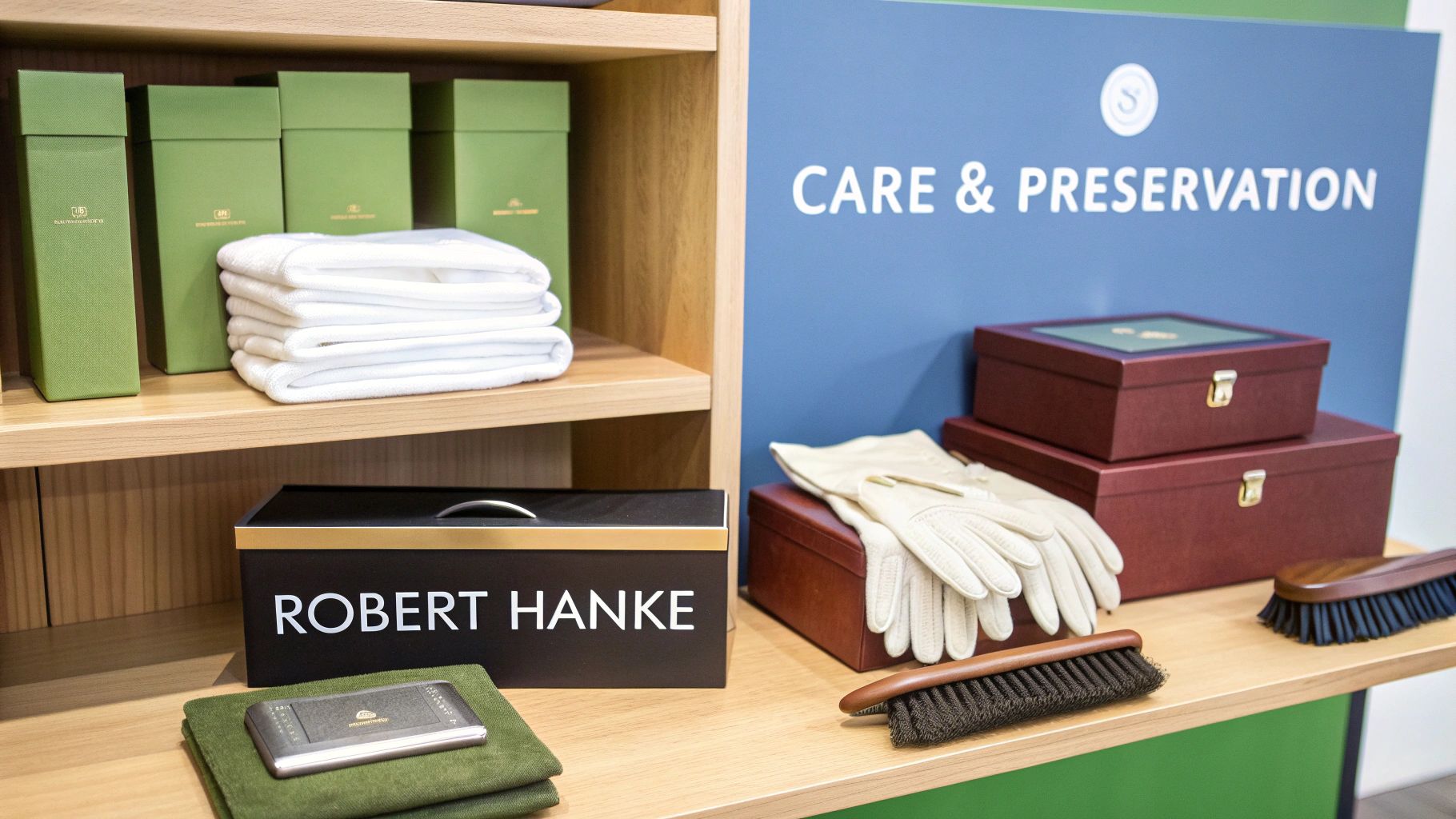
When a piece needs more than a dusting, a gentle hand wash is the only way to go. A word of warning: never put antique porcelain in a dishwasher. The combination of harsh detergents and extreme heat will absolutely wreck delicate paintwork, gilding, and the glaze itself.
Instead, follow this tried-and-true method:
- Line a plastic tub or your sink with a soft towel. This simple cushion can prevent a catastrophic chip if your hand slips.
- Fill the basin with lukewarm water and just a drop of mild, non-abrasive dish soap.
- Wash one piece at a time. Use a soft cloth or sponge and avoid any kind of scrubbing.
- Rinse well with fresh, lukewarm water, then gently pat it dry with a soft, lint-free towel.
Display and Storage Best Practices
Where you keep your collection is just as critical as how you clean it. The environment can be a silent enemy, causing gradual damage that you might not notice until it's too late.
A stable environment is the golden rule of porcelain preservation. Fluctuations in temperature and humidity can cause the porcelain and glaze to expand and contract at different rates, leading to fine cracks known as crazing.
When displaying your pieces, pick a spot away from direct sunlight, which is notorious for fading hand-painted details. An enclosed cabinet is ideal, as it protects from both dust and accidental knocks. Also, be mindful of heat sources—keep your porcelain away from radiators, vents, and fireplaces.
If you need to put pieces into long-term storage, wrap each one individually in acid-free tissue paper or a soft, clean cloth. Pack them in a sturdy box, using bubble wrap as padding to keep them from bumping against each other. The final step is crucial: store the box somewhere with a stable climate, not in an attic or basement where temperature swings are the norm.
Hanke Marks: Your Questions Answered
When you start digging into Robert Hanke porcelain marks, a few common questions always seem to pop up. Whether you're trying to pin down a date or just make sense of what you're seeing, this section tackles the most frequent queries from collectors.
Think of this as a quick-reference guide to help you solve those final little mysteries after you've inspected a piece.
What Does "Czechoslovakia" Mean on the Mark?
If you see the word "Czechoslovakia" on a Hanke piece, you can instantly date it to the period between 1918 and 1945. This isn't just a simple label; it’s a direct reflection of a massive historical shift.
After World War I, the Austro-Hungarian Empire collapsed, and the factory's home in Bohemia became part of the new nation of Czechoslovakia. This makes the country name one of the most reliable dating clues you can find. If it says "Austria," it's from the earlier imperial era. It's as simple as that.
Did Hanke Mark Every Single Piece?
Not always. While the vast majority of Robert Hanke porcelain left the factory with a clear mark, you might occasionally stumble upon an authentic unmarked item. There are a few reasons this could happen.
Marks sometimes got left off very small objects where there wasn't room, or they could get buried under a thick glaze during the firing process. Over a century of handling, a printed mark could also simply wear away.
Authenticating an unmarked piece is definitely trickier and relies on pure connoisseurship. You'll need to look closely at other clues:
- The type and quality of the porcelain itself.
- The style of the decoration and the feel of the glaze.
- The overall shape and form—does it match known Hanke designs?
How Can I Tell an Impressed Mark from a Printed One?
Spotting the difference between these two mark types is easy once you know the secret. A printed mark is completely flat. It was applied with ink, like a stamp, either under or over the glaze.
An impressed mark, on the other hand, is literally pressed into the wet clay before the piece was ever fired. You can actually feel the indentation. The Hanke factory used both techniques over the years, and knowing which one you're looking at can sometimes offer another small clue for dating.
Quick Tip: Just run your fingertip lightly across the mark. If you feel a dip or depression, it’s an impressed mark—a physical trace of the hands that made it. If it’s perfectly smooth, it’s printed.
Ready to uncover the story behind your own finds? The Curio app puts an antiques expert right in your pocket. Snap a photo to instantly identify items, get an estimated value, and learn their fascinating history. Download Curio today and let your treasures talk. Visit us at https://www.curio.app to get started.