If you want to accurately date your vintage Monet jewelry, learning to spot the different Monet jewelry marks is the most important skill you can develop. The company’s signature evolved over the decades, starting as Monocraft in the late 1920s and changing to the famous Monet mark—with a crucial copyright symbol added after 1955. These tiny stamps are your best tool for verifying a piece is authentic and figuring out its age and potential value.
Your Quick Guide to Identifying Monet Jewelry Marks
For anyone who loves and collects vintage jewelry, getting to know Monet's marks is non-negotiable. These signatures are like a timeline stamped right onto the piece, giving you a clear window into its history. A simple mark can be the difference between identifying a rare pre-war design and a more common piece from the 1960s.
Think of this guide as your starting point. We'll kick things off with a quick-reference chart to help you instantly recognize the most common marks. Mastering these signatures is the first real step toward building a fantastic and well-informed collection.
Why Marks Are Crucial for Collectors
That little signature on a piece of Monet jewelry tells you so much more than just the brand name. It's packed with essential details for any serious assessment or valuation.
Here’s why you should always look for the mark:
- Authenticity Confirmation: A legitimate mark is your best proof that a piece is genuine Monet.
- Accurate Dating: The style of the signature, especially the presence or absence of a copyright symbol, helps you pinpoint the production era with incredible accuracy.
- Value Determination: As a general rule, earlier marks like "Monocraft" or the pre-1955 "Monet" signatures often belong to rarer, more valuable pieces.
- Historical Context: The mark is a direct link to the design trends and manufacturing methods of a specific time, adding a rich story to every piece.
Beyond the main signature, don't forget to inspect the clasps and other findings—they offer great clues, too. If you're interested in going deeper, you can learn more about identifying different types of vintage necklace clasps in our detailed article.
Before we dive into the details, use the table below for a quick overview of the key marks and the eras they belong to. It’s the perfect cheat sheet to get you started.
Quick Reference Chart of Monet Marks by Era
Use this chart for rapid identification of Monet jewelry marks by comparing the signature on your piece to the time period and key features listed.
| Time Period | Mark / Signature | Key Identifiers |
|---|---|---|
| 1927–1937 | MONOCRAFT | Stamped in all capital block letters. You'll find this on early Art Deco pieces and handbag monograms. |
| 1937–1954 | Monet | Written in script or block letters, but always without the copyright symbol. Rare "Monet Jewelers" hang tags also appear in this era. |
| 1955–1970s | Monet© | The addition of the copyright symbol (©) is the definitive sign for all post-1955 jewelry. |
| 1980s–Present | Monet© with ® | Later pieces often include the registered trademark symbol (®) and sometimes list the country of origin. |
This chart gives you a bird's-eye view, but there's a lot more to uncover about the nuances of each mark, which we'll explore throughout the rest of this guide.
The Monocraft Era: 1927 to 1937
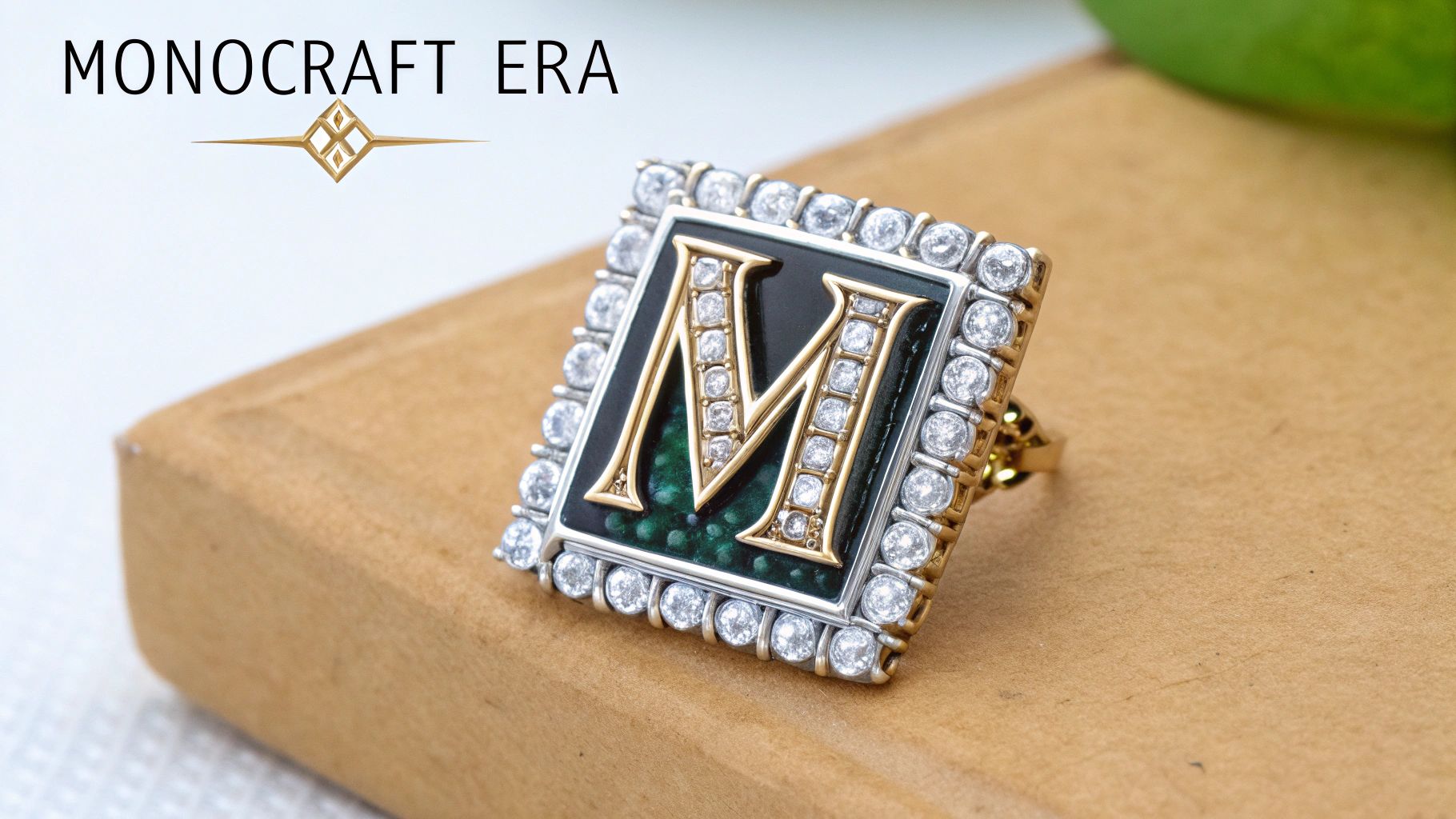
Before Monet became a household name, the company had a different identity altogether. It all started in 1927 as the Monocraft Products Company, founded by brothers Michael and Joseph Chernow in Providence, Rhode Island.
Their first venture wasn't actually costume jewelry. Instead, they specialized in crafting elegant, gold-plated monograms for personalizing women's handbags and accessories, which were all the rage during the Art Deco period. This early focus was incredibly important—it’s where the Chernows honed the expert metalworking and plating skills that would later define their jewelry empire.
Identifying the Monocraft Signature
Finding a piece from this early decade is like uncovering a hidden treasure. These items are the rarest and most coveted by serious collectors, and knowing how to spot their unique signature is crucial.
Keep an eye out for these distinct features of the Monocraft mark:
- The Name: The stamp will always read "MONOCRAFT", never "Monet."
- The Font: It’s almost always stamped in clean, sans-serif block capitals.
- Placement: On items like initial brooches or handbag plaques, you'll typically find the mark stamped directly into the metal on the reverse side.
Since these pieces predate the official switch to the Monet brand in 1937, a clear Monocraft stamp is a real find for any enthusiast.
For collectors, seeing the "MONOCRAFT" name is a surefire way to date a piece to the company's first decade, from 1927 to 1937. It’s a direct link to the origin story of one of costume jewelry’s most iconic brands.
Examples of Monocraft Pieces
While Monocraft wasn't producing full jewelry lines yet, their pieces are beautiful examples of early 20th-century design. You can really see the geometric and stylized aesthetics of the Art Deco movement in their work.
The most common examples you’ll run into are single or double initial brooches, clips, and decorative plaques made for accessories. Learning to recognize that simple "MONOCRAFT" signature is the key to correctly dating these fascinating pieces of jewelry history.
The Big Shift: Monet Marks from 1937 to the 1950s
Everything changed for the Monocraft Products Company in 1937. The Chernow brothers decided to pivot, rebranding their company to "Monet"—a name that felt classic, sophisticated, and perfectly suited to their new focus on high-end costume jewelry. This was the moment Monocraft faded into the background and the legendary Monet brand was born.
For collectors, the earliest Monet jewelry marks from this period can be a bit of a treasure hunt. Unlike the standardized marks of later years, these early signatures varied. You'll typically find a simple "Monet" stamp, sometimes in a lovely script and other times in clean block letters. The most important clue for dating these pieces is what isn't there: the copyright symbol (©). Monet didn't start adding the © to its marks until 1955.
This pre-1955 era is fascinating because the jewelry tells a story not just of a brand finding its footing, but of the major world events that shaped its production.
How World War II Changed Everything
When the Second World War began, everyday life was turned upside down—and that included the jewelry industry. Base metals were suddenly critical materials for the war effort, so companies like Monet had to get creative. This is when you see a very special and rare type of Monet jewelry emerge: pieces made from sterling silver.
These items are almost always marked "Monet Sterling." The designs themselves often echoed the times, with patriotic themes like eagles and flags making an appearance. Because the use of sterling was a temporary, necessity-driven measure, these pieces represent a unique chapter in Monet's history and are highly sought after by collectors.
Expert Tip: If you spot a "Sterling" stamp next to the Monet mark, you can be almost certain the piece dates to the war years of the 1940s. Their unique material and historical significance make them particularly valuable finds.
Early Signatures and a Commitment to Quality
Beyond the special wartime sterling, the late 1930s and 1940s are defined by the early script mark and an incredible dedication to quality. One of Monet's breakthrough innovations was its triple-plating technique. By layering gold or silver over a base metal three times, they created a finish that was not only beautiful but incredibly durable—truly rivaling the look and feel of fine jewelry. It's this commitment to quality that explains why so many early Monet pieces are still in fantastic condition today.
In addition to stamped marks, Monet also used hang tags on its earliest jewelry. Keep an eye out for these key variations:
- Early 'Monet' Script: A simple, elegant script logo stamped directly onto the back of a piece, usually on a clasp or the reverse of a brooch.
- 'Monet Jewelers' Hang Tag: An extremely rare find. These were small paper or metal tags used from the late 1930s through the mid-1940s. Finding a piece with its original tag still attached is a huge win for any collector.
Before fully dedicating themselves to the Monet brand, the company dabbled in pop culture. In 1936, for example, Monocraft did quick production runs for Shirley Temple and the Dionne Quintuplets, though the quality wasn't quite up to their later standards. Today, those earliest transitional marks—like the serif 'Monét' or the dangling 'Monet Jewelers' tags—are definitive proof of a piece's age, placing it at over 60 years old. With fewer than 10% of these items surviving in excellent shape, their value is often much higher than more common Monet jewelry. You can dive deeper into this early period by reading about Monet's fascinating 1930s history.
The Copyright Symbol: A Clear Dividing Line
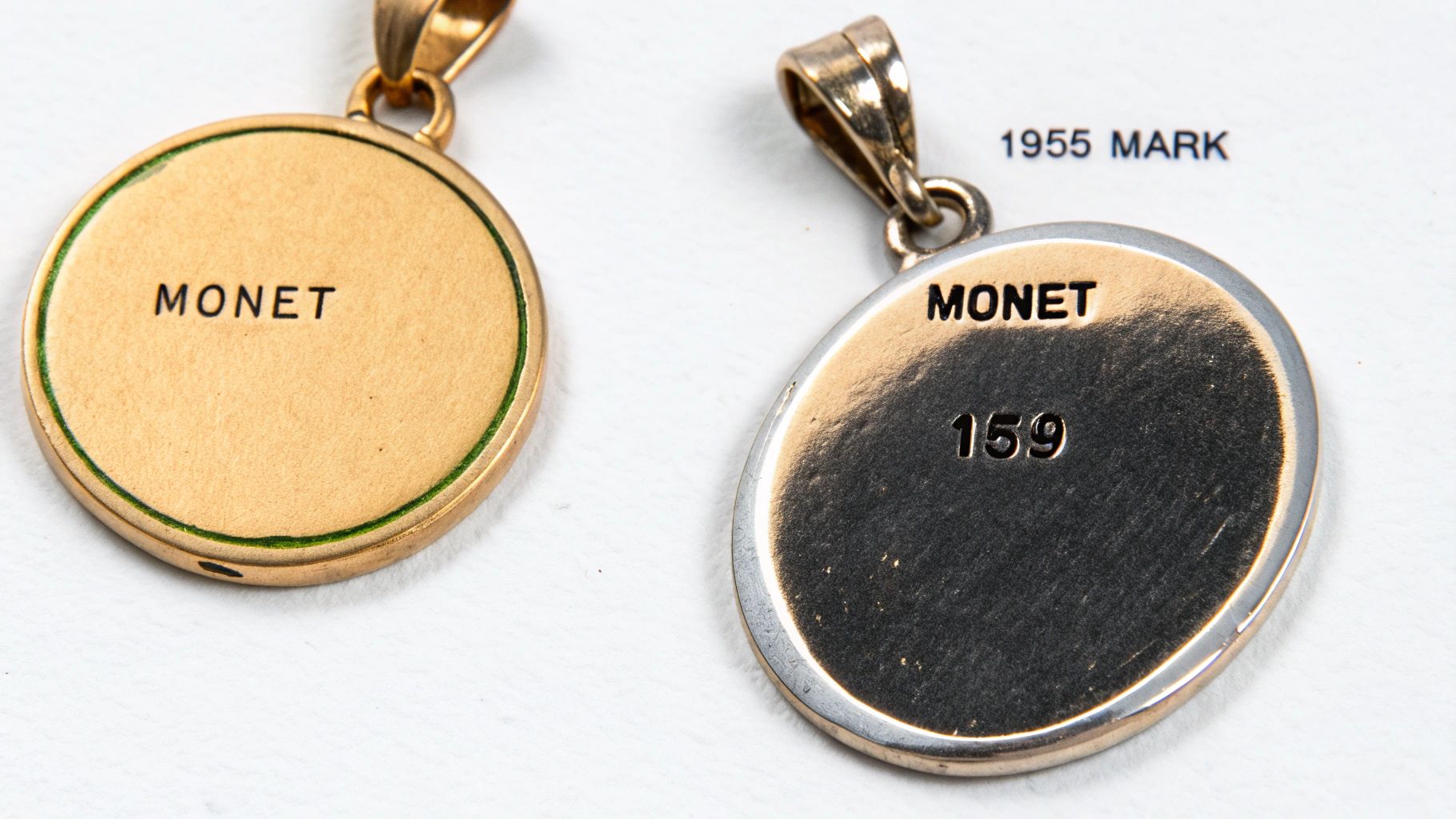
For anyone trying to date Monet jewelry, the year 1955 is a huge benchmark. This is when the company started adding the copyright symbol (©) to its signature, and for collectors, that little symbol is everything. It draws a clear line in the sand, separating the earlier vintage pieces from everything that came after.
If you find a piece stamped with just "Monet" and no ©, you've got something from 1937 to 1954. It's a simple but incredibly reliable rule. This shift wasn't just Monet doing its own thing; it was part of a larger movement by designers to protect their work from knockoffs as Monet's reputation for quality grew.
This wasn't merely a legal move—it signaled a new chapter for the brand. The appearance of the Monet© mark meant you were looking at a piece from the post-war era of innovation. The absence of the symbol gives you 100% certainty that the piece is older. For a deeper dive into this important dating clue, you can explore Monet jewelry's history on AntiquesKnowHow.com.
Visual Differences Pre- and Post-1955
Once you know what you’re looking for, telling the difference between a pre- and post-1955 mark is easy. It all comes down to that one little symbol.
- Pre-1955 Mark: You'll see the name "Monet" by itself. It's often in a clean block font, but sometimes you'll see a script version. No other symbols will be present.
- Post-1955 Mark: The signature will read "Monet©." The copyright symbol is usually small and tucked right up against the name.
This clear distinction is a lifesaver for collectors, both new and seasoned. It’s the very first thing I check when I’m examining a piece.
Connecting Marks to Design Trends
Interestingly, the introduction of the copyright symbol also lines up with some major shifts in jewelry styles. Monet's designs in the mid-'50s and '60s really leaned into the popular trends of the time, giving us another way to connect a mark with an era.
Take charm bracelets, for example. Their popularity exploded after 1955, and Monet was at the forefront, creating tons of intricate charms. So, if you find a charm marked "Monet©," it almost certainly comes from this booming period. The same goes for those beautifully tailored, matching sets of necklaces, bracelets, and earrings that were the height of fashion in the '50s and '60s—they almost always carry the copyright mark.
By looking at the signature and the style of the piece, you can start to paint a much richer picture of its history. Think of the "Monet©" mark as your entry point into one of the most creative and productive periods for the brand.
Spotting Fakes and Valuing Your Collection

Once you get a good feel for the real Monet jewelry marks, you'll be much better equipped to spot fakes and figure out what your collection is really worth. Identifying a counterfeit often comes down to the tiny details that forgers just don't get right. Authentic Monet pieces are celebrated for their quality craftsmanship, a standard that knock-offs almost never meet.
The most glaring giveaway is a badly executed mark. Keep an eye out for blurry, shallow, or uneven stamps. The font is another big clue; it must match the known examples for that specific decade. Any inconsistency should make you pause. Also, check the plating. A genuine Monet piece has that signature rich, durable triple-plating that gives it a nice weight. Fakes, on the other hand, often feel cheap, with a thin, brassy finish that might already be flaking.
Common Red Flags for Counterfeits
- Sloppy Marks: Look for any signature that's smudged, hard to read, or even misspelled.
- Incorrect Fonts: The style of the lettering should be a perfect match for documented Monet marks from that era.
- Poor Plating: Fakes will often have a thin, cheap-looking gold or silver tone that looks discolored or is peeling away.
- Lightweight Feel: Real Monet has a satisfying heft from quality base metals and thick plating. Fakes often feel flimsy and light.
A genuine Monet mark is always crisp, clear, and confidently struck. If the signature looks sloppy or like it was added as an afterthought, trust your gut. It’s worth a closer look before you buy.
How to Value Your Monet Jewelry
Figuring out what a Monet piece is worth goes far beyond just identifying the mark. A few key factors come together to determine its value on the collector’s market, separating a common piece from a rare find.
Condition is everything. A piece with little to no wear, pristine plating, and a solid, working clasp will always fetch a higher price. Rarity is just as important. For instance, pieces from the early Monocraft years (1927-1937) or the few sterling silver items made during WWII are far more desirable than mass-produced designs from the 1970s. For more general tips on spotting value, this guide on how to identify valuable antiques offers great context that applies to vintage jewelry, too.
Finally, don't underestimate the power of design. Bold, intricate, or iconic designs that perfectly capture the style of their time are always in high demand. For a deeper dive into appraisal, check out our guide on valuing antique jewellery. By combining your knowledge of the marks with these other factors, you’ll be well on your way to building a collection that’s rich in both history and value.
Your Monet Mark Questions, Answered
When you're sorting through a pile of vintage jewelry, a few key questions always pop up. It's no different with Monet. To help you feel more confident in your finds, here are some straightforward answers to the most common questions collectors ask.
Think of this as your quick reference guide for everything from value to spotting the real deal.
What Is the Most Valuable Monet Jewelry Mark?
Every collector hopes to find that one special piece. While a lot of a piece's value comes down to its design, rarity, and condition, the earliest marks are definitely the ones that get a collector's heart racing. The "Monocraft" mark, used from 1927 to 1937, is the holy grail for many, as it comes from the company's earliest days before they were a household name.
Beyond that, keep an eye out for these other high-value marks:
- "Monet Jewelers" Hang Tags: Finding a piece with its original paper or metal hang tag from the late 1930s to mid-1940s is incredibly rare and adds a huge premium.
- "Monet Sterling" Mark: During World War II, base metals were rationed for the war effort. Monet pivoted to sterling silver, and these pieces are now prized for their history and unique material.
- Pre-1955 "Monet" Mark: Any piece signed simply "Monet" without the copyright symbol (©) is an early one, dating before 1955. These are far more desirable than the mass-produced pieces that came later.
Does All Authentic Monet Jewelry Have a Mark?
For the most part, yes. Monet was incredibly proud of their craftsmanship and brand, so signing their work was standard procedure. A clear, crisp mark was their seal of quality.
That said, there are a couple of rare exceptions. Sometimes, in a matched set like a necklace and earring pair, only the primary piece (usually the necklace) would be stamped. It’s also possible the only mark was on a paper hang tag that was removed and lost decades ago. You might find a piece with tell-tale Monet construction or patented findings, but without a mark, it's tough to prove its authenticity and will almost always be valued lower. Just like with other brands, as noted in this guide to Avon jewelry marks, the signature is everything.
How Can I Differentiate a Vintage Mark from a Modern One?
This is one of the easiest and most reliable dating tricks in all of costume jewelry. The secret is the copyright symbol (©).
Simply put: If the mark is just the word "Monet," the piece was made before 1955. If it has "Monet©," it was made in 1955 or later.
This one little symbol is a game-changer for dating your finds. For pieces made even later, from the 1980s onward, you might also spot the registered trademark symbol (®). Another clue for more recent production is a country of origin stamp like "China" or "Mexico," as all early Monet was proudly made in the USA.
Have you ever found a beautiful piece of jewelry and wondered about its story? With the Curio app, you can turn that curiosity into knowledge. Just snap a photo to instantly identify your antiques, learn their history, and get an estimated value. Download Curio today and uncover the secrets hidden in your collection. Find out more at https://www.curio.app.