So, you've found a piece of Sarah Coventry jewelry and you're wondering what it's worth. Let's get right to it. For most individual items—a brooch, a pair of earrings, a simple bracelet—you're typically looking at a value between $10 and $50.
While most pieces are charming and affordable collectibles, you'll occasionally stumble upon a rare find. Complete, pristine sets, especially those still in their original boxes, can definitely catch the eye of a serious collector and fetch a higher price.
What Is Sarah Coventry Jewelry Actually Worth Today
To really understand the value of Sarah Coventry, you have to look beyond the materials. This isn't about gold content or precious gems. It's about owning a piece of American history.
The brand became a household name not through fancy jewelry stores, but through "fashion parties" held in living rooms all over the country. This clever sales model made their stylish designs incredibly accessible, which is why there's so much of it still around today.
Because it was so widespread, most Sarah Coventry pieces aren't exceptionally rare. Instead, their value comes from nostalgia, collectibility, and the appeal of certain designs. Think of it like collecting vintage comic books: a common issue might be worth a few dollars, but finding a rare first edition in perfect shape is a whole different story.
The Collector's Market Perspective
Today, the market for Sarah Coventry is driven by collectors, thrifters, and people who just love vintage style. Most pieces you'll find at an estate sale or flea market will fall into that $10 to $50 range. This makes sense, given the brand's focus on affordable costume jewelry made with gold or silver-toned metals and faux gemstones made of glass or plastic.
That said, designs with bold colors, shimmering rhinestones, or that classic iridescent aurora borealis finish tend to do better. Scarcity and style always play a big role.
The real charm of Sarah Coventry lies in its story. Each piece is a tangible link to mid-century fashion and the entrepreneurial spirit of the women who sold it. Its value is a blend of modest monetary worth and rich historical significance.
To give you a clearer picture, here’s a quick breakdown of what you can generally expect. This table provides a simple overview, but remember that factors like condition and rarity—which we'll get into next—can really change the final price. For a deeper dive, you can also explore our broader guide on how to determine vintage jewelry value.
Sarah Coventry Jewelry At-a-Glance Value Guide
| Jewelry Type | Common Price Range | Potential Value (Rare/Sets) |
|---|---|---|
| Brooches & Pins | $10 - $25 | $40 - $75+ |
| Earrings (Pairs) | $10 - $20 | $30 - $60+ |
| Necklaces | $15 - $35 | $50 - $100+ |
| Bracelets | $15 - $30 | $45 - $80+ |
| Complete Sets (Boxed) | $40 - $75 | $100 - $250+ |
As you can see, finding a complete, matching set—especially one that still has its original box—is where you start to see the value climb. Collectors love finding a full "parure" (a matched set of jewelry) in great condition.
The Story Behind the Sparkle
Before you can really get a feel for the value of Sarah Coventry jewelry, you need to understand its story. This wasn't a brand you'd find behind glass counters in a fancy department store. Instead, Sarah Coventry built its empire one living room at a time, right in the heart of American homes.
The company was started back in 1949 by Lyman K. Stuart in Newark, New York. He named it after his granddaughter, Sarah, and decided to skip the traditional retail route altogether. His big idea was to sell directly to customers through home parties, making the experience feel more like a social gathering than a sales pitch.
This "party plan" was pure genius for the post-war era. It gave women a respectable, flexible way to earn their own money, turning thousands of them into entrepreneurs long before that was a buzzword.
The Party Plan Phenomenon
Picture it: a 1960s living room, buzzing with the chatter of friends and neighbors as they pass around trays of sparkling new jewelry. That was the magic of a Sarah Coventry party. The company's reps, who they called “Fashion Show Directors,” were more than just salespeople—they were hostesses, personal stylists, and pillars of their communities.
The model was a smash hit for a few key reasons:
- No Upfront Costs: A woman could start her own business without paying for a starter kit, which opened the door for anyone who wanted to give it a try.
- It Was Fun: The parties turned shopping into a social event. You weren't just buying a necklace; you were enjoying an afternoon with friends.
- Instant Feedback: The company knew right away which designs were flying off the trays, so they could keep making what people loved.
And boy, did it work. Just 15 years after launching, Sarah Coventry was selling an unbelievable 35,000 pieces of jewelry every single workday. Their name became as recognizable as giants like Coca-Cola and Kodak. You can dig deeper into this incredible story and its roots in the Finger Lakes region.
Sarah Coventry's real genius wasn't just selling jewelry—it was selling an opportunity. It empowered a generation of women to build their own businesses, and that legacy gives every brooch and bracelet an extra layer of meaning.
How History Shapes Value Today
So, what does this history mean for the value of the jewelry now? Well, the massive amount of jewelry made during the company’s heyday, from 1949 to 1984, is why you can find it so easily today. That sheer abundance is what keeps the price of most common pieces fairly modest.
But that history also gives each piece a story. A simple pin isn't just a pin—it’s a tiny time capsule from mid-century America. It represents a unique moment in fashion and a tribute to the women who built a business from their own homes. For collectors, that story is a huge part of the appeal, adding a sentimental value that money just can't buy.
How to Identify Authentic Sarah Coventry Jewelry
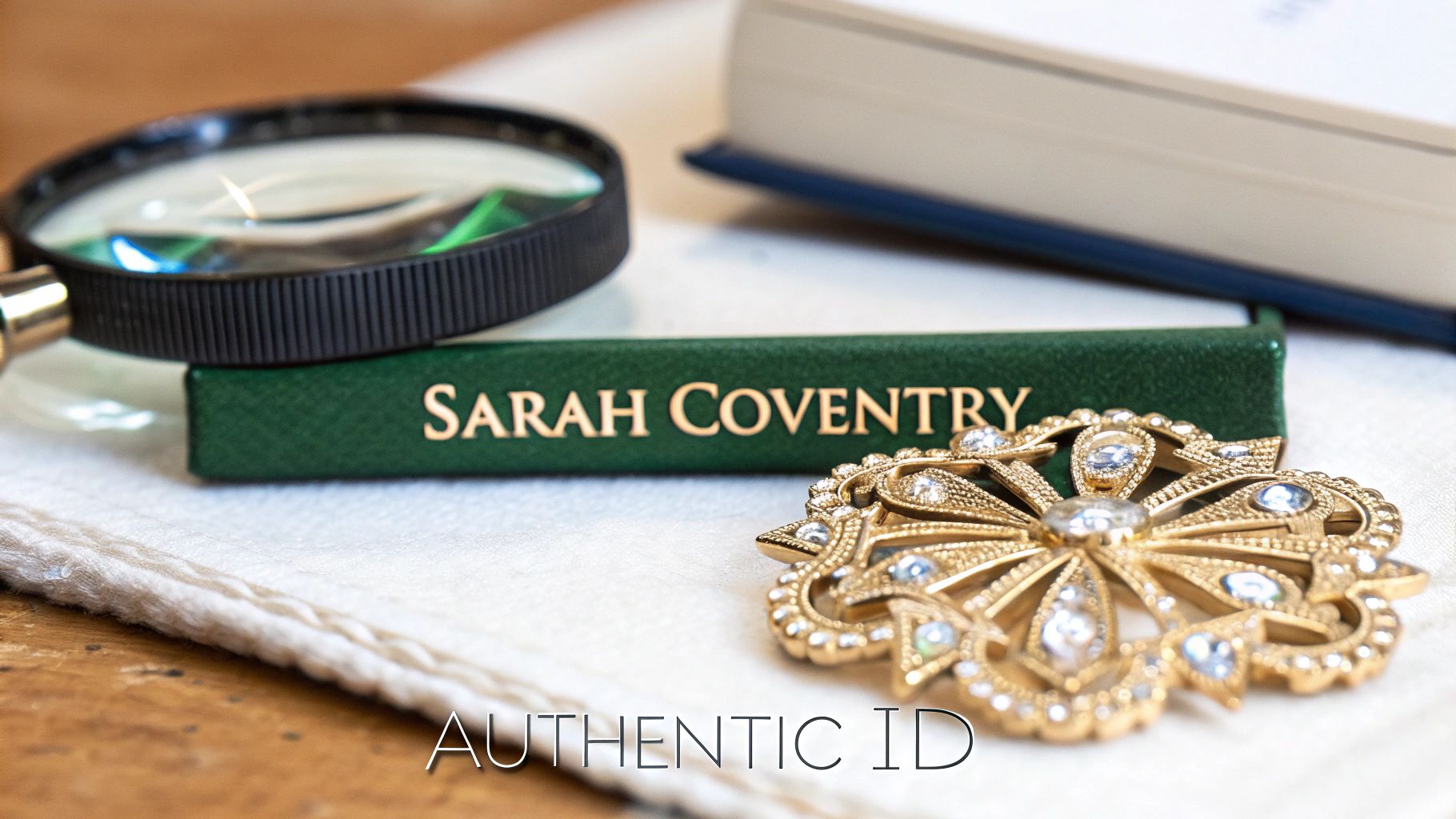
Before you can figure out what a piece of vintage jewelry is worth, you need to know if it's a genuine Sarah Coventry treasure or just a pretty look-alike. The very first step is playing detective. Your most important clue? The hallmark.
Thankfully, Sarah Coventry made our job pretty easy by marking almost everything they produced. You just need to know what you’re looking for. So, grab a magnifying glass or just use the zoom on your phone's camera, and let’s take a closer look. Check the back of brooches, the clasps on necklaces and bracelets, and the inner bands of rings.
Common Sarah Coventry Hallmarks
The company's signature, or "hallmark," changed a bit over the years. These little variations are great because they not only prove authenticity but can also give you a general idea of when the piece was made. Here are the most common marks you'll run into:
- ©SARAHCOV: You'll see this one all the time. It was widely used during the brand's heyday in the 1960s and 70s.
- SARAH COVENTRY: Sometimes the name was spelled out in full, often with the copyright symbol (©) right beside it.
- SC: This simple two-letter mark was perfect for smaller items like earring clips or delicate clasps where space was tight. It's almost always accompanied by the copyright symbol.
If you come across a piece that looks like Sarah Coventry but doesn't have a mark, be skeptical. It's true that minor components like generic earring backs or necklace extenders might be unsigned, but the main feature of a genuine set—the pendant, the brooch, the central part of the bracelet—is almost always signed. It’s an important detail, especially since so many other brands made jewelry in similar styles. For comparison, you can see how another major player marked their pieces in our guide to identifying Avon jewelry marks.
What to Do If There Is No Mark
Unsigned pieces are a tough sell. Without that confirmation, they’re much harder to authenticate and, as a result, usually have a lower value. An unmarked piece could be anything—an early prototype, part of a set where only the main piece was signed, or simply a well-made imitation.
Expert Tip: When you're looking at a potential Sarah Coventry piece without a clear hallmark, compare it to signed examples you know are authentic. Pay close attention to the quality of the construction, the weight of the metal, and the fine details in the design. Real Sarah Coventry jewelry has a consistent level of craftsmanship that fakes often lack.
At the end of the day, a clear and correct hallmark is your best friend. It’s the proof you need to confirm you're holding a real piece of fashion history, which is the foundation for determining the true value of Sarah Coventry jewelry.
What's My Sarah Coventry Jewelry Really Worth?
Figuring out the value of a piece of Sarah Coventry jewelry is a bit like putting a puzzle together. It's rarely about one single thing. Instead, you have to look at several key factors that separate a common $10 flea market find from a collector's prize that could fetch over $100.
Some designs are just plain harder to come by. While Sarah Coventry was known for its mass production, certain pieces had much shorter production runs. Limited editions, special hostess-only rewards, or early designs from the 1950s are often scarcer, making them a bigger deal for collectors trying to track down every last piece of a collection.
Condition Is Everything
If there's one golden rule in costume jewelry, it's this: condition is king. A piece that looks like it just came out of the box will always be worth more than one that's clearly been loved a little too hard. Even small imperfections can slash the value.
When you're inspecting a piece, get your magnifying glass out (or just look closely!) for these common deal-breakers:
- Worn Plating: Look for areas where the gold or silver finish has rubbed off, especially on high-contact spots like clasps, ring bands, and the back of pendants.
- Missing Stones: Are all the little rhinestones and faux pearls still there? A single missing stone can sometimes cut the value in half, as finding a perfect match is next to impossible.
- The Dreaded Green Gunk (Verdigris): That greenish-blue crust you sometimes see is a form of corrosion. It's a major red flag for collectors and very difficult to remove without damaging the piece.
- Broken Parts: Always test the clasps, pin backs, and earring clips. They need to be secure and functional.
Finding a piece in its original Sarah Coventry box is like hitting the jackpot. It tells a story of an item that was treasured, and that pristine condition can easily double its value compared to an identical, well-worn piece.
Keeping the Set Together
Sarah Coventry was brilliant at selling matching sets—a necklace with coordinating earrings and a bracelet, for instance. In the jewelry world, a full set is called a "parure," and a partial one (like just a necklace and earrings) is a "demi-parure." Whatever you call it, keeping these family members together is vital for value.
Think of it this way: a complete, boxed set might sell for $75, but if you sold those pieces individually, you might only get $15 apiece. The magic—and the money—is in the complete collection.
You'll also hear collectors talk about "book pieces." This simply means the jewelry was featured in an original Sarah Coventry catalog, ad, or brochure. Being a "book piece" is like having a birth certificate for your jewelry; it confirms its authenticity and era, which collectors absolutely love and are often willing to pay a premium for.
Before we dive deeper, let's look at how these different factors can dramatically swing the value of a piece.
How Different Factors Impact Sarah Coventry Valuations
| Valuation Factor | Low Value Example (e.g., $5-$15) | High Value Example (e.g., $50-$100+) |
|---|---|---|
| Condition | Shows visible wear, such as worn plating, a missing stone, or a broken clasp. | Mint condition, looks unworn. May include the original box and packaging. |
| Rarity | A very common, mass-produced design from the 1970s, like the "Fashion Petals" brooch. | A limited-edition piece, an early 1950s design, or a rare color variation. |
| Completeness | A single earring from a set, or a necklace sold without its matching bracelet. | A complete, matching "parure" (necklace, bracelet, and earrings) sold together. |
| "Book Piece" | An uncatalogued or common design not featured in prominent advertising. | A verified "book piece" featured in a well-known Sarah Coventry catalog from the 1960s. |
As you can see, a piece's story is told through its condition, scarcity, and originality. By learning to spot these clues, you're well on your way to becoming a savvy collector or seller.
Rare Sarah Coventry Pieces Worth Hunting For
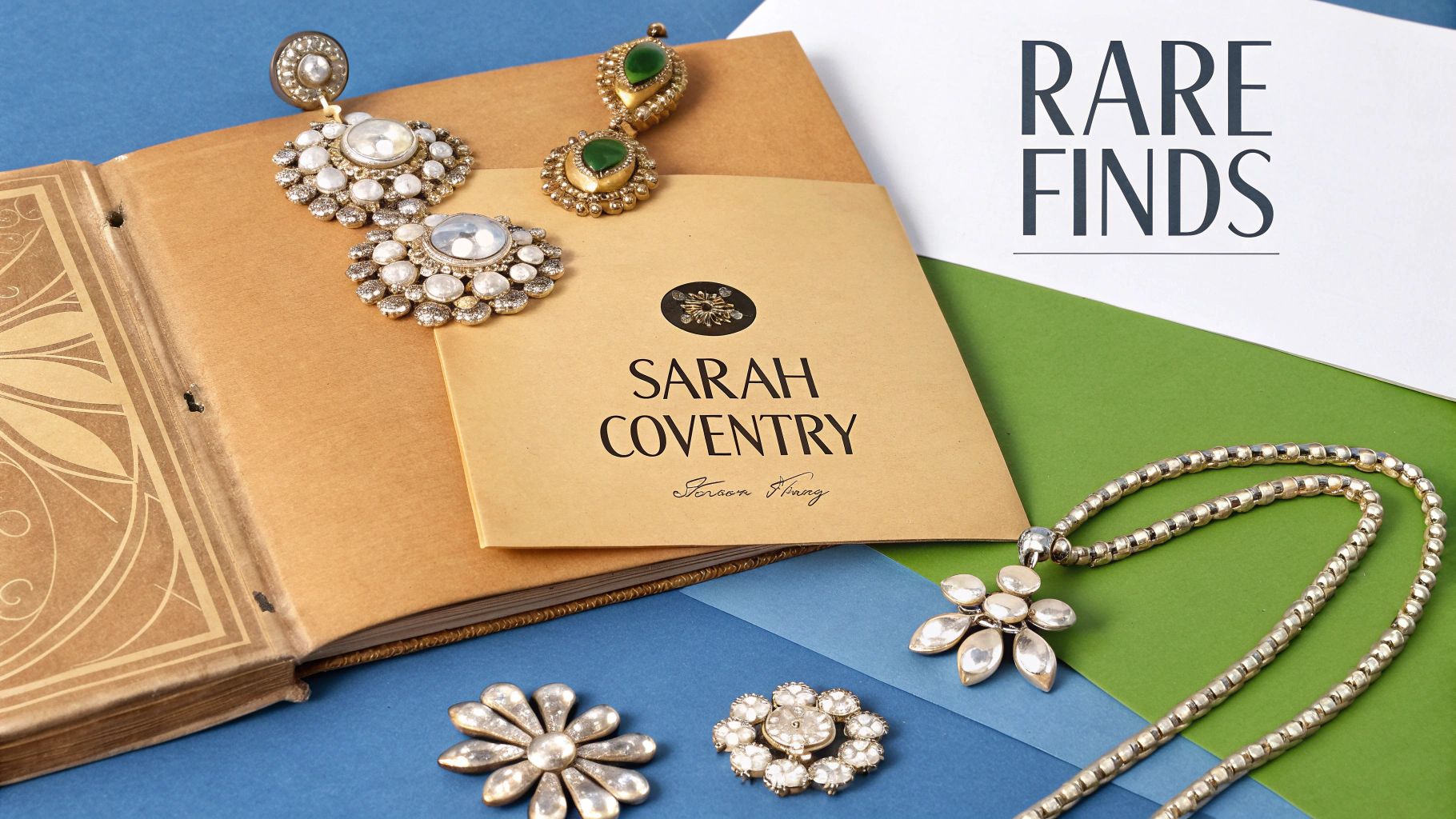
While you can find plenty of lovely Sarah Coventry pieces, the real fun for a collector is uncovering a true rarity. It's like panning for gold; most of what you find is just river rock, but every so often, a genuine nugget appears. To find those nuggets, you need to know which designs and collections are the most sought-after.
These aren't the brooches and earrings you see at every flea market. They’re the ones that make a seasoned collector’s heart beat a little faster, usually because of a standout design, unusual color, or a notoriously short production run. Knowing how to spot them is what separates a casual enthusiast from a serious collector and is key to understanding the higher end of the value of Sarah Coventry jewelry.
Iconic Collections That Command Higher Prices
A few specific, named collections have achieved almost legendary status over the years. These lines represent Sarah Coventry at its creative peak and are always in high demand. If you spot one of these, you've definitely found something special.
Keep an eye out for these fan-favorite lines:
- 'Blue Lagoon' (1964): You'll know this one when you see it. It features striking turquoise and deep blue thermoset plastic "leaves" set against a bright silver-tone finish. The collection has a bold, tropical feel that just screams 1960s.
- 'Northern Lights' (1973): This line is famous for its stunning aurora borealis rhinestones. These stones have a special coating that makes them flash with an iridescent rainbow of color, creating a dazzling effect that makes every piece a true showstopper.
- 'Strawberry Ice' (1968): A playful and fruity design that uses textured gold-tone metal studded with shimmering red and pink rhinestones. It's a whimsical, charming collection that collectors absolutely adore.
The most collectible Sarah Coventry lines are the ones that perfectly capture the spirit of their time. 'Blue Lagoon' is pure mid-century modern, while 'Northern Lights' is the epitome of 70s glam. It’s this distinct personality that makes them so desirable today.
Other Valuable Finds to Watch For
Beyond the big-name sets, there are other types of Sarah Coventry jewelry that tend to carry a higher price tag. These pieces really show off the brand's clever and versatile design work, making them prized finds for any collection.
While most everyday pieces sell in the $10-$50 range, some of the more premium designs can bring in a lot more. Collector favorites like convertible pieces or "book pieces" (designs featured prominently in old catalogs) can command prices anywhere from $70 to over $400. For instance, sales data from high-end vintage marketplaces shows a 1980s silver pearl flower brooch-and-earrings set listed for $380, proving that unique pieces have serious potential. You can see more real-world examples of Sarah Coventry resale values on 1stDibs.
Savvy collectors also keep an eye out for these less common categories:
- Convertible Jewelry: Pieces designed to be worn in multiple ways are always a great find. Think of a brooch that comes apart to become two smaller pins, or a necklace with a pendant that can be removed and worn on its own. This built-in versatility adds a ton of appeal and value.
- Men's Jewelry: It’s easy to forget, but Sarah Coventry also made a handsome line of cufflinks, tie tacks, and money clips for men. These items are much rarer than the women's jewelry, and finding a complete set still in its original box is a fantastic discovery.
How to Sell and Care for Your Collection
Once you've figured out what Sarah Coventry treasures you have, you're at a crossroads: do you sell them or keep them? If you decide to sell, online marketplaces like eBay and Etsy are fantastic options. They're teeming with collectors and vintage fans who are specifically looking for pieces just like yours.
To really catch a buyer's eye, your photos need to be top-notch. This is non-negotiable. Use good, natural light and a simple, uncluttered background. Make sure you get crystal-clear shots of the hallmarks, the clasp, and any special details. A piece that’s beautifully photographed will always sell faster and for more money than one with blurry, dark pictures.
Preserving Your Vintage Jewelry
Decided to hold onto your collection? Great! Proper care is everything when it comes to keeping your pieces in beautiful shape and protecting their value. Remember, this isn't solid gold and diamonds, so a gentle touch is needed to keep the plating and settings intact.
Here are a few simple rules I always follow:
- Cleaning: A soft, dry cloth is your best friend. Just use it to gently wipe away any dust or smudges. Stay far away from harsh chemical cleaners or jewelry dips—they can completely ruin the finish.
- Storage: Keep your jewelry somewhere dry and away from humidity (so, not the bathroom!). Storing pieces individually in soft pouches or a fabric-lined box is ideal to prevent them from getting scratched or tangled up.
- Display: If you like to have your jewelry out on display, make sure it's not in direct sunlight. Over time, the sun can cause the colors in the stones and metals to fade.
Whether you're selling or saving, taking good care of your jewelry is what preserves its history and charm. For more great advice, you can check out these essential jewelry maintenance tips. And if you want a deeper dive into getting the best price, our guide on how to sell antiques online has you covered.
A Few Final Questions
Still have a few things on your mind about your Sarah Coventry jewelry? Let's clear up some of the most common questions we hear from both new and seasoned collectors.
Is All Sarah Coventry Jewelry Signed?
You'll be hard-pressed to find a genuine piece that isn't signed. The vast majority of Sarah Coventry jewelry proudly displays a hallmark.
Look for markings like ©SARAHCOV, SARAH COVENTRY, or SC, usually on the back of the piece or near the clasp. While you might find a small part like an extender chain unmarked, the main event—the brooch, pendant, or earring—is almost always signed. If you've got an unsigned piece, it's a lot tougher to prove it's the real deal, which unfortunately means its value takes a hit.
What Was the Most Popular Era for Sarah Coventry Jewelry?
Without a doubt, the brand's heyday was the 1960s and 1970s. This is when Sarah Coventry really hit its stride, creating the bold, expressive, and sometimes wonderfully over-the-top styles that defined the era.
Pieces from the 1950s are also highly collectible, showcasing that classic, elegant mid-century charm. The company kept going into the 80s, but for today's collectors, the 60s and 70s are where the magic really happened.
A quick tip for valuation: Start with a simple visual search online. Seeing what similar pieces have recently sold for is the best way to get a real-world snapshot of what people are actually paying right now.
How Can I Get an Accurate Appraisal for My Jewelry?
For a quick and surprisingly accurate starting point, a photo-based identification app is your best friend. Just snap a picture, and the app can often give you a solid market value range by comparing your piece to its massive database of recent sales.
If you suspect you have a particularly rare or valuable set, or if you need a valuation for insurance, it's always smart to talk to a certified appraiser who specializes in vintage costume jewelry. But for most of the Sarah Coventry treasures you'll come across, an app gives you the instant insight you're looking for.
Curious about a piece you own? The Curio app makes identification simple. Just take a photo to instantly learn about your item, its history, and what it's worth. Discover the story behind your find today.