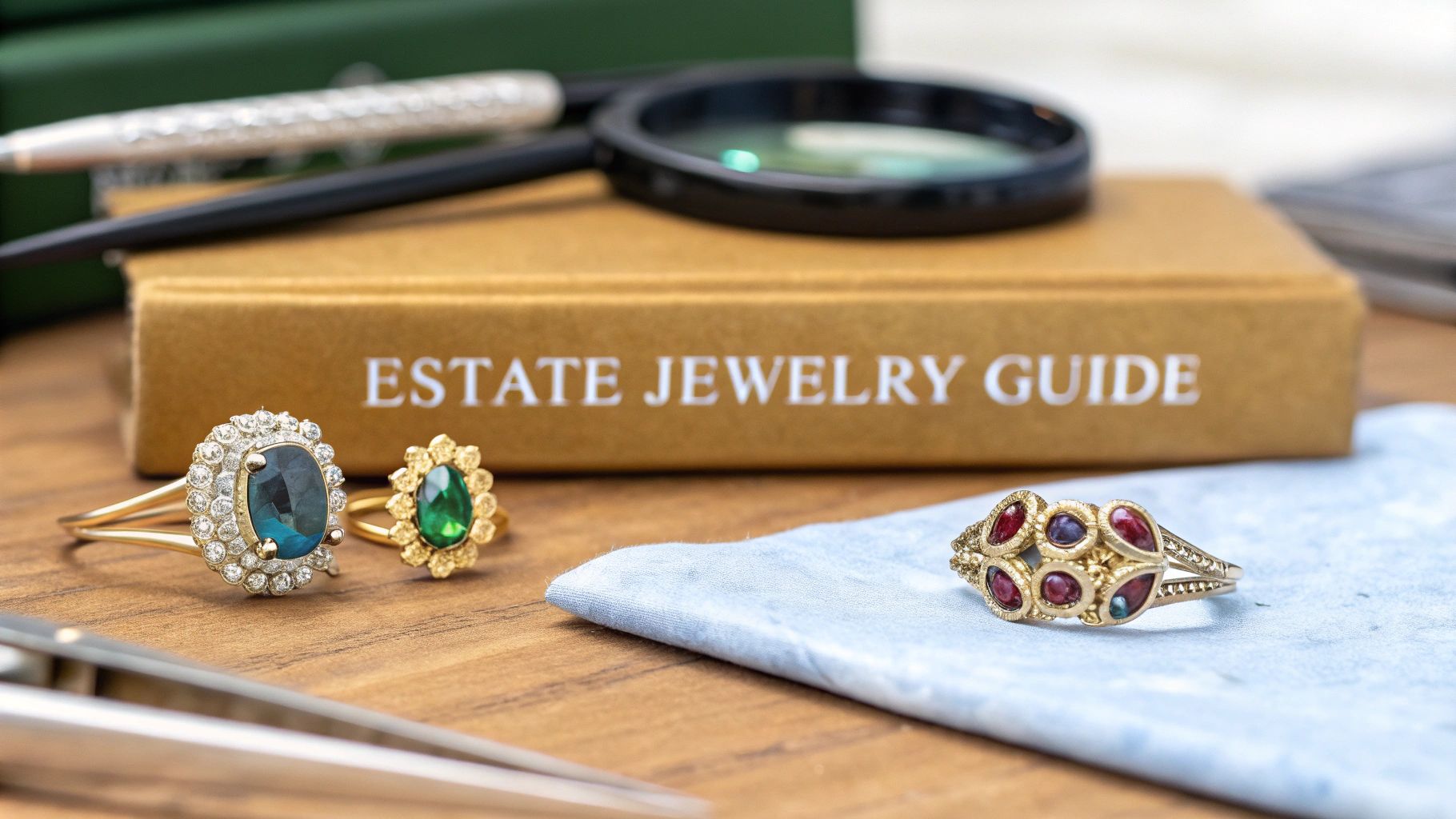
So, what exactly is estate jewelry? The simplest way to put it is this: estate jewelry is any piece of jewelry that has been previously owned.
It’s the industry's catch-all term for "secondhand," covering everything from a diamond ring someone bought last year to a treasured family heirloom that’s been passed down for generations.
Unpacking the Meaning of Estate Jewelry
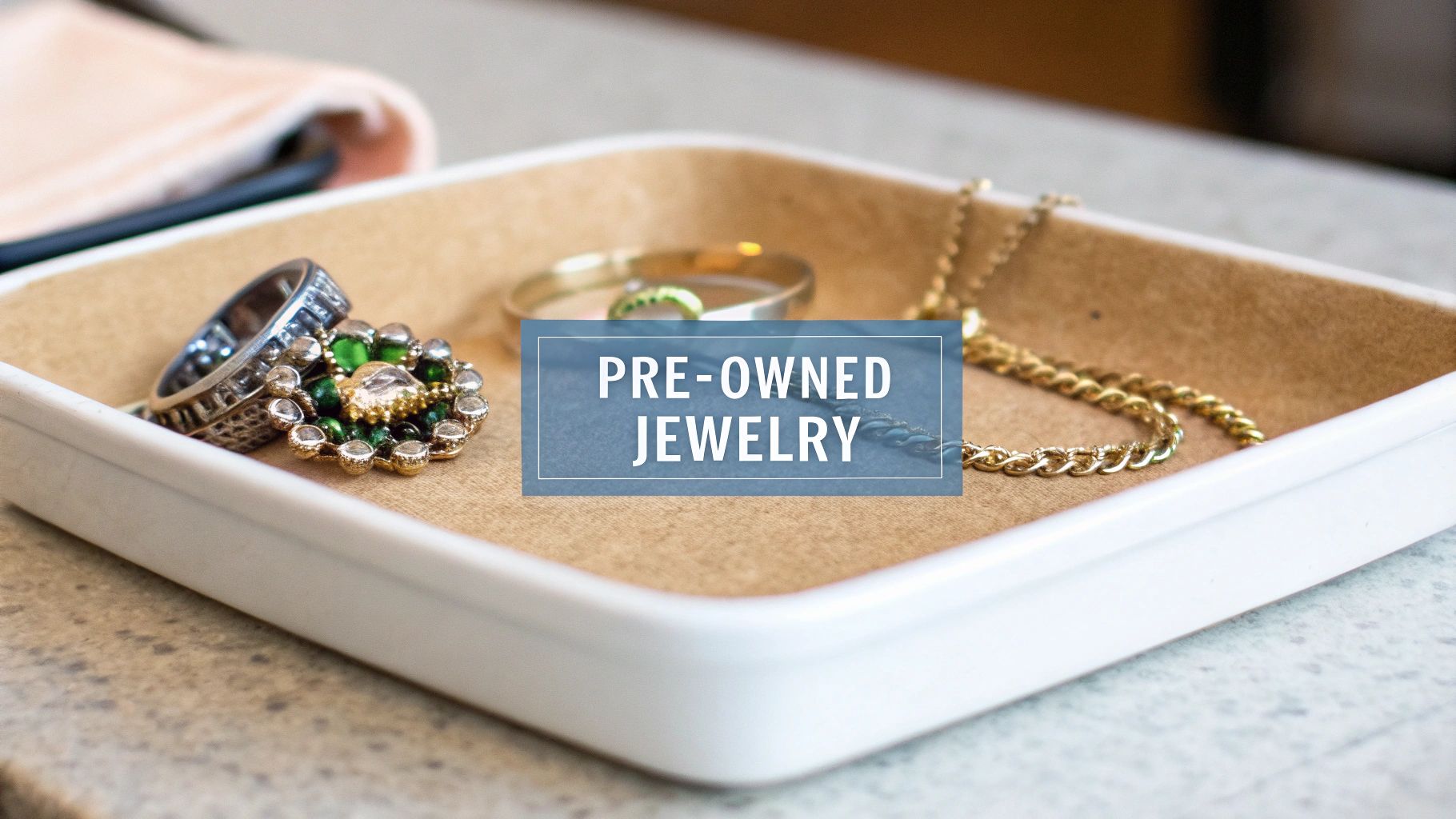
The word "estate" itself can be a little misleading. It often conjures up images of formal wills and inherited fortunes, but its meaning in the jewelry world is much more straightforward.
Think of it as a giant umbrella. Underneath it, you'll find every pre-owned piece imaginable, no matter its age or how it came back to the market. A modern designer bracelet sold by its original owner is just as much "estate jewelry" as a Victorian brooch discovered at a flea market.
While all estate jewelry has a past, not all of it is old. The one thing that ties it all together is that it has had at least one previous owner. This simple fact is what gives these pieces their unique character and separates them from brand-new items in a display case.
Why Is It So Popular Now?
The love for estate jewelry has absolutely exploded in recent years. Today’s buyers are looking for more than just a pretty accessory; they want pieces with a soul, a history, and a story to tell.
This growing interest has turned pre-owned jewelry into a huge business. Worldwide, retail sales for estate and antique jewelry hit an impressive $4.4 billion in 2023. The vintage ring market—a massive slice of that pie—was valued at $3.29 billion in 2024 and is expected to climb to $5.23 billion by 2031.
This isn't just a fleeting trend. It's a real shift toward appreciating the value and charm of pre-owned luxury. You can explore more about the rise of old jewels and what it means for today's market.
The Allure of the Past: Every tiny scratch, bit of patina, or unique repair on an estate piece tells a part of its story. Owning one is like becoming the next chapter in its history, connecting you to the people and moments that came before.
Key Categories At a Glance
To really get a handle on this world, it helps to know the main subcategories that fall under the "estate" umbrella. While we'll dive deeper into each one later, understanding the basic language is the first step for any budding collector or curious buyer.
To help you get started, here's a quick cheat sheet.
A Quick Guide to Pre-Owned Jewelry Terms
Learn the essential terms used to classify previously owned jewelry at a glance.
| Category | What It Means | General Age Range |
|---|---|---|
| Estate | The broadest term for any pre-owned jewelry. | Any age (from 1 day to 100+ years) |
| Vintage | Jewelry old enough to reflect a specific, recognizable style from a past era. | 20 to 99 years old |
| Antique | A true historical artifact, prized for its age, rarity, and craftsmanship. | 100+ years old |
Think of these terms as building blocks. "Estate" is the foundation, while "vintage" and "antique" add specific layers of age and historical significance.
Decoding Antique vs. Vintage Jewelry
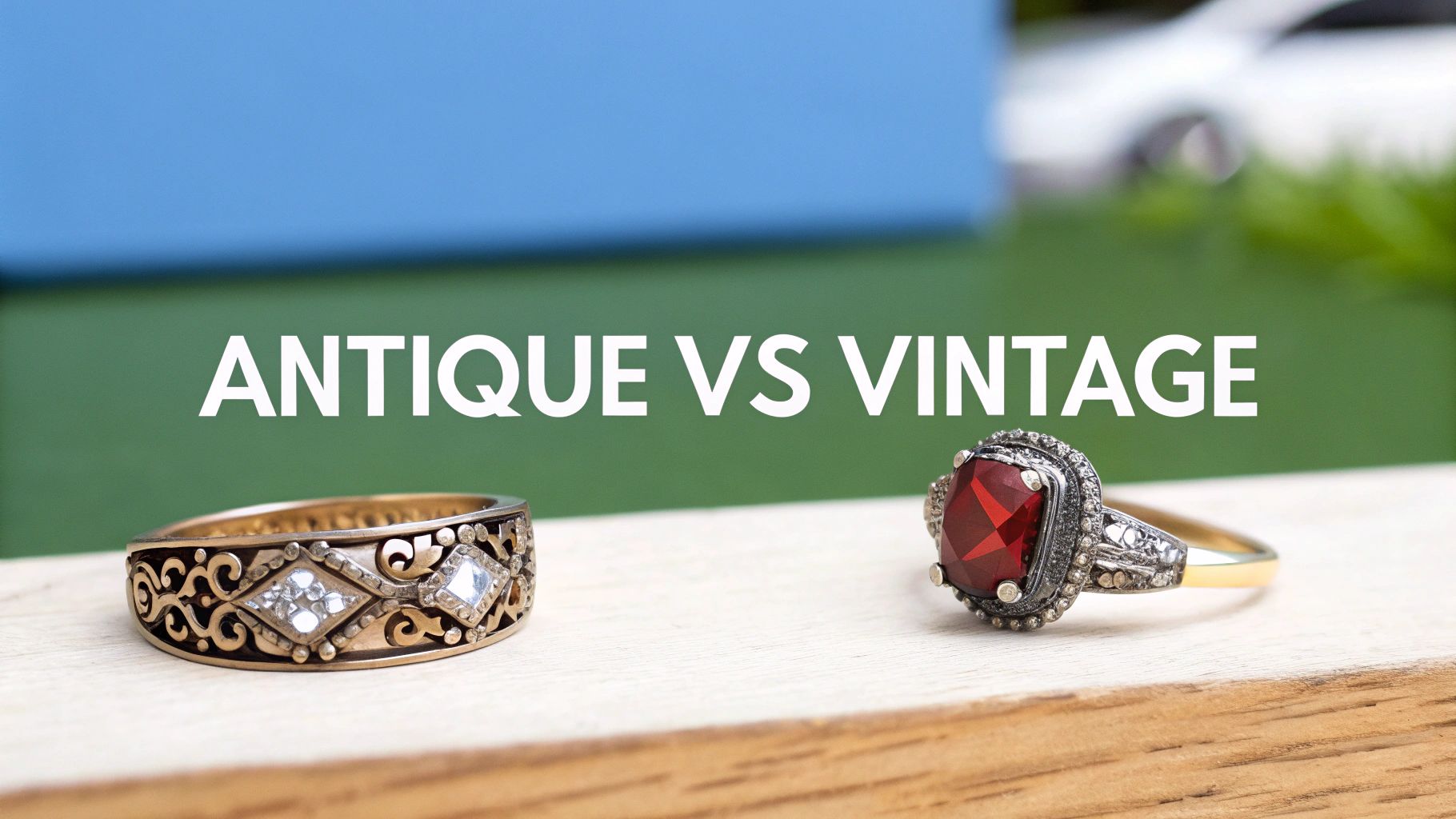
Since any piece that’s been owned before falls under the big "estate" umbrella, the next step is learning to tell them apart. I see it all the time—the biggest point of confusion for newcomers is the line between antique and vintage. People often use these words interchangeably, but in the jewelry world, they mean very different things.
Think about it like classic cars. You can call any used car "pre-owned," but you'd never mix up a 1970s muscle car with a Ford Model T. Each one represents a totally different era, with its own history and value. Jewelry is exactly the same.
What Makes Jewelry "Antique"?
An antique piece is more than just old; it's a genuine artifact from another time. To earn this prestigious title, a piece of jewelry must be at least 100 years old. That's not some arbitrary number. It means the item has survived through generations, carrying the style and craftsmanship of a long-gone era.
A delicate platinum and diamond necklace from the Edwardian period, say from around 1905, is a perfect example of an antique. Its value isn't just in the metal and gems—it’s in its age, its rarity, and the piece of history it represents. These are the kinds of treasures that collectors dream of.
The 100-Year Rule: This is the gold standard in the industry. An item made in 1924 officially becomes an "antique" in 2024. This category is always moving forward, which is part of what makes it so exciting.
And What About "Vintage"?
Vintage jewelry, on the other hand, is a classic from our more recent past. This label generally applies to pieces between 20 and 99 years old. They're old enough to feel nostalgic and represent a distinct design period, but they haven't quite hit that century milestone yet.
A chunky, geometric gold bracelet from the 1980s? That's vintage. A funky cocktail ring from the 1960s? Also vintage. These pieces capture the spirit of their time, which is why people hunt them down for their unique style. Getting these terms right is crucial, and you can dive deeper into the difference between vintage and antique to really train your eye.
Once you understand these age brackets, you can speak the language of dealers, accurately describe your own family heirlooms, and navigate the fascinating world of estate jewelry with confidence.
A Journey Through the Jewelry Eras
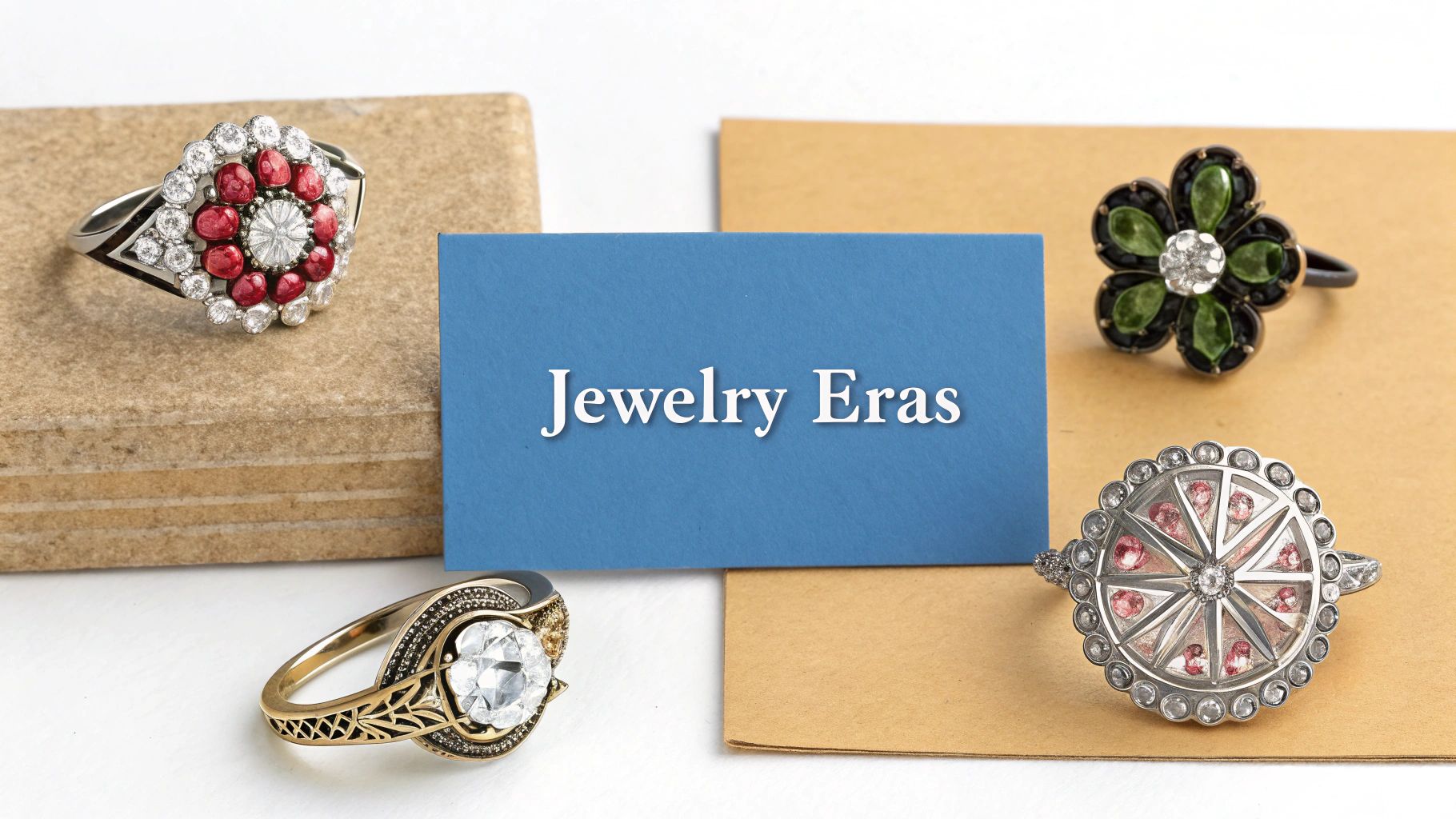
Every piece of estate jewelry is a time capsule, a direct connection to the fashion, values, and craftsmanship of its day. Learning to spot the tell-tale signs of different periods is like learning a new language—one spoken in metal and gemstones. Let’s walk through the major jewelry eras so you can start to recognize the unique story each piece has to tell.
If you really want to go down the rabbit hole, this comprehensive guide to jewelry through time is a fantastic resource for exploring this fascinating evolution even further.
The Sentimental Victorian Era (1837–1901)
Jewelry from Queen Victoria's long reign is deeply romantic and packed with symbolism. This was the first time jewelry became truly accessible to the middle class, thanks to industrial growth. As a result, designs were often incredibly personal, drawing heavily on themes from nature.
You'll see a lot of rich yellow and rose gold, usually with intricate engravings. Lockets for holding a snippet of hair, snake motifs symbolizing eternal love, and delicate floral designs were all the rage.
Look for these Victorian hallmarks:
- Symbolic Motifs: Snakes, hearts, flowers, and clasped hands were used to send messages of love, friendship, and remembrance.
- Dark Gemstones: Deep red garnets, purple amethysts, and black onyx were favorites. Mourning jewelry, which became a huge trend after Prince Albert died, often featured these somber stones.
- Metalwork: Gold was king, but jewelers often topped it with silver to set diamonds, long before platinum became a common choice.
The Elegant Edwardian Era (1901–1910)
After the heavy, sentimental mood of the Victorian period, Edwardian jewelry felt like a breath of fresh air. Designs became light, delicate, and incredibly sophisticated, reflecting the high-society tastes of King Edward VII. It was truly an age of elegance and grace.
The defining feature of this period? Platinum. Its incredible strength allowed jewelers to create intricate, lace-like filigree work that was simply impossible before. Pieces from this era often look wonderfully airy and feminine.
The Platinum Revolution: Edwardian jewelers fell in love with platinum because it was strong enough to hold gems in the most minimal settings. This created the illusion that diamonds were floating on air, a signature style often called "garlands and lace."
The Bold Art Deco Era (1920–1935)
The Roaring Twenties brought a radical new style: Art Deco. As a direct reaction to the soft, flowing curves of the past, this era celebrated industrial progress with bold, geometric designs. Clean lines, sharp angles, and perfect symmetry defined everything from skyscrapers to engagement rings.
Art Deco pieces are unapologetically modern and visually arresting. Think sharp, repeating patterns and a major focus on structure. Jewelers also started experimenting with high-contrast colors, pairing bright gemstones like emeralds and sapphires right alongside diamonds and black onyx.
The styles of Art Deco and the earlier Art Nouveau period are often compared for their groundbreaking creativity. If you want to get into the details, we have a whole article breaking down the difference between Art Deco and Art Nouveau. Knowing both will definitely sharpen your eye.
To make spotting these eras a little easier, here's a quick reference chart to help you identify the defining features of each period.
Identifying Clues from Major Jewelry Eras
A quick reference chart to help you identify the defining features of historical jewelry periods.
| Era and Dates | Signature Styles and Motifs | Preferred Metals | Popular Gemstones |
|---|---|---|---|
| Victorian (1837-1901) | Romantic, sentimental. Snakes, hearts, flowers, hands, mourning motifs. | Yellow Gold, Rose Gold, Silver-topped Gold | Garnet, Amethyst, Onyx, Pearl, Diamond (Old Mine Cut) |
| Edwardian (1901-1910) | Light, airy, delicate. "Garlands and lace," filigree, bows, ribbons. | Platinum, Yellow Gold | Diamond, Pearl, Sapphire, Peridot |
| Art Deco (1920-1935) | Bold, geometric, symmetrical. Sharp lines, repeating patterns, architectural forms. | Platinum, White Gold | Diamond (Asscher, Emerald cuts), Emerald, Sapphire, Onyx |
| Retro (1935-1950) | Big, bold, sculptural. Hollywood glamour, patriotic motifs (red, white, blue), ribbons, bows. | Yellow Gold, Rose Gold, Green Gold | Ruby, Sapphire, Citrine, Aquamarine |
| Mid-Century (1950s-1960s) | Abstract, textured, playful. Starbursts, animal motifs, free-form shapes, textured gold finishes. | Yellow Gold, Platinum | Diamond (Brilliant Cut), Turquoise, Coral, Pearl |
Keep this chart handy when you're looking at estate pieces. Soon enough, you'll start to recognize the distinct personality of each era at a glance.
Uncovering the True Value of Estate Jewelry
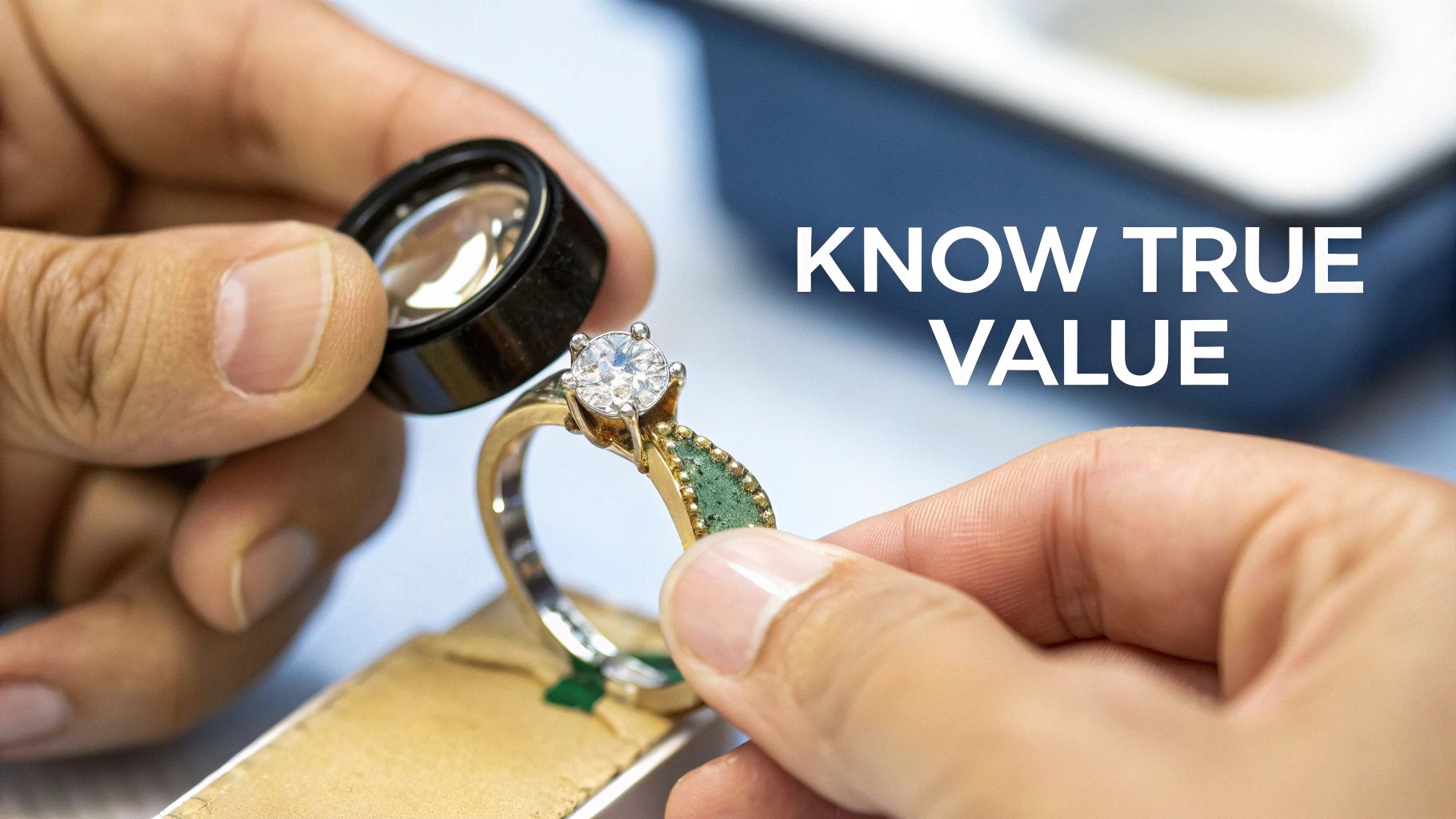
What's the real difference between a priceless family heirloom and just another pretty trinket? It all comes down to valuation—a process that looks far deeper than a gemstone's sparkle or the weight of its gold.
While the famous "Four Cs" (Cut, Color, Clarity, and Carat) are a great start for diamonds, they barely scratch the surface when it comes to estate jewelry. True value is a fascinating mix of the physical and the historical.
Think of it like appraising a classic car. The engine's condition is vital, sure, but so is the original paint job, how many were ever made, and whether a celebrity once sat behind the wheel. Estate pieces are judged the same way, where a rich history can be just as important as the materials themselves.
Beyond the Four Cs: Key Valuation Factors
To really get a feel for what an estate piece is worth, you need to look at it like a historian, an artist, and a collector all at once. Several key elements come together to paint the full picture. It can be helpful to have a basic understanding of property valuation, as many of the same ideas apply here.
Here’s what appraisers and seasoned collectors always have on their checklist:
- Condition: This is everything. A piece that's been carefully preserved, with all its original stones and minimal damage, will always fetch a higher price than one with obvious repairs or modern alterations.
- Rarity: Was this a one-of-a-kind commission for a duchess, or was it a popular design sold in department stores? The fewer there are in the world, the more desirable it becomes.
- Craftsmanship: The quality of the work speaks volumes. A piece showing off intricate hand-engraving, delicate filigree, or a complex setting reveals a level of artistry that commands a premium.
- Provenance: This is the piece's documented life story. A brooch with a verifiable paper trail linking it to royalty or a famous socialite has a value that goes far beyond its metal and gems.
- Maker's Marks: That tiny stamp from a legendary design house like Cartier, Tiffany & Co., or Van Cleef & Arpels can instantly multiply a piece's value. It’s a guarantee of quality and design heritage.
The Growing Market for Timeless Pieces
The market for pre-owned treasures isn't just for hobbyists anymore; it's a booming financial sector. The fine jewelry market alone was valued at a staggering $49.8 billion in 2023 and is projected to climb to $87.2 billion by 2031.
Within this massive market, certain historical styles are leading the pack. Art Deco pieces, for example, have been seeing an appreciation of 15-20% annually thanks to their timeless, geometric appeal that still feels modern today.
This strong growth signals a major shift: people are increasingly seeing estate jewelry not just as beautiful accessories, but as tangible assets with serious investment potential.
Getting a handle on what drives value is the first step toward making smart decisions, whether you’re looking to buy, sell, or simply care for a family treasure. For more practical advice, check out our complete guide to valuing antique jewellery.
Practical Tips for Buyers and Sellers
Whether you’re hunting for a new treasure or hoping to find a new home for a family heirloom, diving into the estate jewelry market is a genuine thrill. A little know-how goes a long way, helping you navigate the process with confidence and sidestep the usual mistakes.
The trick is to approach every piece with a healthy dose of curiosity and a good eye for detail.
Smart Strategies for Buyers
For buyers, you’ll want to put on your detective hat. Before you let your heart get set on a piece, take a minute to really look it over for clues about its past.
Always examine a piece under good, strong light. Look for little things, like inconsistencies in the metal color that might point to an old repair, or check to see if the prongs holding a gemstone look thin or worn down.
Never be afraid to ask questions! A good, reputable dealer loves to talk about their collection and will be happy to share everything they know.
Here are a few key questions to get you started:
- Can you tell me about this piece's history or provenance? Knowing its story not only adds to the charm but can also add to its value.
- Have any repairs or alterations been made? This is a big one. It’s essential for understanding the piece's current condition and originality.
- What maker’s marks or hallmarks are on the piece? These tiny stamps are like a passport, telling you who made it, what it’s made of, and where it came from.
Honestly, your most important step is finding a seller you can trust. Look for dealers with fantastic reviews, a transparent return policy, and a real, genuine passion for what they sell. A great seller isn't just a salesperson; they're your guide.
A reputable dealer not only sells you a piece of jewelry but also provides the confidence and knowledge that comes with it. Their expertise is part of the value.
Essential Steps for Sellers
If you're on the selling side of the table, your first job is to figure out exactly what you've got. This means going deeper than just identifying the metal or the stones.
Is it a signed piece from a famous house like Cartier or Tiffany? Does it come from a sought-after period, like the geometric glamour of Art Deco? These details matter—a lot.
To get the best possible price, here's what you should do:
- Get a Professional Appraisal: For anything you suspect is valuable, getting an appraisal from a certified gemologist is non-negotiable. This gives you an official, unbiased valuation to work with.
- Gather Documentation: Dig up any original boxes, old receipts, or past appraisals you might have. These documents can seriously boost a piece's value and make it much more attractive to discerning buyers.
- Choose the Right Platform: You have options—selling to an estate jeweler, going through an auction house, or using a consignment shop. Each has its own set of pros and cons when it comes to speed, convenience, and the final price you'll walk away with.
A Few Final Questions
As you get more comfortable exploring the world of estate jewelry, you'll probably have a few practical questions pop up. Let's walk through some of the most common ones that I get asked all the time.
Is Estate Jewelry a Good Investment?
It certainly can be. Think of it this way: when you buy a brand-new piece of jewelry, its value often drops the moment you walk out of the store, much like a new car. Estate jewelry, on the other hand, has often already passed that initial depreciation stage.
Pieces from iconic houses like Cartier or Van Cleef & Arpels, or those from highly sought-after eras like Art Deco, tend to not just hold their value but actually increase over time. It all comes down to rarity, craftsmanship, and the story behind the piece. Of course, just like any other investment, you need to know what you’re looking at, so a little research goes a long way.
How Should I Care for My Estate Jewelry?
Gentle is the name of the game here. How you care for a piece really depends on its age and what it's made of. A good rule of thumb is to steer clear of harsh chemicals and ultrasonic cleaners, especially for older items. They can be too aggressive for delicate settings and can ruin porous gems like pearls, opals, and emeralds.
For most pieces, a simple and safe cleaning method works wonders:
- A soft cloth with a touch of mild soap and warm water is usually all you need.
- Always store your jewelry separately in soft pouches or a fabric-lined box. This prevents pieces from scratching each other.
- If you have a truly old or fragile antique, your best bet is to talk to a professional jeweler who specializes in restoration. They'll know exactly how to clean and maintain it without causing harm.
Where’s the Best Place to Find Authentic Pieces?
You've got a few great options, and each has its own vibe. Your local, reputable antique shops and specialized estate jewelers are fantastic starting points. These places usually have experts on staff who have already curated a collection of quality, authentic pieces.
Auctions are another exciting avenue, whether online or in-person. You can find some incredible one-of-a-kind items, but you'll need to go in with a bit of knowledge to bid confidently. And of course, there's the thrill of the hunt at estate sales. You might just stumble upon a hidden gem, but you'll be on your own to verify its authenticity. If you're shopping online, stick with sellers who have stellar reputations and clear, fair return policies.
When you do find that potential treasure, figuring out its story and value is the next big step. Instead of falling down an internet rabbit hole, you can get answers right away with the Curio app. Just snap a photo, and the app can help you uncover an item's history, origin, and an estimated value—all from your phone. You can download Curio and start your discovery.