So, you've stumbled upon an old bottle and are wondering if you've hit the jackpot. The value of vintage bottles can swing wildly, from just a few dollars to over $100,000. It's a fascinating world where a common, clear medicine bottle might only be worth a buck or two, but a rare, brightly colored bitters bottle from the 1800s could fetch a small fortune at auction.
Figuring out what you have is the first step. Is it a forgotten piece of trash, or is it a hidden treasure? It all comes down to a few key details.
What Makes an Old Bottle Valuable
Finding an old bottle in your grandma's attic or uncovering one while gardening is always a thrill. But determining its value is a bit like being a detective. You have to piece together small clues—the color, the shape, the markings—to reveal the full story and, ultimately, its price tag.
It's a common misconception that older always means more valuable. That's not always the case. A quirky bottle from 1950 could easily be worth more than one from 1850 if it’s particularly rare or sought after by a niche group of collectors.
The world of bottle collecting is huge. You've got everything from vibrant bitters and old whiskey flasks to embossed soda pop and medicine bottles. Every category has its own "holy grails" that drive collectors wild. That's the fun of it—a simple piece of glass could be a mass-produced item worth next to nothing, or it could be a rare artifact with a story to tell.
The Core Pillars of Bottle Valuation
Think of a bottle's value as a building held up by a few main pillars. If one pillar, like its condition, is shaky, the whole value can come down. But if all the pillars are strong, you might be holding something special. Before we get into the nitty-gritty of pontil marks and maker's marks, let's look at the big picture.
These are the main things appraisers check first:
- Rarity: Was this a limited run? Was it made for a tiny local business? Does it have a weird mistake from the factory? The fewer there are, the more it's worth.
- Color: Deep cobalt blues, rich ambers, and vivid greens are much harder to find than standard clear or aqua glass. Unusual colors almost always boost the value.
- Condition: This one's a biggie. Chips, cracks, and heavy cloudiness can kill a bottle's value. A pristine, "attic mint" bottle that looks like it was made yesterday will always command the top price.
- Desirability: Is the bottle from a hot collecting category? Things like figural bitters (bottles shaped like people or objects) or historical flasks have a huge, passionate following of buyers ready to compete for them.
If you're new to collecting, here's the most important thing to remember: value is a mix of all these factors. An incredibly rare bottle with major damage might be worth less than a more common one in perfect shape.
To get a better handle on this, the table below breaks down the key factors and their impact on a bottle's final price.
Key Factors Driving Vintage Bottle Value
This table summarizes the primary characteristics that influence a vintage bottle's worth, rating their general impact on final valuation from low to high.
| Valuation Factor | Description | Impact on Value |
|---|---|---|
| Rarity & Scarcity | How many are known to exist? Was it a limited production or a common item? | High |
| Condition | Are there chips, cracks, stains, or scratches? "Attic mint" is the goal. | High |
| Color | Is the glass a rare or unusual color like cobalt blue, puce, or teal? | High |
| Age | Generally, pre-1900 bottles (especially hand-blown) are more desirable. | Medium-High |
| Embossing | Is the lettering sharp and detailed? Does it have an interesting graphic or design? | Medium |
| Maker's Mark | Can the manufacturer be identified? Some glassworks are highly collected. | Medium |
| Pontil Mark | The presence of a pontil scar helps date a bottle to pre-1860, adding historical value. | Medium |
| Overall Appeal | Does the bottle have a unique shape or interesting history that collectors find appealing? | Medium-Low |
Think of this table as your starting point. It's a quick cheat sheet for sizing up any bottle you come across and getting a feel for where it might land on the value spectrum.
The 7 Clues That Determine a Bottle's Worth
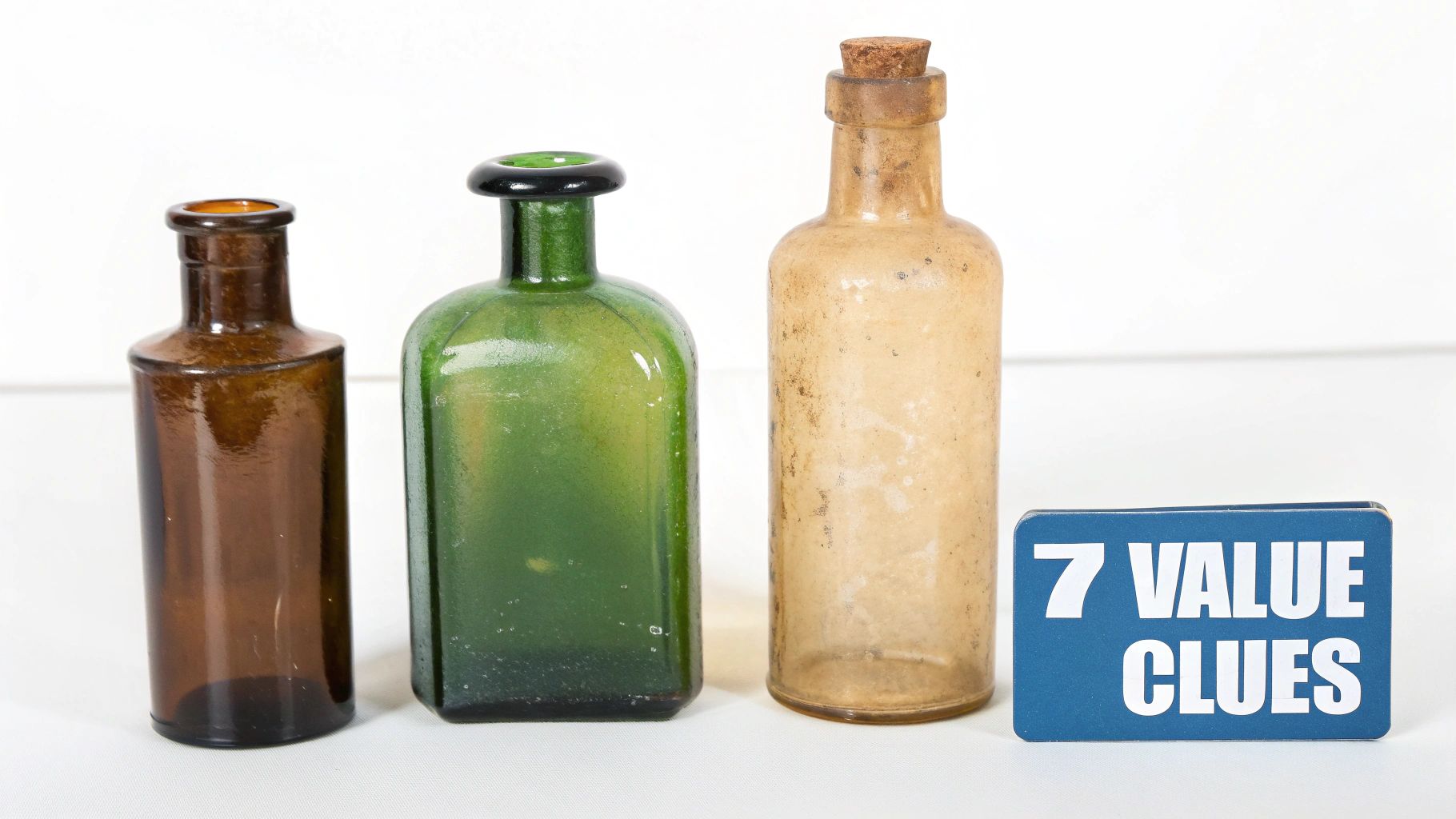
Think of yourself as a detective. Every vintage bottle holds a story, and its value is hidden in the details of how it was made and how it survived the decades. Appraisers and seasoned collectors know exactly what to look for—a set of seven key clues that together reveal a bottle's real story and, ultimately, its worth.
Learning to spot these clues is what separates someone who sees an old piece of glass from someone who recognizes a historical artifact. An oddly shaped bottle with tiny air bubbles trapped inside and a rough, scarred base tells a fantastic story of being hand-blown long ago. That history makes it far more exciting to a collector than a perfectly uniform, machine-made bottle from a later era.
Let's break down each of these clues.
Clue 1: Rarity and Scarcity
This is the big one. Just like with any collectible, the simple law of supply and demand is king. A bottle produced by the millions will probably never be worth much, no matter how old it is. The real gems are the ones that were made in small numbers to begin with.
So, what makes a bottle rare?
- Limited Production: Maybe it was made for a tiny local pharmacy, a special event, or a product that never took off.
- Factory Errors: A misspelling in the embossed text or a weird color mistake can make a bottle a one-of-a-kind treasure.
- Low Survival Rate: Some bottles were just too fragile, or they held products that encouraged people to toss them out immediately. Very few survived.
To put this in perspective, the global market for new glass bottles was valued at nearly $65 billion in 2025. Billions are made every year, but almost all are used and recycled. A tiny fraction—way less than 0.01%—survives in collectible condition. You can learn more about these market dynamics to see why a rare find is such a big deal.
Clue 2: Age and Manufacturing Method
While age alone doesn't guarantee value, it’s a huge piece of the puzzle because it tells you how the bottle was made. Early bottles (think pre-1900) were almost always hand-blown. This process gave each one a unique character, full of the little imperfections that collectors love.
A rough, jagged scar on the bottom, known as a pontil mark, is a dead giveaway of a bottle made before the 1860s. On the flip side, the invention of the Automatic Bottle Machine around 1903 standardized everything, churning out millions of identical bottles. These are usually less valuable, though there are exceptions.
Clue 3: Color
Picture a row of old bottles on a sunny windowsill. Which one catches your eye first? It’s probably the most vibrant one. Collectors have the exact same reaction.
Common colors like clear, aqua, and light green are a dime a dozen. The real thrill is in finding bottles with rare, striking colors, which were often more expensive to produce and saved for high-end products.
Some of the most sought-after colors include:
- Cobalt Blue: A stunning, deep blue often used for poison or medicine bottles.
- Puce: A funky, hard-to-describe brownish-purple or grayish-purple.
- Teal and Peacock Greens: Brilliant, eye-popping greens that just pop on a shelf.
- Deep Ambers and Olives: Richer, darker tones are always more desirable than common light browns.
Clue 4: Condition
This one is non-negotiable. A super-rare bottle with a big crack might be worth only a fraction of what a more common bottle in perfect, "attic mint" condition would fetch. Collectors want pieces that look as close to new as possible.
Damage that will tank a bottle's value includes:
- Chips and Cracks: Especially on the lip or body of the bottle.
- Heavy Staining or Sickness: This is a cloudy, sometimes iridescent film on the inside that’s often impossible to clean.
- Excessive Scratches: A bottle that's been tumbled around underground for a century will show heavy wear, which definitely hurts its appeal.
Clue 5: Embossing and Labels
The words and pictures on a bottle are a window into its past. Sharp, detailed embossing with cool fonts or graphics—like an eagle, a building, or an animal—is highly desirable. It's like the bottle's built-in artwork.
Paper labels are even better because they almost never survive. Finding a bottle with its original paper label fully intact is like finding a unicorn. It can easily double or triple the bottle's value.
Clue 6: Maker's Marks
Most glass companies left a little signature on the bottom of their bottles. These "maker's marks"—usually a combination of letters, numbers, or symbols—are clues to who made the bottle and where. This is absolutely critical for dating a bottle and tracing its history.
The Society for Historical Archaeology has an incredible online database for identifying these marks.
A resource like this can connect an anonymous piece of glass to a specific time and place, giving it a story that adds serious value.
Clue 7: Bottle Type and Desirability
Finally, what was the bottle actually for? Just like with cars or stamps, certain categories have huge, passionate followings that drive prices way up.
Some of the most popular collecting categories are:
- Bitters Bottles: Often found in wild shapes (like log cabins or fish) and amazing colors.
- Historical Flasks: Embossed with patriotic symbols, famous faces, or Masonic emblems.
- Whiskey Bottles: Early Western American whiskeys are particularly prized.
- Soda Bottles: Early "blob-top" and Hutchinson-style sodas from small, long-gone towns are a collector favorite.
- Medicine Bottles: "Quack" cure bottles with crazy claims and cool colors are always in demand.
A bottle from one of these hot categories will almost always have a higher starting value than a common household item, like a ketchup or ink bottle, even if they're the same age and color.
How to Identify and Date Your Bottle
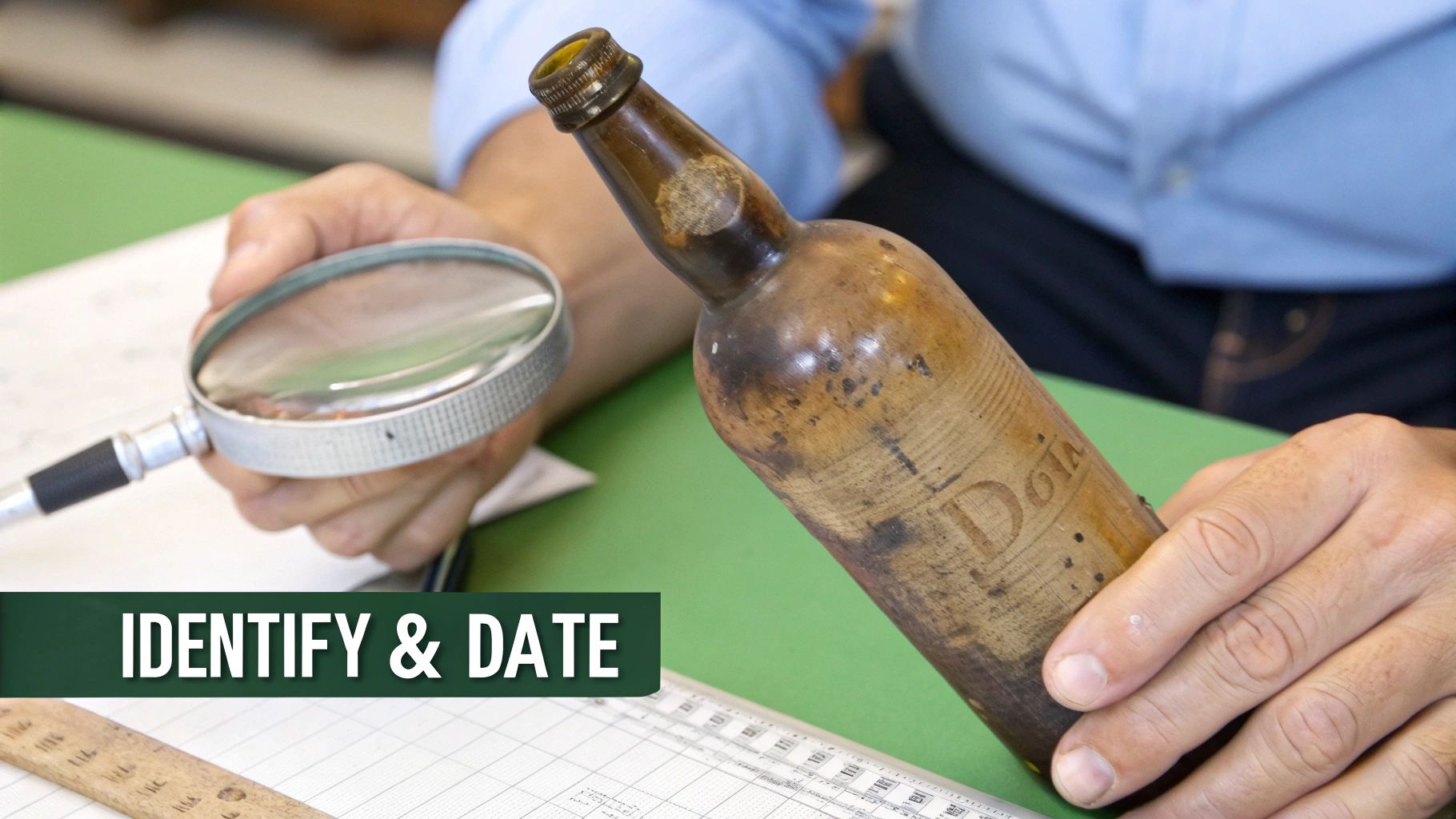 So, you’ve got an old bottle and you're ready to play detective. The good news is that every single bottle has a story etched right into its glass, whispering clues about how and when it was made. Learning to read these clues is the first step to figuring out its age, origin, and potential value.
Think of it like solving a puzzle. The seams, the shape of the lip, and the marks on the base are all critical pieces. By looking closely at these features, you can turn a dusty old bottle into a genuine piece of history.
Let's walk through the key things to look for. You'll soon be able to spot the difference between a handcrafted treasure and a common machine-made bottle.
Start with the Seams
The most obvious clue on many bottles is the mold seam—that faint vertical line running up the side. Where that seam stops is one of the most reliable ways to get a rough age. It tells you exactly what kind of technology was used to make it.
As bottle-making techniques evolved, the seams climbed higher and higher up the bottle.
- No Seams: Does your bottle have no seams at all, maybe with a few bubbles trapped in the glass? You're likely looking at a free-blown bottle, made before 1850.
- Seam Stops Below the Lip: If the seam travels up the body but stops on the neck, it's a good sign it was made between 1850 and 1900. The lip was finished separately by hand after the body came out of the mold.
- Seam Runs Over the Top: A seam that goes all the way up and over the lip is the classic signature of a fully machine-made bottle, produced after 1903 with an Automatic Bottle Machine.
Examine the Lip and Top
After you’ve checked the seams, the next stop is the bottle's lip. The way the top was finished is another huge piece of the dating puzzle. Early glassmakers had to finish the lips by hand, and the process left behind tell-tale marks.
A crude, uneven lip often means an older, hands-on process. A perfectly smooth, uniform lip screams modern machinery.
A key thing for collectors to remember is that imperfections often mean age and character. A crudely applied lip might not look "perfect," but it’s a highly desirable feature because it proves the bottle was handmade before mass production took over.
Here’s what to look for:
- Applied Lip: Seen on bottles from around 1840 to 1870, this lip was literally a separate glob of molten glass applied to the neck and shaped. You can often feel a distinct ring where it was attached.
- Tooled Lip: Common from 1870 to 1910, this involved reheating the bottle's top and using a special tool to shape it. The result is much smoother than an applied lip.
- Machine-Made Lip: After 1903, machines made the entire bottle in one go. These lips are perfectly uniform, and the mold seam runs right over the top.
Flip It Over and Check the Base
Now for the final check: turn the bottle upside down. The base can hold one of the most definitive clues for early, hand-blown glass: the pontil mark. This is the scar left by the iron rod (the "pontil") that held the hot bottle while the glassmaker finished the lip.
If you find a pontil mark, you can be almost certain your bottle dates to before the Civil War. After about 1860, new tools made the pontil rod obsolete. If you're ready to go even deeper, our complete guide on antique glass bottle identification has even more expert tips.
There are a few different types of pontil marks:
- Bare Iron Pontil: A rough, circular scar with a reddish-brown iron residue. Common from 1840 to 1865.
- Glass-Tipped Pontil: A small, sharp dot or blob of glass right in the center of the base.
- Open Pontil: A very early style (pre-1850) that looks like a jagged, broken ring of glass.
A smooth base, or one with clear maker's marks and numbers, tells you it's a post-1860 bottle. By combining what you learn from the seams, lip, and base, you can build a surprisingly accurate picture of your bottle's past.
Real World Vintage Bottle Values and Prices
Alright, you've learned to read the clues in the glass. Now for the fun part: connecting those clues to actual cash value. This is where bottle collecting gets really exciting, because the price difference between a common find and a true rarity can be absolutely mind-boggling.
Think about it this way: a plain brown whiskey bottle from the 1910s might be a neat $10 to $20 shelf-sitter. But an 1870s bitters bottle, one shaped like a log cabin and glowing in a rich amber, could easily pull in several thousand dollars. That huge jump isn't random; it’s driven entirely by the things we've been talking about—rarity, color, condition, and how much people want it.
From Bitters to Soda: A Look at Market Prices
Different kinds of bottles pull in different crowds of collectors, and each category has its own pricing rules. A bottle's original job often gives it a unique story that collectors today find fascinating. For example, those wild, unsubstantiated claims on 19th-century "quack" medicine bottles give them a quirky, historical charm that's hard to resist.
Let's dive into some of the most popular and valuable collecting categories.
- Bitters Bottles: This is the big leagues of bottle collecting. Early American bitters from 1860-1890 were often made in incredible colors and wild shapes—fish, barrels, even ears of corn. Simpler ones might start around $50, but the rare figural bottles in perfect shape can blast past $25,000.
- Whiskey Bottles: Early Western American whiskey bottles are a huge favorite, especially those with embossed pictures of pioneers or animals. While common amber flasks can be had for $20-$40, a rare embossed bottle from the late 1800s can command anywhere from $500 to $5,000 or even more.
- Soda & Mineral Water Bottles: Before giant corporations took over, almost every town had its own local bottler. Collectors go nuts for early "blob top" or Hutchinson-style soda bottles from these long-gone businesses. A bottle from a big city might only be worth $15, but find one from a tiny, short-lived company, and you could be looking at $200-$400.
- Medicine Bottles: Millions of plain clear or aqua medicine bottles are out there and aren't worth much. But the ones in deep cobalt blue or rich forest greens are a different story. "Quack cure" bottles with dramatic embossed promises are especially popular, with values typically falling between $30 and $300.
The market for old beverage and spirit bottles can be surprisingly strong. While most old bottles you find will have a modest value, the right mix of rarity, condition, and history can lead to some truly impressive prices.
This is especially true when iconic brands are involved. For instance, vintage glass beverage bottles from names like Coca-Cola and Pepsi can pull in four-figure prices at auction. We've seen individual, unopened Coke bottles from the mid-20th century with asking prices of $2,000–$3,000, while a few exceptionally rare Pepsi listings have soared as high as $30,000. You can read more about how certain vintage beverage bottles can be worth a fortune and see similar trends in the world of antique spirits.
Example Price Ranges for Collectible Bottle Types
To put some real numbers to these ideas, the table below gives a snapshot of the market. This is based on recent sales and listings, showing exactly how specific features can make a bottle's value jump.
| Bottle Category | Example | Key Value Drivers | Estimated Value Range |
|---|---|---|---|
| Bitters | Drake's Plantation Bitters (Log Cabin Shape) | Rare figural shape, desirable amber color, strong embossing, 1860s origin. | $1,500 - $3,500 |
| Whiskey | J.H. Cutter Old Bourbon (Embossed Shield) | Early Western brand, desirable amber color, crude applied top, pre-1900. | $300 - $700 |
| Soda | Hutchinson Stopper Soda (Small Town Bottler) | Rare origin (small, defunct company), blob top, unusual color (teal green). | $150 - $400 |
| Medicine | Cobalt Blue Poison Bottle (Embossed Skull) | Striking cobalt blue color, embossed warning (skull & crossbones), unique shape. | $75 - $250 |
| Common | Clear Machine-Made Medicine Bottle | Common clear glass, post-1910 automatic machine production, no rare features. | $1 - $5 |
As you can see, the details make all the difference. A common, machine-made bottle is often worth just a few dollars, but a bottle with a unique story, color, or shape can be a significant find.
Where to Research and Sell Your Vintage Bottles
So, you’ve figured out what kind of bottle you have and suspect it might be worth something. What now? The next step is to nail down its value and find the right place to sell it. This is where a little homework can turn that dusty bottle into a nice profit.Think of it like selling a classic car. You wouldn't just slap a "for sale" sign on the windshield without knowing what similar models have recently sold for. The same logic applies here—understanding the market is everything.
Finding Reliable Valuation Resources
Before you even think about listing your bottle, you need a solid idea of its current market price. Don't just rely on a single source; that's a recipe for getting it wrong. Pulling information from a few different places will give you a much more realistic estimate.
Online collector communities and forums are fantastic places to start. These are virtual hangouts for people who live and breathe old glass, and they're usually happy to share what they know. Sites like the Federation of Historical Bottle Collectors (FOHBC) are goldmines of information and can connect you with experienced folks.
For a more data-heavy approach, check out these tools:
- Online Price Guides: A service like WorthPoint is a game-changer. It pulls together years of sales data from countless auction sites, letting you see what your exact bottle—or ones very much like it—have actually sold for.
- Auction House Archives: Major players in the antique bottle world, like Heckler or Glass Works Auctions, often keep searchable databases of their past sales. This is the best way to see what truly high-end, rare bottles are commanding.
Choosing the Right Selling Platform
Once you have a good handle on your bottle's value, it's time to decide where to sell it. The right venue really depends on what you have. If you're thinking about using a broad marketplace, it's smart to weigh the pros and cons of selling on Etsy or similar sites first.
Here’s a quick rundown of your best options:
- Online Marketplaces (eBay, Etsy): These are perfect for common to moderately valuable bottles, generally in the $10 to $200 range. You get access to a massive audience, but you also face a lot of competition. Great photos and a detailed, honest description are non-negotiable if you want to stand out.
- Specialty Auction Houses: If you’ve discovered a genuinely rare or high-value bottle (think $500+), a specialty auction is the way to go. They have a built-in network of serious collectors ready to spend big, and they handle the entire process for a commission.
- Local Antique Shops or Shows: This is your fastest path to a cash sale. Just know that you'll be offered a wholesale price, which is usually 40-60% of what the bottle might sell for at retail. You're trading top dollar for pure convenience.
No matter which path you take, remember that presentation is key. Your bottle's story, told through excellent photos and accurate details, is your single best sales tool. For more ideas on reaching buyers, our guide on where to sell antiques has plenty of extra tips.
Preserving Your Bottle's Value and History
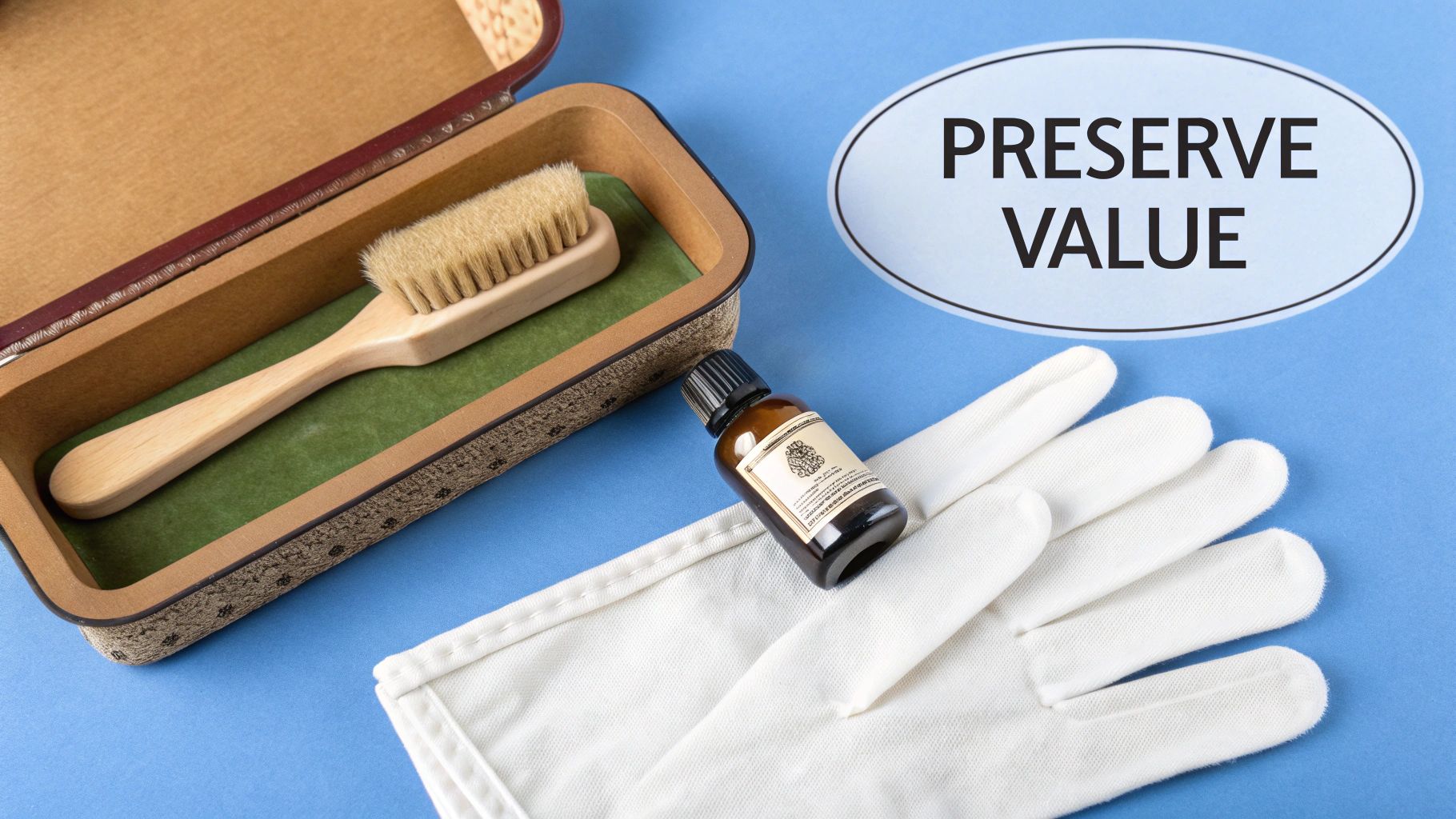
Unearthing a rare old bottle is an incredible thrill, but that's just the first step. Protecting its condition is just as important—maybe even more so—when it comes to preserving its value.
The single biggest mistake I see new collectors make is getting overzealous with cleaning. Going at a delicate piece of glass with harsh chemicals or aggressive scrubbing can cause permanent damage, literally wiping out its worth in an instant.
Think of it as preservation, not just cleaning. Your goal is to gently remove loose dirt and grime, not to make it look brand new. You want to avoid scratching the glass or causing "sickness"—that dreaded cloudy haze that’s nearly impossible to get rid of. Stay far away from abrasive brushes, steel wool, and especially the dishwasher.
Gentle Cleaning and Care
For most dug or found bottles, a gentle soak in warm, soapy water is all you need. If you’ve got some stubborn gunk inside, you can carefully use a soft-bristled bottle brush. If you're looking for a more detailed walkthrough, our complete guide on how to clean vintage bottles will show you how to do it safely.
A cardinal rule for every collector: It is always better to leave a little dirt behind than to risk causing irreversible damage. Pristine condition drives value, and a single careless scratch can be a very expensive mistake.
Authentication and Provenance
Taking care of the glass is one thing, but you also need to preserve its story. Fake and reproduction bottles have been circulating since as early as the 1930s, made to fool collectors by mimicking valuable, hand-blown originals.
Here are two things you absolutely need to focus on:
- Authentication: Get familiar with the tell-tale signs of an authentic bottle from your target era. Study the seams, the style of the lip, and the pontil marks on known examples. Reproductions often just feel too perfect, or they might have mold seams that don't match the period they're supposed to be from.
- Provenance: This is simply your bottle's life story, and it can be a huge value-add. Document everything you can. Where did you find it? Is there a family story attached to it? Any old receipts, letters, or photos that feature the bottle can add layers of history and significantly boost its appeal to serious collectors.
By becoming a careful steward of both the physical object and its history, you're ensuring that its story—and its value—will last for generations to come.
Common Questions About Vintage Bottle Values
As you start diving into the world of bottle collecting, you're bound to have some questions. It’s a hobby filled with fascinating details, and getting a handle on them is how you learn to spot a treasure. Let's tackle some of the most common questions that come up for new collectors.
Are All Old Bottles Worth Money?
Not at all. Just because a bottle is old doesn’t automatically make it valuable. Think about it—the market is swimming in common, machine-made bottles from the 20th century, especially the clear or aqua ones. Most of those are worth very little.
Real value is created at the intersection of age, rarity, condition, and desirability. A rare, hand-blown bottle from the 1800s in a stunning cobalt blue will always fetch more than a more common bottle, even if it's from the same time period.
What Is the Biggest Mistake New Collectors Make?
Hands down, the most frequent and costly mistake is cleaning a bottle the wrong way. New collectors, eager to make their find sparkle, will often grab abrasive brushes, harsh chemicals, or even toss it in the dishwasher. This can instantly scratch the glass, leave a permanent cloudy film, or completely shred a fragile paper label.
When in doubt, it is always better to leave some dirt than to cause irreversible damage. One overzealous cleaning can be a very expensive lesson.
Does a Bottle Need to Be Unopened to Be Valuable?
This is a great question, and the answer completely depends on what kind of bottle you have. For most true antiques—like old bitters, patent medicines, or early soda bottles—the value is all in the glass. The shape, the color, the embossing... that's the prize. The original contents are usually long gone and don't matter a bit.
But for more modern collectibles, the script flips entirely:
- Mid-Century Coca-Cola: An unopened bottle with its original soda and sealed cap can be worth many times more than an empty one.
- Premium Spirits: A sealed bottle of vintage whiskey or tequila is vastly more valuable than its empty counterpart. The contents are the treasure.
- Early Bitters: With these, the bottle itself is the collectible, and being empty is the norm.
Knowing which category your bottle falls into is fundamental to figuring out what it's truly worth.
Ready to uncover the story behind your own vintage finds? Don't guess—get answers. The Curio app uses your phone's camera to identify your antiques, provide historical context, and give you an estimated value. Download Curio today and turn your curiosity into knowledge.